
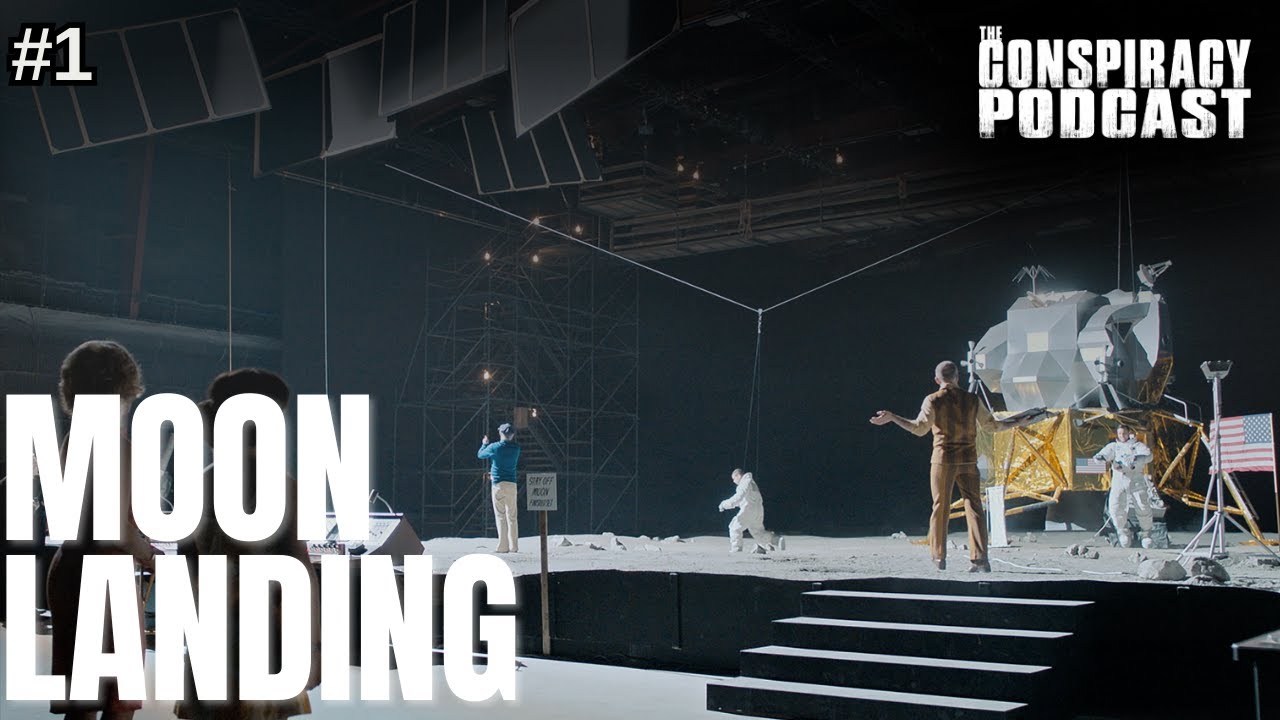
Was the Moon Landing Faked?
Was the Moon Landing Faked?
No. Apollo 11 landed astronauts on the moon on July 20, 1969, and five more crewed missions followed through 1972. Independent tracking, hundreds of pounds of returned lunar samples, and mirrors astronauts left behind that observatories still use today all confirm it happened.
By the Conspiracy Podcast team | Last updated: August 2026
The guys covered this twice, a year apart. Episode one closed divided, one host arguing NASA faked part of it. The follow-up closed with all three agreeing humans walked on the moon.
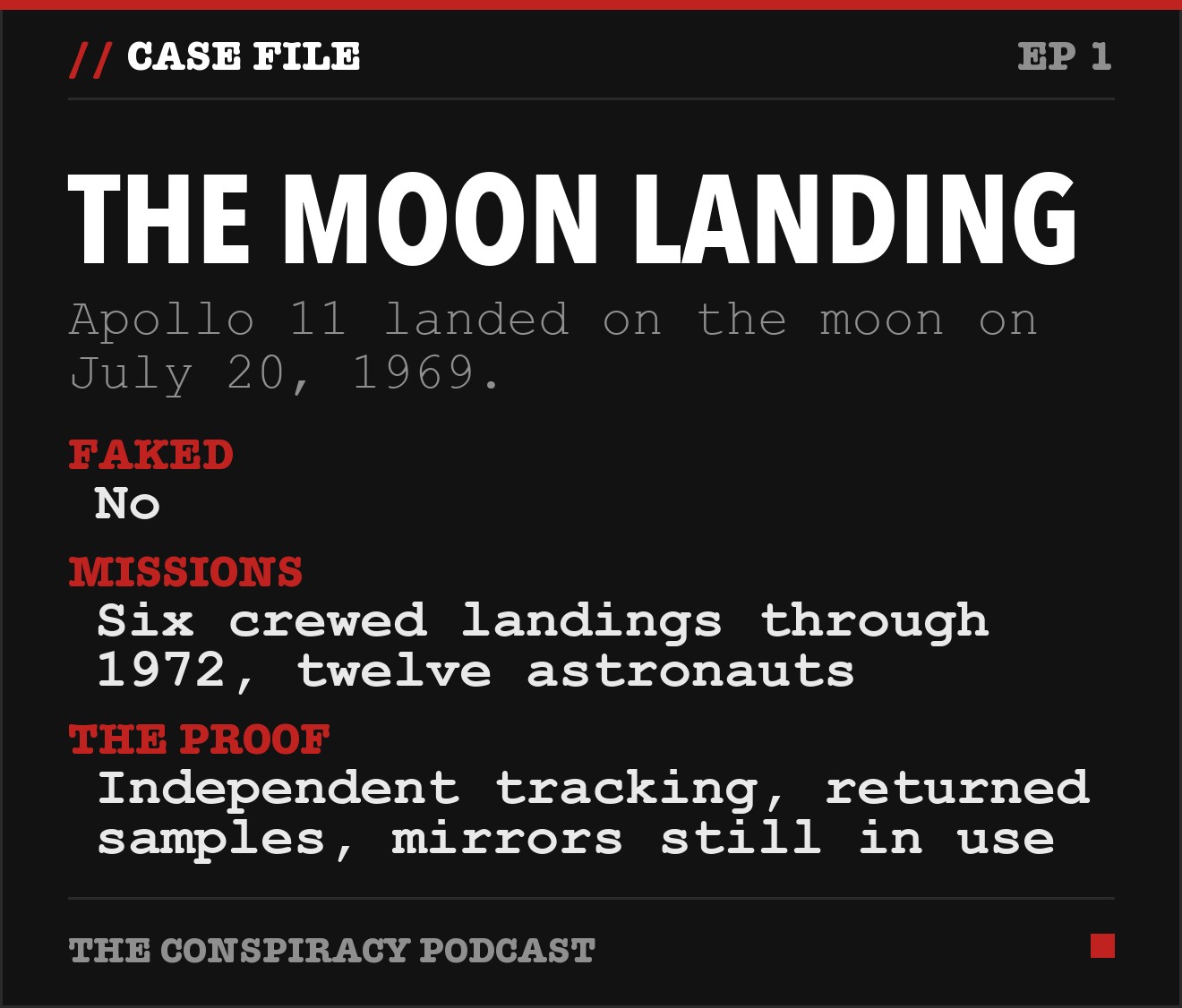
Was the moon landing faked?
No. NASA landed six crewed missions on the moon between 1969 and 1972, and twelve astronauts walked on its surface. Independent nations tracked the missions, laboratories abroad studied returned samples, and hardware the astronauts left behind is still measurably in use today.
Episode one opens with the full history: Sputnik in 1957, Gagarin beating the United States into orbit in 1961, and Kennedy’s promise that year to land a man on the moon before the decade was out. The origin episode walks through Mercury, Gemini, and Apollo, including the 24 billion dollars the effort cost in 1960s money, about 174 billion adjusted for inflation. Six of those missions landed on the moon between 1969 and 1972, Apollo 17 the last. By the hosts’ estimate, 10,000 people worked the program daily, and a secret that size has never produced a single whistleblower with hard proof.
What changed between the two episodes was time to sit with the argument, not new evidence. In the second episode, the hosts bring up comedian and podcast host Joe Rogan, who spent years entertaining hoax doubts on his own show, then said on a later episode that he no longer thinks the landing was faked, crediting experts who explained why faking it would have been nearly impossible and calling the evidence overwhelming. The Conspiracy Podcast hosts describe a similar shift in their own thinking. By the end of episode two, all three say directly that they believe the crewed landings happened.
Why are there no stars in the moon landing photos?
Camera settings, not a cover-up. The lunar surface, spacesuits, and lander were extremely bright in sunlight, so the cameras used a fast shutter and low sensitivity. That exposure was too quick to register starlight, though the stars never went anywhere.
The hosts hit this one in episode one, before either of them had the technical explanation in hand. The argument that stuck, offered as a debunk in the moment, was a simple comparison: take a photo of someone at the beach in bright daylight and the background will not show stars either, even though the sky is full of them. The lunar module landed in the Sea of Tranquility, a region in full daylight at the time, not the far side that never sees the sun. A camera set to correctly expose a brightly lit foreground will always underexpose starlight sitting behind it.
By the second episode the hosts had a fuller, technical version of the same answer. The lunar surface, the astronaut suits, and the lunar module were extremely bright in direct sunlight, so the cameras needed a fast shutter and low sensitivity to keep bright objects from blowing out the image. That combination was tuned for brightness, making the dim light of stars too faint to register on film. The cameras were built for a well lit moon, not a night sky. The stars themselves did not vanish. They simply never had enough light to leave a mark on that particular exposure.
Why does the flag look like it is waving?
It never waved in wind, since the moon has no air. NASA sewed a horizontal rod along the top so the flag stayed extended, and the ripples came from being folded for the trip. Astronauts twisting the pole set it swinging, and a vacuum has no resistance to damp it.
Episode one spends time on this because it is one of the most repeated hoax claims. The flagpole was not a single vertical rod. NASA added a horizontal rod along the top so the flag could display fully extended with no wind to hold it open. Photos show the crease pattern from being folded for the trip inside the lunar module, which is why the fabric looks rippled along the bottom edge while the top, held by the rod, stays comparatively flat. The hosts agree the flag was not moving on its own, just crumpled and held out by hardware.
The part that still confuses viewers is the brief movement after astronauts plant the pole. On Earth, air resistance damps that kind of swinging within a second or two, so a flag disturbed by hand stops moving almost immediately. The moon has no atmosphere, so once astronauts twisted the pole into the soil and let go, the fabric kept swinging longer than it would on Earth, because nothing was there to slow it down. NASA has explained the flag’s movement this way, and every clip hoax proponents cite shows that same pattern, motion starting the moment a suited astronaut touches the pole.
I have it pulled up right now, you can clearly see the pole, yeah, you can see the hole that’s in the top, and then otherwise it was just a wrinkled thing that they put in.
the guys, on the record
Did Stanley Kubrick film the moon landing?
No credible evidence supports that claim. The theory holds Kubrick used skills from 2001: A Space Odyssey to help fake the footage, but 2001 premiered in April 1968, before Apollo 11, and nobody involved with the film has ever backed the story.
The hosts bring this up in episode one as a version of the hoax theory: that Kubrick, fresh off directing 2001: A Space Odyssey, secretly shot the moon landing footage with his own effects team. The pushback is practical. Filmmaking equipment in the 1960s was not built to run in a vacuum or in temperatures hundreds of degrees below zero, which is what a soundstage would have needed to replicate or avoid. The hosts note that NASA had the budget and the engineers to solve problems like that for real hardware, which cuts against faking it ever being the easier path.
Outside the episode, the Kubrick theory traces largely to Dark Side of the Moon, a 2002 mockumentary by French director William Karel, built as a satire that mixed real interviews with an invented conspiracy and fooled viewers who mistook it for a genuine documentary. Kubrick’s widow, Christiane Kubrick, publicly denied he had any involvement in faking the landing. The timeline is also hard to square with the theory, since 2001: A Space Odyssey came out more than a year before Apollo 11 flew, meaning the visual techniques people cite were already public knowledge, not a secret weapon built for a cover-up.
| Theory | What the record shows |
|---|---|
| The 13-day delay. The hosts calculate a moon signal takes 13 days to reach Earth. | Wrong formula: they used sound’s speed, not light’s, which gets there in about a second and a half. |
| The Van Allen belt. 1960s tech could not survive the radiation, the claim goes. | NASA routed Apollo through the belt’s thinnest section, limiting exposure to one or two hours, shielded. |
| Missing telemetry. NASA destroyed the mission data, other shows argue. | NASA says hardware went obsolete, and tapes were reused to save money, not to hide anything. |
| Non-parallel shadows. Commentators including Candace Owens cite shadows running in different directions. | The moon’s uneven terrain and lack of rotation can bend shadows in ways that look off to Earth-trained eyes. |
These claims persist because the landing was the biggest television event in history, filmed under conditions nobody had recorded before. The guys revisit the case in their follow-up episode. For more, our roundup of famous conspiracy theories covers more ground.
What is the strongest evidence the landings were real?
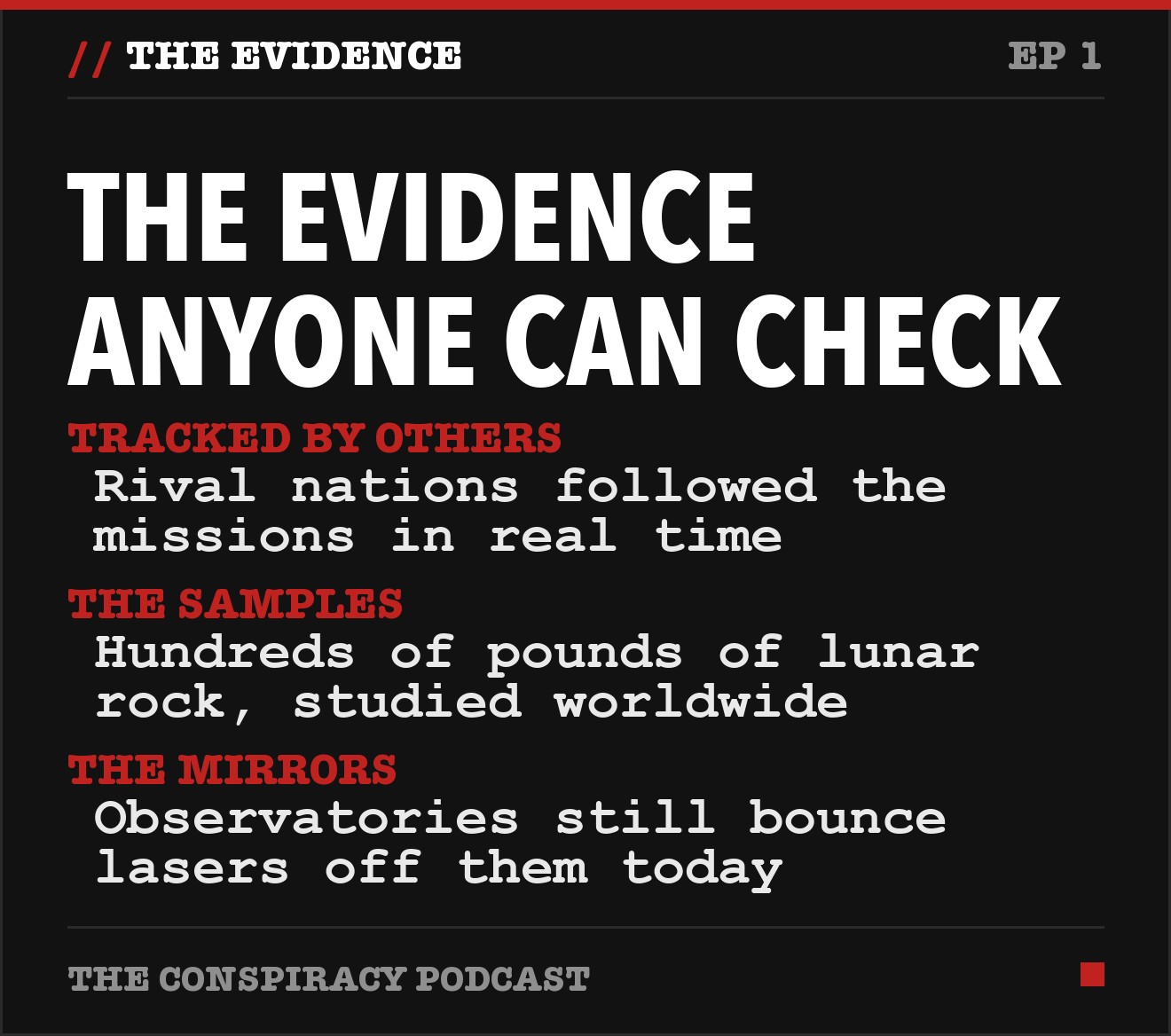
Independent verification nobody could fake. Apollo 11, 14, and 15 left mirror arrays observatories still use to bounce lasers off the moon. Scientists worldwide have studied the samples NASA brought back, and the Soviet Union, with every reason to expose a hoax, never disputed it.
The clearest piece of proof sits on the lunar surface. Apollo 11, 14, and 15 each left behind a retroreflector array, a panel of mirrors angled to bounce a laser beam back to its source. Observatories on Earth, including facilities built for lunar laser ranging, fire lasers at those panels and measure the time light takes to make the round trip. That measurement is precise to a few centimeters, and it only works because hardware sits on the lunar surface reflecting real light. A hoax staged in a studio would have had no reason to plant working optics on the moon.
The second and third pieces come from outside NASA. The six landings brought back more than 800 pounds of lunar rock and soil, independently studied by geologists in multiple countries and confirmed as unlike anything found on Earth. Even the Soviet Union, the government with the strongest incentive to catch the United States faking a Cold War victory, tracked the flights with its own deep space monitoring and never claimed the landings were staged. Its own later robotic missions returned their own, smaller, samples that matched the composition of what Apollo brought home. None of that required trusting NASA’s word.