What Really Happened at Roswell?
What Really Happened at Roswell?
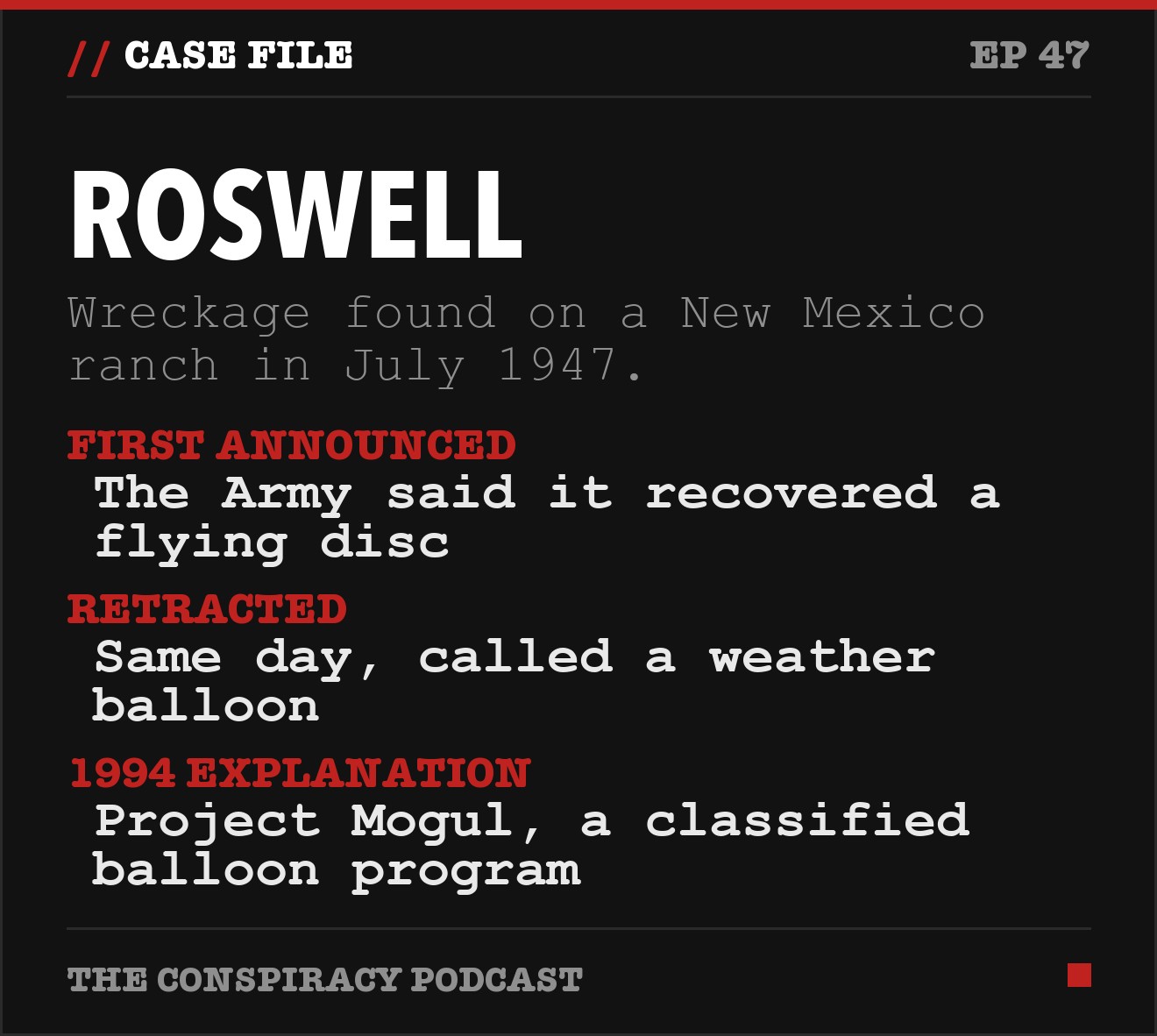
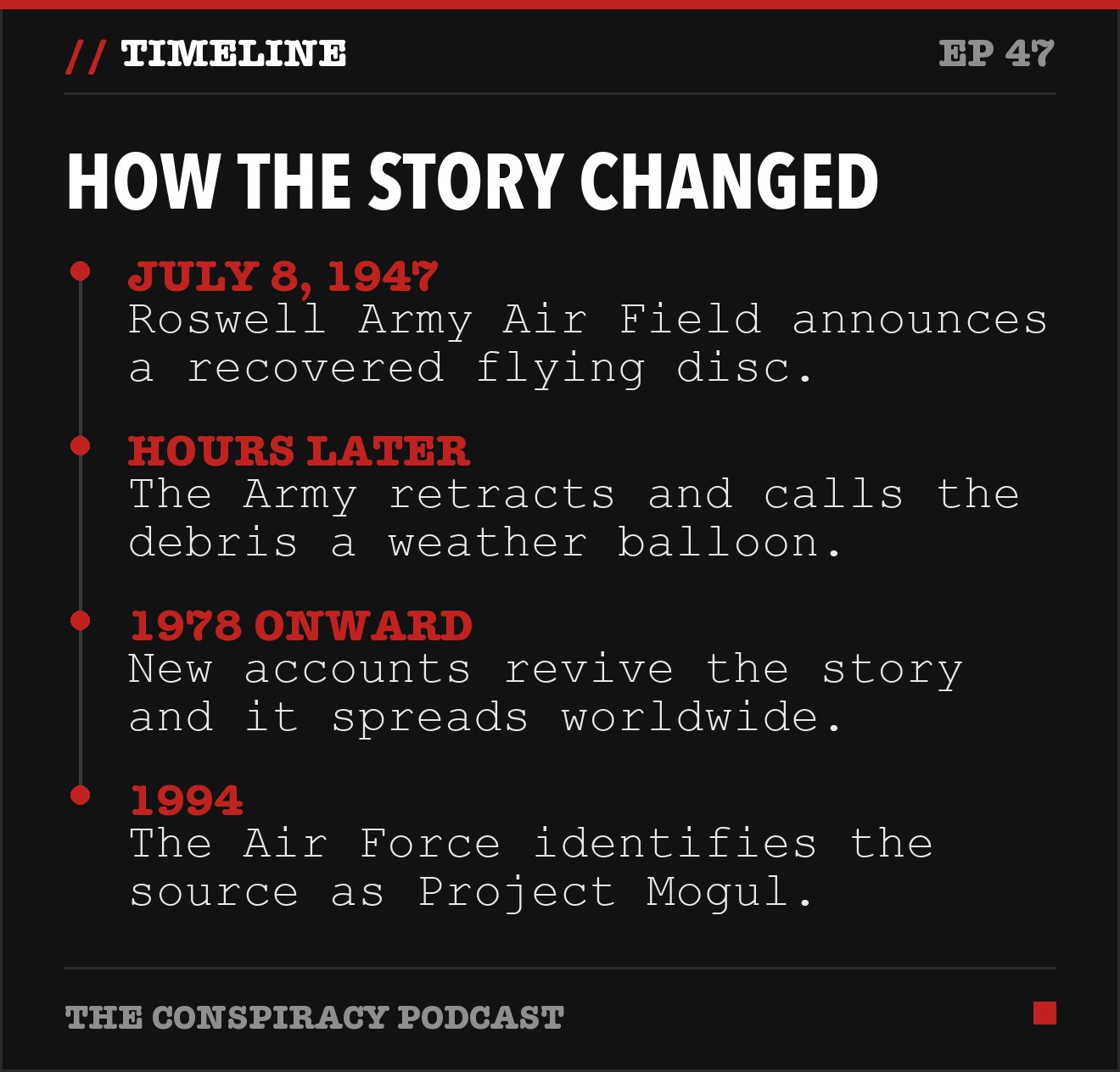
In July 1947, wreckage appeared on a New Mexico ranch. The Roswell Army Air Field announced it had recovered a flying disc, then retracted the story that same day and called it a weather balloon. In 1994 the Air Force identified the source as Project Mogul, a classified balloon program built to detect Soviet nuclear tests.
By the Conspiracy Podcast team | Last updated: August 2026
Nearly eighty years later, this is still the case that launched a genre. The same-day reversal, disc to balloon, is what keeps it alive: a public announcement retracted before the ink dried looks like a cover-up whether or not one happened. Decades of deathbed claims, a forged government memo, and a hoaxed autopsy film piled on top of that first suspicious swap. Here are the questions people actually search, answered against the documented record.
What was found at the Roswell crash?
Rancher Mac Brazel found scattered debris on his property in Lincoln County, New Mexico, in the summer of 1947: rubber strips, tinfoil, tough paper, sticks, and tape, some of it printed with a flower pattern. There was no metal, no engine parts, and no markings of any kind. The whole find weighed about five pounds.
Brazel brought the material to Sheriff George Wilcox in Roswell, who passed it up the chain to Colonel William Blanchard, commanding officer of the Roswell Army Air Field. From there it reached Major Jesse Marcel, the intelligence officer who examined it and later posed for press photographs with the debris. The material formed two loose bundles, one of foil and paper roughly three feet long, one of rubber strips about half that, and by every contemporary description on record it looked like scattered wreckage from a downed device, not a spacecraft. The full Roswell episode walks through the ranch find piece by piece.
Context matters here. Weeks earlier, pilot Kenneth Arnold’s sighting near Mount Rainier had touched off a nationwide flying saucer craze, and hundreds of copycat sightings followed that summer, many of them simply echoing Arnold’s own description of what he saw. Brazel and the local sheriff’s office were primed to read ordinary debris through that lens, and so, briefly, was the Army’s own public information office. A real cultural frenzy meeting a genuinely odd scatter of material on a rancher’s land is what turned a routine debris cleanup into a legend before anyone had tested a single piece of it.
What happened on July 8, 1947?
On July 8, 1947, the Roswell Army Air Field’s public information office announced it had recovered a crashed flying disc, and the Roswell Daily Record ran it as a banner headline. By that same evening, Eighth Air Force command in Fort Worth had reversed the story, identifying the wreckage as a conventional weather balloon.
The announcement came from the RAAF’s public information officer, Walter Haut, acting on orders from Colonel Blanchard. Within hours the retraction came from Brigadier General Roger Ramey at Eighth Air Force headquarters in Fort Worth, Texas. Ramey had debris, torn pieces of a weather balloon and a radar reflector, laid out for photographers, and Major Marcel was pictured kneeling over it. Those photographs, taken and released the same day as the first announcement, became the Army’s evidence that the matter was closed, and outside New Mexico the story mostly dropped out of the national press within days.
What makes the date interesting is the speed, not the content. A weather balloon is a mundane object, and switching the story that fast should have settled the matter. Instead the turnaround itself became evidence for a cover-up: skeptics have long asked how trained officers announced a flying disc with apparent confidence, then produced a different explanation within one news cycle. It is a fair question. It is also the exact reason Project Mogul stayed classified for another forty-seven years, since the honest answer, a secret listening program aimed at the Soviets, was not something the Army could say out loud in 1947.
What did the Air Force say it really was?
Project Mogul. According to the Air Force’s own 1994 report, “The Roswell Report: Fact versus Fiction in the New Mexico Desert,” the debris came from a classified balloon train built to detect Soviet atomic tests. A 1997 follow-up, “The Roswell Report: Case Closed,” addressed the separate claims about recovered bodies that had been added to the story decades later.
Project Mogul used long trains of high-altitude balloons carrying microphones and other sensors, designed to catch the sound signature of a Soviet nuclear detonation before the United States had reliable ground-based detection. It was authorized before the Soviet Union had even tested a bomb, which is part of why the program stayed classified for decades afterward. Researchers tracked one balloon train, designated Flight 4, moving northeast that June and lost contact with it roughly 17 miles from Brazel’s ranch, a detail the 1994 report treats as the clearest physical link between the classified program and the debris he found.
The 1997 report tackled a newer problem. By the 1980s, witnesses were describing recovered bodies, not just debris, decades after the original event. The Air Force’s explanation pointed to anthropomorphic test dummies used in later high-altitude parachute experiments conducted in the same part of New Mexico, arguing that decades of retelling had folded a separate, later program into the original 1947 story. That explanation accounts for where dummy-related reports could plausibly have come from. It does not, and cannot, prove a negative, which is part of why the claim survives even where the documented record does not support it.
Is Area 51 in Roswell?
No. Area 51 is a secretive Air Force testing site in the Nevada desert, and Roswell is a town in New Mexico, roughly 850 miles away. They are unconnected locations with unconnected histories that get merged in popular conversation because both became symbols of the same broader UFO mythology.
Area 51 is the popular name for a restricted Air Force facility on the Nevada Test and Training Range, near a dry lake bed called Groom Lake, roughly 90 miles north of Las Vegas. It was used to develop and test classified aircraft, including the U-2 spy plane, starting in the mid-1950s, about eight years after the Roswell incident. Its real secrecy, unusual aircraft silhouettes tested at high altitude, and total lack of official acknowledgment for decades gave it a UFO reputation that grew independently of anything that happened on Brazel’s ranch.
The two cases get folded together for simple reasons. Both are Southwestern desert stories about the government hiding aircraft technology, both peaked in public imagination during the same UFO-heavy decades, and popular culture has repeatedly blurred them. On the episode, one host has to correct another for crediting Independence Day’s famous alien scenes to Roswell, when the film’s fictional government facility is actually Area 51. That kind of casual mixup, repeated across decades of films and television, is most of why the two places feel like one story rather than two. The hosts pick up Area 51 on its own terms in their next episode.
Why do people still believe aliens crashed at Roswell?
Because the initial cover story fell apart within a day, and a real admission of deception followed in 1994, even though what was actually hidden was a balloon program, not a spacecraft. Once officials admit to lying once, on the record, people reasonably assume they might be lying about the rest too.
| Theory | What the record shows |
|---|---|
| Government balloon cover-up. The Army announced a disc, retracted it within a day, and classified the real program for forty-seven years. | Confirmed. The Air Force’s own 1994 report identifies the debris as Project Mogul, a real classified balloon program. |
| Crashed alien spacecraft. Introduced by a 1980 book and expanded through the 1980s and 1990s with claims of recovered bodies. | No physical evidence. The original debris was foil, rubber, and sticks. Body claims trace to a hoaxed 1995 autopsy film and to test dummies used years later. |
| Majestic 12. Documents purporting to be a 1952 Eisenhower briefing on a recovered craft and bodies, released in 1987. | Exposed as forged documents by 1991. No authenticated copy has ever surfaced. |
| Deathbed witnesses. Multiple men came forward decades later, some shortly before their deaths, describing bodies and cover-up details. | Uncorroborated by any contemporary document. The 1997 Air Force report attributes the claims to conflated memories of later, unrelated incidents. |
None of the theories in that table needed to be strong to survive contact with the public. They only needed the original story to look shaky, and thanks to that one-day reversal, it did. Once a rancher’s tinfoil and rubber became a classified secret for forty-seven years, even a mundane secret, every later claim picked up a plausible-sounding foothold. The guys walk through the entire evidence trail and explain why they land on Project Mogul anyway.
they literally have two days to just move the real stuff, and they’re like, all right, just give me some random stuff in the broom closet, look what we found.
the guys, on the record