
Who Was DB Cooper?
Who Was DB Cooper?
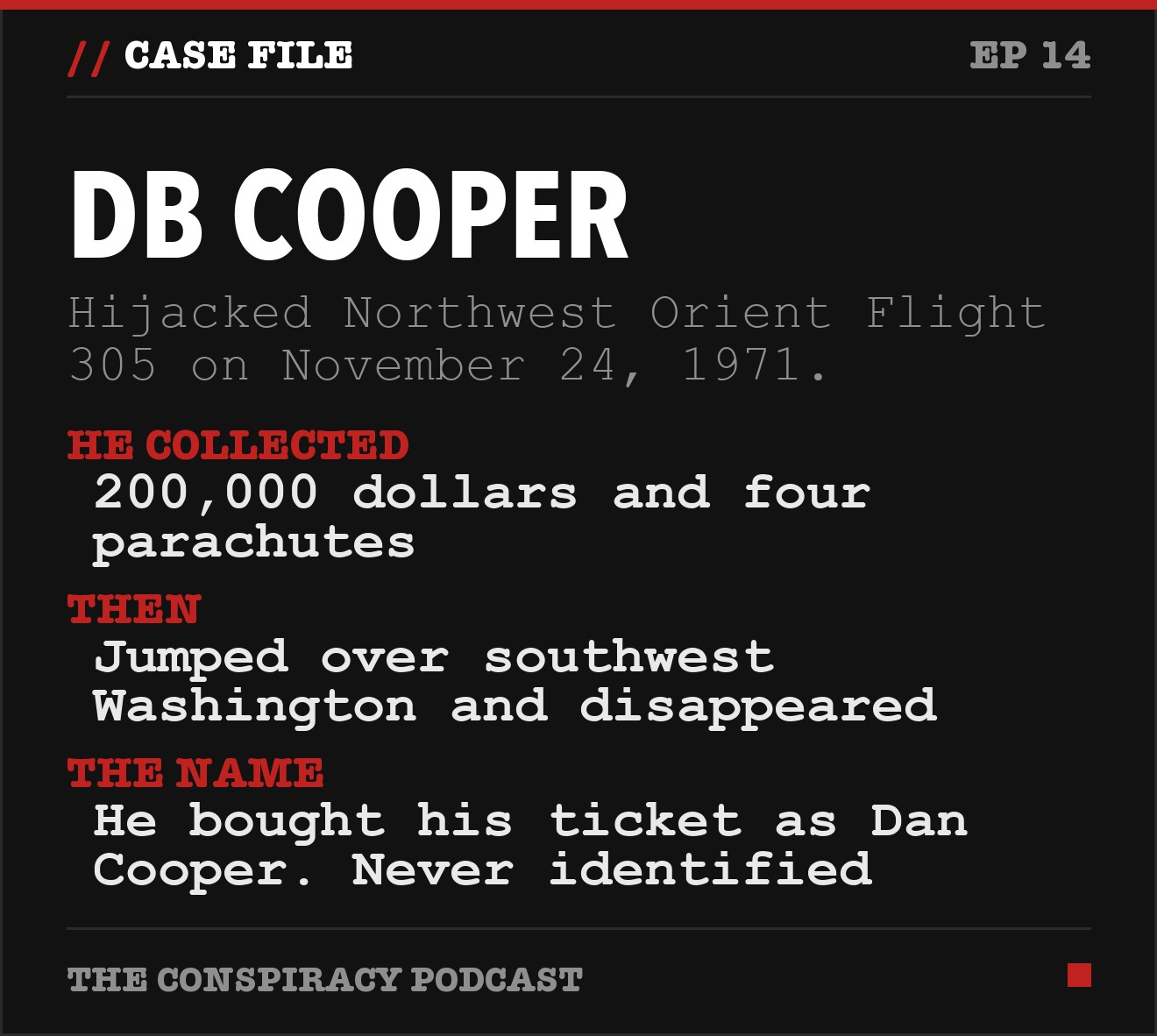
DB Cooper is the name given to an unidentified man who hijacked Northwest Orient Flight 305 on November 24, 1971, claiming he had a bomb. He collected 200,000 dollars and four parachutes, then jumped from the plane over southwest Washington and disappeared. He bought his ticket as Dan Cooper, and nobody has ever confirmed who he really was.
By the Conspiracy Podcast team | Last updated: August 2026
More than fifty years later, the FBI’s own file still lists over a thousand names and no confirmed answer. Nobody knows who Cooper was, whether he survived the jump, or where the rest of the money went. That mix of a clean plan and zero resolution is why the case still gets argued today.
Who was DB Cooper?
DB Cooper is the media name for a man who boarded Northwest Orient Flight 305 in Portland, Oregon, on November 24, 1971, using the alias Dan Cooper. He told a flight attendant he had a bomb, demanded 200,000 dollars and four parachutes, and jumped from the plane’s rear stairs somewhere over southwest Washington. He was never identified.
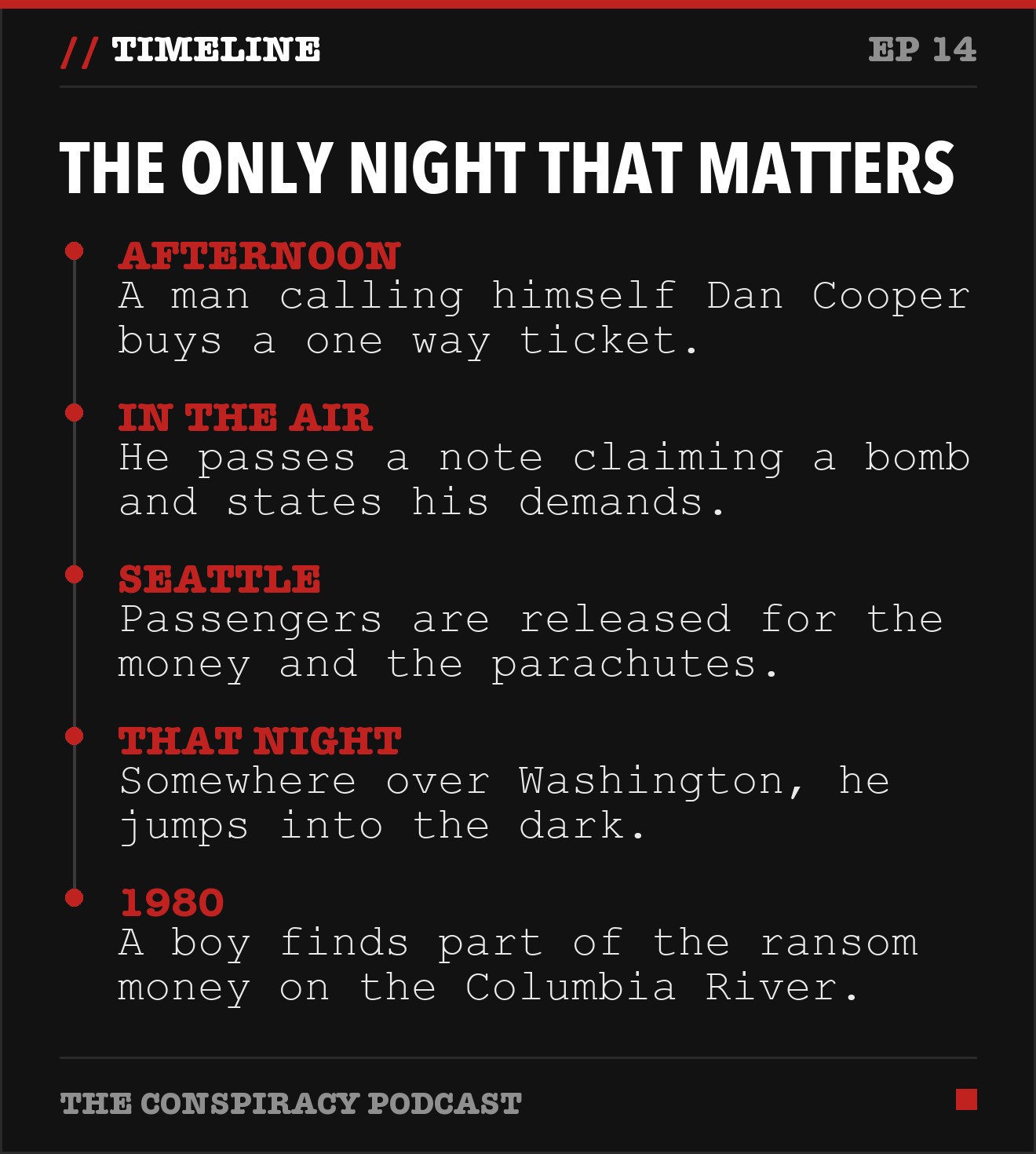
The flight was short, just Portland to Seattle. Cooper paid cash for his ticket under the name Dan Cooper, boarded in a black suit and thin tie, and ordered a bourbon and soda before takeoff. Once airborne, he passed a note to a flight attendant claiming he had a bomb, then opened his briefcase to show her a tangle of wires. His demands went to the captain: 200,000 dollars in twenty dollar bills and four parachutes. When the plane landed, he traded the 36 passengers for the money and chutes, kept the crew, and had the plane take off again.
The name itself came from a media mistake, not the case file. Cooper’s ticket read Dan Cooper, still the name on the FBI’s own file, labeled NORJAK for Northwest hijacking. A reporter covering the story that first night got the name wrong, and DB Cooper went out on the wire instead. The mistaken initials had no real connection to the case, but they were catchier, and they stuck. The hosts walk through the whole flight in order, note by note, in the DB Cooper episode.
Did DB Cooper survive the jump?
Nobody knows for certain. The FBI’s own public position, laid out by Special Agent Larry Carr, is that Cooper probably did not survive: he jumped at night, in cold rain, wearing an ordinary business suit, with a parachute that could not be steered. No body, chute, or remains tied to the jump has ever been found.
The conditions were about as bad as a jump gets. Cooper went out somewhere between Seattle and Reno, after 8 p.m., into total darkness, cold rain, and heavy wind. He was dressed for an office, not the woods, with no cold weather gear and no survival equipment. He jumped with two parachutes, but one turned out to be a training rig sewn shut for demonstrations, unusable. That left him with a single military reserve chute, built to slow a fall in a straight line rather than steer toward anything.
That is what pushed agents like Carr toward the theory that Cooper was not the expert jumper first assumed. An experienced military jumper, the reasoning goes, would have refused those conditions with that equipment. The counterargument is simple: despite helicopters, ground teams, and decades of searches, nobody has ever recovered a body, a parachute, or any item tied to the jump, beyond the tie he left on the plane. That silence is why both answers, that he died in the woods or that he walked away, still have believers.
Was any of the money ever found?
Yes, a small part of it. In February 1980, an eight year old boy digging on a Columbia River sandbar called Tena Bar found about 5,800 dollars in decaying twenty dollar bills. The serial numbers matched the ransom cash the FBI had logged in 1971. It remains the only ransom money ever recovered.
The boy was clearing a spot for a campfire on the riverbank when he uncovered bundled stacks of cash, most of it rotted and stuck together. His family nearly burned it before deciding to report the find instead. The FBI matched the serial numbers against the list agents had copied by hand from the ransom bills in 1971, before Cooper ever boarded the plane. The match was exact, the first physical confirmation that the money had gone somewhere real instead of vanishing with him.
What the discovery did not do was end the case. Investigators searched the surrounding banks repeatedly and never found another bill or wrapper. That has fed competing readings of the same fact: that the bag broke open and the rest scattered downstream and disintegrated, that the current separated the bills naturally, or, more skeptically, that the bundle was placed there deliberately to point investigators away from wherever the rest of the cash ended up. None of those readings has ever been confirmed, which is on brand for this case.
Who are the main DB Cooper suspects?
Investigators reviewed more than a thousand people over the decades. The names that get the most attention publicly are Richard Floyd McCoy, a copycat hijacker cleared by a solid alibi, and two men named only after their deaths, Duane Weber and Kenneth Christiansen. None of them was ever charged, and the FBI never confirmed any of them as Cooper.
Richard Floyd McCoy is the closest thing to a copycat on record. Five months after the Cooper hijacking, McCoy hijacked a different flight using almost the identical method: a bomb note, a demand for four parachutes, and a jump from the same kind of rear airstairs. The FBI arrested him days later and connected the similarities back to the Cooper case. But records placed McCoy at home with his family the night Cooper jumped. He was convicted for his own hijacking, not Cooper’s, and the FBI ruled him out.
The other two names surfaced through family members, not evidence. Duane Weber reportedly told his wife, Jo, in his final hours that he had a secret, that he was Dan Cooper, and she brought her account to the FBI. Kenneth Christiansen was named by his brother Lyle, convinced after watching a television documentary and recalling a vague, unfinished statement Kenneth made before he died. Neither left behind physical evidence, a confirmed match, or a criminal charge.
| Theory | What the record shows |
|---|---|
| Cooper died in the jump. The FBI’s own working theory, based on the weather and his gear. | He jumped at night in cold rain with an unsteerable parachute, but no remains have ever been recovered. |
| Cooper survived and got away. The version where the plan simply worked. | No confirmed sighting, spending, or trace of him has ever surfaced after 1971 beyond the Tena Bar bills. |
| Richard Floyd McCoy was Cooper. He pulled an almost identical hijacking five months later. | Ruled out by a documented alibi placing him at home with his family that night. |
| Duane Weber was Cooper. Based on a private deathbed statement to his wife. | Reviewed by the FBI. Never confirmed, and no physical evidence ever tied him to the case. |
| Kenneth Christiansen was Cooper. Based on a brother’s suspicion after a TV documentary. | Reviewed by the FBI. No documentary or physical evidence has ever connected him to the hijacking. |
Twenty bucks, said there’s a bomb, in the middle of the forest, found a suit, and dipped out. What a great story.
the guys, on the record
Is the DB Cooper case still open?
Not as an active investigation. In July 2016, after 45 years and more than a thousand suspects reviewed, the FBI announced it was redirecting resources away from the case, its own language for stepping back rather than declaring it solved. DB Cooper’s real identity has never been confirmed, so the case remains officially unresolved.
The FBI called it one of the longest and most exhaustive investigations in its history: 45 years, roughly a thousand named suspects, and only 24 who could not be fully eliminated by the mid 1970s. Its 2016 statement described moving resources elsewhere rather than closing the file outright, adding that it would still review credible new physical evidence. That is a narrower claim than solving the case. Nobody has been charged or confirmed, and the hijacker who jumped from Flight 305 remains, officially, just an alias.
That gap between suspended and solved is why the case has not gone quiet. Amateur researchers still comb through FBI records, argue over wind patterns and drop zones, and occasionally claim a new suspect online, decades after the professionals stepped back. Our full case file on the DB Cooper hijacking covers the suspect list and the jump conditions in more detail than any single answer here can. If you like a mystery that never quite closes, our roundup of famous conspiracy theories has plenty more like it.