Is the Bermuda Triangle Real?
Is the Bermuda Triangle Real?
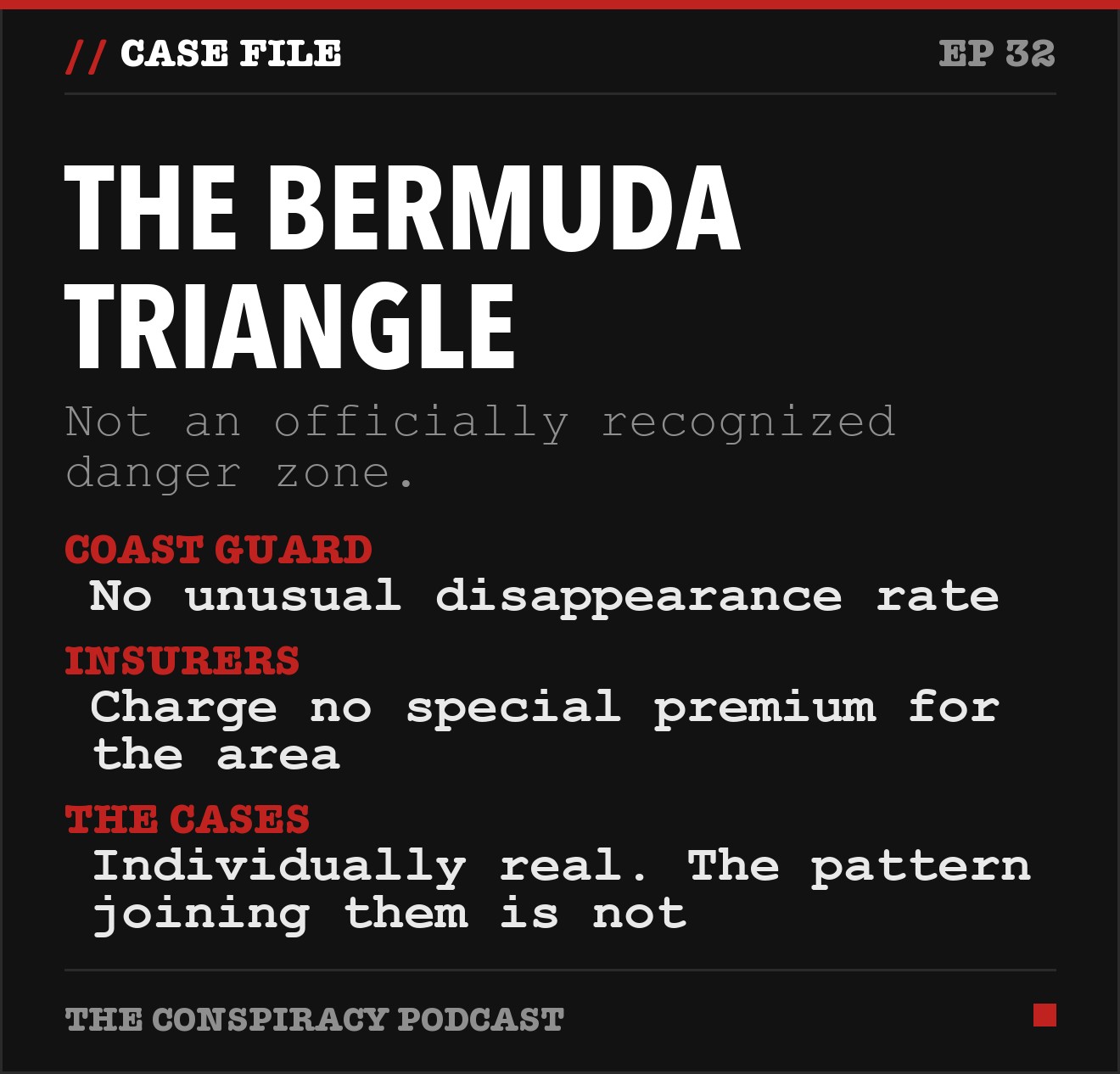
The Bermuda Triangle is not an officially recognized danger zone. The US Coast Guard, insurers, and the National Oceanic and Atmospheric Administration have found no evidence ships or planes disappear there more often than in any other trafficked stretch of ocean. The individual cases behind the legend are real. The pattern connecting them is not.
By the Conspiracy Podcast team | Last updated: August 2026
So why does the argument keep going. A real cluster of losses, planes and ships gone with no wreckage and no distress call, happened in this stretch of water across a few specific decades, and pulp writers turned it into a legend before anyone checked the math. Here are the questions people actually search, answered straight.
Do planes still fly over the Bermuda Triangle?
Yes, constantly. Commercial flights, cargo carriers, and private planes cross the region daily on standard routes, with no special clearance and no elevated incident rate. The technology gap behind the famous losses, compass-only navigation and patchy radio contact, closed decades ago once GPS and satellite communication became standard.
The hosts found this out themselves while researching the update episode: ships and planes still go straight through the region today, more than they expected. The failures behind the 1940s and 1950s losses do not really apply now. Pilots then often navigated by compass and dead reckoning, with radio contact that could cut out entirely in bad weather. Today, satellite communication holds up through most storms, and GPS removes the guesswork that once let a course drift for miles unnoticed.
That has not stopped the hosts from hedging their own bets. By the end of the update episode, one host admits that even after two episodes concluding there is nothing supernatural going on, he would still divert a flight around the triangle. Knowing the statistics and still not trusting them is the engine behind the legend. The hosts walk through the losses that built that instinct in their original Bermuda Triangle case file.
What happens when you enter the Bermuda Triangle?
Nothing happens. There is no dead zone, no instrument blackout, and no gravitational pull switching on at an invisible line. Ships and aircraft cross those exact coordinates every day on normal instruments. The dramatic version, spinning compasses, ghost ships, planes swallowed whole, comes from a specific run of incidents between 1918 and the 1960s.
Two things get conflated under entering the triangle. One is folklore: compasses spinning wildly, ghost ships found adrift with nobody aboard, an old fear dressed up for the radio age. The other is a testable claim, that instruments malfunction and vessels vanish there at a higher rate. Researchers checked that directly. Tests for a localized magnetic anomaly turned up nothing specific to this ocean. By 2010, NOAA stated there is no evidence disappearances happen more often here than in any other large, well-traveled area of ocean.
The magnetic angle is not baseless on its face, since genuine anomalies do exist elsewhere on the planet. The region is also large, about 500,000 square miles, not all of it tested. What actually explains most of it is far less exotic: hurricane season. The area sits inside a major hurricane corridor, and before modern forecasting, a storm could turn a calm crossing into a fight for survival.

How many planes have gone missing over the Bermuda Triangle?
There is no official tally, and researchers found the number is not unusual for a heavily trafficked, storm-prone corridor. The specific losses that built the legend are a short, named list clustered between 1945 and 1963: Flight 19’s five torpedo bombers, the airliners Star Tiger and Star Ariel, a Douglas DC-3, and two Air Force tankers that collided midair.
The most thorough challenge came from Larry Kusche, a research librarian, in his 1975 book, The Bermuda Triangle Mystery Solved. He worked from newspaper coverage and weather records for each date and location, then compared what happened against what later writers claimed. The count of missing ships and planes was not proportionally greater than elsewhere in a busy, storm-prone ocean, and specific claims did not hold up either. Some reported vessels had simply turned up safe at port, and one repeated 1937 plane crash off Daytona Beach appears never to have happened.
The named incidents look less mysterious up close. The Star Tiger vanished January 30, 1948, flying from the Azores to Bermuda, and the Star Ariel vanished January 17, 1949, flying from Bermuda to Kingston, Jamaica, almost a year apart. Both were airliners at the outer edge of their fuel range, with no wreckage found. A Douglas DC-3 carrying 32 people disappeared between San Juan and Miami that December, and investigators closed the case citing insufficient information. In 1963, two Air Force tankers collided in midair, and a supposed second crash site turned out to be seaweed and driftwood, not a plane.
What is found under the Bermuda Triangle?
Mostly ordinary seafloor, plus a lot of nothing where the legend says there should be wreckage. The USS Cyclops, the US Navy’s largest non-combat loss with 309 men aboard, has never been located despite searches spanning a century. No sunken city and no confirmed advanced technology has ever turned up, whatever the theories claim.
The one genuine oddity people point to is Bimini Road, an underwater rock formation near Bimini Island, discovered in 1968. It runs roughly half a mile in a straight line, built from flat, rectangular blocks that look, at a glance, like a paved road under shallow water. Believers in the Atlantis theory, including followers of psychic Edgar Cayce, who predicted Atlantis evidence would surface that year, argue it is leftover construction still interfering with ships and planes. The hosts are open to Atlantis having existed. That it is still sinking ships today is treated as theory, not fact.
The more grounded answer is methane hydrates: natural gas deposits found in fields along the continental shelf, including the Blake Ridge off the southeastern United States. The mechanism is not speculative. When enough gas escapes, it lowers the density of the water above it, and a vessel can lose buoyancy and sink almost instantly, reproduced with scale models in lab tests. What remains a hypothesis, not a fact, is whether this ever happened at scale here. Surveys found no evidence of a large release in roughly 15,000 years.
What happened to Flight 19?
On a training mission in December 1945, five US Navy torpedo bombers, Flight 19, grew disoriented over the Atlantic and radioed rising confusion about their position before running out of fuel and ditching at sea. All 14 crew were lost. A rescue plane sent after them vanished too, for 27 men total, and no wreckage was ever recovered.
The squadron left Florida for a routine navigation exercise. Partway through, the flight leader’s radio transmissions described conditions that did not match what ground control expected: confusion about heading, disagreement about the way back to land, the water looking the wrong color. Contact was lost before anyone could talk the formation home. The accepted explanation is that the planes ran low on fuel and were forced down into rough seas in darkness, where wreckage would be extremely hard to find, and, in the end, was never found.
Flight 19 is the reason the legend exists. Seven years later, a 1952 Fate Magazine article by George Sand, The Sea Mystery at Our Back Door, linked the loss with other disappearances into a single pattern. A decade after, a 1962 American Legion piece by Allan Eckert added a flourish that stuck: a claim that Navy investigators said the planes flew off to Mars. No such conclusion appears in the actual inquiry, a fabrication that outlived the article it came from. In 1964, writer Vincent Gaddis folded Flight 19 into a pulp piece, The Deadly Bermuda Triangle, and coined the name that stuck.
Even the newest attempt to close the file cannot fully explain it. When the rogue wave research made headlines, the scientist behind it answered Flight 19 with simultaneous human error, five pilots making the same fatal mistake independently. A rogue wave cannot reach a plane in the air, and five trained pilots failing the same way at once is not obviously more plausible than the theories it replaces. The hosts pick that objection apart in their 2026 rogue wave update.
Strip away the drama and the theories split into two piles: no evidence at all, or real phenomena with no proof they happened here. For more of this, see our list of famous conspiracy theories.
| Theory | What the record shows |
|---|---|
| Atlantis technology. Leftover tech interferes with instruments near Bimini Road. | Bimini Road is a real limestone formation. The claim traces to a psychic’s prediction, not a recovered artifact. |
| Wormhole or time warp. A rip in space-time displaces ships and planes. | Rests on one pilot’s 2017 memoir. Wormholes remain unconfirmed in physics. |
| Alien portal. Extraterrestrials use the region as an entry point for study. | No wreckage or evidence supports it. The theory assumes the thing it is trying to prove. |
| Methane hydrate release. Escaping seafloor gas drops water density and sinks ships instantly. | A real, tested mechanism. No evidence of a large release here in about 15,000 years. |
| Rogue waves. Converging storms can build a wave near 100 feet, capable of overwhelming a ship. | Demonstrated in a wave tank. Cannot explain planes flying thousands of feet up, including Flight 19. |
| Human error and weather. Compass-era navigation, hurricanes, and a busy shipping lane account for the losses. | Backed by a 1975 debunking and a 2010 NOAA statement, plus safe daily crossings now. |
Are you kidding me? They’re really saying that a rogue wave took down planes?
the guys, on the record