
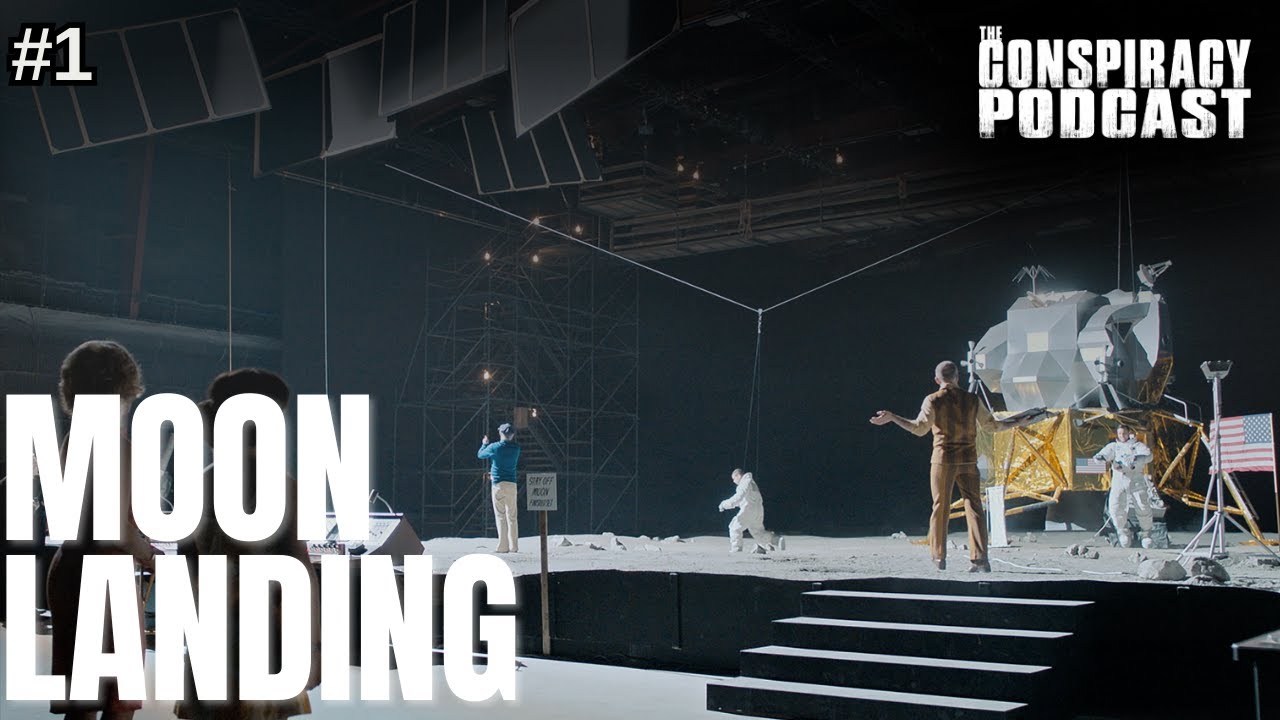
Was the Moon Landing a Hoax? – Episode #1


Was the Moon Landing a Hoax?
Eric runs the crew through a crash course on the space race, from Sputnik to JFK’s big promise to the six times NASA says we landed. Then the believer, the skeptic, and the researcher claw through the classics: no stars in the photos, a flag that looks like it is waving, the impossible cold for 60s cameras, and the live stream that math says should have taken 13 days. Jorge lands on a middle theory nobody saw coming.
The hangup is simple. If you spend 174 billion dollars and put 10,000 people on the job, somebody talks. Unless they don’t.
- The full space race timeline: German rocket scientists, Sputnik in 1957, Yuri Gagarin beating the US to space, and JFK’s 1961 moon promise
- The Stanley Kubrick theory that the 2001: A Space Odyssey director secretly shot the fake landing
- No stars in the photos, and the daytime-on-the-moon argument the boys use to debunk it
- The waving flag, and how a horizontal rod plus a wrinkled folded-up flag explains the look
- The live-stream problem: a back-of-napkin calculation claiming a radio wave would take 13 days to reach Earth
Read the full transcript
Today we are doing the moon. Did we land on the moon? Did we land on the moon? Who has any, uh, what is the moon? I don’t know, I literally, I don’t even know what it is. So this is an episode I’ve been wanting to do a while. A lot of people think still to this day that we did not land on the moon. It’s confusing, bro. I mean, you can’t blow, ain’t that, I mean seriously. Yeah, there’s a lot of conflicting data out there. Yeah, a lot.
So what we’re gonna do first is we’re going to kind of just do a crash course in the space race. So if you know anything about it, we’re just going to do a real, real quick crash course. Okay, put your history hats on, boys. Yeah, here we go, girls. So, um, the space race actually began like towards the end of World War II, so 1945. We, you know, the Allies conquered Germany, losers, and took basically the assets of Germany, right? So after the war both the U.S. and USSR at that time acquired custody of German rocket development assets. So it’s like we only did it because of them.
It’s so funny, we could only do it because, no, I mean, the Germans were ahead of their, like, you know, they were the technological leaders in, uh, ballistic missiles, that’s true. And so they were, you know, working on that, and so when we won the war, and we as in the Allies together won the war, you know, when you conquer a place you absorb, you basically, spoil the war, baby, takes everything from the village. So that’s what happened, we took them, right? So we took that stuff, and including scientists, we took them essentially. So there’s a lot of those German, that’s a whole nother podcast, I’m dead serious, it’s a real thing.
So anyways, we took them, and basically a competition began in 1955 when the United States announced its intent to launch a satellite. Funny enough, four days after the U.S. announced that, the Soviet Union responded by declaring they would also launch a satellite. So all of a sudden, so what happens is, like, in the 50s you have communism that became really a big thing. The U.S. boomed, oh yeah, right? So we have these butting heads entities, I guess, like two superpowers. I mean it’s like the real superpowers, like, you know, Germany died and then the USSR is killing it and working on it.
What happened is something called, you know, Sputnik was one of the first. They launched Sputnik in 1957, and Sputnik was basically, you know, the first major development in Russian space flight. Well, for people who don’t know, Sputnik is a satellite. Yeah, it was the first man-made object that was launched into orbit of the planet. So there you go, that’s right, Sputnik one, on October 4th 1957.
And then in 1958 Eisenhower reacted to the Soviet space lead in launching the first satellite by recommending to the U.S. Congress that a civilian agency be established to direct space activities, but not military, right. And that was the birth of NASA, and the movie Hidden Figures. And then it’s a beautiful Costner, oh yeah, Kevin, there’s only one, bro, what do you mean, it’s a good movie. So this whole race gained a lot of momentum because the USSR sent the first human, his name is Yuri Gagarin, into space with an orbital flight on April 12th 1961. So they beat us to space, they beat us, it was a huge problem.
That was a major, major, not the moon, right, true, yeah, but still it’s a big thing. Just to clarify, so they were ahead. It’s really important to know that in the 50s and early 60s the USSR was ahead, right. So Gagarin’s flight led U.S. President JFK to raise the stakes on May 25th 1961 by asking Congress to commit to the goal of landing on the moon and returning him safely to Earth before the end of the decade. So that’s 1961. That’s a big ask, bro. Not only will we go to space, but people to go to the moon.
And I’m gonna read this, and it’s super short, but it’s taken from JFK’s speech, and it’s actually amazingly inspiring. I believe that this nation should commit itself to achieving the goal, before this decade is out, of landing a man on the moon and returning him safely to Earth. No single space project in this period will be more impressive to mankind, or more important for the long-range exploration of space, and none will be so difficult or expensive to accomplish. Let it be clear that I am asking the Congress and the country to accept a firm commitment to a new course of action, a course which will last for many years and carry very heavy costs, 531 million dollars in fiscal 1962.
Like, but that’s like plus inflation, it’s like, yeah, two trillion dollars. And he goes on and he says an estimated seven to nine billion dollars additional over the next five years. Oh my God, that’s so much money back in the 50s, bro, that’s like literally all the money in the universe. If we are to go only halfway, or reduce our sights in the face of difficulty, in my judgment it would be better not to go at all. JFK. You just kind of sounded like Eric though, didn’t sell my JFK. I can’t do his action, dude. The greatest thing we fear is fear itself, thank you, there it is, ladies and gentlemen.
So that was 1961, and that’s when we launched essentially the U.S. into the space race. They approved the money and they really started to do it. And just a note that I found interesting when actually diving into it more is Kennedy proposed on September 20th 1963, a speech in front of the United Nations, that the United States and the Soviet Union join forces in an effort to reach the moon. Okay, what, no, we’re not joining that, our arch nemesis. Yeah, I thought it was interesting that he would do that.
But the Soviet Premier Nikita Khrushchev initially rejected Kennedy’s proposal. However, on October 2nd 1997 it was reported that Khrushchev’s son Sergey claimed that Khrushchev was about to accept the proposal. I doubt it. But Kennedy was assassinated in 63, then he dropped the idea as he did not have trust in Lyndon Johnson. Who’s Lyndon Johnson? He was the president afterward, yeah. It’s just a crazy thing, because wouldn’t that, can you imagine if we joined the USSR to go to the moon? So I just think it was interesting, I had no idea, I never heard of that, that there was a chance our president and the Soviet premier actually were considering working together to go to the moon. That was pretty interesting.
So here are a couple things, and this puts things really into perspective about the program. So there were three NASA programs to go to the moon. Really? Yeah, oh wow. There’s one that was called Project Mercury, that sounds pretty cool, it was 1958 to 1963. And the goal was to put man into orbit and return them safe. So it’s like, okay, the first is like I am, and then get close, it’s a gradient, yeah, that makes sense. So Project Mercury had 20 missions. Now, was this the plan or did this actually happen? This is actually real life, yeah.
So Project Mercury had 20 missions, 14 of 20, yeah, 14 of them were animals. You have no idea, so think about it, you’re going to this completely unknown place, you have no idea who’s manning the controls. Oh, the monkeys. So that was a bigger project where they had to teach monkeys how to be astronauts. Project Banana Hammock. So after they did the animal testing, of which super dark stories in there, because like three or four of them died, then they did six missions with astronauts, of which it ended with the highlight essentially, which was getting the first man into orbit. That’s actually part of Hidden Figures, he actually orbits and then he goes back down, which is John Glenn. He was like a colonel or captain or some dude, right, he’s a good guy.
So then that program transferred essentially to the Gemini program. And the goal of Gemini was to prep and advance space flight technology for the Apollo program to land on the moon. Because the Apollo program was actually to get to the moon, so this was just like a stepping stone. Essentially their goal was to go, okay, we’re out of Earth’s orbit, no, we’re in space, so now what are we doing, like how do we get back, how do we dock, you know. You have to go and you have to get one ship to turn around and then you have to do all these things, then you have to test if an astronaut can go out of the ship and live. Yeah, can he survive in a plastic wrap, and can he tighten the screw without his head exploding, those were all these negative 300 degrees.
So they did 10 flights, they achieved space docking and they also tested if radiation was safe. So there is, well, there’s a magnetic field around Earth that’s protecting you from a lot of the radiation from the Sun. So when you don’t have that, you’re in space, they could just literally vaporize you. So that’s, they ended that in 1966, so then it moved into the Apollo program. And the goal of the Apollo program was to land a man on the moon and return him safely. They did 17 Apollo missions, damn, that’s so many, 17. Like seriously, I’m such an idiot, I’m like, there was like two, it was 11 and 13.
The first Apollo, or Apollo one, was the tragic one that blew up, like, before it, it was about to launch, or was doing a test launch, and they were trapped inside, the door wouldn’t open and it caught fire and they all died. Dude, that sucked, that didn’t even fly, they were on the ground. God, that’s terrible. I know, that was in 1967, and that was Apollo one. So I was like, what a great start, cancel the program, it was such a tragedy, such a setback. So Apollo one, that’s what happened, and then there’s so many stories within the Apollo program, but essentially Apollo 11 is what made it to the moon.
So why was there 17? Because we went to the moon many times, yeah, they were like, let’s keep going. That’s part of the conspiracy. So fast forward a little bit to Apollo 11, and Apollo 11 had the goal of landing in July in the Sea of Tranquility. Oh, that’s like one of the craters, yeah, there’s no sea, it’s a crater. July 16th 1969 at 9:30 in the morning. Sorry, who named it the Sea of Tranquility? I know, it seems like a little like bougie ass name. Maybe it’s tranquil, yeah, because it’s silent, there’s nothing, there’s zero sound, maybe, we don’t know.
So on July 16th 1969 at 9:32 a.m. the Saturn V rocket lifted off from Kennedy Space Center in Florida. So the trip took three days, that’s so long. After achieving orbit, Neil Armstrong and Buzz Aldrin, think about it, I mean, not that long at all, right, how long did it take to get from Florida to California, like driving, yeah, dude, six days, that’s what I’m saying, like 70,000 miles an hour. It seems like it’s a long time, it’s like, I’m not going 60, no, you only have the rocket to get out of here, but dude, when you’re going through space there’s no friction, I mean you’re going like, well you got a main rock and then you got like the secondary thrusters, yeah, why don’t you watch some movies.
So after getting into orbit, Armstrong and Aldrin transferred into the lunar module, and the lunar module was named Eagle. And there were three of them, three astronauts, and they left Collins in the command module Columbia. So he didn’t get to go? Yeah, and then there’s like a little one, they began their descent. So how did that dude get like, that’s so shitty, who stays here? No one remembers him because he was on the phone. He set the Eagle down on a safe landing spot, and when he did he said the Eagle has landed. Oh, and that’s where that comes from, really, I had no idea, that’s exactly where that comes from. I just learned something, wow.
So they landed and, what they did, I don’t really get it, but six hours later is when he stepped out. There’s like chilling, I took a nap, so it’s probably like scared shitless, I’m sure there must have been so many tests. This is all part of the conspiracy, six hours later they got the film crew there. So Armstrong left the Eagle and became the first human to set foot on the moon, and then everyone forgot about Buzz Aldrin because he became irrelevant. Well, he was there, I do feel bad a little bit for Collins, I didn’t even know he existed, I literally had no idea this man was a real man. So once again, the educational podcast, the first step was witnessed on live television by one-fifth of Earth. That’s a lot.
Well, now here’s the thing about that, I was thinking, okay, you’re streaming from the moon, live, they’re live streaming from the moon back in the day, and wasn’t it like super hard to even make a phone call from like California to New York back then? Yeah, that’s a great point, because they were using copper wire back then, so all the phone lines are copper. So you have to think that the plausible delay from that far away, is, God, maybe four minutes, three or four minutes, I think it’s gonna be faster. I think it’s gonna be slower, I mean, no, slower, because even if it’s going the speed of sound, which is, think, radio wave, and speed of sound is what, like eight decimals, speed of sound is, uh, 343 meters per second, I don’t do meters, goddammit, okay, this is goddamn America. Look, speak the speed of sound in mph, 767 miles per hour, which in space is not that fast.
That ship, the Eagle, was zipping, homie, I guarantee it’s going like seven, eight, nine, ten thousand miles an hour. So it’s kind of, it’s a little odd, I’m just saying it’s a little odd, like how could they live stream it. So that’s just, we’ll table that. Hold up, how many miles do you think it is from here to the moon? Let’s, I’m gonna take a guess, there’s a bet, I’m gonna say 387,000. Not a bad guess, Eric, 210, wow, better, 238, you did the research. So do the math, at the speed of sound how many thousand miles, 238,000.
Okay, so I’m just gonna do a simple equation here, I’m gonna do 238,000 divided by 757, so that’s 314 hours that it would take for a radio wave to get from the moon. So we’ll do 314 divided by 24, yeah, we’ll take 13 days, first for a radio wave to travel from the moon to Earth, bro, 13 days. No, but how do they talk? That’s a great question, homie. Now do you feel like this is out of our, no, no, because the communications is much more advanced than this, radio waves, they’re not doing radio waves, speed of light satellite communications, bro, it’s literally like light speed communication, you flick a laser beam at the satellite and it flicks the laser beam down, it’s like, boom, it’s all done by speed of light.
Maybe that was the case back then, but no, you think of like, they didn’t have ethernet cables and back then, bro, ethernet in the speed of light, that’s what that communication level is done in the 50s, did it, no, that kind of, no, they had the big giant microwaves that were like supercomputers. I don’t know, this is above my pay grade, okay, but somehow they live streamed it, live stream with a 13-day delay, yeah, or they just recorded it and then sent the video, right, and then everybody just watched a 30 second video and they send it back, and there’s a delay, a 13-day delay. I don’t know, 13 days seems a little too heavy, that’s the math, homie, that’s the math.
Real quick, just before, we should have done better reasons, no, we’re going to digress, but you literally just said they launched the first satellite in human history was Sputnik, and they’re gonna be doing satellite communications now. Let’s get through, before we jump into that, because I see what you’re saying, let’s just finish, this is the last part here. So the first step was witnessed on live TV by one-fifth of Earth, that’s a lot of people, which is like 750 million people at that time. One small step, yeah, what, no, you didn’t say there you go, sorry, I wasn’t alive.
Buzz joined him on the surface 20 minutes later. They spent about two hours and 20 minutes outside of their craft on the moon, totally just jumping around, jump around, yeah. And then the next day they launched from the moon to rendezvous with Collins on the Columbia. Oh, so they stayed the night in their capsule and then they shot off the moon, and then they had to dock with it. Would you be able to sleep, dude? No, you’re there for one day, I’d be terrified, I’d be like a meth head, looking out their windows, I’d be terrified. I have trouble sleeping at Universal, let alone you’re on the moon and you’re like, I’m not tired, man. I have trouble sleeping when my dog barks.
So Apollo 11 left lunar orbit and returned to Earth, landing safely in the Pacific Ocean on July 24th. I wonder how many days that was, there’s three to get there, who’s another three to get back, that’s an obscure question, sir. So they landed on the moon on the 20th and they got back the 24th, yeah, okay. So after that the U.S. went to the moon six different times. Whoa, really, I never heard of this, six other times, six total, oh, so five other times, five other times, yeah, and including the Apollo 13 incident, but they didn’t make it, yeah, that was a whole other thing.
How many times did they land on the moon? Six total times. They never landed, no, I know, but six total times they actually made it to the moon, oh my God, and that went all the way to Apollo 17. No one knew about this, what the, there’s like a whole thing that 17 landed once, we never went back, no, that’s what I thought, I thought it was one time, one and done, yeah, this is nope. Jesus, you know nothing about history, I know. Flat earthers, spreading the false, yeah, I know, they’re like, there is no moon, bro, look, the moon is a dish. So there it is, and then in 1972 it was the last time we went to the moon.
Don’t you think it’s weird that they went so many times and then over the last legitimately 50 years, exactly 50 years, they were like, nope, no more space, either, nope, or, like with UFOs, no one gives a, no, literally no more space at all, until Elon Musk is like, yo, maybe we should go to space, and they’re like, no. Like, how is NASA, what is NASA, they were doing, in space, just not the moon, no, but what is it, like satellites, yeah, more satellites, yeah, like satellites. That was more like earth related, like we wanted to increase our communication system, not like exploration.
It’s like, shit’s like Wall-E now, like, have you seen how many satellites around Earth, yeah, it literally looks like a trash can, there’s like a bunch of trash around Earth, it’s ridiculous. Okay, so the U.S. went to the moon six different times between 1969 and 1972. It’s still fascinating. So there were 12 people who have stepped on the moon. I only know men, yeah, no, two white males. Is it just me, or is it a thing that nobody’s ever heard of this, right? I mean it’s documented in history, I’m sure, if it’s even true, by the way, if it’s true, but it’s not a very well-known thing, that we went many times, they only know the two.
So, oh, and there were a couple other things I wanted to go over, like, basically just to give you an idea, the entire space program, Mercury, Gemini and Apollo, cost 24 billion dollars. Yeah, we just gave that to Ukraine. So 24 billion dollars, now adjusted for inflation, which this shows how horrible inflation is, 174 billion. That is bad, as I thought it would be, I thought it was gonna be like seven times higher, dude, I thought it was gonna be like 400 billion. So essentially we spent 174 billion dollars to go to the moon, and what did we get? Literally zero, there were like no advances, you get bragging rights number one, but there was no, it’s not like the moon had gold.
Well, you don’t know that until you get there, yeah, but you don’t know what’s there, they went there six times, there was nothing found. The way you’re looking at it is from a materialistic gain, I’m only going off of the history of mankind, the whole purpose of conquest is to literally steal from the other person that you’re defeating. There’s nothing there, so to answer your question, like, what do we get, nothing, there’s nothing there. Why do they keep going? Do you think there was something they write that I never heard of, the other 12 guys, it’s like JFK’s like, I will make them. So, you know, there’s this conspiracy, it just doesn’t go away, and it’s the fact that the moon landing was a fake, right.
So that’s the conspiracy, it was a fraud, it was a fake. And whatever it was, what’s his name, the director, um, Stanley Kubrick. Okay, a big conspiracy is that Stanley Kubrick, when he was filming 2001: A Space Odyssey, he filmed, now that you say that, that’s actually a really good point, he filmed the fake landing on the moon. So here’s the thing about that, okay, you have to think, this is the 50s or 60s, sorry, 60s, like how advanced was their filmmaking equipment? So you’re gonna tell me that their filmmaking equipment could literally make film in a zero oxygen environment? You know how cold it is in space, Jorge, it is like 300 degrees below zero.
And they’re like, like dash cam, like homemade, as funny as some videos, the camera’s gonna, like in 300 below on the VHS, is gonna record that, although, to be honest, or to be fair, like my GoPro worked really well in Wisconsin, there you go, I hate you guys. It’s possible, I mean, what is it gonna do just because it’s so cold, it’s gonna break your equipment, literally if your body is exposed you instantly turn into an ice cube. They have the best engineers, they modified that, yeah, exactly, we had 174 billion dollars, I know, sure.
So just a couple, let’s just take a couple of the big points that I came across. One of the big points was that a lot of this is photography, that’s a lot of what conspiracy theorists go, like, the photography was bad, things that didn’t make sense in the photos, one of which is there are no stars in the pictures. Yeah, you heard of that one, that is a big, yeah, you’ve heard of that, I mean, dude, no stars in it. You take a photo in Florida, which has really no stars, or stars in Florida, like come on, there’s two sides of the moon, right, the one that has the dark side, the dark side, yeah, because the way that the rotations work you only ever see one side of the moon, right.
They landed on the side with sunlight, number one, right, that’s right, well obviously. So was that during the day, would you say? It doesn’t matter, you always, there’s no sunlight, no, sunlight is day. No, but Eric, the way that the Earth rotates and the way things are revolving around the Sun, there’s only one side that’s ever getting sun, ever, no, that’s what they call it, the dark side of the moon, because that side of the moon is actually never getting sunlight. So it’s only one side that’s ever getting sun, so they landed in the Sea of Tranquility, which is in the sun.
Now here’s the debunk of this, in my opinion, you go to the beach, take a photo of me horribly with my shirt off, in the background you’re not going to see a star, okay, okay, Eric, I’m sorry. Yeah, but we also live on earth and there’s like an atmosphere, it’s like, you see the picture and there’s black in the background, okay, so the sun magically doesn’t delete the black background, that’s why you can’t see the stars. Yeah, right, I understand, the light pollution, yeah. So the thing is, you take a photo of the sky during the day, you’re not going to see the sun, you’re gonna see the stars, I know, but there’s an atmosphere, but when you land on the moon in the sunlight you’re in day, because it’s always day.
There’s no light in space, actually, I don’t, I don’t know, see that’s what I’m saying, like, I get it when you’re saying, but there’s like, there is no magnetic field around the moon, there is no atmosphere around the moon, and you can clearly see the black in the back, so why would the sun pollution only get rid of the stars, not the black background? You would think the background would be light, be some vibrant as like Earth, like when you’re here, just be like bright and shining, right, it’s sunny, that’s why you can’t see the stars, maybe it’s an angle, it’s like Instagram, it’s the angles, yeah, I don’t know.
I mean, to me the sky, remember it’s daytime, so I know it looks dark on the moon, like those photos, where is it daytime, yeah, this is always daytime, yeah, that’s a good point. I mean, so you’re just taking a photo during the day, okay, so that one I’m not that worried about, I’m like, that was, if there’s, all right, there was like sufficient data to be like, okay, give me the camera, yeah, it could be the lens, like, it’s all, it’s the 60s, right, like, okay, all right.
So number two that I noticed was like a big item, number two is that the flag is waving, yeah, dude, that was a big one, there was literally no air. But here’s the thing, here’s what I found out when I was looking into this, is that, okay, so you got the flagpole, the vertical one, but then there’s also a horizontal pole, so they could hang the flag, because there’s no air. There’s a horizontal pole going up and then one going to the side, they put a pole this way, oh really, yeah, they put a horizontal, oh okay, that makes sense, like NASA did that.
Does it look like it’s waving? I mean it could be, like, so here’s the other part, right, which is, that’s a great point, that’s one half the point, right, yeah. The other part is that it was literally folded up, right, for six days or however many days, three days, so it’s just wrinkled, yeah, and then it’s posted, like you said, with the horizontal pole, and then the down point. Well, it’s weird when you look at that picture, when you look at the top part, the horizontal part, you can see it’s not wrinkled at the top, it’s because it’s gotta be because of the pole. I have it pulled up right now, you can clearly see the pole, yeah, you can see the hole that’s in the top, and then otherwise it was just a wrinkled thing that they put in.
But like, look at this picture, they’re saying, look at this picture, bro, look at that big black sky, oh okay, there’s no stars, dude, it’s like just daytime, I will take a photo of you at the beach next week and there will be zero stars, yeah, but it won’t be black, homie, when the sky is black you’re gonna be, Eric, if there’s no stars, there’s no stars during the day, it’s always day on the moon. No, but Eric, we’re on Earth. You realize that only black shows every color on it, that’s not black, right, not blue, like, bro, it’s black, I feel like I’ve won this.
It just, it could have been one of those days, yes, the stars just weren’t there. So every picture they take of the galaxies and stuff, they can only not see stars during daytime, because, oh yes, we took a picture of this new solar system, that’s right, what do you mean, have you ever taken a photo of a galaxy during day, you’ve never taken a photo of a galaxy, you don’t see astronomers out, like, in force during the, like, noon. So how can they even take pictures of galaxies, because it’s gotta be daytime, you take it at night, if you take it from space take it whenever.
So wait, exactly, look at that, he came in hot, you know, it’s a debunk. No, he’s on my side, yeah, no, he’s on my side, I’m on Eric’s side, no you’re not, you don’t know your own argument. He’s saying that astronomers don’t go out midday on the earth, so then why would they go out midday on the moon. You want to use your little telescope and you want to look into space, you do it at night. Let’s move on to the next one. So the flag is waving, flag’s waving, we all agree, yeah, it’s not an issue, we think it’s not waving, I think it’s a little crumpled, yeah, you can clearly see that, yeah.
And then really the other major point that kept coming up was, if we really went to the moon in 1969, why haven’t we gone back? Well, exactly, that’s what I was talking about, 72. No, but see, I think the thing, because I used to think the same thing, that was one of my biggest arguments, but now, like, rediscussing it, I really think it’s like, there’s no point, why would you waste 170 billion dollars, desolate rock, because it provides nothing for you, there’s nothing to provide for you. I would send somebody back, the first people just sucked, there’s nothing, it was six times, there’s nothing there, unless you go to a different part, you go to a different part.
I’m gonna give you two hours to explore the moon, seriously, I’ve never heard of anybody going back, I’m gonna give you an empty bag of chips that six other people have reached into and there’s no chips in there, and then you’re gonna be like, nah, get another, there’s no chips in that bag, there was zero Doritos left, yeah, nobody’s gonna find them. Well, first of all, how do you know there’s nothing there, I’m saying this is only what’s reported, who, the same thing with the UFOs, oh, there’s no UFOs, oh yeah, you know we did have UFOs back in the 50s and the 60s. Your persistence actually makes me, I’m actually on your side now.
So my theory is way grounded in comparison. No, honestly, I think it just came down to money, they’re like, we’re not spending this, and NASA is a very PR oriented thing, they’re like, you notice all this, but didn’t necessarily live on for, I don’t know, 50 more years, it’s still alive, budget, like, recently the budget was reduced, oh okay, yeah, reduced enough that they said they weren’t going back out to outer space, or at least satellites, yeah, recently, with Mr. Elon, Jeff Bezos all the time, you noticed that it was taken up to the moon, I mean Elon and Bezos really have created a new space race.
And like, public desire, everyone’s like, yeah, if you go to Mars, man, enough cash, bro, in space, here we go, it’s like little batteries included. So I think kind of like the game ended, like, it was the game ended, that makes sense to me, no more chips in the bag, yes. I mean, what Eric’s saying makes total sense, because I used to think that was, like, why are they not going back, like, what the, but then I’m like, well, why, they’ve already done it, it’s like, you know, you ride a roller coaster so many times you’re like, okay, it’s not funny anymore, I already know what it is, like 12 times, it’s not like they found six, 12 people, yeah, true, but it’s not like they found life, it’s not like they found something, they took rocks.
It’s not like they found, um, spice, like in Dune, oh yeah, what is it, there’s some, like, base on the dark side of the moon, I actually do believe that, I 100 believe that, can you imagine just living, like, the dark side of the moon is dark all the time, that’s gonna be crazy, yeah, it’s like living in Alaska, but like on the shitty time of Alaska the whole time, Eric was born in Alaska, guys, I don’t see why we need to throw in, Alaska sucks, unless it’s the greatest state in the country, why do we not see any pictures of looking back to Earth?
We do, there are a couple, yeah, I can show you some, okay, yeah, I’ve never seen, there’s a couple from the lunar module, no, yeah, I mean I’ve seen it from like the space station, no, no, I’m talking about from the moon, no, you did, they did, I’m still, I think, I’m honestly, to me I think the biggest thing for me is twofold, it’s one, like, how could they equip these cameras, these video recorders, in the 60s, bro, to survive in the most terrifyingly dangerous environment known to mankind, space, it is honestly, because those computers are the size of this room.
If they can build, you know, pyramids, if they could build the pyramids, I mean they can build, you know, I challenge you to take your iPhone and take a picture in negative 208 degrees Fahrenheit, I’m not an engineer, I would if I was an engineer, how do we test that, Horizon’s gotta get his face, and he’s gonna go out and take his iPhone out, the only person who could do that is Mr. Beast, yeah, and he would, send us to Antarctica and then give me the most expensive pizza.
So where are you at on this whole thing, did it, would, it would take six times, did they fake it six times, I mean, no, they didn’t fake it six times, but most people only heard of it, I mean, they were such in a fury to get ahead of the Russians, I think they faked it the first time, I think they faked it the first time, like, maybe, yeah, they faked the first time to own the moon, they were like, oh, Russians, you know, when they landed on the moon they beat the Russians, when we landed on the moon, literally like the next day, the Russians were like, uh, yeah, well, we didn’t really want to go to the moon, we wanted to work on satellites, so they changed all of their direction to satellites.
No, I truly believe they faked the first one, I think they landed on it after, I think they totally landed on it afterwards, refined the message, Apollo 16 or something, no, I think they totally landed on the moon, I think the moon has been landed on, I think the first time they faked it because they were under the gun and they had to win, like, they already lost with Sputnik, already lost, yeah, you can’t, like, we’re Americans, you can’t lose twice, yeah. It’s kind of like the story of Steve Jobs and the Apple computer, where it didn’t work, like, he presented it and he manipulated it a little bit to make it so it seemed like it worked, but it didn’t actually fully work until it was released.
So they did make it work when it was released, yeah, but it didn’t work in the presentation, it was, like, fake it until you make it, yeah, they make a decent argument. Yeah, I think it’s absurd to think that we would spend 170 billion dollars and then have 10,000 people working on it on a day-to-day basis, and then nobody coming out, how do you trick ten thousand people, nobody snitches, no, dude, you know, like, some of those guys become crackheads, they’re like, what do you want to know, exactly, give me seven dollars, it’s just like, I got all the inside.
It’s just, conspiracies to me are so hard to maintain, like, how are they maintainable, they’re either proved to be a conspiracy or they’re proved to be true, there’s never, especially, you know, 50 years later, but it’s not proven, that’s what I’m saying, like, I do believe that Eric has a good point, like, you don’t spend that much money, I’m on everything, but I truly believe they faked the first one, I think they faked the first one because they couldn’t take another L to the Sputniks, yeah, they couldn’t take another L, so, like, fake it, and then they finally were like, oh, do it, we did it.
I mean, if they did, that would be an incredible deception, I don’t know how they did it, I mean, it’s not that difficult, dude, you just said 10,000 people, how do you trick ten thousand, 4K back then, bro, like, you wouldn’t believe anything, I mean, Jesus, like, you’re watching The Golden Girls, you’re like, oh, it looks like, this looks real to me, bro. All right, well, it sounds like we’re pretty divided on this one, it’s weird, we’re like a frat, we’re like fractionated, yeah, like we’re like kind of believe each other, kind of, now, yeah, well, you’re goddamn stupid.
Well, look, there’s also the one that I brought up to you guys before we did the podcast, which was, they had a picture of the actual space boot, you know, like the actual bottom of the boot that they wore, and then there’s the picture of the boot print on the moon, completely different, it’s different, but there is, like, a boot cover that they wore only when they were outside, what the, yeah, that makes sense. Anyways, we’re getting, like, yeah, you know.