
Is the Loch Ness Monster Real?
Is the Loch Ness Monster Real?
No. Decades of sonar searches, a 2018 DNA survey of the entire loch, and forensic analysis of the most famous photograph have never turned up physical or genetic evidence of a large unknown animal. What people are seeing is a mix of known wildlife, floating debris, and at least one confessed hoax.
By the Conspiracy Podcast team | Last updated: August 2026
Loch Ness is 23 miles long and over 800 feet deep, plenty of room for a legend to hide in. The story runs from a saint’s tale in the Scottish Dark Ages to a 2018 genetics study, with a genuinely funny hoax confession in between. It earns its spot on any list of the world’s famous cryptids, and it may be the most argued over name on that list.
Is the Loch Ness Monster real?
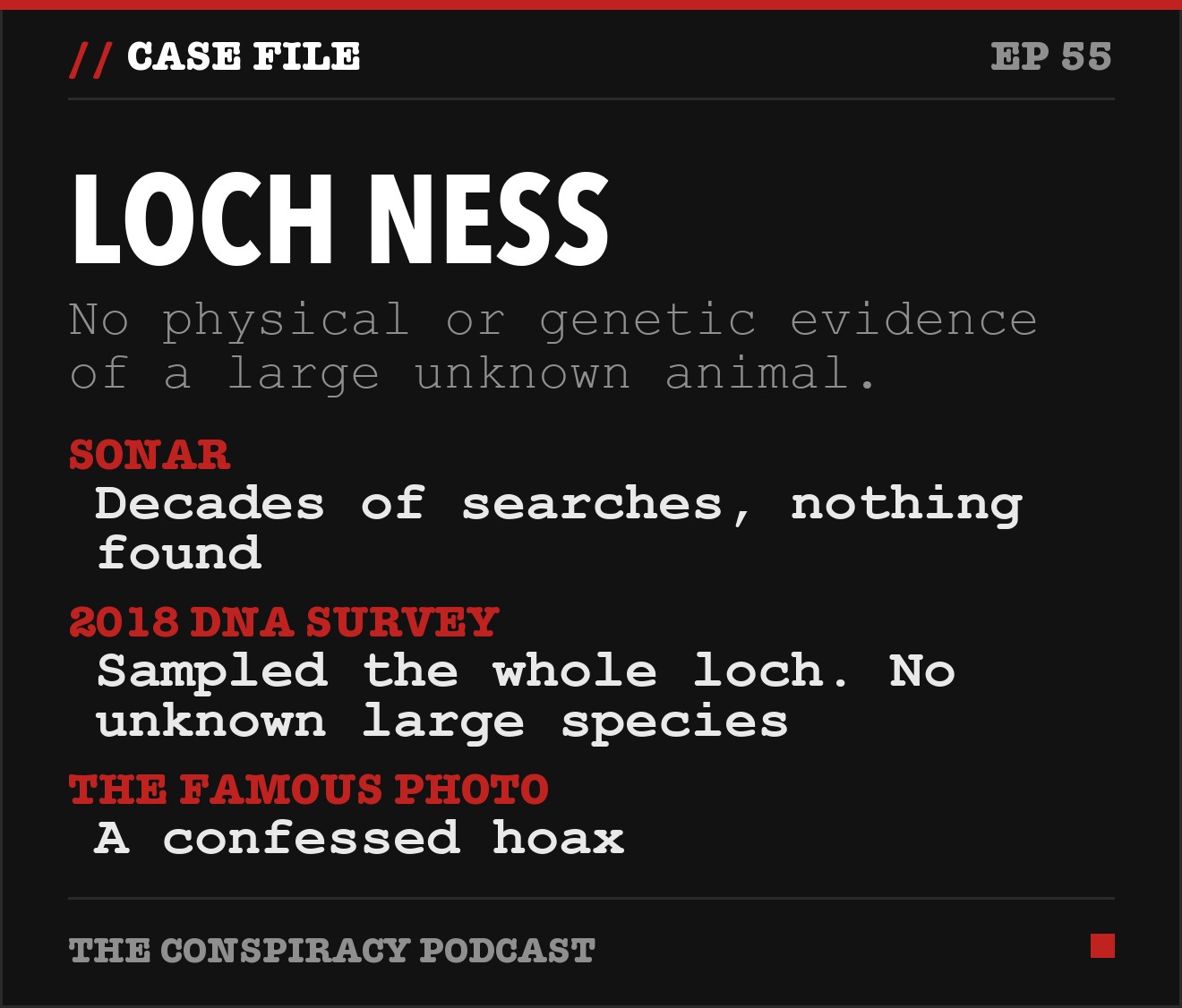
Almost certainly not. No search has ever produced a body, a bone, or a verified specimen, and the two strongest pieces of supposed evidence have not held up: the most famous photograph was confessed as a hoax, and a full DNA survey of the loch found no reptile DNA at all. What remains are ordinary explanations for an extraordinary claim.
The hunt for physical proof has run for almost a century. In 1962 the Loch Ness Phenomena Investigation Bureau ran daylight camera watches for years. Robert Rines led sonar expeditions in 1972 and 1975 that produced a handful of blurry, disputed images. Twenty four boats swept the loch in 1987’s Operation Deep Scan, picking up sonar contacts later chalked up to seals, and in 2003 the BBC funded a 600-beam sonar search that concluded the monster was a myth. The full episode walks through every one of these searches, decade by decade.
So why does the legend refuse to die? Partly it is geography: the loch is enormous, cold, and murky, with visibility dropping to a few feet in places, so a boat can pass within yards of something and never see it. Partly it is the town itself, which has built a real tourism economy on the mystery. And partly it is human nature, since a confirmed absence of evidence does not feel the same as a confirmed absence of monster. That gap is where Nessie has lived for ninety years.
What was the Surgeon’s Photograph?
The Surgeon’s Photograph is the famous 1934 image of a small head and neck rising out of the water, credited to a London physician who insisted his name stay off it. For sixty years it was the single best piece of evidence for the monster, until a deathbed confession in 1994 revealed it had been staged with a toy submarine.
The photograph was credited to Robert Kenneth Wilson and published in the Daily Mail in April 1934. Wilson refused to have his real name attached, so editors called it the Surgeon’s Photograph instead, even though Wilson practiced as a gynecologist, not a surgeon. For decades the image was reproduced cropped in tight, making it look larger and more dramatic than the original frame. A 1993 documentary analysis returned to the uncropped photograph, compared the ripple pattern to the object’s actual size, and concluded the shape in the water was only about ninety centimeters long, roughly the size of a large bird.
The full story came out in 1994, when Christian Spurling confessed shortly before his death that the photograph was a hoax from the start. Spurling built the head and neck out of wood putty mounted on a toy submarine, at the request of his stepfather, a big game hunter named Marmaduke Wetherell. Wetherell had a motive: months earlier the Daily Mail had hired him to find the monster, and the footprints he reported turned out to be a mounted hippopotamus foot. Humiliated by the same paper, Wetherell staged the photograph as revenge, then recruited Wilson to be the credible face of the fake.
What did the DNA survey of Loch Ness find?
In 2018, a team led by geneticist Neil Gemmell of the University of Otago sampled water across the entire loch for environmental DNA. They found no trace of reptile DNA, ruling out anything like a surviving plesiosaur, but recovered a very large amount of eel DNA, which is what fuels today’s giant eel theory.
Environmental DNA testing works by filtering water for the tiny traces every living thing leaves behind: skin cells, scales, waste, and mucus. Gemmell’s team sampled multiple points and depths across the loch and matched the DNA against global genetic databases to identify what actually lives in the water. No reptile DNA turned up in any sample, the clearest evidence yet against a surviving plesiosaur, and no trace of the other large, exotic fish species earlier theories had floated, like an oversized catfish or a wandering Greenland shark.
What the samples did contain was eel DNA, and a lot of it, with European eels present in large quantities at every depth tested. Gemmell framed the finding carefully: the data cannot rule out that people are occasionally seeing a much larger than average eel, but it cannot confirm that either, since no one has ever caught or measured a giant one there. Still, it is the most scientifically grounded theory of the bunch, since it does not require anything unknown to be living in the loch.
When was the first Loch Ness Monster sighting?
The earliest often-cited account has nothing to do with the loch itself. It comes from the Life of Saint Columba, written by the monk Adomnan around the end of the 7th century, describing an incident from 565 AD in which the Irish missionary is said to have driven off a water beast in the River Ness, not the loch.
According to Adomnan, Columba was traveling near Inverness when he came across a burial. The mourners said a man had just been killed by a monster while swimming the river. Columba sent a follower to swim the same stretch, and when the creature surfaced to attack, he made the sign of the cross and ordered it back. The beast retreated. It is a dramatic scene, but it was written generations after Columba’s lifetime, as part of a hagiography meant to demonstrate sainthood, not a wildlife record.
That is the honest version, and it comes with two caveats. First, the location is the River Ness, not the loch itself, so even taken at face value it is not a sighting in Loch Ness. Second, there is a long silence after it, since the next notable references do not appear until the 1800s. The modern legend as most people know it really starts in 1933, when a new lochside road opened up and a local couple reported an enormous animal rolling on the surface, the story that actually built Nessie into a phenomenon.
What is the best explanation for the sightings?
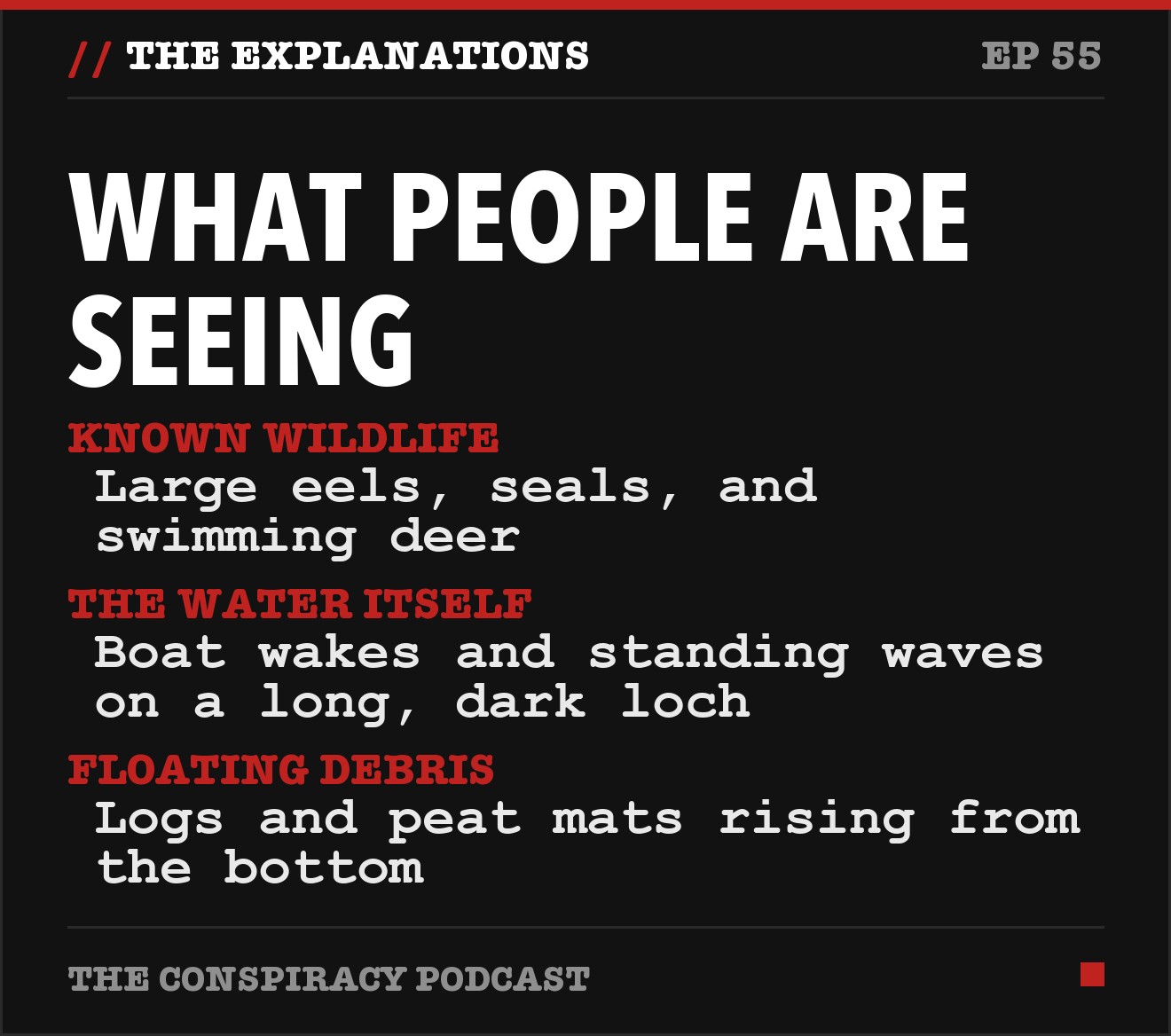
No single theory covers every report, but the leading real explanations are misidentification and one confirmed hoax. Waves, floating logs, boat wakes, otters, and unusually large eels account for most sightings, and the most famous photograph is a proven fake. There is no physical or DNA evidence anywhere for a large unknown animal.
Line up the mundane explanations and they cover a lot of ground. Diving birds and otters create a hump and ripple pattern that can look like a creature from a distance. Floating logs resemble a long neck at the right angle, and boat wakes crossing on a calm day photograph strangely. Even the loch’s geology gets blamed, since researchers have floated the idea that gas bubbling up from below could disturb the surface. None of these need a monster, and most were catalogued and dismissed decades ago.
There is also one more colorful theory tied to the Surgeon’s Photograph, separate from the toy submarine confession. In 1979 a naturalist proposed that Wilson had actually photographed a circus elephant bathing in the loch, trunk raised like a snorkel, meaning the long neck everyone assumed they saw was really a trunk. It is a real published idea, not just a bit, though it never became the leading explanation, since the 1994 confession already accounts for the photograph. Hear the hosts land on their own favorite explanation by the end of the episode, eel evidence included.
| Theory | What the record shows |
|---|---|
| The Surgeon’s Photograph. The most famous piece of evidence, a 1934 photo of a head and neck. | Confessed as a hoax in 1994 by Christian Spurling, built from a toy submarine and wood putty. |
| Giant eel. An unusually large European eel misidentified as something stranger. | The 2018 eDNA survey found abundant eel DNA throughout the loch and no reptile DNA. |
| Surviving plesiosaur. A prehistoric marine reptile that lived on in the loch. | Loch Ness froze solid in the last Ice Age, and no reptile DNA has ever turned up. |
| Misidentified wildlife. Otters, seals, diving birds, logs, and boat wakes. | Cited by investigators for decades as the likely source of most ordinary sightings. |
| Swimming elephant. A circus elephant bathing with its trunk raised like a periscope. | A real 1979 proposal for the photo, overtaken by the 1994 hoax confession. |
I’m looking forward to the day when you’re at a bar and somebody starts talking about the Loch Ness Monster and you go, it’s an elephant.
the guys, on the record