
Why Is Lake Lanier So Dangerous?
Why Is Lake Lanier So Dangerous?
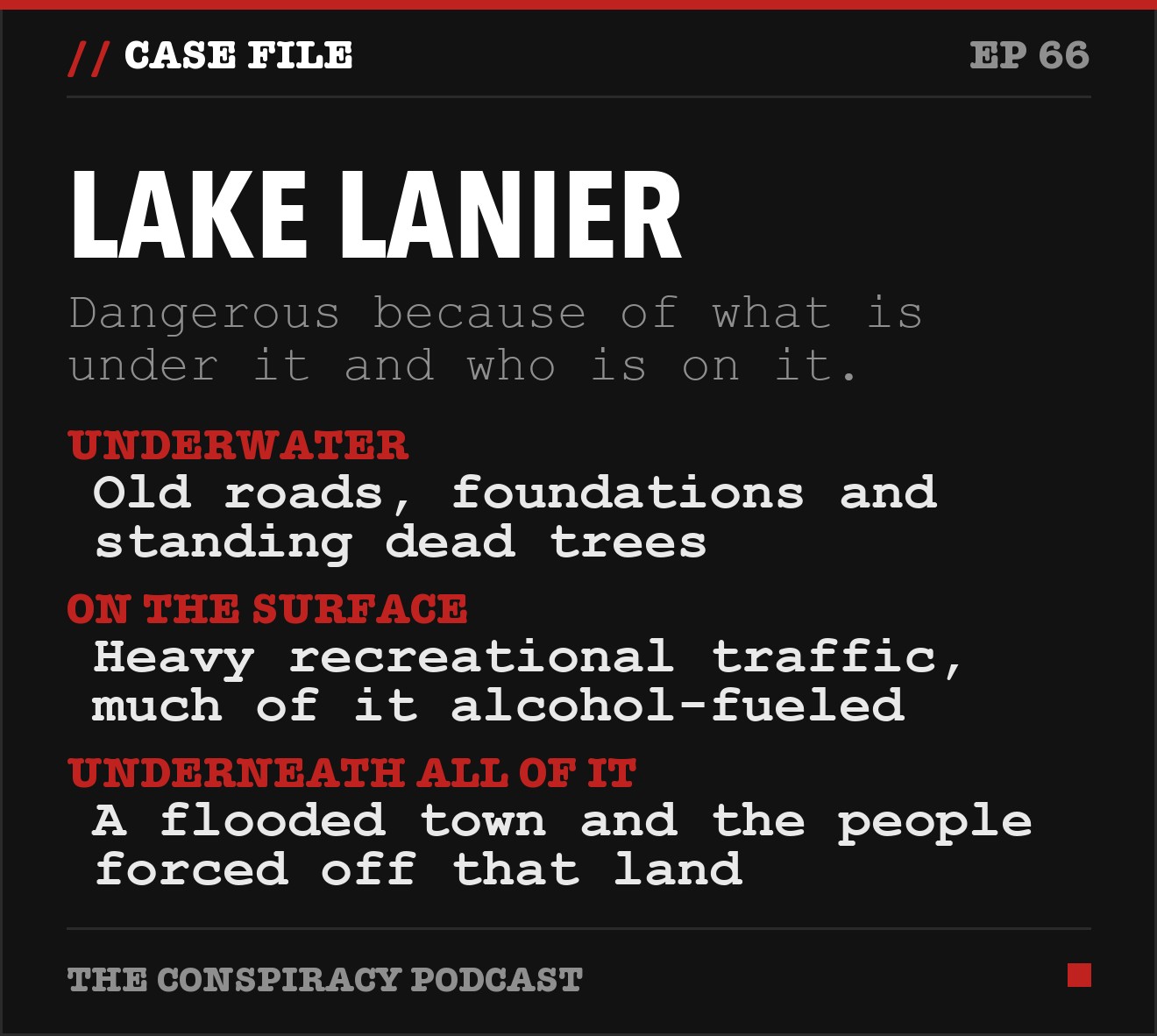
Lake Lanier is dangerous because of what is under the surface and who is on top of it. The lake was formed by flooding farmland and a small town, so old roads, foundations and dead trees sit hidden underwater, while the lake’s huge recreational boat traffic, much of it alcohol-fueled, adds a steady stream of accidents.
By the Conspiracy Podcast team | Last updated: August 2026
Lake Lanier draws millions of visitors a year for boating, fishing and lake days, and it also has one of the highest reported death tolls of any lake in the country. Both things are true at once, and so is a third: the ground under the water has its own history, separate from the drownings, that deserves to be told straight. Here are the questions people actually search.
Why is Lake Lanier so dangerous?
Lake Lanier is dangerous mainly for physical reasons. The lake was built by flooding farmland, so old roads, building foundations and dead trees still sit underwater, hidden hazards for swimmers and boats. Add extremely heavy recreational boat traffic on summer weekends, and the combination produces a steady toll of drownings and boating accidents.
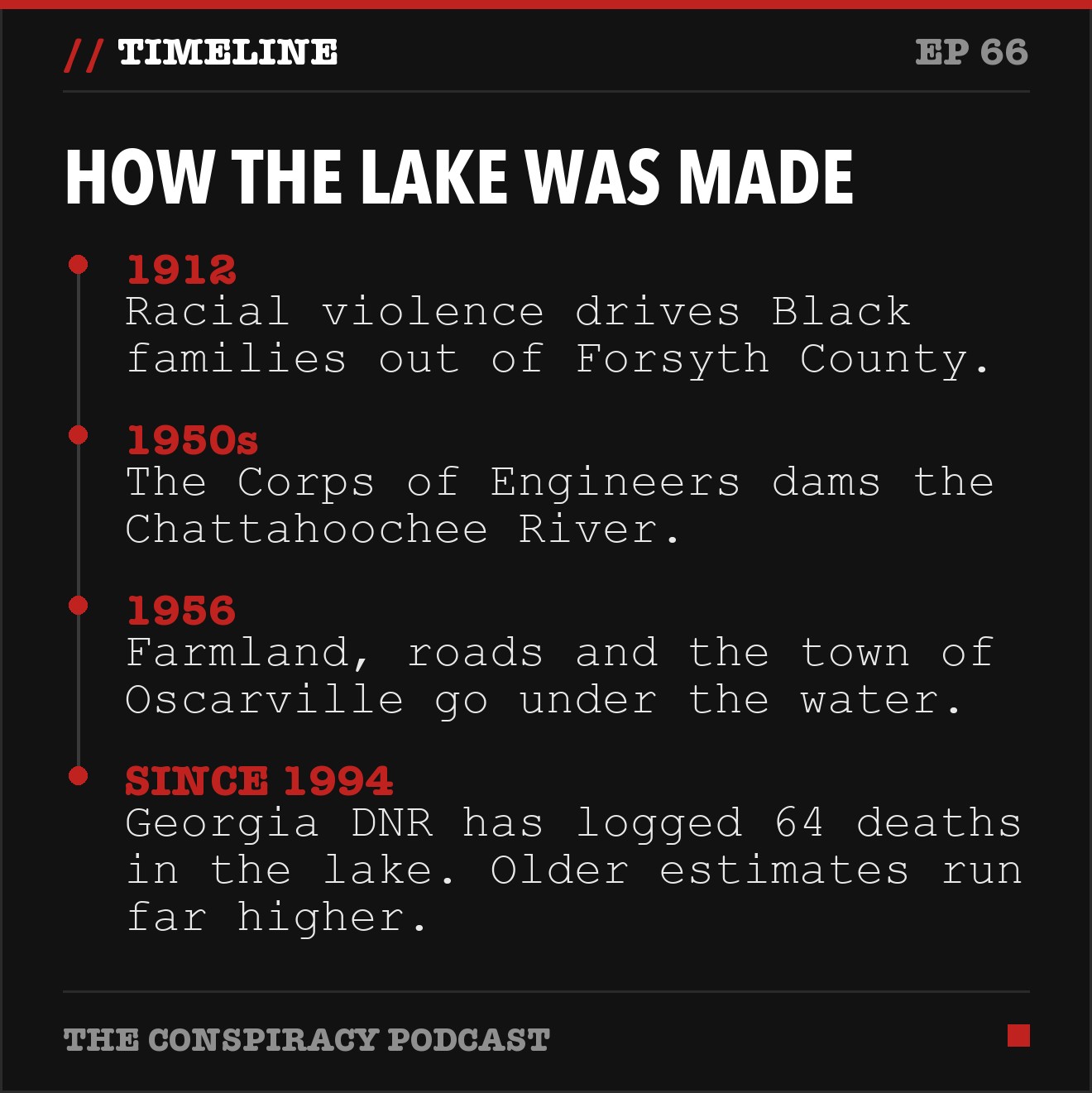
Lake Lanier covers about 38,000 acres and reaches roughly 200 feet deep, formed when the Army Corps of Engineers dammed the Chattahoochee River in the 1950s. Crews cleared some of what stood on the land before the water rose, but not all of it. Old ferry boats, foundations, roads and church walls are still down there, along with cemeteries only partly relocated. Those structures and the dead trees left standing when the lake filled are invisible to swimmers and boaters, and divers describe near-zero visibility a few feet down.
The other half of the danger is human. Lake Lanier sits about an hour north of Atlanta, the closest big lake for millions of metro residents, and summer weekends bring heavy boat traffic and heavy drinking together on the same water. Georgia’s own accident reporting treats boating under the influence as a major factor, and the hosts land in a similar place after going through the numbers: not a curse, just crowds, alcohol and hard objects under the surface. The hosts cover the full picture in the full Lake Lanier episode.
What towns are under Lake Lanier?
The best documented is Oscarville, a Black farming community in Forsyth County, Georgia. When the US Army Corps of Engineers dammed the Chattahoochee River in the 1950s to create Lake Lanier, the rising water covered Oscarville along with farms, roads, churches and cemeteries across roughly 59 square miles bought from about 700 farmers.
The government began buying the land in the late 1940s for flood control, power and drinking water for Atlanta. Owners who refused to sell often found their property declared unfit to live in, which cleared the way to take it anyway. Crews removed some old buildings and relocated roughly 20 cemeteries before the water rose, though not every grave was found. Sections of road, church foundations and unmarked graves are still on the lake bed today, along with the remains of Oscarville itself.
Oscarville’s story is older than the dam, and darker. The community was not emptied by rising water. It was emptied decades earlier, in 1912, when mob violence drove out nearly the entire Black population of Forsyth County and left the land informally in white hands, long before the government came looking for farmland to flood. That history is a documented event on its own, not a spooky backstory for the lake, and it is worth walking through directly below.
How many people have died at Lake Lanier?
Counts vary widely by source and time period. The Georgia Department of Natural Resources has logged 64 deaths at Lake Lanier from all causes since 1994. Older, less formally sourced estimates going back to the lake’s 1956 completion put the total closer to 700, a figure often used to call it the deadliest lake in the country.
The 64-since-1994 figure comes from Georgia’s official boating incident and fatality records, covering drownings, boating-under-the-influence crashes and other accidents. The show’s hosts cite 2023 as a particularly bad year, with eight drownings at the lake. It is the lower number, but it is the one with an actual agency behind it, and it only covers three decades of a lake that has existed since the mid-1950s.
The 700-since-1956 figure gets repeated constantly, including on the show, but it does not trace back to one clear agency the way the 64 figure does. Treat it as a widely cited estimate, not a hard count. A few individual cases, like Kelly Nash’s unresolved 2017 death, stay genuinely open, part of why true crime audiences keep circling back to this lake. For more cases like it, our roundup of famous conspiracy theories is a good next stop.
Is Lake Lanier haunted?
There is no verified evidence of hauntings at Lake Lanier. What people call haunted is the Lady of the Lake, a legend built around a real 1958 case: Delia Parker Young and her friend Susie Roberts disappeared after their car went off a bridge into the lake, and it took until 1990 to learn what happened to both of them.
One night in 1958, Delia Parker Young and Susie Roberts vanished on their way to a local roadhouse in Delia’s car. The only trace was skid marks on a bridge, suggesting the car had gone into the water. A year later, a fisherman found a body in a blue dress like the one Delia had been seen in, missing both hands and unidentifiable, so it was buried in an unmarked grave. The case stayed open until 1990, when bridge repairs turned up Delia’s car with Susie’s remains inside, and dental records confirmed the earlier body had been Delia’s all along.
That case is where the Lady of the Lake legend comes from. Visitors near the bridge report seeing a woman in a blue dress missing her hands, and some swimmers describe a feeling of being grabbed underwater. The show also mentions a shadowy figure with a lantern, poling a boat at night and gone the moment anyone shines a light on it. Both are folklore, not documented fact: an unverified ghost story tied to a real 1958 disappearance, with nothing to do with what happened in Oscarville in 1912.
What happened to Oscarville, Georgia?
Oscarville was a Black farming community in Forsyth County, Georgia. In September 1912, after accusations of assault against two white women, white mobs lynched one Black man without trial and had two Black teenagers executed after a one-day trial, then burned Black homes and churches until nearly the entire Black population of the county fled.
The trouble started with two accusations in September 1912. One woman said a Black man had assaulted her in her home. Days later, 18-year-old Mae Crow was found badly injured in the woods and died from her injuries without identifying an attacker. Authorities arrested several men and teenagers, including Rob Edwards, Ernest Knox and Oscar Daniel. Before any trial, a mob dragged Edwards from his cell and lynched him from a telephone pole in the town square. Knox, 16, and Daniel, 17, went before an all-white jury in a one-day trial that historians, including Patrick Phillips in Blood at the Root, describe as a coerced confession with no real defense. Both were convicted and hanged publicly.
What followed went well beyond those five men. Night riders burned Black-owned homes, churches and businesses, and white landowners took over abandoned farms without any formal sale. Patrick Phillips’ research puts the toll at roughly 98 percent of the county’s Black population, about 1,098 people by the 1910 census, gone within four months. Forsyth County stayed almost entirely white for decades afterward, and the land Oscarville sat on became part of the lake bed when Buford Dam was completed in the 1950s, long after its people had been driven out. The hosts trace the full sequence in the Lake Lanier case file.
| Theory | What the record shows |
|---|---|
| Alcohol and heavy boat traffic. Lake Lanier draws huge weekend crowds, many of them drinking on the water. | Georgia’s own reporting names boating under the influence as a major factor. This is where the hosts land as the main driver of the death toll. |
| Submerged hazards from the flooded land. Roads, foundations and dead trees from the towns the lake covered are still down there. | Confirmed. Crews cleared some of the site before the water rose, but structures and old ferries remain on the lake bed. |
| Vengeful spirits. An idea that circulates online, and comes up on the show as a passing thought, tying the deaths to supernatural payback for the 1912 expulsions. | Not supported by evidence, and it risks trivializing a documented atrocity by turning it into set dressing for a ghost story. |
It seems like thousands of people go there and they just rage party, Weekend Warriors. I think it’s more on that side, just a lot of party, a lot of booze, and you end up with accidents more than other places just because it’s such a party spot.
the guys, on the record