Who Killed JFK?
Who Killed JFK?
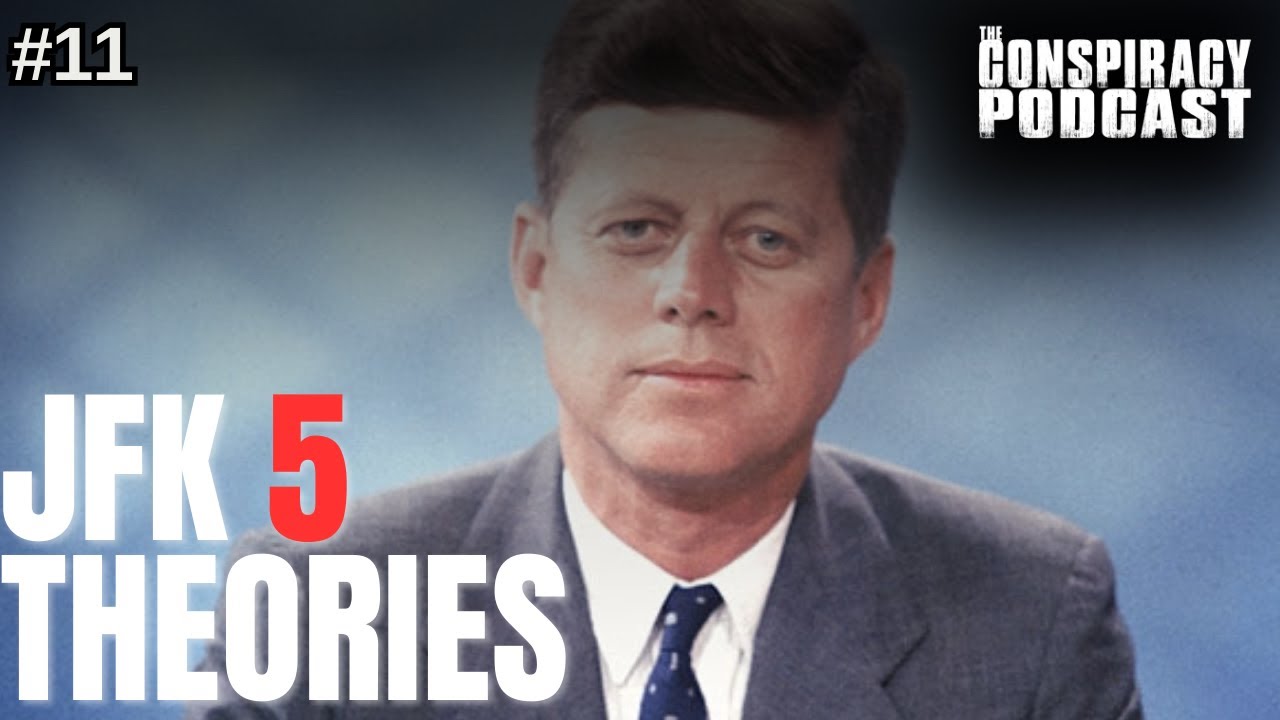
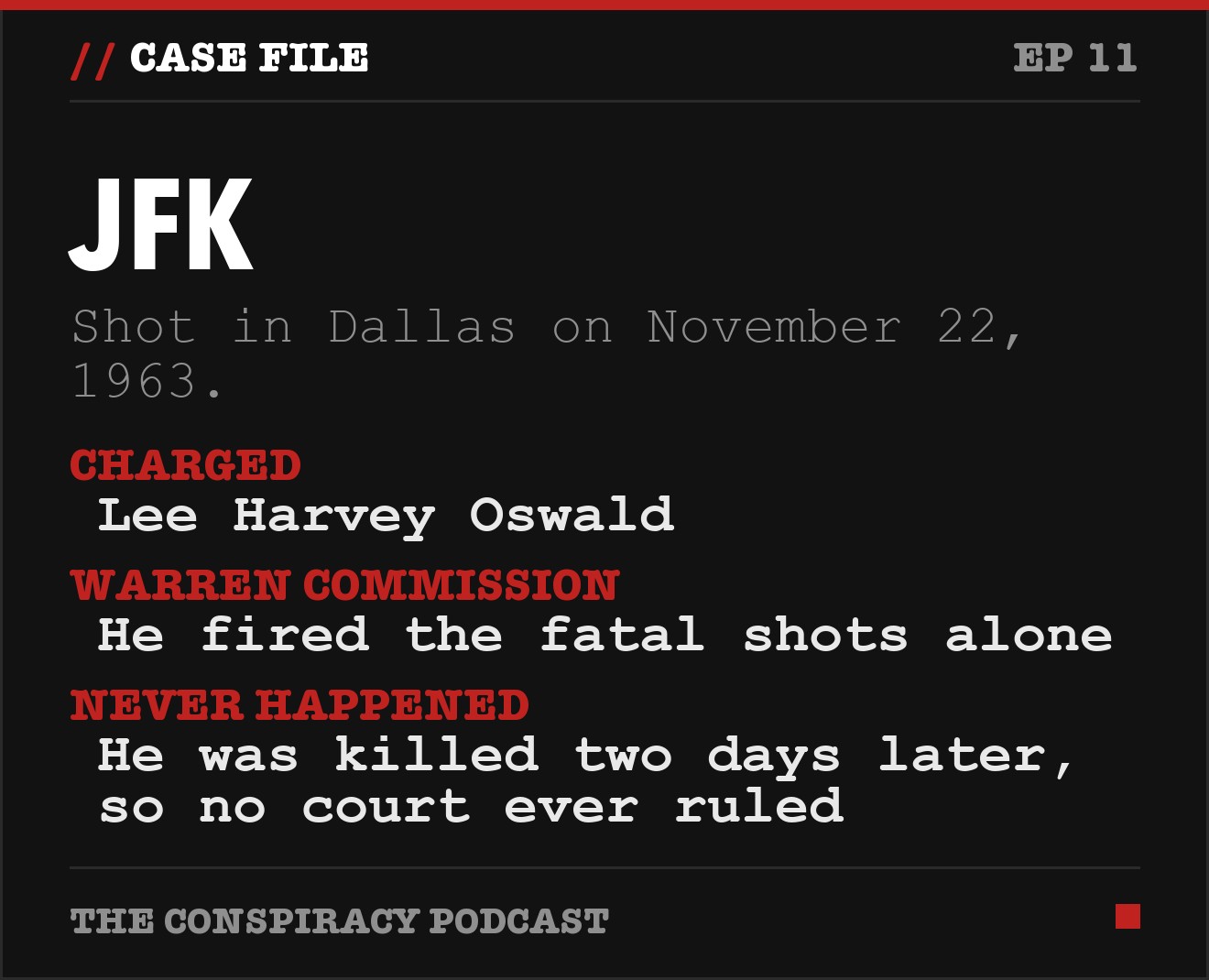
Lee Harvey Oswald was charged with shooting President Kennedy on November 22, 1963. The Warren Commission concluded he fired the fatal shots alone. He was shot dead two days later and never stood trial, so no court ruled on his guilt. More than sixty years on, the case is still disputed, including among this podcast’s three hosts.
By the Conspiracy Podcast team | Last updated: August 2026
The Kennedy assassination is one of the most examined crimes in American history, with roughly 2,000 books written about his death alone. A government commission investigated it in 1964, and a congressional committee reinvestigated it in the 1970s and reached a different conclusion. The Conspiracy Podcast spent five episodes on the evidence, and the three hosts still did not land on the same verdict.
Who shot John F. Kennedy and why?
Lee Harvey Oswald was charged with firing the shots that killed President Kennedy from the sixth floor of the Texas School Book Depository on November 22, 1963. The Warren Commission concluded he acted alone. His motive was never established. Oswald was shot dead before he could stand trial, so his guilt was never tested in court.
The shooting happened as Kennedy’s motorcade turned from Houston Street onto Elm Street in Dealey Plaza, below the depository. Witnesses reported at least three shots in quick succession. One struck Kennedy’s neck, a second struck Texas Governor John Connally, and a third hit Kennedy’s head and killed him. Police found three spent cartridge cases and a bolt action rifle, serial number C2766, hidden near a sixth floor window. The hosts walk that sequence in the Warren Commission episode, almost word for word from the government’s own report.
A motive was never pinned down. The series traces a restless life: a chaotic childhood, a Marine Corps stint, a defection to the Soviet Union in 1959, and a disillusioned return in 1962. Six months before Kennedy died, someone shot at retired Army Major General Edwin Walker’s home with the same rifle model later tied to the assassination. The Warren Commission and the House Select Committee on Assassinations both concluded Oswald was responsible, though he never stood trial. The hosts read his file as a man chasing relevance more than following a plan.
Who was responsible for the death of John F. Kennedy?
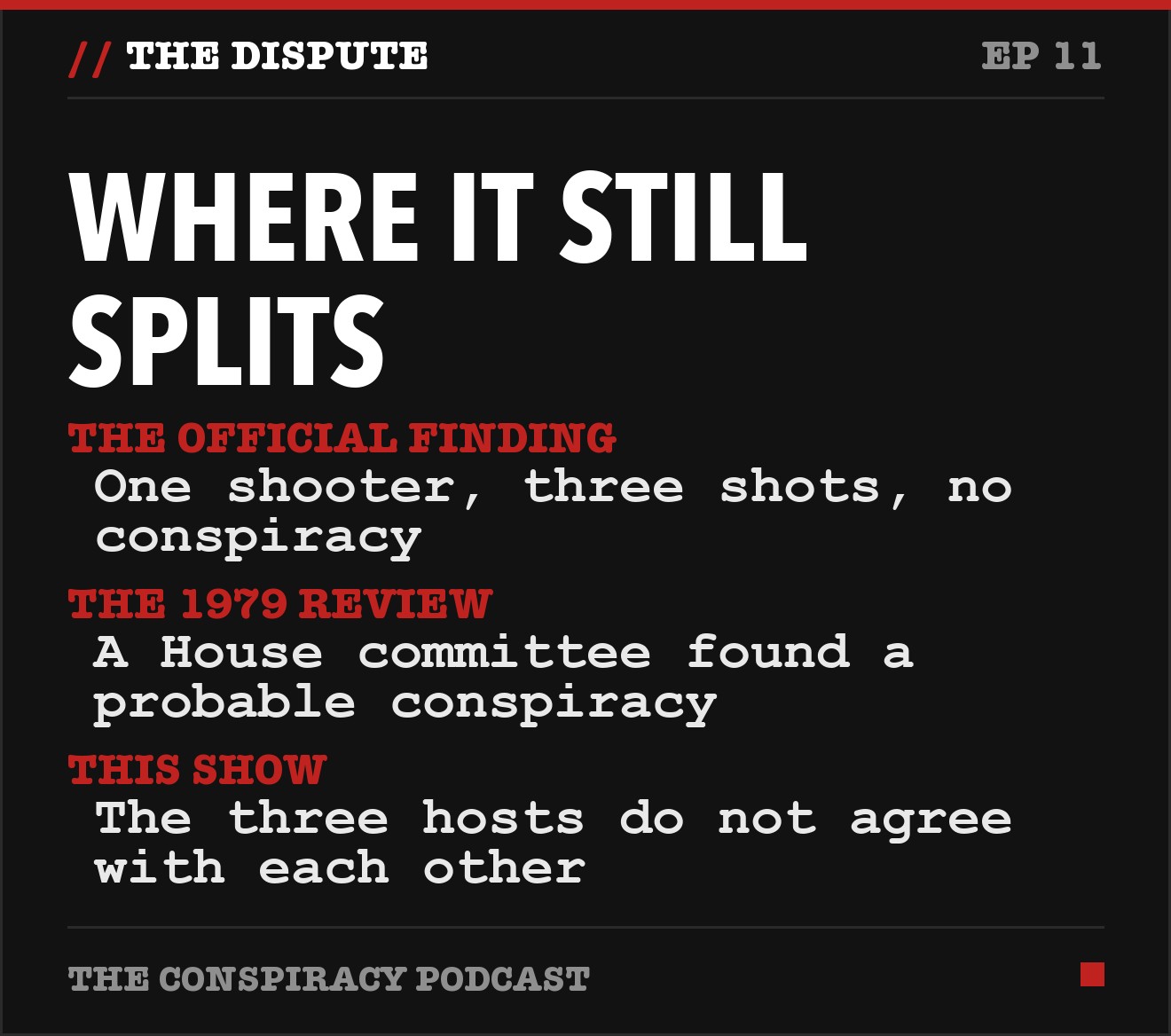
No single investigation has agreed. The Warren Commission concluded in 1964 that Lee Harvey Oswald alone was responsible. A congressional reinvestigation, the House Select Committee on Assassinations, concluded in 1979 that Kennedy was probably killed as the result of a conspiracy, without ever naming who else might have been involved.
The 1979 finding leaned on acoustic evidence suggesting a fourth shot from a second gunman, later discredited. The same report cleared the Soviet government, the Cuban government, and organized crime as a group, while criticizing the FBI, CIA, and Secret Service for withholding information and failing in their protective duties. Beyond the two official investigations, a long list of individual theories has grown up around the case, and the hosts weigh the more prominent ones before giving their own opinions.
| Theory | What the record shows |
|---|---|
| Umbrella Man. A black umbrella opened as Kennedy passed, allegedly a signal. | The man came forward in 1978 and called it a silent protest. |
| Second shooter on the grassy knoll. A professional, not Oswald, is theorized to have fired the fatal shot. | Witnesses disagreed on the shots’ origin. The acoustic evidence for it was later discredited. |
| Jim Garrison’s conspiracy. Businessman Clay Shaw allegedly conspired with CIA linked figures to frame Oswald. | A jury acquitted Shaw in 1969. No evidence of CIA involvement was ever found. |
| Lyndon Johnson. Johnson allegedly had Kennedy killed to stay on the 1964 ticket. | Claims rest on secondhand accounts from a self described mistress and convicted felons. No physical evidence ties him to it. |
| Organized crime. The mafia allegedly ordered the hit and used Jack Ruby to silence Oswald. | Cleared as a group. Ruby, convicted of murdering Oswald, said he acted alone. |
| Secret Service accident. Agent George Hickey’s rifle allegedly discharged by accident, killing Kennedy. | The Warren Commission says Hickey cocked his rifle but never fired it. |
None of these theories has ever produced a smoking gun. What keeps them alive is less any single piece of evidence than an accumulation of small unresolved details: witnesses never called before the Warren Commission, evidence that went missing, a rifle scope reportedly so misaligned the FBI could not sight through it. The hosts catalogue those loose ends in a full episode before offering any verdict of their own.
What did the Warren Commission conclude?
The Warren Commission concluded that three shots were fired from the sixth floor of the Texas School Book Depository, that Lee Harvey Oswald fired all three and acted alone, and that there was no evidence of a domestic or foreign conspiracy. It also found no evidence Oswald ever worked for the FBI, CIA, or any other government agency.
President Lyndon Johnson created the commission after succeeding Kennedy in office, and it first met on December 5, 1963, less than 30 days after the assassination. Its seven members included Chief Justice Earl Warren, two sitting senators, a House majority whip, future president Gerald Ford, a former World Bank president, and former CIA Director Allen Dulles. The hosts flag that last appointment as worth remembering: an agency already eyed with Cold War suspicion had its own former director judging the president’s murder case. The commission delivered its 888 page report within a year.
The physical case rested on the Mannlicher-Carcano rifle, traced through a Chicago mail order house to a purchase made under the alias A. Hidell and shipped to a Dallas post office box Oswald had rented. To make three shots account for every wound on both Kennedy and Governor Connally, the commission concluded a single bullet passed through both men, a finding it acknowledged some internal disagreement over. That trajectory, covered next, became the most argued detail in the case.
What is the magic bullet theory?
The magic bullet, formally the single bullet theory, holds that one shot passed through Kennedy’s neck and then caused all of Governor John Connally’s wounds: through his back, out below his nipple, through his wrist, and into his thigh. The Warren Commission needed this to make three shots explain every wound. Critics have long called the required path implausible.
The nickname captures the disbelief. For the theory to work, one round has to change direction after leaving Kennedy’s neck, avoid deforming further on the way through, and still carry enough force to break a rib and a wrist bone. The commission concluded it did exactly that, based on the men’s seating positions and the Zapruder film, the home movie that captured the shooting. The hosts argue a cheap, short barreled, bolt action rifle firing at a moving target in seconds leaves little room for that kind of precision.
The theory gets shakier once you follow the bullet itself. A nearly whole round turned up loose on a hospital stretcher at Parkland Hospital, with no documented chain of custody connecting it to any patient. The Warren Commission concluded it had fallen from Governor Connally’s stretcher and was the same bullet that passed through both men. The hosts call this the single most unresolved hole in the entire case, not because an intact bullet is impossible, but because nobody can actually prove which stretcher it came from.
Do the hosts think Lee Harvey Oswald acted alone?
No. All three hosts believe Oswald fired at Kennedy, but none of them agree beyond that. One thinks Oswald missed and a professional on the grassy knoll fired the fatal shot as part of a government plot. Another suspects a wider conspiracy used Oswald as a decoy. The third believes Oswald acted alone, with only a small margin of doubt.
The two more skeptical hosts point to the same detail: Oswald had worked at the depository only two or three months before the motorcade route became public, which makes it hard to accept that he picked that job to set up the shot. One doubts a cheap, short barreled rifle could make a moving target shot that also matches the direction Kennedy’s head snapped on impact. The other simply argues that a conspiracy means more than one person planning in secret, and that the series’ loose ends add up to more than coincidence. The finale episode lays out both arguments in full.
The third host leans on the physical case: fingerprints, a rifle traced back to Oswald, and eyewitnesses placing him at the window and fleeing the scene. He keeps only a small margin of doubt, built mostly around the timing question the other two raise. He also floats his own theory, that Oswald tried to recruit help by letter, that whoever he wrote to backed out, and that calling himself a patsy meant he felt abandoned rather than framed. It is a theory, not a finding, and the hosts say so themselves.
He killed him, like that’s my stance, I do believe all the evidence points to him, shooting, fingerprints, gun, everything, witnesses, him there, he took the shots.
the guys, on the record
A November 2013 poll found 61 percent of Americans believed the assassination involved a conspiracy, 30 percent believed Oswald acted alone, and 9 percent had no opinion. The hosts land in roughly the same split. For more patterns like this one, our roundup of famous conspiracy theories covers a lot more of them.