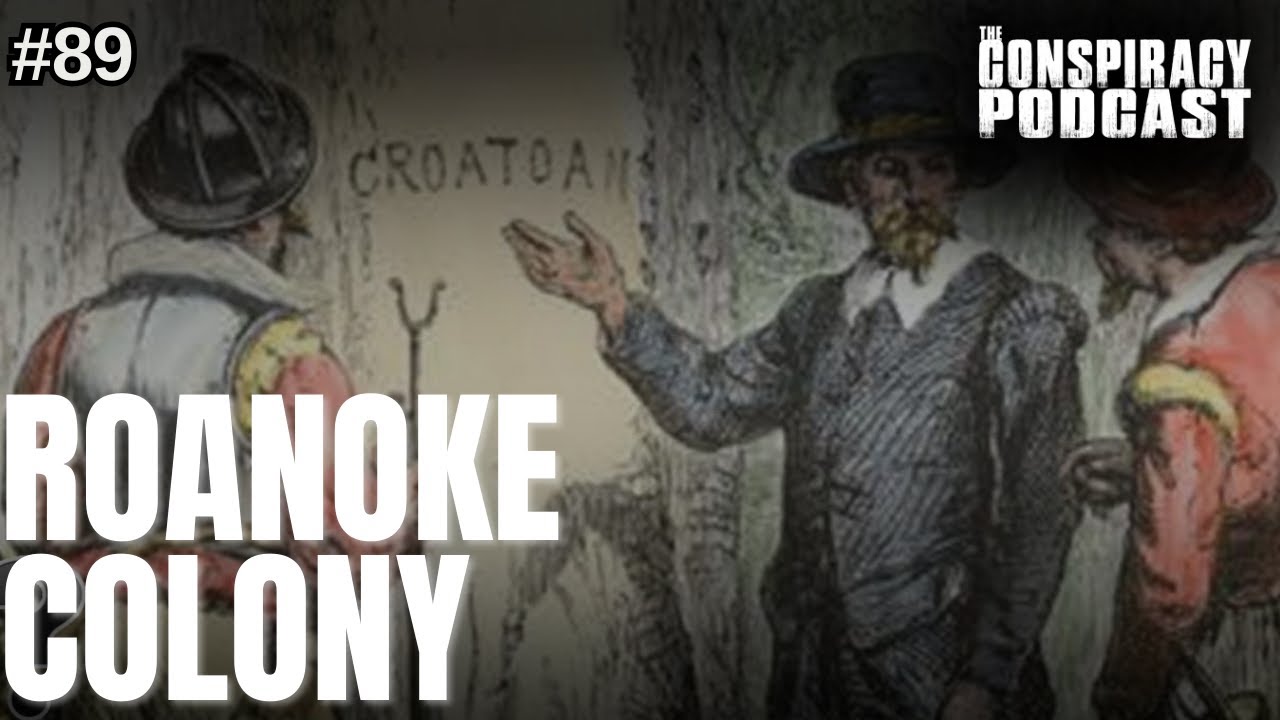
What Happened to the Lost Colony of Roanoke?
What Happened to the Lost Colony of Roanoke?
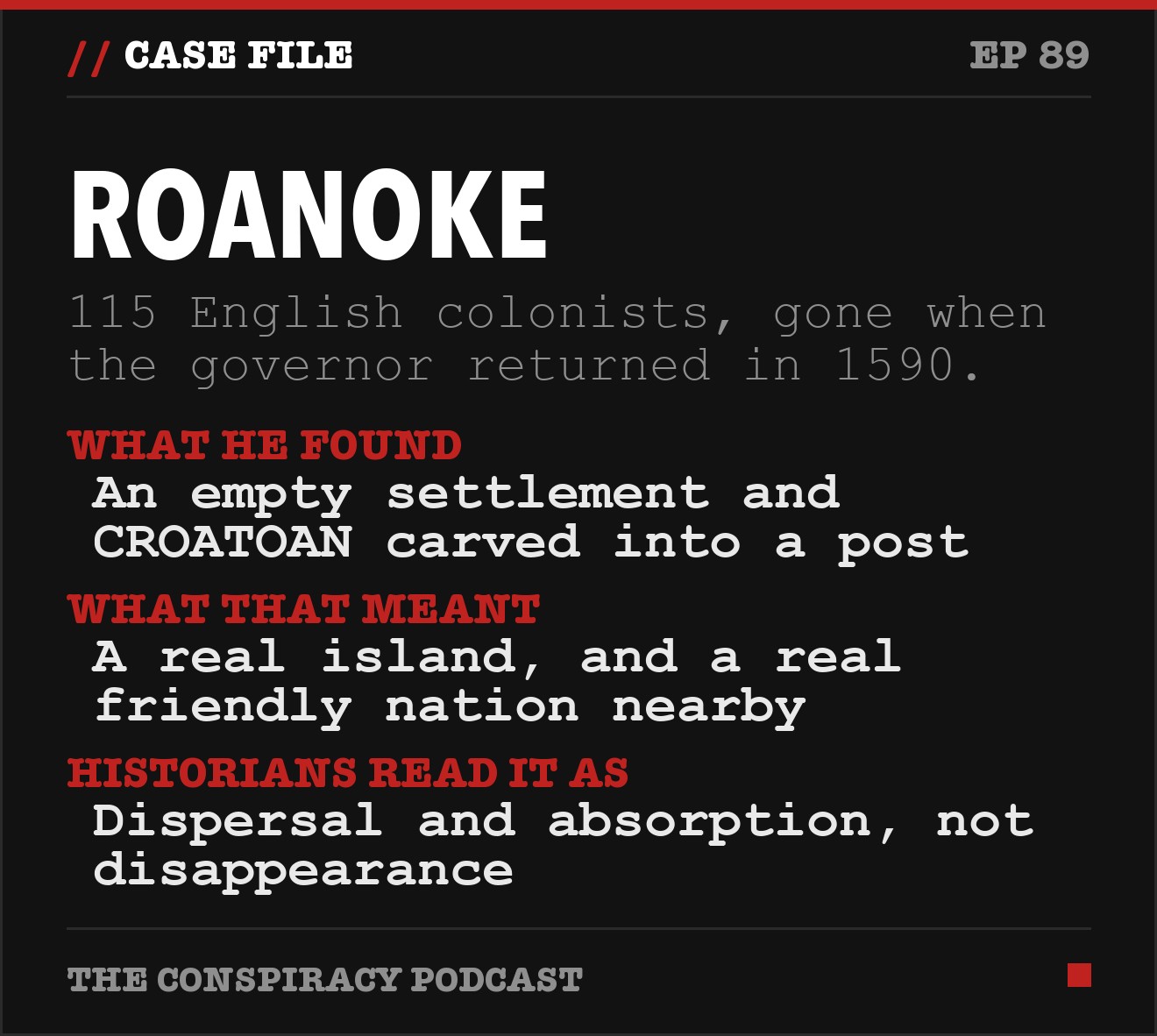
The 115 English colonists of Roanoke Island most likely did not vanish. When Governor John White returned in 1590, he found the settlement empty except for the word CROATOAN carved into a post, a direct pointer to a real island and a real, friendly nation nearby. Most historians read that as dispersal and absorption into Indigenous communities, not disappearance.
By the Conspiracy Podcast team | Last updated: August 2026
Roanoke gets called America’s oldest cold case, but it is less a mystery with zero leads than one strong lead nobody chased down. Governor White had a three year gap and a wrecked search attempt standing between him and an answer, and the English crown never sent anyone back to look. That gap is where every theory has lived for more than four centuries.
What happened to the Lost Colony of Roanoke?
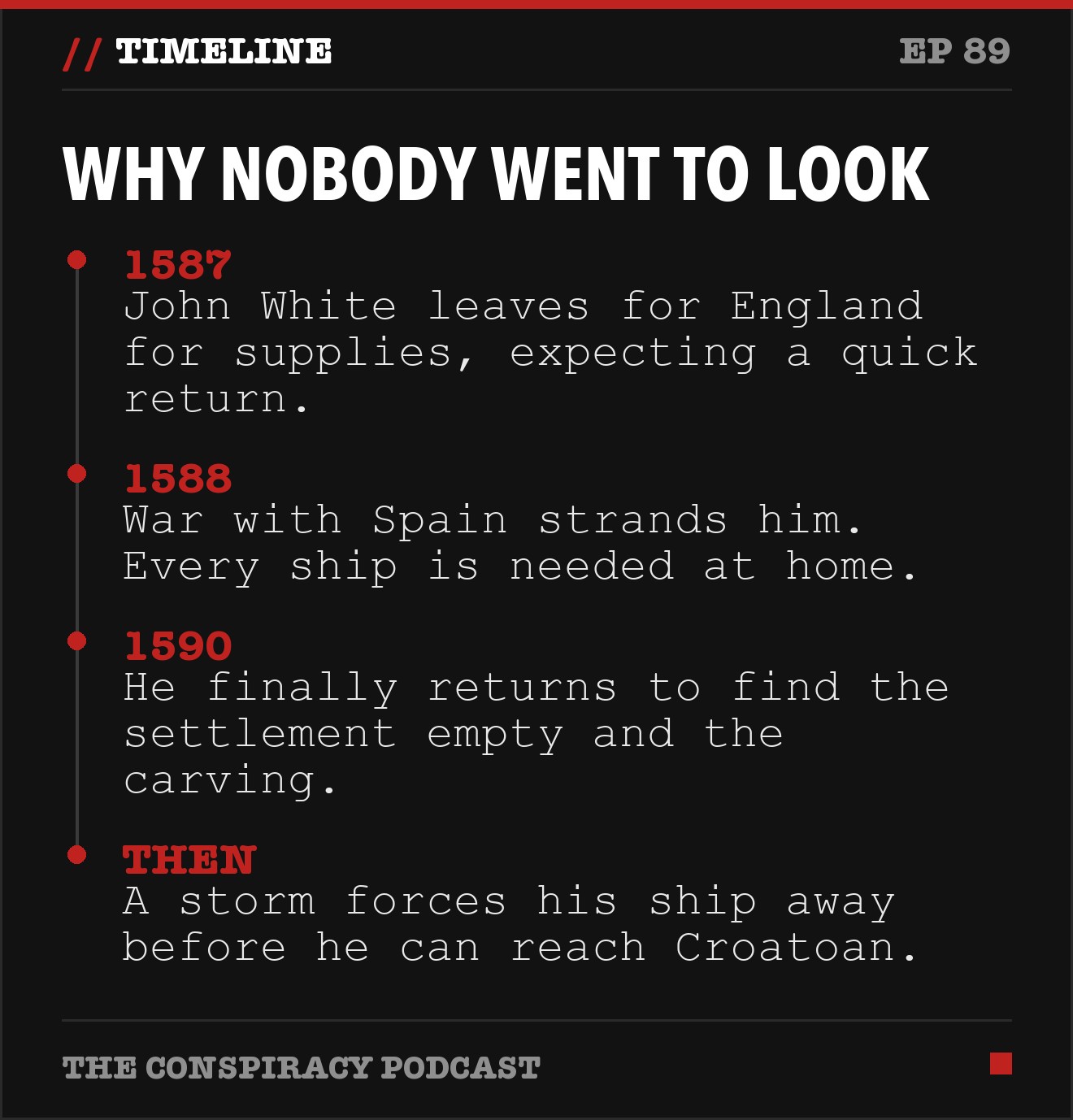
In 1587, Sir Walter Raleigh sent 115 colonists to Roanoke Island under Governor John White. White sailed home for supplies, and England’s war with Spain delayed his return three years. When he finally landed in 1590, the fort stood empty and overgrown, with only the word CROATOAN carved into a post to explain where everyone had gone.
White’s group rebuilt a fort left by an earlier 1585 expedition and tried to rebuild relations with neighboring Algonquian communities, some of which had soured after that first English visit. The settlers included White’s daughter Eleanor Dare and her newborn, Virginia Dare. As stored food ran low and new crops had not yet taken, White agreed to sail back to England for supplies, promising to return within three months. The hosts walk the full sequence in the Roanoke episode, including how badly that timeline slipped.
When White reached Roanoke in 1590, he found no bodies, no graves, and no sign of struggle, just an abandoned fort and one carved word. He tried to sail on to Croatoan Island himself, but a storm damaged his ships and the captain refused to go further, turning White back to England for good. No English search party was ever sent after that. What looks like total disappearance is really an unfinished investigation: one strong clue, no follow up, centuries of argument.
| Theory | What the record shows |
|---|---|
| Integration with the Croatoan or other Algonquian communities. The leading scholarly explanation: the colonists dispersed and were absorbed into nearby Indigenous nations. | Matches the CROATOAN carving directly, plus later accounts of Indigenous communities on Hatteras Island with English ancestry and artifacts mixed into Native settlement sites. |
| Attacked by the Spanish. Spain had a fortified base at St. Augustine, Florida and saw England’s colony as a rival claim. | Spanish colonial records mention Roanoke but describe no raid on it. No weapons damage or mass grave has ever been found at the site. |
| Relocation to Chesapeake Bay. A hidden symbol on one of White’s own maps points to a planned inland fort. | The symbol is real and was confirmed with imaging technology in 2012, but no colonial site has ever been confirmed at that location. |
| Witchcraft, time travel, alien abduction, and dramatized retellings like the FX series American Horror Story: Roanoke. | No historical evidence of any kind. These are folklore and fiction built on top of a real mystery, not part of the documented record. |
the English government covered it up 100%.
the guys, on the record
What does CROATOAN mean?
CROATOAN was the single word Governor John White found carved into a wooden post when he returned to the abandoned colony in 1590. It was not a code. Croatoan was the real name of a real island, now called Hatteras Island, and of the Indigenous nation who lived there and had been allied with the English colonists.
White also found the letters C, R, O carved into a nearby tree, treated by most researchers as an abandoned first attempt at the same word. By White’s own written account, he and the colonists had prearranged a signal before he left in 1587: a cross carved above any message would mean they had gone under attack. No cross was carved anywhere on the post or the tree. That detail rarely makes it into retellings, and it matters, because it means whoever carved CROATOAN was not signaling an emergency.
Croatoan Island sat roughly fifty miles south of Roanoke, in the Outer Banks region that is now called Hatteras Island. It was home to the Croatoan people, an Algonquian speaking nation the colonists already knew well and considered friendly. White took the carving as good news. It told him exactly where to look next, and it meant the colonists had likely left on their own terms rather than under attack, which is why he tried immediately to sail there himself before weather turned him back.
Who was Virginia Dare?
Virginia Dare was the granddaughter of Governor John White, born on Roanoke Island in 1587 to his daughter Eleanor Dare and her husband Ananias Dare. She is generally recognized as the first child born in the Americas to English colonists. She was an infant, days old, when White left for England, and she vanished with the rest of the colony.
Virginia Dare was born on August 18, 1587, and christened the following Sunday, the first child born on Roanoke Island. Her mother, Eleanor Dare, was Governor White’s daughter, and her father, Ananias Dare, served as one of the twelve men White appointed as assistant governors of the colony. White departed for England on August 27, just nine days after his granddaughter’s birth, expecting to return with supplies within a few months. He would not see her, or anyone else in the colony, again.
No record states what happened to Virginia Dare after 1587. She is not singled out in any later English account, any Native American oral history that has survived, or any archaeological find, she disappears from the record along with the other 114 colonists at the same moment. If she survived past 1590, she would have been raised inside whatever community her family joined, entirely outside the English documentary record. That is the honest answer: not a fate, an absence of one.
Did the Roanoke colonists join a Native American tribe?
Most likely, yes, at least in part. The CROATOAN carving points directly at the Croatoan people, an Algonquian nation on what is now Hatteras Island who were already allied with the colonists. Later accounts and archaeological finds support colonists living among the Croatoan and other regional nations rather than being wiped out.
The alliance did not start with a mystery, it started with a person. Manteo, a Croatoan man, had sailed to England in 1584 with an earlier expedition, learned English, and returned as a guide and interpreter. In August 1587, the colonists baptized him and, on Sir Walter Raleigh’s orders, named him Lord of Roanoke, the first Native convert and titled ally in the English colonies. When White read CROATOAN as a message rather than a warning, he was relying on a relationship the colonists had built with Manteo’s own people, not guessing at strangers.
More than a century later, English explorer John Lawson recorded that Hatteras islanders described ancestors who could talk in a book, meaning read, and had gray eyes, unusual among Algonquian peoples. Lawson published this in 1709 as firsthand observation, not proof, and historians treat it as suggestive rather than conclusive. It fits the pattern of the archaeology: not one smoking gun, but small signs pointing toward a nation that, by its own account, had adopted English strangers into itself. Our roundup of famous conspiracy theories digs into more patterns like it.
Has any evidence of the Lost Colony ever been found?
Some evidence, but nothing conclusive. Archaeologists have found European artifacts at an inland North Carolina site known as Site X and at a Croatoan town site on Hatteras Island, both consistent with colonists living on for years after 1587. No burial, no colonist’s remains, and no document has ever confirmed exactly what happened to any of the 115.
Site X sits inland in Bertie County, near where Salmon Creek meets the Albemarle Sound. First Colony Foundation researchers found it after a 2012 examination at the British Museum revealed a hidden fort symbol beneath a patch on one of White’s own maps. Digs there in 2012 and 2014 turned up English pottery called Border ware, a metal shoelace tip called an aglet, and a cloth tool called a tenter hook, all dated to the late 1500s or early 1600s. The Foundation’s own conclusion is careful: the site may have sheltered a handful of colonists, not the whole group.
The stronger physical case comes from Hatteras Island, at a Croatoan town site near Cape Creek. In 1998, East Carolina University archaeologists recovered a gold signet ring engraved with a rearing lion, a crest tied to the Kendall family and Raleigh’s earlier Roanoke expeditions. More recent digs led by archaeologist Mark Horton found English metalworking waste mixed into the Croatoan village’s own occupation layers, read as years of colonists living and working inside the community, not a single short visit. Neither Hatteras nor Site X has produced a body or a grave. The hosts weigh both in our full breakdown of the Lost Colony.