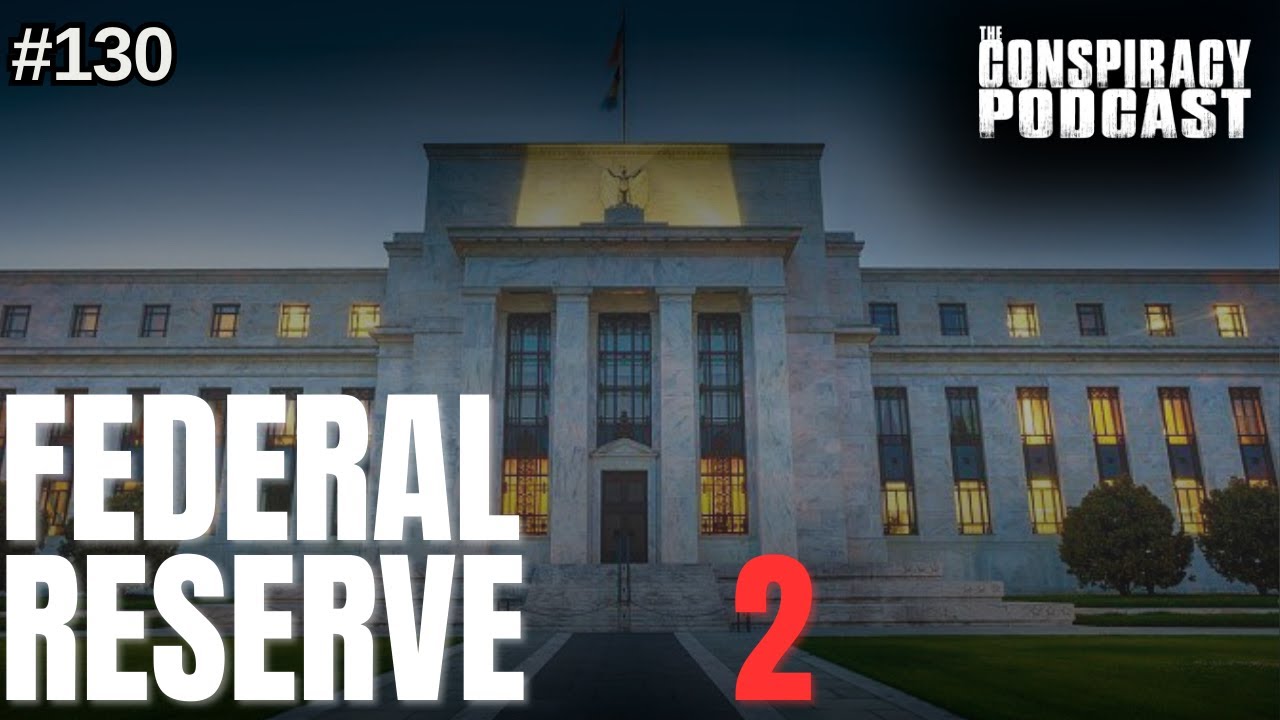
The Federal Reserve: Part Two – EP 130

The Federal Reserve: Part Two
Part two picks up where the gold standard left off. In 1944, representatives of 44 nations met at Bretton Woods, New Hampshire and pegged the world’s currencies to the US dollar, which was itself redeemable for gold at 35 dollars an ounce. That arrangement held through the boom years of the fifties and sixties, but foreign nations, led by France’s Charles de Gaulle, started demanding gold for their dollars and drained US reserves. In August 1971, Nixon suspended the dollar’s convertibility to gold, a move he called temporary that became permanent, ending the gold standard for good and moving the world onto fiat currency. The guys point to the website WTF Happened In 1971, which charts how worker pay, productivity, and cost of living all track together until that year, then diverge.
From there the episode walks through the 2008 financial crisis, the bank bailouts, and the trillions printed since, including the claim that 60 percent of the entire money supply was printed between 2020 and 2021. Then it moves into the theories: that the Federal Reserve is not truly federal despite the name, since member banks hold non-transferable shares in regional banks rather than real control; that a hidden group of families, not necessarily the Rothschilds, actually run the show from the shadows; and the Jekyll Island story, where the Fed’s blueprint was reportedly drafted in secrecy before the Federal Reserve Act passed Congress in 1913.
The guys also revisit two older theories through the lens of the Fed. One holds that JP Morgan arranged for the Titanic to sink in order to eliminate financiers Astor, Guggenheim, and Strauss, who allegedly opposed a central bank, while Morgan himself canceled his trip. The other centers on JFK’s 1963 executive order authorizing the Treasury to issue silver certificates, which some argue threatened the Fed’s control over currency. The episode closes on how the Fed is structured today, from Fed chair Jerome Powell and the seven-member board of governors to the 12 regional reserve banks and the Federal Open Market Committee that sets interest rate policy, plus the guys’ own theory tying the 1913 income tax law to a system of permanent government debt.
- In 1944, 44 nations met at Bretton Woods and pegged their currencies to the US dollar, which was redeemable for gold at 35 dollars an ounce
- In August 1971, Nixon suspended the dollar’s convertibility to gold after France and other nations drained US gold reserves, ending the gold standard
- The Federal Reserve Act, along with the first modern federal income tax, both passed in 1913
- Member banks hold shares in the 12 regional Federal Reserve banks, but those shares cannot be sold or traded and do not grant ordinary corporate control
- The Federal Open Market Committee, made up of the board of governors and regional bank presidents, is the body that sets US monetary policy and interest rates
- Roughly 60 percent of the entire US money supply was printed between 2020 and 2021
Read the full transcript
Welcome to part two of the Federal Reserve. We ended part one at pretty much the end of the gold standard, right around 1933, right before the war. That is when they started buying back the gold, when it became basically illegal for a private citizen to own it. They wanted you to give it back, not the government, just us, totally legit and above board.
It makes sense though, because how can they remove the gold standard if a bunch of people own gold? If you allow private citizens to own gold and you are trying to centralize a banking system that is not propped up on it, they are just going to hold their gold and not believe in you. A bunch of people were hoarding their gold back then, just like if something came through where they wanted everybody to give up their guns, everybody is going to go bury them out back.
There is one other thing I want to touch on, which was in 1971. That is when Nixon went off the gold standard, and that was globally. There is a really interesting website called WTF Happened In 1971 dot com. All it does is give you stats of what happened during that year, shown as graphs. The top one is worker pay versus productivity, and everything was tracking together until 1971 when worker pay flatlines while productivity keeps climbing.
There are other ones too, insurance cost, cost of living, housing cost. Everything started trending differently after 1971. Statistics are statistics, it just is what it is. When you start to see a pattern, you go back and find that one point, that one date, and that starts to paint the picture of what happened and why. That is the basis of any investigation, deductive reasoning. You deduce the common denominator. All this stuff happened in the same year, so what did they do that year to make this occur?
Look at median male income, the blue line, versus female income. The male income just planes off and becomes a flatline, while the female income keeps tracking with GDP per capita. GDP is skyrocketing but the median male income stays baseline. Basically more women started working, and at least the graphs for women are trending upwards even though historically women were not paid what they should have been.
Back to the Federal Reserve. World War II reshaped the global economy. In 1944, representatives of 44 nations met in Bretton Woods, New Hampshire to design a new monetary system. Why are they always meeting in these obscure locations? They cannot just meet at a Denny’s. The result was a compromise between the rigidity of the gold standard and the flexibility of fiat. Fiat is the currency the world is on now.
The US dollar, backed by the world’s largest gold reserves, became the central reserve currency. Other nations pegged their currencies to the dollar, and the US promised to redeem dollars held by foreign governments for gold at 35 dollars an ounce. So gold only mattered in terms of an emergency baseline and in trade with other countries, not for citizens. They went off the gold standard and came back onto it for a short period, about three decades.
American currency even had a slogan, as good as gold, because they said they had the gold to back it up. That was the fifties and the sixties, during the boom of America. We were masters with tons of money and tons of gold. Then by the late sixties we started doing things called Vietnam, these pointless wars that do not actually accomplish anything.
The confidence in America’s promise began to crack. Foreign nations led by France’s Charles de Gaulle started demanding gold for their dollars from the US. So our reserves started to drain because we had to fork it over. In August of 1971, Nixon announced the United States would temporarily suspend the dollar’s convertibility to gold. He said it was temporary, but that temporary measure became permanent. It marked the end of the gold standard, and we entered the age of fiat money, currency backed by the government, not by metal.
The shift to fiat transformed the global economy. No longer constrained by gold reserves, central banks gained unprecedented power to manage interest rates, expand credit, and influence economic growth. Money became a tool of policy rather than a physical commodity. Supporters argued that fiat money allowed flexibility in times of crisis. Governments could stimulate demand during recessions by lowering interest rates, raising them, or printing.
So a recession is when we have lower GDP, lower production in the country. The government could lower interest rates so you would be more likely to take out a loan, which stimulates you spending money. When interest rates go up, you stop spending. Low interest rates and people want to buy a house, which brings jobs to all the construction workers. This is why Trump’s idea lately of a 50-year mortgage is the worst idea.
If it happened, people would say, oh, I can afford the million-dollar home now, because all they care about is the monthly payment. We were talking about this before the episode. A guy posted the numbers based on a 6 percent interest rate on a 400,000 dollar loan. On a 30-year term your payment is about 2,300 bucks, and the total paid over the lifetime is about 860K. So you are paying nearly 200 percent for the loan over 30 years, and nobody thinks about that total.
On a 50-year loan the payment is only about 200 dollars less, around 2,100 bucks, but you pay 1.2 million over the term. So you are literally paying 300 percent on the loan amount for a 200 dollar a month discount. How is that logical in any universe? It is not about saving 200 a month, it is about being able to afford it in the first place, but if 200 dollars a month is your make-or-break, you should not be buying the house.
Don’t they have 72 and 84 month car payments now, because everything is 100 grand? People will absolutely do it. If a car was 3.99 a month on a 10-year loan versus 5.99 a month on a six-year loan, people would be more inclined to take the longer one and just plan to sell it in three years. All we are arguing about is whether people will buy it more, and 80 to 85 percent of the population is going to say hell yeah without thinking about the back end.
It is a terrible idea. The illusion of stimulation. By the early seventies we had drained our gold reserves, and moving away from gold made it so our reserves did not matter. Now we just buy it on credit. Critics warned that without the discipline of gold, nations would succumb to temptation, and temptation is printing money. We will just call it quantitative easing so people do not understand it.
There is always something we need to print money for. Look at the government shutdown. People are clamoring, print money, but the government has been shut down for 45 days now and things seem fine. The only thing I noticed is the TSA starting to get affected, with long lines at Dallas airport and canceled flights. Why is TSA even a government entity? We are talking about the security people, not air traffic control. The air traffic controllers are legit.
Both sides of this proved partly right. The seventies saw extreme inflation, loose monetary policy sent prices soaring. It was not until Federal Reserve chairman Paul Volcker’s aggressive tightening in the early eighties that inflation stopped, but then we went through a recession because of that. The gold standard has never lost its symbolic power. For many it represents a golden age of financial discipline when money could not be conjured by politicians or diluted by debt.
Imagine if the government had an allowance and could not just give 4 million to gender studies in Guatemala. It would be, this is what you got, and that is it. In truth the gold standard was both a triumph and a trap. It brought stability in an age of industrial expansion, but it collapsed under the weight of modern warfare and politics. The bankers came in saying the gold is not going to cut it, you need more tanks.
Its rise and fall marked the transition from money as metal to money as an idea backed by confidence. In that sense, the gold standard’s ghost still haunts the Federal Reserve. Every decision about interest rates, inflation, or money supply is made under the lingering shadow of a time when each of your dollars was worth its weight in gold. Back then it was actually worth something. Now it is just worth anything.
By the late sixties and seventies, government spending and oil shocks unleashed extreme inflation, which led to the recession in the eighties. Then they fixed it and we had major expansion all the way to the dot-com boom, and then 2008, the financial crisis. The credit markets froze, the central bank slashed rates and injected liquidity through massive bond buying programs. To some, those actions saved the economy, but we are not really sure, because we had such a crash and all of us lived through it.
What pisses me off is that the banks that caused the problem got bailed out and propped up by us, taking on a bunch of debt, because they were too big to fail. If they fail, we are screwed, but they already failed. It is a scam. But if they did not bail them out, that would have been a huge financial disaster. Maybe that is what we needed. Your money in the bank is only insured up to 250,000, so anything above that you would just lose.
It was not all the banks, it was Lehman Brothers and a few big ones, and they got hundreds of billions of dollars to prop them up. There are no consequences to their actions, you just get bailed out. Everyone takes some responsibility. If you got a subprime loan with a 400 credit score and a 2,600 square foot house, that is on you, you signed on the dotted line. I got wrecked in 2008 and it was on me, I should not have had multiple houses with the income I had, but they kept approving me.
It went tubular, but that does not mean it was not unethical on the banks’ part. They should not have been approving these loans, and that is what caused it. Then they bundled them as backed by government securities, rated them Triple A, and everyone defaulted. If you have not seen The Big Short, it explains it so well. All of these things led to the ability to print trillions of dollars electronically, and that is kind of where we are.
By the 21st century the Federal Reserve has evolved into one of the most powerful economic institutions on the planet, yet its influence, complexity, and aura of secrecy ensured that it remains a magnet for suspicion to this day. We already did a two-hour episode on the financial system of COVID, so I did not go further into it. One thing to add about COVID, 60 percent of the entire money supply was printed between 2020 and 2021. It is crazy.
Even Musk said it on the Rogan show the other day, our interest payments are now more than our military budget. The interest payment alone is trillions of dollars a year, and it is compounding. Welcome to compound interest. It is impossible to get out of the debt. The government is borrowing the money, taking our money, paying minimum payments on its credit cards, and spending all of our money on worthless stuff and fraud, which we just found out about with the Doge program.
Then we get taxed more. We pay sales tax, income tax, real estate tax, state tax. Say you sell clothes, the buyer already paid taxes on their money, pays tax on the sale, and then you pay tax on that money again. Your money is being taxed a million times. We are still in the red. Do you think there is any intent to pay it back? Of course they do not want you to pay it back. What is the Fed going to do with 36 or 40 trillion dollars?
They do not want the money, that is more than they could ever spend. They want the power, the influence, the control. It is the board of the Fed who is lending. What do they do with that power? Do you know how much money it costs to get into office? They can tell the government, you want more money, then pass this little thing we like, or we call back the debts. And the government says sure, whatever you need.
They are getting fake money to give back fake money, moving it from one computer to another, because there is no gold standard. What is the US government getting the money from? They say it is on the promise of future GDP. The US government does not make money, it takes money. The money being lent is fictional, because it is not backed by anything. Where is the money? Confidence. The Fed is the source of the money, but there is no gold, there is nothing there.
It is like a dude in a server room who just goes, sure. How do they convince people? There is somebody who literally presses the button. The cash is not printed, it is a digital print at the mint, and you just send it on the wire. Damn it, Jonathan printed another trillion.
Now we get into all the different theories about the Federal Reserve, the myths, the legends, the arguments, and possibly what is actually going on. Perhaps the most persistent claim is that the Federal Reserve is not truly federal. It was created as a hybrid, but they moved away from the hybrid, from districts to the board, and the board is private dudes. In theory the Federal Reserve is owned by a collection of public and private entities.
The New York Federal Reserve might be owned partly by Bank of America, a little JP Morgan, a little BlackRock, mixed with government ownership, allegedly. The paper trail is so deep it is almost impossible to follow. The myth and conspiracy is that it is fully privately owned with no public stake. The member banks do own shares in the regional banks, but those shares do not grant control in the ordinary corporate sense, nor can they be sold or traded.
Profits beyond limited dividends flow back to the US Treasury, but the word federal is misleading because it is not a federal thing. Some believe the idea merges with centuries-old antisemitic theories about groups like the Rothschilds. It is about as federal as FedEx. People own shares, so it looks public, but it is like owning 80 percent of the shares and making all the decisions. It gives the illusion of being democratic, for the people, but your choice does not matter because they own all of it.
For all of Jefferson’s faults, his warning that we read at the beginning of part one was deep, basically warning that you will own nothing. Look at what is happening. Trump says 50-year mortgage, and in 40 years another president says 75-year mortgages, and your kids will not be able to own anything. You default on it, and guess who owns it, then they sell it back to you on a 200-year mortgage.
This theory, the notion of a shadowy group controlling money, is probably the crux of all conspiracies. Is there a seed family or group of families controlling things in our economic environment? I do not think it is the Rothschilds, because I do not feel like we know the names of the people who are actually in power. They are not going to publicize their name. The Rothschilds are a massive banking family with more power than they admit, but the real ones you have never heard of.
There are some people in power but we do not know their names, and that is very much on purpose. If you have control over that much money, you stay hidden. If I was super rich you would never see me, no Instagram, nothing. Then there is the Jekyll Island cabal, that the blueprint was created in secrecy on Jekyll Island, ground zero for the overall conspiracy. Books and films portray it as the moment the group seized control of America’s economy.
The secrecy was obvious, but there is no evidence. Of course there is no evidence. If you were going to control the most powerful country in the world, you would not leave the papers there or send a cryptic text saying we meet at Jekyll. Although it is almost too cliche, maybe that is hiding in plain sight. It took a lot of years before it even came out, and it was supposed to remain secret. They say real life is more unbelievable than fiction. Some movies get toned down because the truth is too unbelievable.
It is almost too extreme, almost Matrix-like. You have to make it this way to create the construct that people need to follow, when in the grand scheme it is like a board game. We are literally in a board game. They say, oh, you need this money to survive, but in the grand scheme it is all nothing. There is actually no money at all, that is the point. Money is a figment of our imagination, a fugazi.
Part of this is the question of whether it is unconstitutional, against the founding principles. It passed through an act of Congress, the Federal Reserve Act, because Congress is totally above board. All 350 million people did not cast a vote on this. There were a couple hundred congressmen and however many senators, and they voted on your behalf. You did not vote, you voted for them, and that is where it is messed up.
There are a couple of other theories that interweave with what we talked about, an overall arc of evil, creating debt and enslavement. Critics believe the Fed traps the nation in perpetual debt. Because the government borrows money by selling bonds that the Fed purchases, Americans are forced to pay endless interest to bankers who created the money out of thin air. It is an infinite loop of infinite control, all based off a lie, where the rich get richer and the poor get poorer.
Imagine if scientists told you, oh, oxygen, your breathing, we have to give it to you otherwise you die, but you have to borrow it and pay us back later. It is that concept, a thing you cannot see. Another theory we touched on two years ago on the Titanic episode holds that JP Morgan sank the Titanic to eliminate opponents of the Fed. It happened at the same time they were creating the Fed.
The version is that three wealthy men who supposedly opposed the central bank, Astor, Guggenheim, and Strauss, were murdered by the Titanic, and JP Morgan canceled his trip at the last minute along with a couple other dudes. Then there is the one that JFK was assassinated because he was against the Federal Reserve. His 1963 executive order authorized the Treasury to issue silver certificates, which threatened the Fed’s control over the money.
I have a silver certificate, a dollar bill that is redeemable for silver. My grandma got it for me. She is a numismatist, she collects coins, so I started collecting coins too. It is cool because it shows how things used to be. Today I want to run through what the Fed setup is like now. Powell is the chair of the board of governors of the Federal Reserve, and he has been there since 2018.
The board of governors consists of seven members appointed by the president and confirmed by the Senate. Trump nominated Powell in 2017 to be the chair, but Obama nominated him to the board of governors in 2012, so it was both. People always try to play politics with the chairmen. When the 2008 crisis was going on, Bush had appointed Ben Bernanke, just to bring that up.
Beyond the board, the Fed is made up of 12 regional reserve banks across the US, whose presidents take part in policy decisions, and some vote and help implement monetary policy. So there are 12 regionals and the main board of governors. The key decision-making group for monetary policy is the Federal Open Market Committee, the FOMC. This is where it gets insane, where is the money coming from? It is designed to be so confusing that nobody understands it, so it must be legit.
If you ask 100 people what the FOMC is, you might get one who knows exactly. The FOMC dictates monetary policy. When Powell does the interest rate cut every month or two, he goes to that committee of the governors, and that is the committee that decides what to do with the rate. Then he gets on camera and says, we decided to do this. In conspiracy lore, the Fed is depicted as controlled not by legitimately appointed public officials but by hidden elites, private bankers, secret cabals.
Ultra-wealthy banking families, the Rothschilds, the Rockefellers, the Warburgs, pulling the strings behind the scenes, or a shadow family nobody knows. In truth the Federal Reserve is neither angel nor demon. It is a human institution, born from crisis, shaped by politics, and continually evolving. But we do not really know. What we have learned from the history is that civilizations keep trying to solve the problem and keep flip-flopping. None of it works.
You know why none of it works? Because of the government. Currency at its simplest is an exchange for goods or services, you are providing some service or commodity for another thing. The government exchanges nothing. Police, fire, roads, that is state level, not federal, and those people are contracted and paid by the government to provide a service. The government itself, the politicians, is not providing a service.
The purpose of the government is to be a service facility for its people, to enhance your life and protect you from foreign entities. That is what the military is for. When I say the government, I am mostly referencing the politicians, not the 4 million employees or the military. The politicians are the ones who have the power, who make the rules and set the laws, but do not actually do anything for us. There is no exchange factor.
The military exchanges, they put their lives on the line to keep us safe. The people who build roads and the fire department are exchanging a real commodity. That is how we got messed up, because the politicians are not exchanging anything, and they are part and parcel to the bankers. A banker’s exchange level is not equivalent to what they are making. They operate off of our money, not their own cash, fronting your cash to do stuff you do not like, and then saying you voted us in.
People think we are a democracy, but we are a constitutional republic. That is what the United States was founded on. Democracy is actually not a great thing, because a democracy is 51 percent, meaning 51 percent are right and 49 percent are wrong, almost half the people. A constitutional republic is based off base core principles, where everyone is supposed to be on the same page, we all want everyone to do well.
Now welcome to 2025, where it is this huge dichotomy, this side hates that side, and it is 50 percent right and 50 percent wrong, always that way. It sucks. But to their credit it was thousands of years of betterment. It is still better than a monarchy or what humanity went through. I was in England with my cousin, and when we got back we both said, God, I love America. I complain about it all the time, but I do not want to be anywhere else, this is my country.
So in regards to the Federal Reserve, what do you believe is going on? Is this just man trying to better everything and forever kicking the can forward? Here is my theory. Guess what else was passed in 1913 along with the Federal Reserve Act, the first modern income tax law. The theory I am going with is debt enslavement, like governmental credit cards. How are they going to pay for this debt? Never, unless you have a tax law that feeds the interest while they keep printing money. It is a never-ending loop you can never pay off.
When did we go into the red? Around the seventies. Before that we were in the black, actually paying it down. Check this out, the initial 1913 tax rates only applied to the top 3 percent of earners. The bottom bracket was 1 percent on income over 3,000 dollars, which is 93,000 in today’s money. The top bracket was 7 percent on income over 500,000, which is 15 million today. You only paid 7 percent while making 15 million.
Nobody else was paying taxes then. Just like everything else, it was slow and insidious, let me get this passed, and eventually everybody is getting taxed on everything. The first tax paperwork was about three pages, the 1040 was a three-pager, and now the tax code is thousands of pages and your taxes are 80 pages. You have to hire professionals. I am going with the theory that it was both at the same time, the private bankers and the government officials.
World War One was right around there, so this was an easy way to fund wars, just print some money because it is not backed by gold anymore. Which means you believe in a secret cabal to create that debt, on both sides. It is possible Morgan was involved, very possible, or other families. It comes down to greed and politicians trying to make their back-door money, because that is the only way they make money, they do not exchange any product.
This game has been played for thousands of years, it is not a new strategy, they were just able to implement it on a global scale. It gets to a point where you have so much money it is not about the money anymore, it is about power and influence. Let me dumb it down. The most powerful government in the world owes you 40 trillion dollars. You cannot spend 40 trillion as an individual, but it is owed to you and compounding interest.
You are not thinking about money, because you make the money. Your credit card is backed by the US government, and the Treasury Department says run it, bypass everything. There is an infinite well of money because you create the money, you run the money of the most powerful entity on earth. So it becomes about influencing that entity, molding the world into what you believe is best for you. Money has ceased to be a problem, you are literally the foundation of the money.
I am with you both on it. I think there is evil in the world, 100 percent, and this seems to be the location where it would be. I do not think everybody involved is evil, and it has to be multiple families, not one. I strongly believe we do not know their names, they are hidden. It is worrisome, because eventually there would be a revolt, a breaking point for sure.
Have you seen the Ray Dalio video, the Changing World Order, about how throughout history there are dynasties and certain events that follow a pattern? Something happens in a dynasty, it goes down, and another takes over. He thinks the next dynasty coming in is China, and it has a lot to do with money. No offense to the Chinese, but we live here. That is the Federal Reserve. There is a lot more we could go into, the little stories within it and the 2008 crash, but I think we covered the basis.