Thanksgiving Myths – EP 131


Thanksgiving Myths
The entire first Thanksgiving narrative hangs on one short note by Edward Winslow describing a three-day gathering with 90 Indians in 1621. No turkey tables, no cranberry sauce, no buckle hats. Over the next 200 years America stitched the rest together, with Lincoln nationalizing it in 1863 to unify a country tearing itself apart in the Civil War.
- The only surviving eyewitness account of 1621 is a brief note by Edward Winslow mentioning a three-day gathering with 90 Indians
- Abraham Lincoln declared the last Thursday of November a national Thanksgiving in 1863, urged on by writer Sarah Hale
- In 1939 FDR moved Thanksgiving a week earlier to lengthen the holiday shopping season during the Great Depression, dubbed Franksgiving
- During Franksgiving, 22 states followed Roosevelt’s earlier date, 23 kept the original, and Colorado and Texas celebrated both weeks
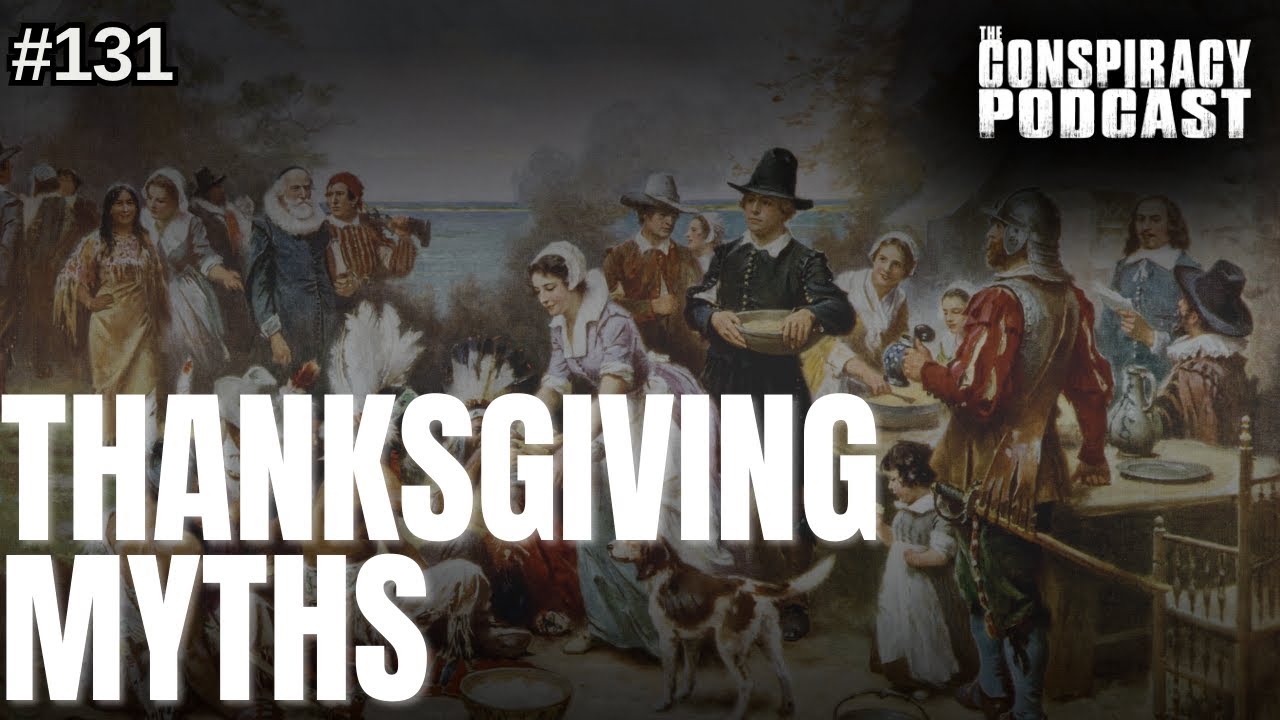
- The buckle hats and black-and-white pilgrim outfits come from Victorian-era artist drawings, not any real evidence of what they wore
Read the full transcript
Welcome back to the Conspiracy Podcast once again. You’re here with us, the place you need to be, because the normal grind of life sucks without us. So welcome to Thanksgiving week. Today is not actually Thanksgiving week, but when you listen, it will be Thanksgiving week and you’ll be winding up your job. It’ll be Tuesday, and you’re like, is it Wednesday afternoon yet? Time to get some turkeys.
Except for our 15% that are not in America, and they’re like, what’s happening? I’m at work. Where’s the episode? I wonder what non-Americans think of Thanksgiving. They probably don’t think anything. It’s just dinner week. Most countries have their own version of something like Independence Day, where it’s some other thing that to us is nothing. We don’t even know what happened. Halloween is pretty worldwide now, though. I didn’t really realize that, but it’s way more everywhere. I don’t think it’s as psycho as it is here.
This is going to be not as long as a normal episode because this is about the myths of Thanksgiving, since it is Thanksgiving week. So buckle up, pilgrims. Thanksgiving as we celebrate it today, warm kitchens, football humming in the backyard, a nation pausing for gratitude, it feels ancient, sacred, and timeless. But like many traditions polished smooth by centuries, the roots of Thanksgiving grow in a different soil. Behind the postcard version lies a tangle of myths and legends and misremembered tales.
That’s what we’re going to talk about tonight. Misremembered tales, political maneuvering, and a little bit of conspiracies that people still whisper about today. It’s like history’s written by the victors. Thanksgiving, we were vibing, we all loved each other, one big family. Had a big picnic table. To understand the holiday, we need to peel back the layers, starting long before the pilgrims even spotted the rocky shores of New England.
Today, if you open a textbook, the story begins neatly in 1621. Pilgrims with their buckled hats and a harmonious feast with the Wampanoag. I say it wrong every time. In reality, our first Thanksgiving narrative is a modern invention shaped centuries after the pilgrims arrived. And here’s the wild part. There’s only one surviving eyewitness reference to 1621. So everything Thanksgiving is based on is on one dude. One witness. It’s not even a detailed description. It’s just a short note by Edward Winslow mentioning a three-day gathering that included some hunting and some eating with 90 Indians.
So this is them like, we’re cool, let’s chill, meanwhile they’re like, get the muskets, boys. There were no tables full of turkey, no cranberry sauce, no pumpkin pie anywhere, no green bean casserole with the crispy onions. No cowboys on the screen. There was not even the word Thanksgiving. A conspiracy? Well, maybe not at first, but over the next 200 years, as America struggled to define itself, politicians and writers collectively constructed something called Thanksgiving.
This myth wasn’t accidental. It was curated, and this is where the conspiracy takes place. Many believe the US government and later state education boards intentionally whitewashed colonial conflict and turned this simple harvest into a national origin story designed to unify the citizens of America. The idea of this conspiracy was to present a peaceful collaboration between settlers and Indians. Like, see, we came in, we were super nice, and they slowly died out because of disease, not because of us restricting their lands and manifest destiny and taking it.
This is called the Thanksgiving myth conspiracy, and it claims that the entire holiday is essentially propaganda. It’s hard to prove if it was coordinated or not, though. Of course, that’s where conspiracies are birthed. It’s the conspiring, the plotting to do a thing. But the fact remains, almost everything taught in school about the first feast of Thanksgiving is a romantic reconstruction.
We’re going to take this a little different. We’re going to take all the myths and go over them. We’re not going to tell the whole full story, because everyone has got an idea of the full story. Very basic story: pilgrims, colonialists, settlers came over and they were having extremely difficult winters and they couldn’t actually be self-sustained. Imagine living in New Hampshire in the winter and all you have is frozen wood. You’re living in a hut.
And shout out Uganda, baby. We’re top ten podcasts in Uganda. In Uganda, you’re killing the game. I don’t know how they even get us. Anyway, what had happened in this story was that the local Indian tribe came and provided food for a big feast and helped essentially save the pilgrims and settlers through the winter by helping them and teaching them to grow corn. So it was the basis for the story of Thanksgiving, where you’re helping your neighbors and helping mankind. Like a 1600s Disney movie with a happy ending. And today it is to bring together your family and friends and have a feast.
So after the Thanksgiving occurred, or at least per the story, we fast forward to the Civil War. You fast forward to 1863, and this is the darkest days of the Civil War, right in the heart of it. It’s here that Thanksgiving leapt from just a story to a full-scale national holiday. This is like, we got to unite the country, boys, the country’s ripped in half. What’s interesting is this is 200 years later, a long time before it became anything.
It’s here that Thanksgiving leapt from scattered regional harvest feasts to an actual national holiday. But this is also where the conspiracy really sharpens. Abraham Lincoln declared the last Thursday of November as a national holiday of Thanksgiving, and it was at the urging of writer Sarah Hale. But many believe there was another motive behind the moral language, which was a psychological unification. The theory claims that Lincoln needed a symbolic holiday to create a sense of shared identity with the Union.
It makes sense. It’s not a bad idea. And this is one of the first conspiracies that are good. He’s like, what do we have in the docket? Okay, alien invasion, nobody buys that. Thanksgiving, ooh, we’re on to something here, boys. But per the definition of conspiracy, it’s a crime, because it’s a lie. So maybe it’s more misremembered. I think it’s personally a crime to intentionally lie to the American people. You just converted it into a conspiracy. I can pretty much make anything a conspiracy at this point.
Some say that he saw Thanksgiving as an emotional lever to keep public morale from collapsing amid the Civil War. And what a perfect guy to do it. Honest Abe, this guy wouldn’t lie to you, this guy is a standup guy. So that’s the question. Did Lincoln invent Thanksgiving to distract the war-weary North? Historian consensus says he wanted unity, yes, but a distraction maybe. Maybe to distract from the bloodlust that you still have. The homies you were on the battlefield against are still living in the South.
So the timing is either perfect or strange, because the country was literally killing each other, ripping each other apart, and he created a national holiday where you sit together and you cheers. It’s brilliant marketing. It’s actually the original marketing firm killing the game. So the next one is called the case of Franksgiving. As in Franklin Roosevelt. In 1939, President Franklin Roosevelt suddenly decided Thanksgiving would be held a week earlier. Why? Supposedly to lengthen the holiday shopping year to help with the Great Depression.
Black Friday retailers were complaining that Thanksgiving fell sometimes on November 30th and there wasn’t enough time between Thanksgiving and Christmas. So the window is a week, and now they’re like, we need three weeks, four weeks to do this. So supposedly major retail corporations pressured the White House. Roosevelt wanted to manipulate economic statistics during a re-election year. The federal government was testing public obedience by altering a cultural tradition that you have held for a hundred years.
This makes so much sense. Can you imagine them being like, yeah, Christmas isn’t on the 25th anymore, folks. We’d be like, what do you mean? I didn’t even know this. This is very new to me. So for two years, they changed it. Half the country celebrated Thanksgiving on a different day. 22 states followed Roosevelt’s date, which was a week earlier. 23 said, no, we’re going to stick to the original Thanksgiving Day. So half the entire country celebrated Thanksgiving on a different week.
And get this, there were two states that celebrated both weeks, Colorado and Texas. Classy. Actually, Thanksgiving’s every Thursday, we’re taking every Thursday, two weeks off in November. It was dubbed Franksgiving, and the conspiracy theory that the government can arbitrarily reshape your culture for financial gain was born. And they can, right? But the justifier is there. It’s to handle the economy. That’s all they have to tell you. They’re like, it’s national security. What did we say in the Federal Reserve episode? Stimulate the economy, no big deal.
Eventually, Congress stepped in and they fixed the holiday to what it is now, which is the fourth Thursday in November. This year it falls on the 27th, so it’s late. That’s what they were trying to avoid. Everybody’s pissed, economy is going to suffer. Great Depression incoming.
The next one’s called the day of mourning and the claim of historical suppression. In 1970, indigenous activists launched an annual national day of mourning on Thanksgiving. They argued the holiday glorifies colonialization and masks genocide. Within activist circles, a conspiracy theory grew that the US government deliberately suppressed media coverage of the protest to maintain the peaceful Thanksgiving myth. Well, the media suppresses everything all the time. It’s a very believable theory. I never know what’s true. That’s why I don’t watch it, I’d rather just be oblivious.
And then there’s a couple other little things that are not necessarily conspiracies, but more trivia. This is for you if you don’t know what to talk about at your Thanksgiving table. Trivia one. We are taught that pilgrims came for religious freedom. It’s technically true but not fully complete. The pilgrims already had religious freedom in the Netherlands. What they really wanted was cultural control and economic opportunity. According to conspiracy theorists, early American writers exaggerated the religious freedom angle in order to create a justification for the pilgrims as our ideal founders.
It’s like, you want the sympathy play on your side. This is a PR thing. This next one is very interesting. What do you picture when you think of the original Thanksgiving? Picnic tables, sharing corn, dressed with the hat and the black and white, the little bow tie that’s actually a real bow. That outfit is made up. That was drawings done by Victorian-era artists, and it was not based on anything real. They didn’t have the little buckle shoes. We don’t really have any evidence that’s what they wore.
We’re talking late November in New England in 1621, where they’d be wearing fur coats and trying not to die. So it’s a bit of a myth. If you actually went back, remember our time travel episode? This is right around the witch time too. And then the other myth, the idea that pilgrims and the Wampanoag formed a lasting friendship, is actually a myth. They had a fragile political alliance based on survival and military necessity. They didn’t really have a warm friendship.
Conspiracy theorists argue that textbooks transform that partnership into a moral. Like they became besties and they survived, but really, later on we displaced those exact natives. I’m not trying to be like, hey, let’s get liberal here and get reparations for everybody. I’m just trying to tell you what really happened. If you want to get upset about that, you have to get upset about the entire human culture since inception. The idea of colonialization is the human experiment. You go into other territories and you’re like, looks like we’re taking your stuff.
In every major society it’s happened, the English, the Spanish, the Romans, the French, the Babylonians, everyone. They’re all like, let’s just take it all, let’s own it. And at the time, you always make yourself out to be the good guy. Every side thinks they’re the good guy. If you’re the one losing, obviously the other guy is the bad guy. You have to convince yourself that you’re right in order to even go through with it. No one’s like, I’m a piece of garbage doing it just for blood. They’re like, this is good for my people, even though from an objective point of view it’s the worst thing that’s ever happened.
Well, that’s pretty much all I put together on Thanksgiving. I know there’s a bigger story that could be had, and maybe we’ll do it next year where we go through the full dinner, supper, and that whole thing. Maybe you guys have some extra things that we missed, send it our way and we can work it in. It was more that I wanted to put together a little thing and just wish everybody happy, because when this comes out it’s a week that we want you to be with your families and enjoy that time. And we want to enjoy that time with our families too. So that’s why it’s a light, easy, breezy episode. And then the following week, we got a good one in store for you.
On Thanksgiving, we wish you the best. Thanksgiving can be hard if you don’t have family, but it can be great. It’s kind of what you make of it. The big thing now is Friendsgiving. Friendsgiving is fantastic. Not to be confused with Franksgiving. What I do love, though, is that regardless of if any of this is true, I think it turned out to be a good thing. It became actual culture. One of the few good conspiracies.
As far as the retail thing, I don’t shop. I have not stepped foot in a store on Black Friday ever, not one time. I never did the camp outs for a flat screen. With my brothers and sister we would do 4 a.m. wake up, we’d go to Macy’s and Best Buy and try to get the free things. They’d be like, oh, you camping out, here’s a donut. At age 16, that was the move. They don’t do it like that anymore, because now it’s cool, just wake up and go online, same price, from my home.
You know what’s extremely exciting? For the first time in a while, a Barnes and Noble has opened up. I bet they figured it out finally after 25 years of Amazon reaming them. I think people are ready to go back and buy a book and drink a coffee and sit there in a cozy spot. But the thing is, if you go into a Barnes and Noble, my daughter always makes me take her, there’s a whole little kids section with toys, and the markups on these toys are insane. I’ve seen the same thing for 80% cheaper.
I really hope bookstores and retail make a comeback, where they’re like, maybe there is an experience to have in store. Maybe we should get out of the house and not clicky-clack all the time. There is an interesting thing about reading a physical book, something more tangibly involved. I’m an audiobook listener, but I used to read physical books, and there’s something about that turn of the page where you get to the chapter and you’re like, do I continue or do I stop.
How do you say happy Thanksgiving in Spanish? Feliz Thanksgiving. Gracias. The day of being thankful. Did you guys traditionally do a big Thanksgiving growing up? Yeah, not now, but back then. Did you guys do the what are you thankful for thing? My mom likes to do that, and me and my dad are like, this food’s great, I love it, pass. My favorite, though, is me and my dad used to deep fry the turkey. It’s so good. There’s something about it.
I think it’s nice to just chill, watch football, and day drink a little. We go to my wife’s family, there’s like a million of them, and the girls handle everything and me and the boys are outside. The only thing that’s shitty around here in Florida is it’s never really that cold. I’ll be going up to Atlanta. I love that you have stories, because that’s our culture, these things. You create the traditions with your kids and then it’s a generational thing.
I grew up with a lot of brothers, and we would do Turkey Bowl. Thursday morning, you get out there, and it was cold. Where I was from it wasn’t winter cold, but it was like 50 degrees and a mud bowl, and we’re semi out of shape but in shape a little bit, and it’s touch. In Ohio we would get lucky and it’d be snowing and we’d do it in the snow, wearing huge puffy coats so it’s full tackle. That’s what I love. I actually really love Thanksgiving.
From us to you guys, happy Thanksgiving, we hope you have a great one. We’ve been working on a little teaser for the next one. The following Tuesday will be the first part of Pearl Harbor, December 7th, 1941. We’re super excited about it because it’s one of the big ones, one of the pillars of Mount Rushmore. That’ll be next Tuesday after this, and it’s going to be a two-parter. So we’ll catch you next time. Happy Thanksgiving, guys. Nighty night.