1993 World Trade Center Bombing: Facts, Timeline and Victims
On February 26, 1993, a truck bomb built by Ramzi Yousef exploded in the World Trade Center’s underground parking garage, killing six people and injuring more than a thousand. Yousef told investigators he hoped to topple the North Tower into the South Tower and kill up to 250,000 people. He failed for lack of money, not intent.
By the Conspiracy Podcast team | Last updated: September 2026
Most people know the World Trade Center only from September 11, 2001. Eight years earlier, the same complex survived a bomb built to bring both towers down at lunchtime. The case ended in one of the most complete convictions in American terrorism history, yet an FBI informant, a discredited Iraq theory, and one still missing conspirator keep the story open.
What happened in the 1993 World Trade Center bombing?
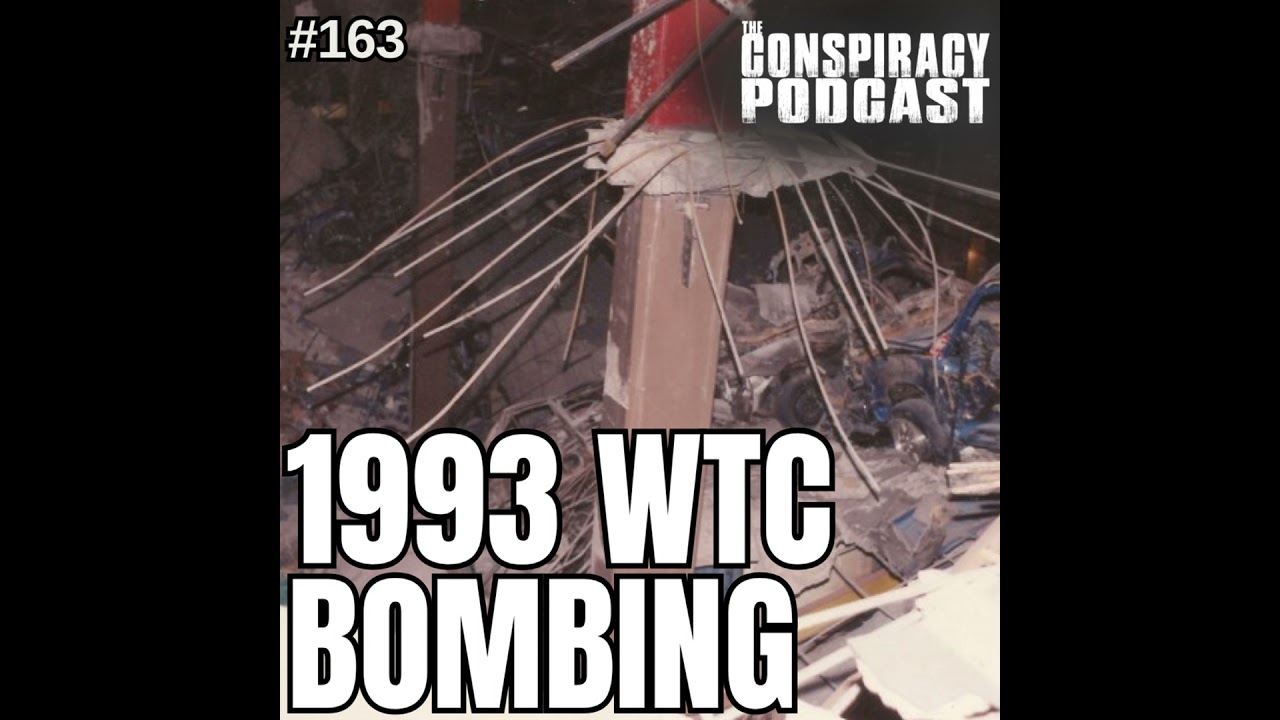
At 12:18 p.m. on February 26, 1993, a Ford Econoline van packed with a homemade bomb detonated on level B2 of the World Trade Center’s parking garage. The blast tore through four sub levels, knocked out power to both towers, and sent smoke as high as the 93rd floor, forcing roughly 50,000 people to evacuate down dark stairwells.
The bomb, urea nitrate boosted with compressed hydrogen gas, delivered somewhere north of half a ton of explosive force, parked as close as the conspirators could manage to a support column beneath the North Tower. It cratered four levels of concrete, cut the main electrical feed to both towers, and killed emergency lighting throughout the complex. With stairwells never built to stay smoke tight, tens of thousands made their way down in near total darkness, some for more than five hours.
One detail rarely makes short retellings. At sentencing, the judge stated on the record that the device also held sodium cyanide meant to vaporize into the North Tower’s ventilation system. Senior FBI officials who worked the case have since said no forensic evidence of cyanide was actually recovered, so the claim stays disputed. The hosts walk through that disputed chemistry in the full episode on the 1993 bombing.
Who bombed the World Trade Center in 1993?
The bombing was engineered by Ramzi Yousef, a Kuwaiti born engineer trained at a militant camp on the Afghanistan Pakistan border. He recruited a small group, including Mahmud Abouhalima, Nidal Ayyad, Eyad Ismoil, and Mohammed Salameh, who rented the bomb van under a false name. All four were arrested, tried, and convicted alongside Yousef.
Yousef arrived at JFK Airport on September 1, 1992, claimed political asylum at the gate, and was released pending a hearing he never attended. He told investigators his motive was retaliation for American support of Israel, not religious ideology. Within five months he had a cell in place: a cab driver who handled logistics, an engineer who ordered the compressed hydrogen gas, an old classmate who drove the van, and Salameh, whose rental deposit unraveled the plot inside a week.
Ayyad was identified through DNA on an envelope he licked, mailed to The New York Times with a letter claiming responsibility. A sixth man, Abdul Rahman Yasin, was indicted after investigators said he helped mix the chemicals, but he was never tried. The FBI released him after he cooperated, and he flew to Iraq the next day. He remains at large and unconvicted; his whereabouts have been unknown since around 2003.
How many people died in the 1993 World Trade Center bombing?
Six people were killed and more than a thousand injured, mostly from smoke inhalation, in what was then the largest building evacuation in American history. The dead were John DiGiovanni, Robert Kirkpatrick, Stephen Knapp, William Macko, Wilfredo Mercado, and Monica Rodriguez Smith, who was seven months pregnant.
DiGiovanni, 45, was parking his car when the bomb went off. Kirkpatrick, 61, Knapp, 47, and Macko, 57, were maintenance supervisors eating lunch in the sub basement. Mercado, 37, worked receiving for the Windows on the World restaurant and was checking in a delivery. Rodriguez Smith, 35, had an office on the B2 level, and she and her unborn child both died in the blast. All six deaths were caused directly by the explosion, not the evacuation that followed.
Given the size of the device and the crowds that day, officials have called it close to a miracle the toll was not far higher. NYPD helicopters airlifted dozens of people from the roof, including eight disabled workers trapped for nine hours, a rescue option sealed off for security reasons before it could be used again.
What was the bomber’s original plan for the World Trade Center bombing?
Ramzi Yousef told investigators he positioned the van hoping the blast would topple the North Tower into the South Tower, collapsing both buildings at lunchtime and killing as many as 250,000 people. An FBI explosives expert later said roughly 500 more pounds of material, or a position closer to the support columns, might have brought the tower down.
The plan failed for a mundane reason: money. Yousef’s cell lacked funds for a device large enough to bring down a 110 story tower, so their half ton bomb fell far short of a full collapse. He also appears to have considered adding sodium cyanide, which a judge later said could have entered the tower’s ventilation system had it vaporized, though FBI officials disputed that any was recovered.
When agents flew Yousef over Manhattan after his 1995 capture and lifted his blindfold to show him the still standing Twin Towers, he replied that they would not still be standing if he had enough money and explosives. At sentencing he told the courtroom, unprompted, that he was a terrorist and proud of it. Both statements are why investigators treat his original intent as settled, even though the outcome fell short of it.
Beyond the confirmed facts, three loose threads still get argued today, and the record treats each of them differently.
| Theory | What the record shows |
|---|---|
| Iraqi intelligence operative. A theory that Yousef was an Iraqi agent using a stolen identity, working for Saddam Hussein’s government. | Fingerprint evidence ties Yousef conclusively to the identity he used from the start. The theory has been reviewed and is not supported. |
| The FBI let it happen. An informant’s secret tapes describe agents discussing a sting that would swap in a fake bomb before a supervisor called it off. | The New York Times reviewed the tapes and found they do not clearly show agents knew a specific date, only that a cell wanted to build a bomb. |
| Chemical weapon upgrade. A federal judge stated in open court that the device held sodium cyanide meant to vaporize into the tower’s air system. | Senior FBI officials on the case say no forensic evidence of cyanide was ever recovered from the scene. |
None of these threads changes the confirmed outcome: six people dead and a chain of arrests inside one week. They explain why the case still gets picked apart online. Our deep dive into episode 163 walks through each question in the order investigators actually resolved it.
And being that it’s six, I do want to say their names because true crime storytelling has a way of making the perpetrator the star and the victims a footnote.
the guys, on the record
How was Ramzi Yousef caught?
Investigators traced a mangled piece of the van’s rear axle, still stamped with a readable VIN, to a Ryder rental location in Jersey City, which led to Mohammed Salameh’s arrest within a week. Yousef fled to Pakistan within hours of the bombing and stayed free for two years before being captured in Islamabad on February 7, 1995.
Salameh had rented the van under a false name and put down a 400 dollar cash deposit. Days later he went back to recover that deposit and was arrested on the spot by an undercover agent posing as a Ryder employee. One law enforcement veteran said that kind of sloppiness would not even happen inside the mob. The arrest let agents roll up the rest of the New York cell within days.
Yousef was found in room 16 of an Islamabad guest house after an associate turned him in for a State Department reward that eventually paid two million dollars. Agents found chemical burns on his fingers from an attempt to destroy his fingerprints, plus bomb making components and airline schedules hidden inside children’s toys. He was convicted and sentenced to life plus 240 years, and remains incarcerated at the federal supermax prison in Florence, Colorado.
Was the 1993 bombing a warning sign for 9/11?
Yes, in ways investigators only connected later. The 9/11 Commission found that Yousef’s uncle, Khalid Sheikh Mohammed, wired 660 dollars to one of the 1993 conspirators, and he went on to become the man the Commission calls the mastermind of the September 11 attacks. The FBI itself has described the 1993 bombing as a dress rehearsal for what came next.
In 1993, Khalid Sheikh Mohammed was a minor financier on the margins of his nephew’s plot, sending a few hundred dollars from Qatar. The two later worked together in the Philippines on plans far more ambitious than a truck bomb, groundwork that fed directly into the September 11 attacks. The dollar figure was small, but the family and operational link between the two bombings is documented in the Commission’s own final report.
The attack also changed how the towers prepared for the next one. The Port Authority added photoluminescent paint to stairwell handrails, installed battery backed emergency lighting, and made evacuation drills routine, changes later credited with saving lives on September 11. In a grim irony, the roof access that let helicopters rescue people in 1993 was sealed afterward for security and was unavailable in 2001. Readers who like foreshadowed disasters can browse our roundup of famous conspiracy theories for more.