
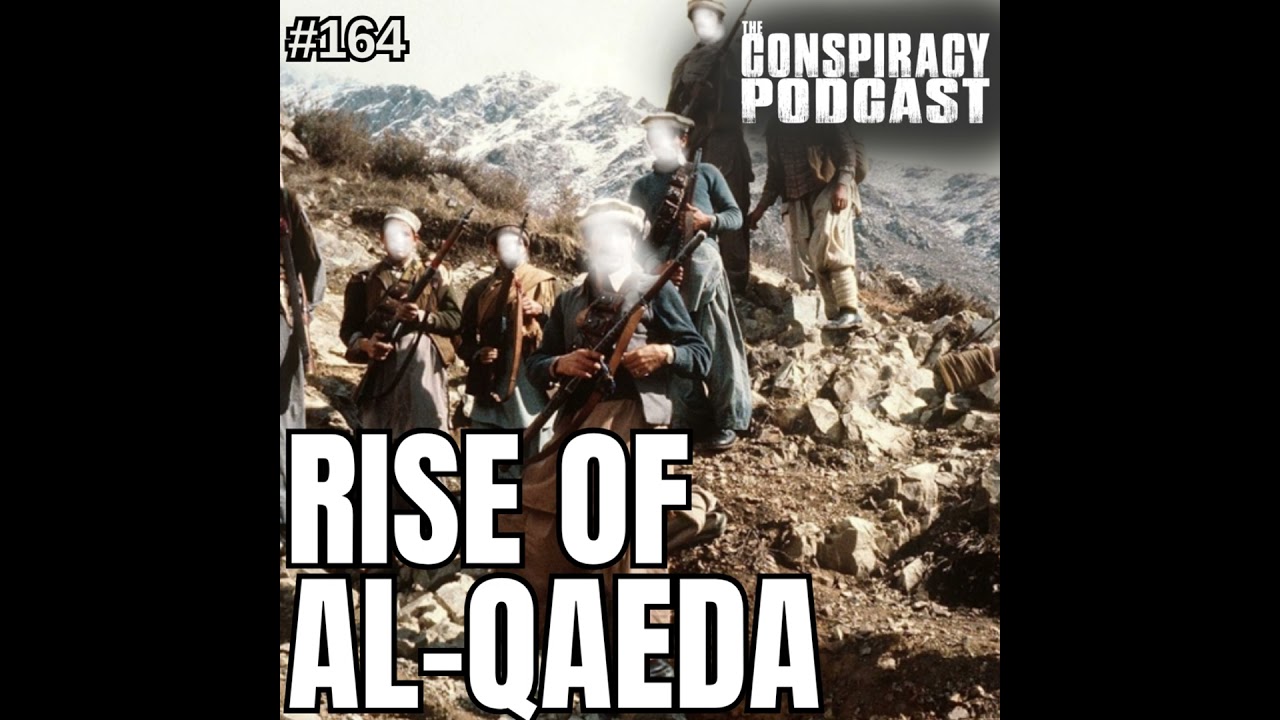
How Did Al-Qaeda Rise? From the Soviet-Afghan War to 9/11
Al-Qaeda rose out of the Soviet-Afghan War, when a network built by Osama bin Laden and mentor Abdullah Azzam formally organized on September 10, 1988, with a founding roster of just fifteen men. Over the next thirteen years, it grew into the organization behind September 11.
By the Conspiracy Podcast team | Last updated: September 2026
Most people meet Al-Qaeda already fully formed, as the villain behind September 11. But it has an origin story with real dates and names, one that the full episode on the rise of Al-Qaeda walks through step by step, starting nearly a decade before anyone had heard the word.
How did Al-Qaeda rise to power?
Al-Qaeda rose out of a recruitment network built during the Soviet-Afghan War, formally organizing on September 10, 1988 with fifteen founding members. Over the next decade it built training camps, declared war on the United States, bombed two embassies and a Navy destroyer, then finished planning September 11.
The chain starts on December 24, 1979, when the Soviet Union invaded Afghanistan to prop up a struggling communist government. Across the Muslim world it read as an atheist superpower rolling into a Muslim country, and thousands of young Arab men, later called the Afghan Arabs, traveled to the Afghan-Pakistan border to join the Mujahideen resistance. In 1984, Azzam and bin Laden founded Maktab al-Khidamat in Peshawar to recruit, train and fund volunteers, eventually running roughly thirty offices across the United States, including a mosque in Brooklyn.
By 1988 the Soviets were withdrawing, and bin Laden’s circle organized what it had built into Al-Qaeda, with handwritten minutes later seized in Bosnia recording a start date of September 10, 1988. Bin Laden issued a declaration of war in 1996 and a fatwa in 1998, the same year Al-Qaeda bombed two US embassies. Two years later it struck the USS Cole, while a separate cell already trained at Florida flight schools for what became September 11.
What does the name “Al-Qaeda” actually mean?
Al-Qaeda translates to the base. It referred literally to the training camps and safe houses bin Laden ran in Afghanistan, and just as literally to a database, the actual list of fighters he had kept since the Soviet-Afghan war. Members swore a formal oath of loyalty to join.
The word carries specific history inside the movement. Mujahideen, the term for the Afghan resistance fighters, comes from an Arabic word meaning those who struggle, tied to jihad, which literally means struggle but carries a narrower meaning of holy war in armed conflict. Founding documents seized in Bosnia describe the group in near mission statement language: Al-Qaeda is an organized Islamic faction whose goal is to lift the word of God.
The name works on two levels at once. It is the physical base, the training camps and safe houses through Afghanistan and Pakistan. It is also the database, the actual list of fighters bin Laden had compiled since the earliest days of the war. Joining required a personal referral from someone already inside, total commitment, and a formal oath of loyalty called bay’ah, sworn directly to the leadership.
Who founded Al-Qaeda?
Al-Qaeda was founded by Osama bin Laden and his mentor, Islamic scholar Abdullah Azzam, who built a Peshawar based recruitment network during the Soviet-Afghan war and formally organized it in 1988. Egyptian surgeon Ayman al-Zawahiri joined the inner circle soon after and pushed the group toward a global mission.
Abdullah Azzam, whose name means servant of God, was born in 1941 in British controlled Palestine and earned a doctorate in Islamic law from Cairo’s Al-Azhar University. His slogan, jihad and the rifle alone, no negotiations, no dialogue, made him a name in religious circles before the Soviet invasion. His student, Osama bin Laden, was born in 1957 in Saudi Arabia, one of dozens of children of a construction magnate tied closely to the Saudi royal family.
In 1984, Azzam and bin Laden founded Maktab al-Khidamat in Peshawar to recruit, house and fund Arab volunteers. By 1988, that circle organized what it had built into Al-Qaeda, a roster of fifteen founding members bound by an oath of loyalty. Around this time Ayman al-Zawahiri, an Egyptian surgeon radicalized as a teenager and imprisoned after the 1981 assassination of President Anwar Sadat, became a fixture at bin Laden’s side, arguing the fight had to go global.
Did the United States fund the fighters who later became Al-Qaeda?
Documented US money flowed through Pakistan and Saudi Arabia to the Afghan resistance in the 1980s because Washington wanted the Soviets bogged down. That funding supported the broader Mujahideen movement, not Al-Qaeda directly. Al-Qaeda did not exist as an organization until 1988, near the end of that war.
This is well documented history, often called the CIA’s Operation Cyclone. For a few years in the 1980s, the United States and the future founders of Al-Qaeda were pulling in the same direction: Washington wanted to bleed the Soviet Union in Afghanistan, and it funneled money, weapons and training through Pakistani and Saudi intermediaries. That does not make them allies, just briefly aligned by the same enemy of my enemy logic behind many Cold War proxy conflicts.
The distinction matters. The money went to the broader anti-Soviet resistance, coordinated through Pakistani intelligence, years before Al-Qaeda existed. Azzam and bin Laden’s own network, Maktab al-Khidamat, ran largely on private Gulf donations and bin Laden’s own wealth, not direct US funding. The accurate description is that the United States funded the Afghan resistance some future Al-Qaeda members fought within, not that it created or funded Al-Qaeda itself.
Here is how four common claims about this era hold up against the record.
| Theory | What the record shows |
|---|---|
| The CIA created Al-Qaeda. Shorthand for the fact that US money reached the Afghan resistance. | Funding went to the broader Mujahideen movement. Azzam and bin Laden’s own circle organized Al-Qaeda in 1988, not the CIA. |
| Bin Laden ordered Azzam’s assassination. Azzam died in a 1989 car bombing. | The bombing is unsolved and unclaimed. Suspects range from rival intelligence services to figures in bin Laden’s own circle. |
| The FBI let the plot happen on purpose. Investigators had documented leads before September 11. | Review found at least five missed threads, but concluded negligence and bureaucratic failure, not proven complicity. |
| The Las Vegas meetups were a planning summit. Several hijackers made unexplained trips there in 2001. | The 9/11 Commission confirmed the trips but found no credible evidence explaining why the men went. |
It almost feels like this entire series that we’re doing is going to be the question of negligence. How much did they know?
the guys, on the record
What is Khalid Sheikh Mohammed’s connection to Al-Qaeda?
Khalid Sheikh Mohammed is the uncle of Ramzi Yousef, convicted for the 1993 World Trade Center bombing. KSM joined Al-Qaeda in 1998 and brought bin Laden the idea that became September 11. He has been charged as a co-defendant in the September 11 case before the military commission at Guantanamo Bay, and has not been convicted; that case remains unresolved.
The connection starts small. In 1993, after Ramzi Yousef’s truck bomb failed to topple the World Trade Center, he named one more contact: an uncle who had wired 660 dollars to help fund the plot, then stepped back into the shadows. Yousef was captured in Pakistan in February 1995, but KSM and his nephew had already been sketching something larger in the Philippines, a plan called Bojinka to blow up a dozen airliners over the Pacific and assassinate the Pope during a visit to Manila.
The Bojinka plot fell apart almost by accident in January 1995, when a chemical fire broke out in the Manila apartment where the plotters mixed explosives, leaving behind a laptop full of the plan. With that plan dead, KSM formally joined Al-Qaeda in 1998 and brought bin Laden a version of the airliner idea that became September 11. He was later charged as a co-defendant in that case before the military commission at Guantanamo Bay, where it remains unresolved.
When did Al-Qaeda formally declare war on the United States?
Al-Qaeda’s declaration came in two stages. In August 1996, bin Laden faxed a declaration of war against Americans occupying Saudi Arabia to a London newspaper. On February 23, 1998, standing with Ayman al-Zawahiri, he issued a fatwa declaring that killing Americans, civilian or military, was a duty for every Muslim able to do it.
The declarations trace to a personal grievance. After Iraq invaded Kuwait in 1990, bin Laden offered to defend Saudi Arabia with his own Arab veterans. The Saudi royal family refused and instead invited roughly half a million American troops onto Saudi soil, which bin Laden considered the central betrayal of his life. He left for Sudan in 1991, was stripped of his Saudi citizenship in 1994, and was expelled in 1996, returning to Afghanistan under the newly ascendant Taliban. The hosts trace that whole arc in their episode on Al-Qaeda’s founding years.
The 1996 fax targeted US troops in Saudi Arabia. The 1998 fatwa went further: bin Laden declared killing American civilians, not just soldiers, a duty for any Muslim able to do it. Six months later, Al-Qaeda bombed two US embassies in East Africa, killing 224 people and drawing cruise missile strikes and a formal US indictment. Our roundup of famous conspiracy theories covers more of the unresolved threads from this era.