Why Do People Believe the Earth Is Flat?
Why Do People Believe the Earth Is Flat?
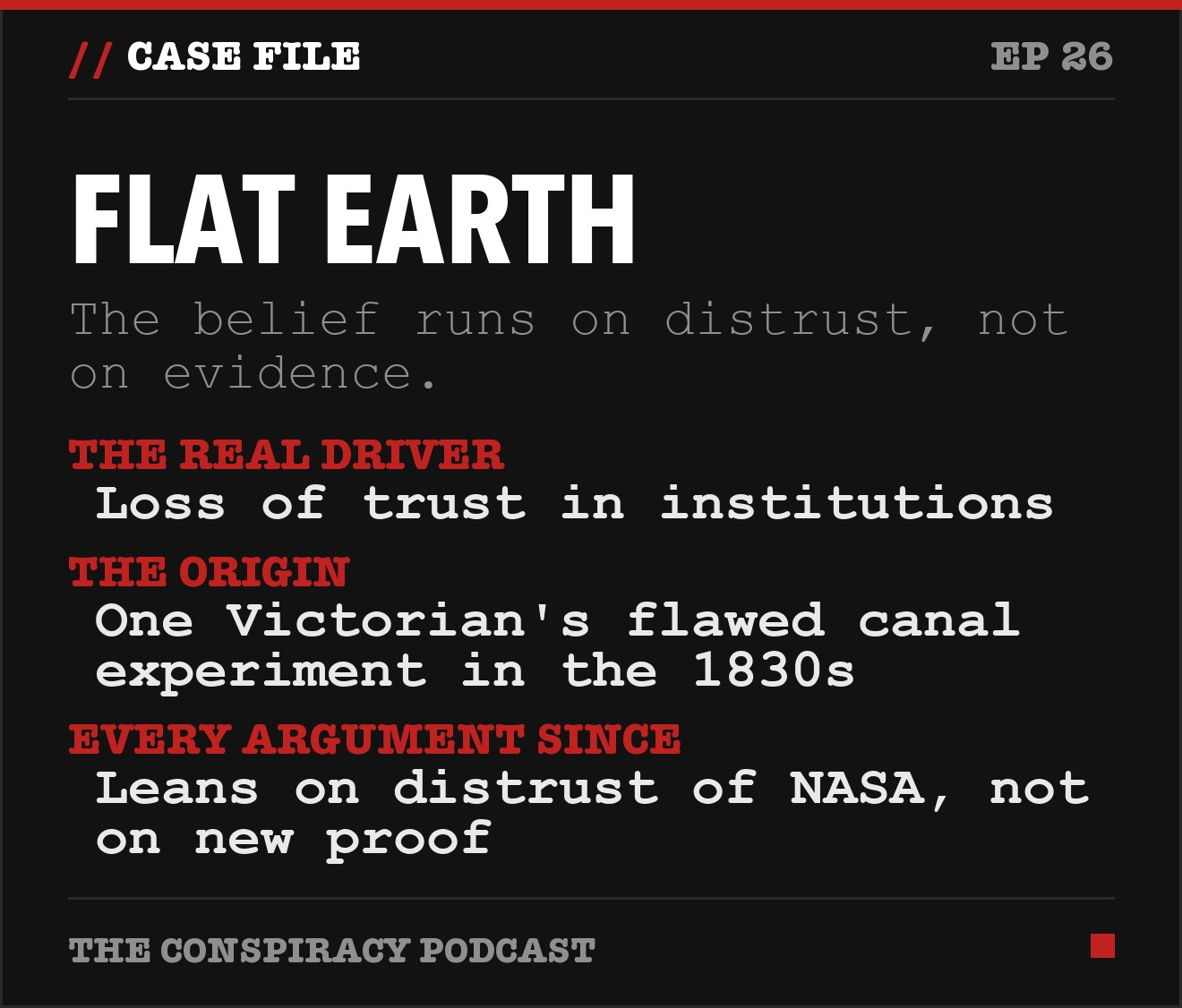
People believe the Earth is flat mostly because they no longer trust the institutions that tell them otherwise, not the evidence itself. The modern movement traces to one Victorian experimenter’s flawed canal test in the 1830s, and every argument since leans on distrust of NASA and expert consensus rather than new proof.
By the Conspiracy Podcast team | Last updated: August 2026
The Earth is round, settled since antiquity and confirmed again by circumnavigation and basic physics, yet a real community insists otherwise. The podcast’s two-part investigation found the belief rests less on evidence and more on community and distrust of authority.
Why do people believe the Earth is flat?
Belief in a flat Earth is driven less by physics and more by distrust of institutions and media, plus the community the movement offers. The hosts found three groups among believers: religious conviction, suspicion of hidden elites, and a preference for personal experience over expert claims.
Episode 27 splits the movement into three overlapping factions, drawn from talks at a 2018 UK Flat Earth convention. The first is faith-based, arguing that a round Earth and the Big Bang are tools atheists use to make God feel abstract, so a flat, designed plane restores a literal reading of scripture. The second treats a flat Earth as part of a larger cover-up, where a small group of elites hides the truth to keep control over ordinary people, the same instinct that fuels other conspiracy theories. The third, which the hosts say they understand best even while rejecting its conclusion, trusts personal experience over books or credentialed experts.
The hosts keep circling back to one problem: nobody can explain what any government would actually gain from faking a spherical Earth. There is no clear benefit, no version of control a round Earth grants that a flat one would not. What does hold up is the social pull. Believers describe losing friends and romantic partners once they went public, which deepens the bond within the community that remains, and conference interviews tend to dwell on belonging rather than the actual geometry. Some of the most committed believers, the hosts note, do not even trust each other, suspecting fellow flat earthers of secretly being part of the cover-up too.
Where did the modern flat Earth movement come from?
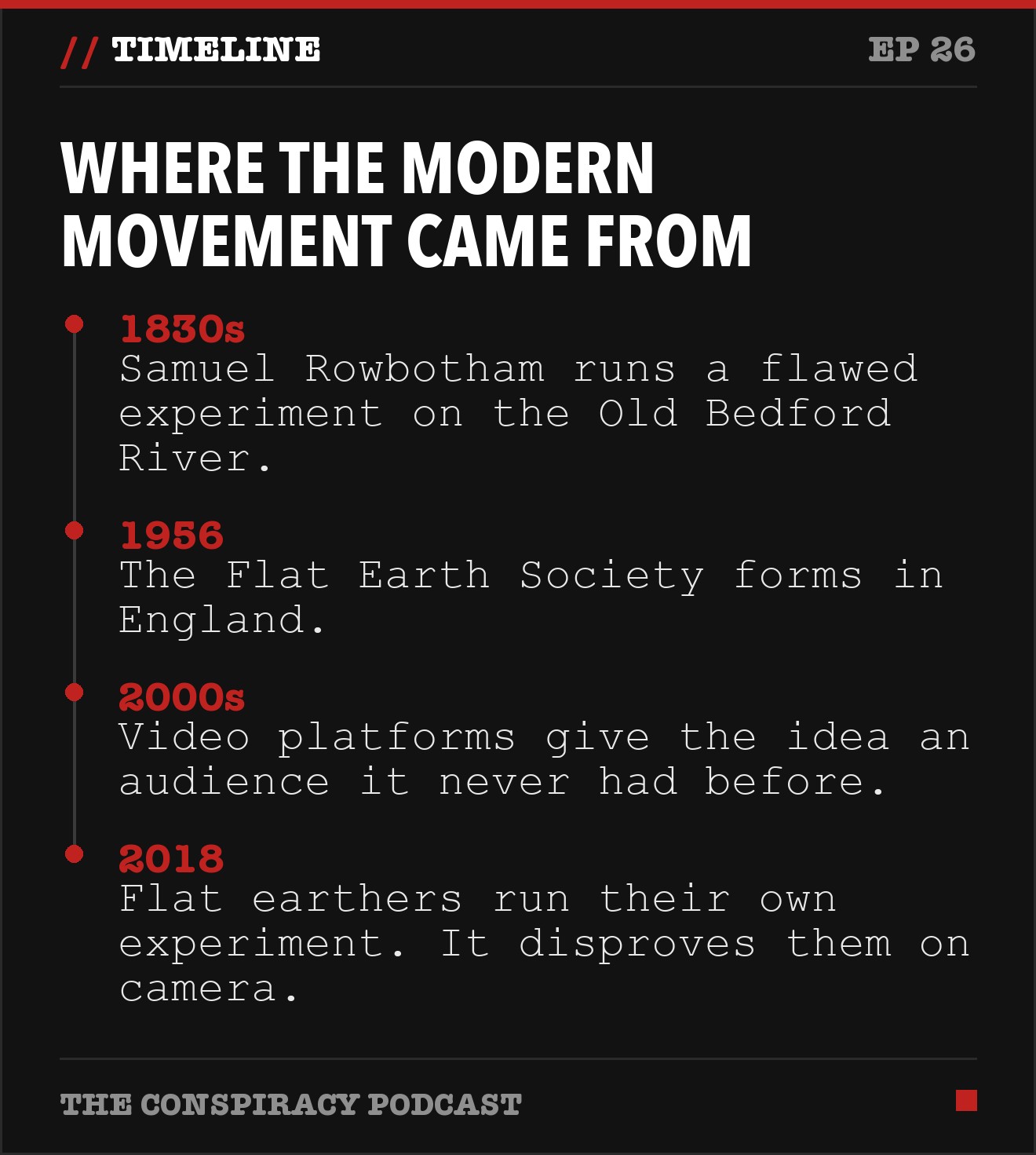
The modern movement began with Samuel Rowbotham, a Victorian Englishman who in 1838 ran a flawed sight-line test along a six-mile stretch of England’s Old Bedford River and concluded the Earth was flat. His book outlived him, and by the 2010s YouTube creator Mark Sargent became the movement’s best-known modern face.
Rowbotham published his theory under the pseudonym Parallax, first as an 1849 pamphlet and later as the book Zetetic Astronomy: Earth Not a Globe, modeling a flat disc with the North Pole at the center, a wall of ice at the rim, and the sun only a few thousand miles overhead. He built that model on the Old Bedford River test, watching a boat carry a flagged pole six miles down a straight canal and reporting, through a telescope, that the flag never dropped from view. The Flat Earth origins episode explains in more detail why that result does not hold up under scrutiny.
The episode does not flatter Rowbotham. Under a second alias, Dr. Samuel Birley, he sold unproven cures, and one of his own children died after he mishandled a household poison, a case a coroner’s court also labeled death by misadventure. His Universal Zetetic Society kept the idea alive after he died and was later reorganized as the Flat Earth Society in 1956, then went largely dormant for decades. The movement’s modern face is different: Mark Sargent, who in 2015 began a YouTube series called Flat Earth Clues, arguing that NASA fakes its imagery and that missing non-stop southern flights point to a cover-up.
What is the ice wall theory?
The ice wall theory holds that Antarctica is not a continent but a ring of ice bounding a flat, disc-shaped Earth, sealed under a solid dome that keeps the oceans from spilling off the side. Believers say governments guard the wall to stop anyone from crossing it.
In Rowbotham’s original model, the North Pole sits at the disc’s center and Antarctica is stretched around the entire rim as an ice barrier rather than a continent at the bottom of a globe. The hosts note the obvious tension in that idea: people have traveled to and across Antarctica for over a century, yet nobody has ever reported reaching an edge where the ice gives way to a drop. Believers respond that explorers who could verify a true wall are kept from going far enough, and that the cold, mapped areas already reached are simply part of the ice sheet, not the actual boundary itself.
The ice wall theory strains against itself the closer you look. If the sun sits only a few hundred to a few thousand miles above a flat disc, the hosts ask why the heat never melts the ice wall it supposedly hangs above. The sun is actually about 93 million miles from Earth, not a few hundred. Mark Sargent’s version updates the picture into a sealed dome, closer to a terrarium with a heat lamp than an open sky. No expedition, flight, or research station has ever produced a boundary consistent with either version, despite decades of people looking for one.
Did Christopher Columbus prove the Earth was round?
No. Educated Europeans and the Spanish crown already knew the Earth was a sphere; Greek scholars had established that by roughly the 5th century BC. Columbus miscalculated the planet’s size and reached the Americas trying to sail west to Asia. The Columbus flat-Earth myth comes largely from Washington Irving’s 1828 biography.
The episode is direct: the idea that medieval Europeans thought the Earth was flat and that Columbus proved them wrong is simply wrong. As the hosts note, citing historian Jeffrey Russell, no educated person in the history of Western civilization from the 3rd century BC onward believed the Earth was flat. Greek philosophers proposed a spherical Earth by around the 5th century BC, and observation had firmly established it by roughly 600 BC. Columbus’s actual dispute with Ferdinand II’s court was about distance, not shape, since he underestimated the Earth’s circumference and believed Asia was only a short sail west.
The myth traces to a specific, named source. Washington Irving, already famous for Rip Van Winkle and The Legend of Sleepy Hollow, published a biography of Columbus in 1828 claiming Spanish geographers refused to believe the Earth was round and accused him of heresy, a scene not supported by the historical record Irving was working from. The book became a bestseller, and later writers repeated the invented scene until it hardened into the version most people learned in school.
What happened when flat earthers tested their own theory?
More than once, believers ran their own experiments to prove a flat Earth and got the opposite result. A ring laser gyroscope detected the Earth’s rotation, and a laser test featured in the documentary Behind the Curve showed measurable curvature. Both results were explained away rather than accepted.
Episode 27 walks through two documented attempts. A YouTube group called Globe Busters set up a ring laser gyroscope, sensitive enough to register the Earth’s motion, expecting it to confirm the Earth was stationary. Instead it recorded a rotation of about 15 degrees per hour, consistent with a sphere turning once every 24 hours. The group dismissed the device as corrupted rather than accept the reading. A separate group tried to prove a stretch of water was perfectly flat using a laser beam across three vertical posts. The beam would not stay level; the water’s surface was measurably bent over the distance tested.
Both tests appear in Behind the Curve, the 2018 documentary that followed prominent flat earthers for a year, and the hosts call it the fairest evidence in the whole debate, since it was flat earthers testing their own claim in good faith and getting a result that argued against it. What stands out to the hosts is not that the experiments failed, but the pattern afterward: every time a test pointed to a round Earth, the explanation offered was a broken instrument or a flawed setup rather than a wrong premise, a pattern the hosts walk through in more detail in our full breakdown of the Flat Earth believers.
The two tests are not the only claims in circulation. Here is how the rest line up against the record:
| Theory | What the record shows |
|---|---|
| The ice wall and dome. A ring of ice seals a flat disc under an indestructible dome. | No expedition or satellite has ever found an edge. Antarctica has been mapped for over a century. |
| NASA fakes its Earth photos. Real astronauts never pan a camera in a full circle. | A sphere cannot be captured whole in one frame from a fixed point, which is why full-globe images are composited, not faked. |
| Missing southern flights prove a cover-up. Layovers are framed as forced detours. | Airlines route by demand and aircraft range. Flight times match a globe. |
| The canal test showed no curvature. Rowbotham said a flag stayed visible for six miles. | Explained by refraction and his own uncontrolled elevation. Nobody has replicated the result. |
Each of these claims traces back to a test that failed and then got explained away, not accepted.
They’re constantly proving themselves wrong and they’re like, it was a mistake, the book’s wrong, the laser’s broken.
the guys, on the record
That pattern, a test that fails and gets waved off as a mistake, shows up across plenty of theories. See our roundup of famous conspiracy theories for more.