What Really Happened to Bruce Lee?
What Really Happened to Bruce Lee?
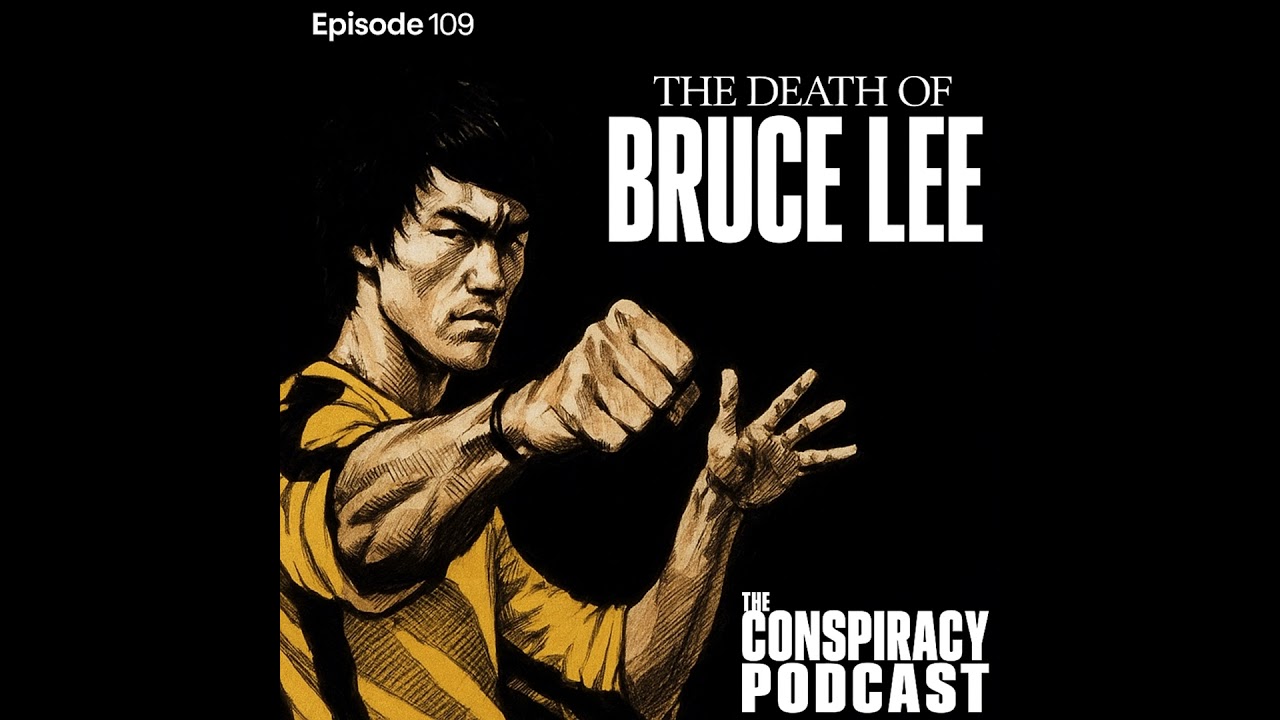
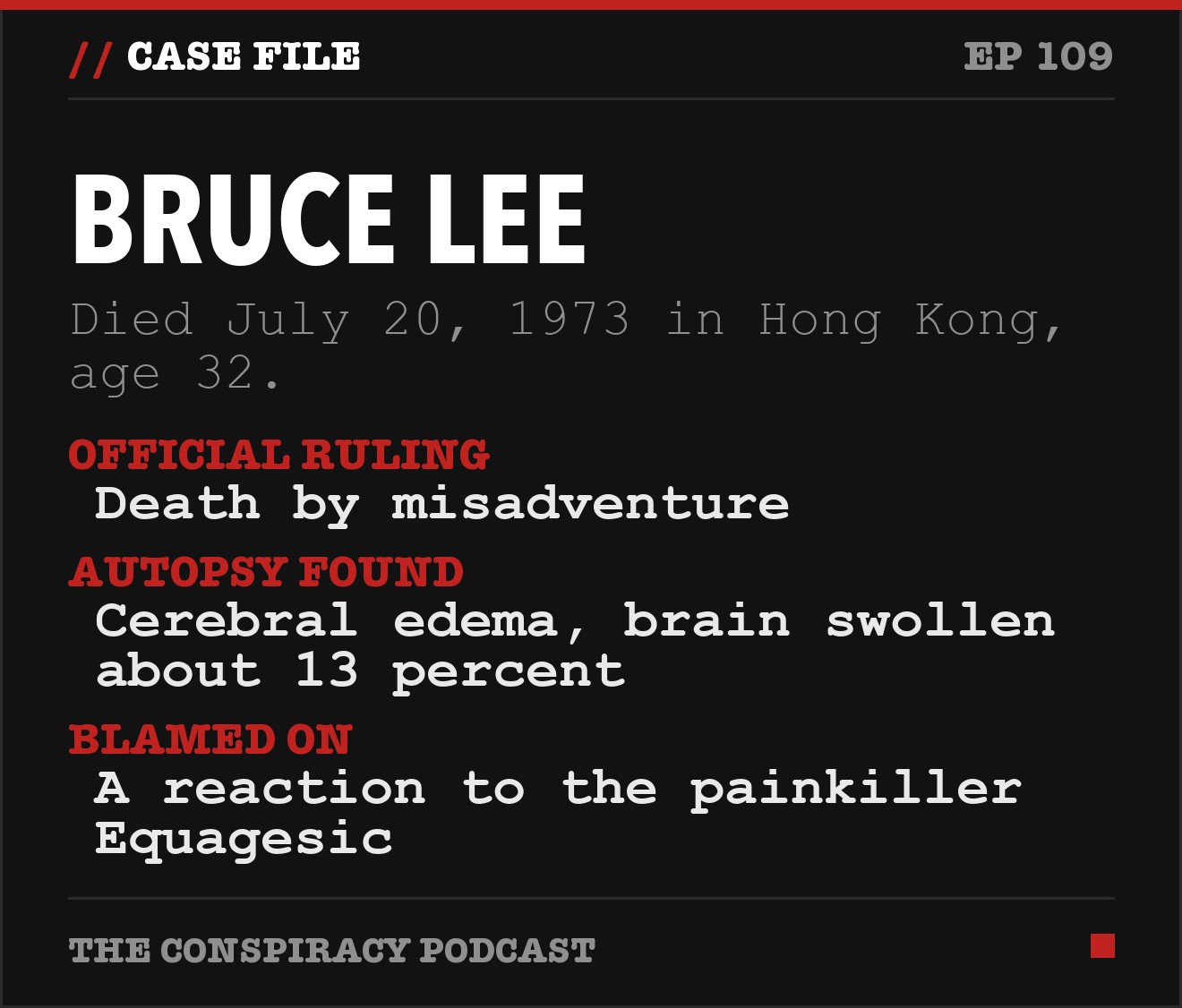
Bruce Lee died on July 20, 1973 in Hong Kong at age 32. The autopsy found cerebral edema, a brain swollen about 13 percent larger than normal. A Hong Kong coroner’s court ruled it death by misadventure, blaming a hypersensitivity reaction to a painkiller called Equagesic.
By the Conspiracy Podcast team | Last updated: August 2026
Fifty years later, people still do not accept that answer. The fittest man on the planet took a headache pill and never woke up, and the gap between how healthy he looked and how ordinary his death sounds is exactly where the theories live. Here are the questions people actually search, answered.
What was the exact cause of Bruce Lee’s death?
The official cause was cerebral edema, swelling of the brain. Doctors found no injury, no aneurysm and no stroke. The medical examiner concluded Lee had a hypersensitivity reaction to Equagesic, a painkiller he had taken before without trouble. On September 3, 1973, the coroner’s court recorded a verdict of death by misadventure.
The autopsy was performed at Queen Elizabeth Hospital in Hong Kong. Lee’s brain weighed about 1,575 grams against a typical adult male figure of roughly 1,400 grams. That kind of swelling raises the pressure inside the skull until it presses on the brain and begins shutting down basic functions, including breathing.
Death by misadventure is a British legal term, which is why it appears here at all. Hong Kong was under British rule in 1973, and the inquest was run to British standards. It means an accidental death that followed from a voluntary risk, in this case taking the pill. It is worth being precise about what that verdict does and does not settle: it closed the inquest, but the underlying cause of the swelling is still disputed by researchers today.
What was Bruce Lee doing when he died?
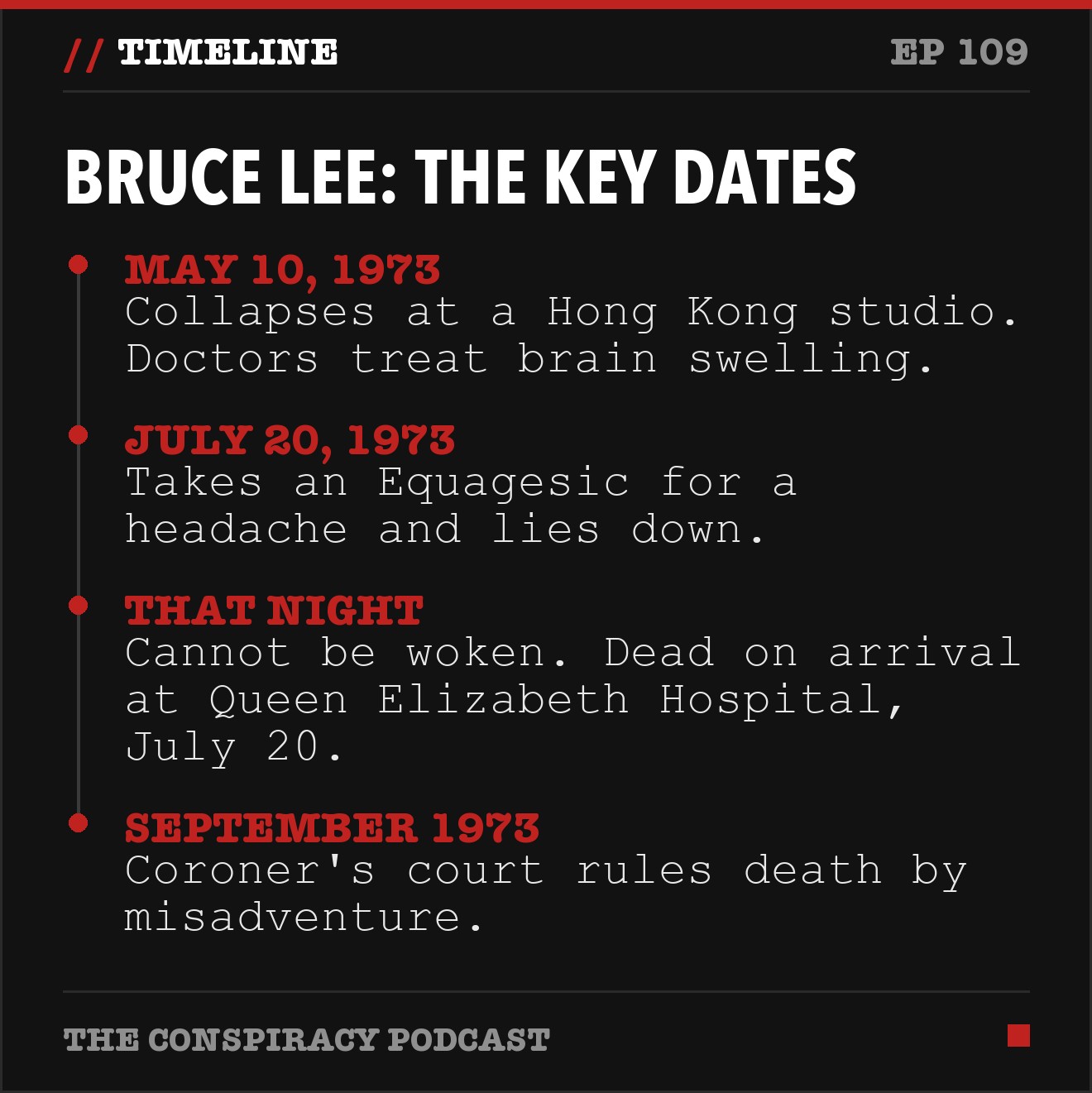
Lee spent his final evening at actress Betty Ting Pei’s Hong Kong apartment, going over the Game of Death script with producer Raymond Chow. At about 7:30 p.m. he complained of a headache, took an Equagesic tablet, and lay down for a nap. He never woke up, and was pronounced dead on arrival at the hospital that night, July 20.
By Chow’s own account, Lee was in high spirits that night. He got up at one point and acted out parts of the film, play fighting in the living room. There was nothing in the evening that suggested a man hours from death.
Then comes the part that actually is suspicious, and it is not the death. It is what happened next. Chow told the press that Lee had collapsed at home with his wife, Linda, rather than at Betty Ting Pei’s apartment. That single piece of image management, protecting a star’s reputation and his family’s earnings, is what fed fifty years of rumors. The hosts walk the full timeline hour by hour in the Bruce Lee episode, including how quickly the story changed.
What pill did Bruce Lee take before he died?
Equagesic, a common prescription painkiller of the era that combined aspirin with a mild tranquilizer called meprobamate. Lee had taken it before with no problems. Toxicology found only two things in his system, the Equagesic and a small amount of cannabis, and the examiner ruled the cannabis out as a cause of death.
The obvious objection is the one everybody raises. How does a pill somebody has already taken suddenly kill them? A hypersensitivity reaction can do exactly that, but it is an unsatisfying answer for a 32-year-old at the peak of his physical life.
There is a detail that changes the picture, and most articles skip it. About two months before he died, Lee collapsed in almost the same way. He was dubbing lines for Enter the Dragon in a hot studio when he became dizzy, went down, and began having seizures and vomiting. Doctors found cerebral edema then too, and saved him with mannitol, a diuretic that reduces swelling. Whatever killed him in July had already nearly killed him in May.
Did Bruce Lee die from drinking too much water?
That is a 2022 hypothesis, not the official ruling. Kidney specialists writing in the Clinical Kidney Journal proposed that Lee died from hyponatremia, a state of too much water and too little sodium that makes the brain swell. Their paper argues his kidneys could not excrete water fast enough to keep up.
The study, titled “Who killed Bruce Lee? The hyponatraemia hypothesis” and led by Priscila Villalvazo, is now one of the most cited pieces of writing on his death. It fits things the older theories never explained. Lee was obsessive about hydration and reportedly drank very large amounts of water, while keeping his sodium intake low. Equagesic is also known to affect the kidneys.
Two cautions belong on this, and reputable coverage tends to lose them. First, it is a hypothesis built from historical records, not a finding from new evidence, and no one can test it now. Second, it does not require a villain. It is the same category of answer as the official verdict, an ordinary physiological failure in an extraordinary body.
Why did Bruce Lee have his sweat glands removed?
Lee reportedly underwent surgery in 1972 to remove sweat glands from his armpits, because he did not want to be seen sweating on camera. Effortlessness was part of the image. That cosmetic decision is now central to one of the more plausible medical theories about his death.
On July 20, 1973, Hong Kong was extremely hot, and Lee had been rehearsing intense fight scenes earlier that day. The heat theory holds that high temperatures plus a reduced ability to sweat led to heat stroke, and that overheating caused the brain swelling. It also lines up with the May collapse, which happened in a hot dubbing studio.
There is no direct medical proof. Heat stroke was poorly understood in the 1970s and the autopsy did not test for it, so this stays a theory. What makes it interesting is that it points the same direction as the water theory and the official verdict: a body with almost no margin left, pushed one step too far.
What are the conspiracy theories about Bruce Lee’s death?
The main ones are a triad hit, an American mafia grab, a jealous mistress, a rival martial artist using a legendary delayed death touch, the CIA, and a family curse. None of them has evidence behind it. The autopsy found no injuries and no signs of foul play of any kind.
| Theory | What the record shows |
|---|---|
| Triad hit. Lee beat a triad member’s son as a teenager, and organized crime had real pull in Hong Kong film. | No evidence has ever surfaced, and the autopsy found no injuries. |
| Poisoned by a jealous lover. Tabloids ran with the fact that he died at Betty Ting Pei’s apartment. | Toxicology found only Equagesic and cannabis. No poison, and nobody was ever charged. |
| The death touch. A strike to a hidden pressure point that kills days later. | A martial arts legend. The autopsy found no injury at all, which is the whole problem with it. |
| The family curse. Bruce and his son Brandon both died young and suddenly. | Two deaths, twenty years apart, with documented and unrelated causes. |
The reason these theories persist is not that any of them is strong. It is that the cover story about where he died was real, and once a producer is caught moving a body’s location in the press, people reasonably assume other things were moved too. Our full breakdown of the death of Bruce Lee takes each theory in turn and explains why the guys end up rejecting all of them.
He took it overboard with the training, with the drugs, with the hydration, everything. All the things combined, and his body just gave out.
the guys, on the record
How did Bruce Lee’s son really die?
Brandon Lee died on March 31, 1993, aged 28, on the set of The Crow. A prop gun fired by actor Michael Massee discharged a bullet fragment that had been left lodged in the barrel by an improperly prepared dummy round earlier in the shoot. The blank’s gunpowder propelled it. It was ruled an accident.
The sequence matters, because the curse version of the story leaves it out. A dummy round, used for close-up shots, had its bullet come loose in the barrel. Nobody cleared it. When a blank was later fired in the same gun, the charge behind it was enough to push that fragment out like a live round.
Two young deaths in one family is genuinely eerie, and it made for a good movie beat when a biopic leaned into it in the 1990s. It is also two people, with two documented and completely unrelated causes, which is where the hosts land. If you like this kind of pattern hunting, our roundup of famous conspiracy theories covers a lot more of it.