Who Was Jack the Ripper?
Who Was Jack the Ripper?
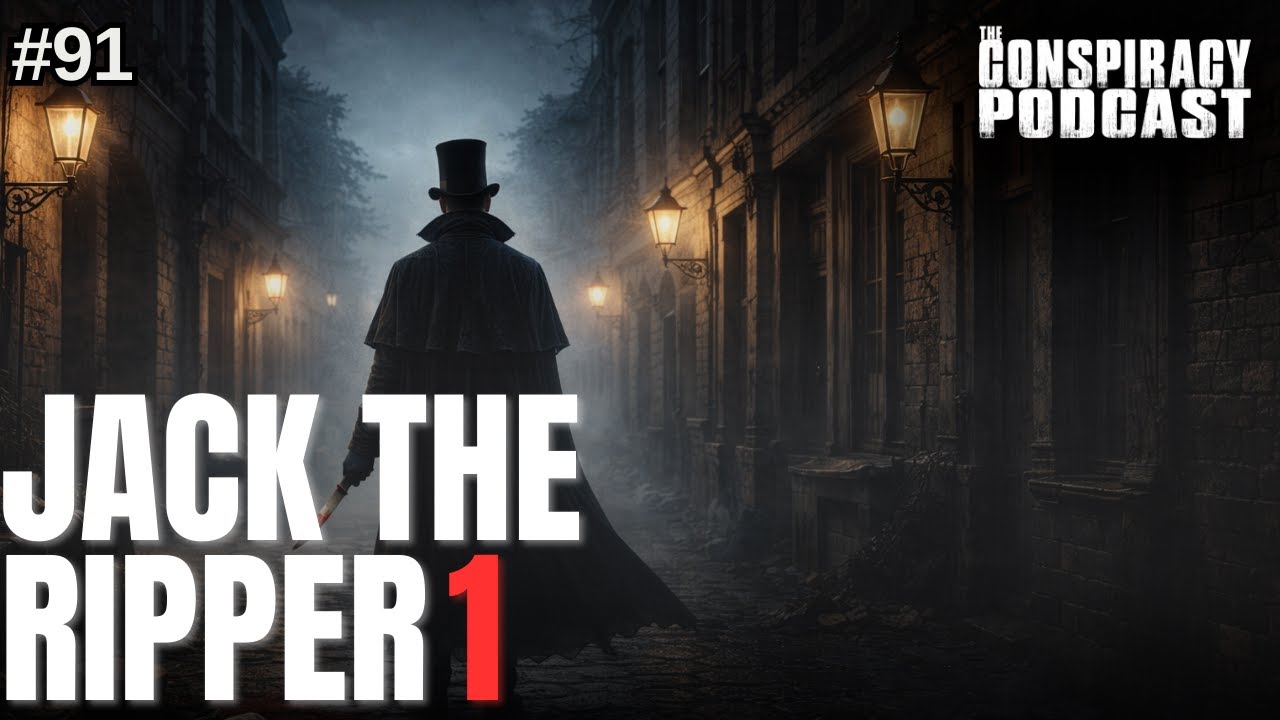
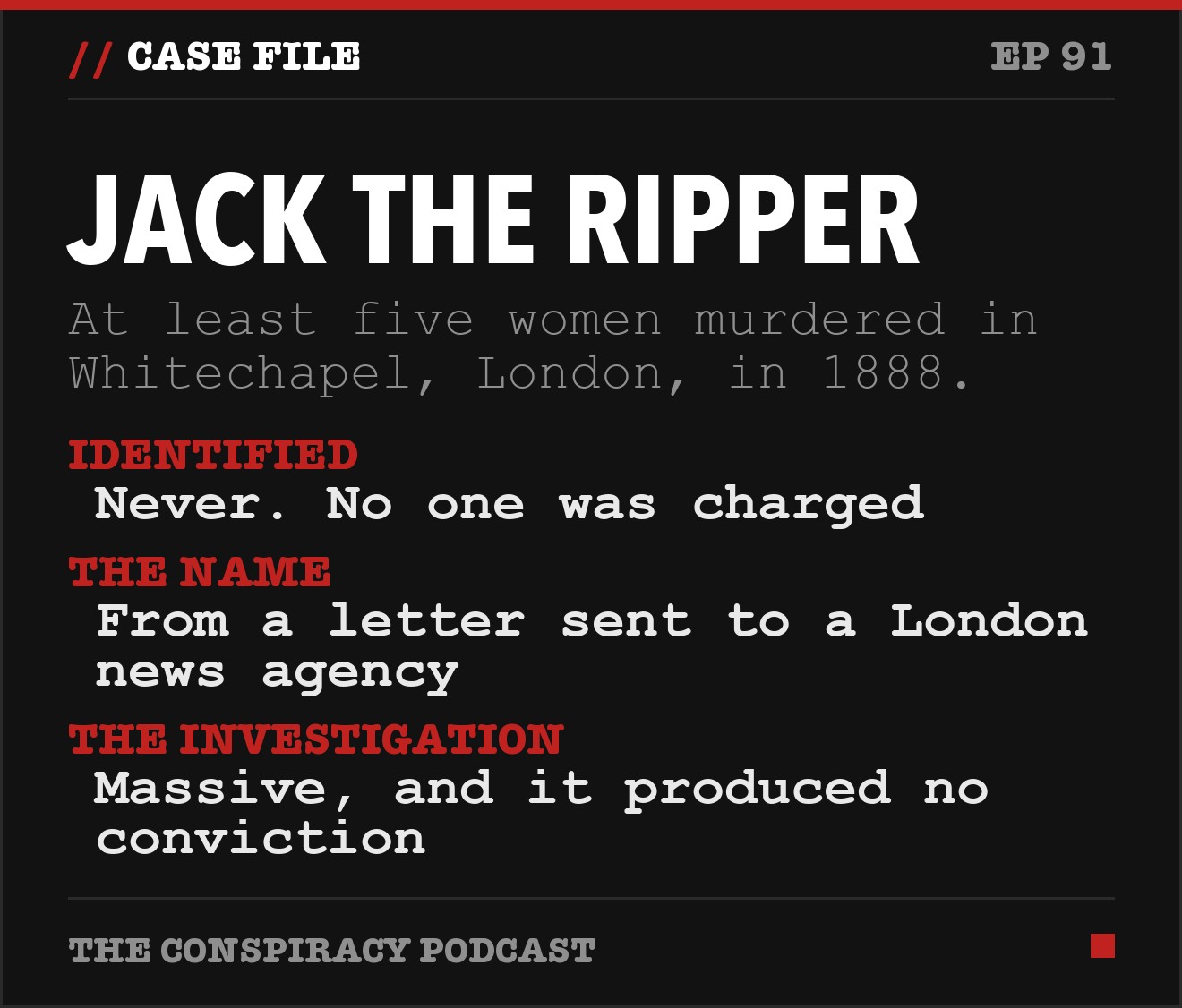
Jack the Ripper is the name given to an unidentified killer who murdered at least five women in London’s Whitechapel district in 1888. The name comes from a letter sent to a London news agency claiming responsibility for the murders. Despite a massive police investigation, he was never caught or identified.
By the Conspiracy Podcast team | Last updated: August 2026
Whitechapel in 1888 was one of the most overcrowded places on Earth, and the murders happened within weeks of each other with almost no forensic science to work from. That mix of horror and mystery built the template for the modern serial killer myth. More than 130 years later, every suspect is dead, and the case still is not settled.
Who was Jack the Ripper?
Jack the Ripper is the name history gave to the unidentified man believed to have murdered five women in London’s Whitechapel district between August and November 1888. Police never named a suspect publicly, and no one was ever charged. The case remains one of the most examined unsolved crimes on record, still debated by historians and true crime writers today.
The murders took place in Whitechapel, a district in London’s East End that covered only 1.3 square miles but held a population of roughly 80,000 people in 1888. Waves of Irish immigrants, and later Jewish refugees fleeing persecution in the Russian Empire, had settled there, making it one of the most overcrowded parts of the city. Poverty, alcoholism, and unsanitary lodging houses were common, and London’s Metropolitan Police estimated 62 brothels and around 1,200 women working as prostitutes in the district that same year.
The killer earned his name from a letter received by the Central News Agency of London on September 27, 1888, and forwarded to Scotland Yard. It was signed Jack the Ripper, and while some ripperologists, researchers who specialize in the case, believe it was a hoax to sell newspapers, the name stuck permanently. The hosts walk through the full setting and every confirmed murder in their original two-part series on the Whitechapel murders.
How many victims did Jack the Ripper have?
Historians agree on five confirmed victims, the canonical five: Mary Ann Nichols, Annie Chapman, Elizabeth Stride, Catherine Eddowes, and Mary Jane Kelly. All five died in Whitechapel between August and November 1888. The true total is debated, and other unsolved murders from the same years have never been agreed upon as his work.
Each of the five was a real woman whose life held real hardship before it ended. The killings were extremely violent and involved mutilation, but each victim was more than how she died. Mary Ann Nichols, known as Polly, had been married with five children before domestic conflict and alcoholism put her on the street, and on her last night she was cheerfully showing off a new bonnet she had just bought. Annie Chapman, called Dark Annie, lost a daughter to illness and was left without support after her husband died, yet friends called her steady and reliable despite her struggles. Elizabeth Stride, known as Long Liz, was a Swedish immigrant who spent her final evening drinking cheerfully with friends after a day cleaning rooms for money.
Catherine Eddowes was well known around Whitechapel and spent her last hours laughing with the police officers who had just released her from a drunk tank. Mary Jane Kelly, the youngest of the five and the last to die, was remembered by friends as warm-hearted despite having almost nothing of her own to give. Beyond these five, at least eleven violent attacks on women in the district between 1888 and 1891 were investigated as possibly connected, but no consensus has ever moved the official number off five.
Who are the main Jack the Ripper suspects?
No suspect was ever charged, but historians point to a handful of names most often. Aaron Kosminski, a Polish immigrant with documented severe mental illness, is the most discussed, alongside barrister Montague John Druitt and American serial killer H.H. Holmes. A decades-later FBI profile fits some of these men better than others.
Retired FBI profiler John Douglas, later depicted in the Netflix series Mindhunter, concluded the killer was likely a local man in his mid to late twenties or early thirties, of lower to middle status, with a job such as butcher or mortuary assistant that gave him basic anatomical knowledge but no formal medical training. Aaron Kosminski, who fit much of that profile, was named a prime suspect by two senior Metropolitan Police officials, Robert Anderson and Donald Swanson, in their private writings. Montague John Druitt, a barrister and schoolteacher, was named a suspect in a police memorandum after his body was found in the Thames weeks after the final murder.
Other names come up regularly too, including convicted poisoners George Chapman and Dr. Thomas Cream, and Joseph Barnett, Mary Jane Kelly’s former partner and the only suspect ever personally connected to a victim. A 1976 book also proposed a royal cover-up involving Prince Albert Victor and royal physician Sir William Gull, later picked apart by ripperologists after one of its own sources admitted to inventing parts of the story. None of these men was ever charged. Here is how each theory holds up against the record.
| Theory | What the record shows |
|---|---|
| Aaron Kosminski. A Polish immigrant with documented severe mental illness, named a prime suspect by two senior police officials. | Never charged. The 2014 shawl DNA claim tied to him has been widely challenged over chain of custody and contamination. |
| Montague John Druitt. A barrister named a suspect in a police memorandum after his body was found in the Thames. | The timing lines up with the last murder, but investigators never tied him to a single crime scene. |
| H.H. Holmes. The American serial killer behind Chicago’s Murder Castle, proposed to have crossed the Atlantic in 1888. | No travel records place him in London, and his American killings do not match the Ripper’s methods. |
| The royal cover-up. A 1976 book claimed the murders hid a secret royal marriage involving Prince Albert Victor and the royal physician. | Ripperologists have disputed key details, and one of the story’s own sources admitted to fabricating parts of it. |
Was Jack the Ripper ever identified by DNA?
No. A widely publicized 2014 claim held that DNA on a shawl linked to victim Catherine Eddowes matched a descendant of suspect Aaron Kosminski. A 2019 peer-reviewed follow-up supported the claim but stopped short of calling it proof. Scientists and historians have criticized the chain of custody and the methodology, and the case has not been officially closed.
In 2007, businessman Russell Edwards bought a stained shawl reportedly taken from the scene of Catherine Eddowes’s murder by a police constable and kept unwashed in his family for generations. In 2014, Edwards and Finnish forensic scientist Dr. Jari Louhelainen announced they had recovered mitochondrial DNA from the shawl, blood matched to a descendant of Eddowes and semen matched to a descendant of Kosminski’s sister. A more formal, peer-reviewed version followed in 2019 in the Journal of Forensic Sciences, co-authored by Louhelainen and David Miller.
The criticism has stayed consistent since the first announcement. No surviving 1888 police record confirms the shawl was at the crime scene, and the chain of custody rests on family stories passed down for decades. A 137-year-old textile handled by many people risks contamination, and only one laboratory ever ran the tests. Mitochondrial DNA also identifies a maternal line rather than one individual, so a match points toward a family, not a specific man. Even the 2019 paper’s own authors said the DNA supported Kosminski as a suspect, not proof he was the killer. The hosts pick apart every weak link in that chain in their follow-up episode on the shawl DNA claim.
So the shawl may whisper secrets from that bloody night, but it does not yet speak a name with 100% certainty.
the guys, on the record
Why was Jack the Ripper never caught?
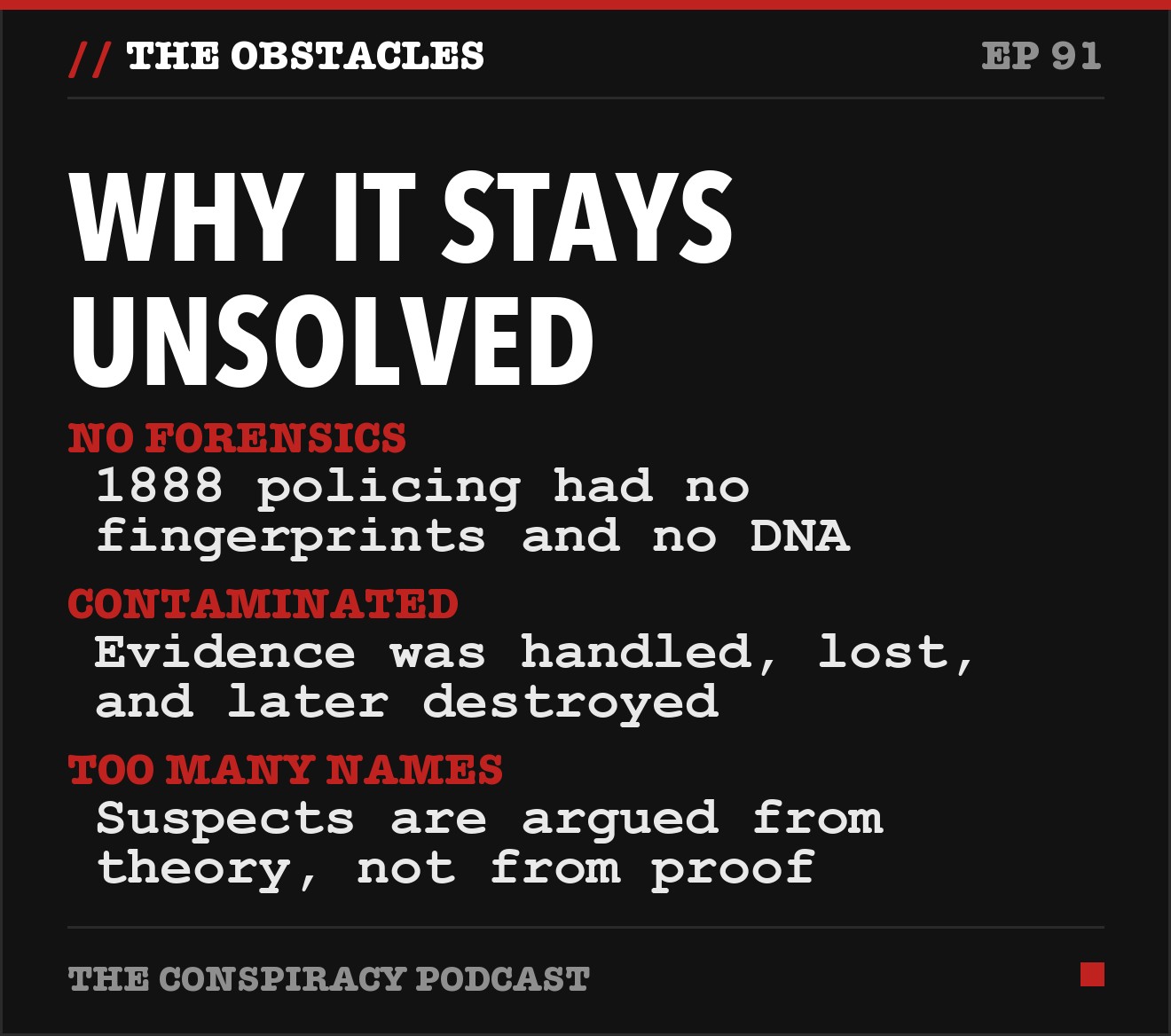
Policing in 1888 had no fingerprinting and no forensic labs. Officers questioned around 2,000 people, formally investigated roughly 300, and detained about 80, all based on eyewitness accounts in a dark, overcrowded district. No arrest, confession, or physical evidence ever closed the case.
The murders happened in a maze of alleys and courtyards in one of the most overcrowded square miles in the world, so witnesses were plentiful but unreliable and the killer had endless places to vanish into. Investigators leaned almost entirely on eyewitness identification, since fingerprinting and forensic photography were not yet standard practice. Police focused heavily on butchers and surgeons after doctors suggested the killer had anatomical knowledge, and inspectors visited dozens of them to check alibis, but none of it produced a name they were confident enough to charge.
Much of the original case file was lost when police records were destroyed during the Blitz in World War Two, so evidence historians would want to reexamine no longer exists. FBI profiler John Douglas theorized the killings did not stop because the man chose to quit, but because some outside event, such as death, institutionalization, or imprisonment for another crime, removed him from the streets. That gap is part of why the case still generates new suspects more than a century later. If unsolved mysteries like this one interest you, our running list of famous conspiracy theories covers plenty more of them.