What Caused the Salem Witch Trials?
What Caused the Salem Witch Trials?
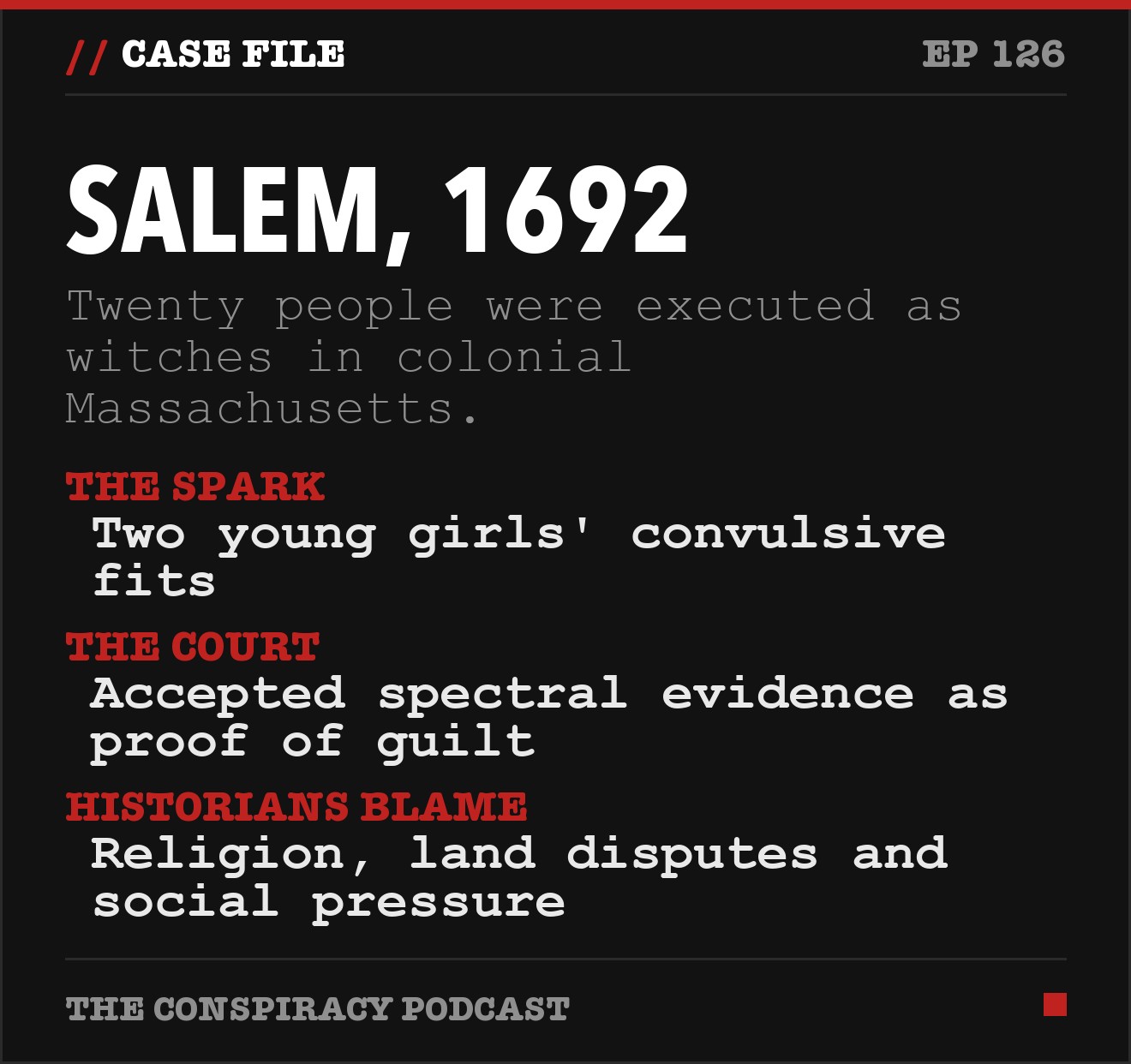
The Salem witch trials of 1692 grew out of two young girls’ convulsive fits, a Puritan village primed by fear of the devil, and a court willing to accept spectral evidence, testimony about a vision of a person’s spirit, as proof of guilt. Twenty people were executed. Historians blame religion, land disputes, and social pressure, not one single cause.
By the Conspiracy Podcast team | Last updated: August 2026
More than 330 years later, Salem is still the reference point for what happens when fear, religion, and the legal system collide. A court convicted people largely on the word of children describing dreams and visions, evidence nobody else could check. That is why the case still gets argued today.
What caused the Salem witch trials?
No single event caused the Salem witch trials. The trigger was two girls in minister Samuel Parris’s household developing violent, unexplained fits in the winter of 1692. The panic grew because Salem Village was already fractured by religious extremism, land disputes, and grudges, with witchcraft as the only explanation anyone had for suffering.
Salem Village in 1692 was a poor, inland outpost next to the wealthier port of Salem Town, long divided over land and independence. Minister Samuel Parris, who arrived in 1689, preached fire and brimstone sermons that treated the devil as a constant threat. Betty Parris, age 9, and cousin Abigail Williams, age 11, then began having violent fits with no medical explanation. A neighbor suggested the witch cake, a folk remedy baked from the girls’ urine and fed to a dog to reveal a witch.
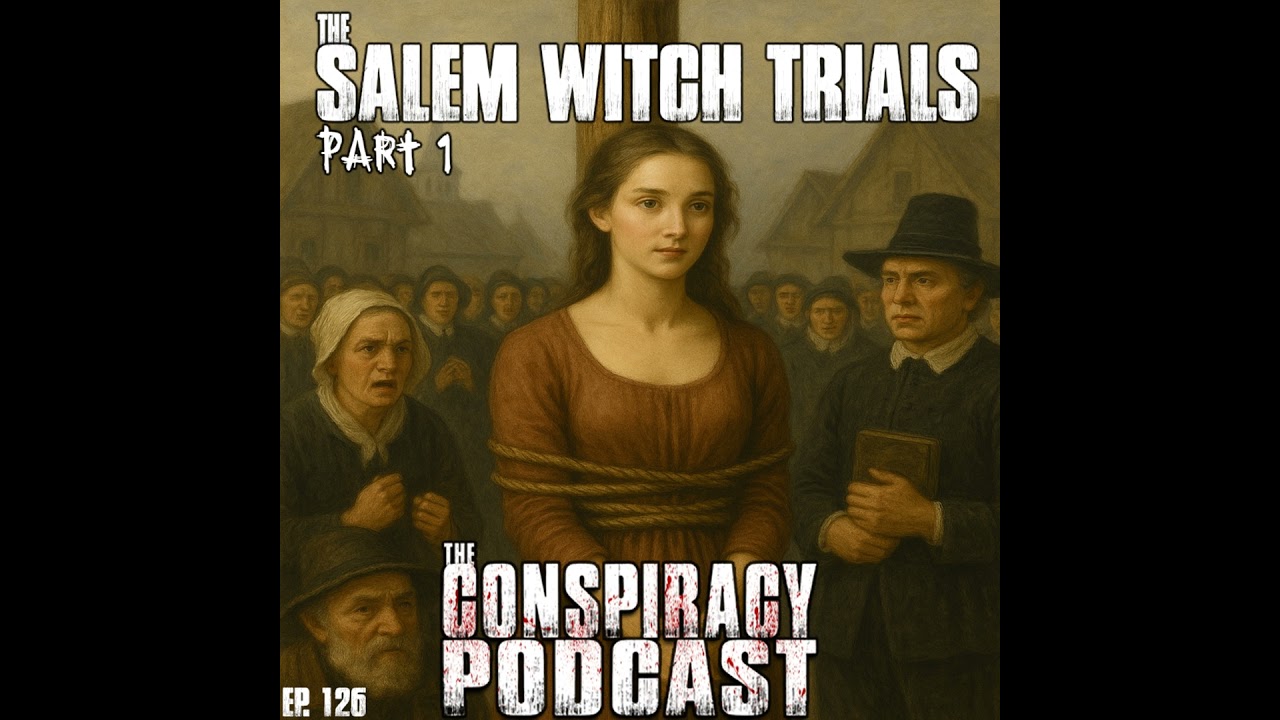
The girls then named their family’s enslaved servant, Tituba, along with Sarah Good and Sarah Osborne, as the source of their torment. On February 29, 1692, arrest warrants went out for all three, the residents Salem found easiest to blame. Under questioning, Tituba confessed to a tall man in black, animal familiars, and a coven of witches in Salem, naming other women as members. That confession turned isolated illness into conspiracy, and accusations exploded from there. The guys trace that whole chain in part one of the Salem Witch Trials series.
How many people died in the Salem witch trials?
At least 25 people died because of the Salem witch trials. The court formally sentenced 20 people to death: 19 were hanged, and one man, Giles Corey, was pressed to death under stones after he refused to enter a plea. At least five more accused people died in jail awaiting trial.
The hangings came in waves. Bridget Bishop died first, on June 10, 1692. In July, five more women hanged together: Rebecca Nurse, Sarah Good, Susanna Martin, Elizabeth Howe, and Sarah Wilds. Nurse’s jury had first returned a not guilty verdict, reversed only after the judge sent them back to reconsider. In August, five more died, including Reverend George Burroughs and Martha Carrier. The final round came on September 22, when eight people hanged together, the largest single group of the hysteria.
Giles Corey’s death stands apart. Refusing to enter a plea meant he could not be tried at all, so the court ordered an old punishment called peine forte et dure: stones piled on his chest until he spoke or died. He was pressed to death on September 19, 1692, the only execution of its kind in the entire hysteria. At least five more accused people, among them Sarah Osborne, one of the first three ever arrested, died in overcrowded jail cells from disease and neglect before trial.
Were any of the accused actually burned at the stake?
No. Nobody in Salem was burned at the stake. Every execution by sentence was a hanging, except Giles Corey, who was pressed under stones. Burning was a continental European punishment for witchcraft, tied to the Catholic Church’s treatment of it as heresy. English common law, which governed Massachusetts, prescribed hanging instead.
This is one of the most common misconceptions about the case, and it is worth saying plainly: it did not happen in Salem. The image comes from centuries of European witch hunts. Between the 1400s and 1700s, continental Europe executed thousands of accused witches, mostly by burning after torture or a forced confession, since the Catholic Church treated witchcraft as heresy. Historians estimate that 40,000 to 50,000 people were executed for witchcraft across Europe in that period.
None of that legal tradition applied in Massachusetts. Salem was an English colony, and English common law prescribed hanging for witchcraft, not burning. In the colonies, burning was reserved for far narrower crimes such as treason. Every person executed by sentence in Salem, from Bridget Bishop to Reverend George Burroughs, died on the gallows, with Corey pressed rather than hanged. The burning image instead comes from popular culture, which borrowed the European punishment and attached it to Salem’s story.
What was spectral evidence?
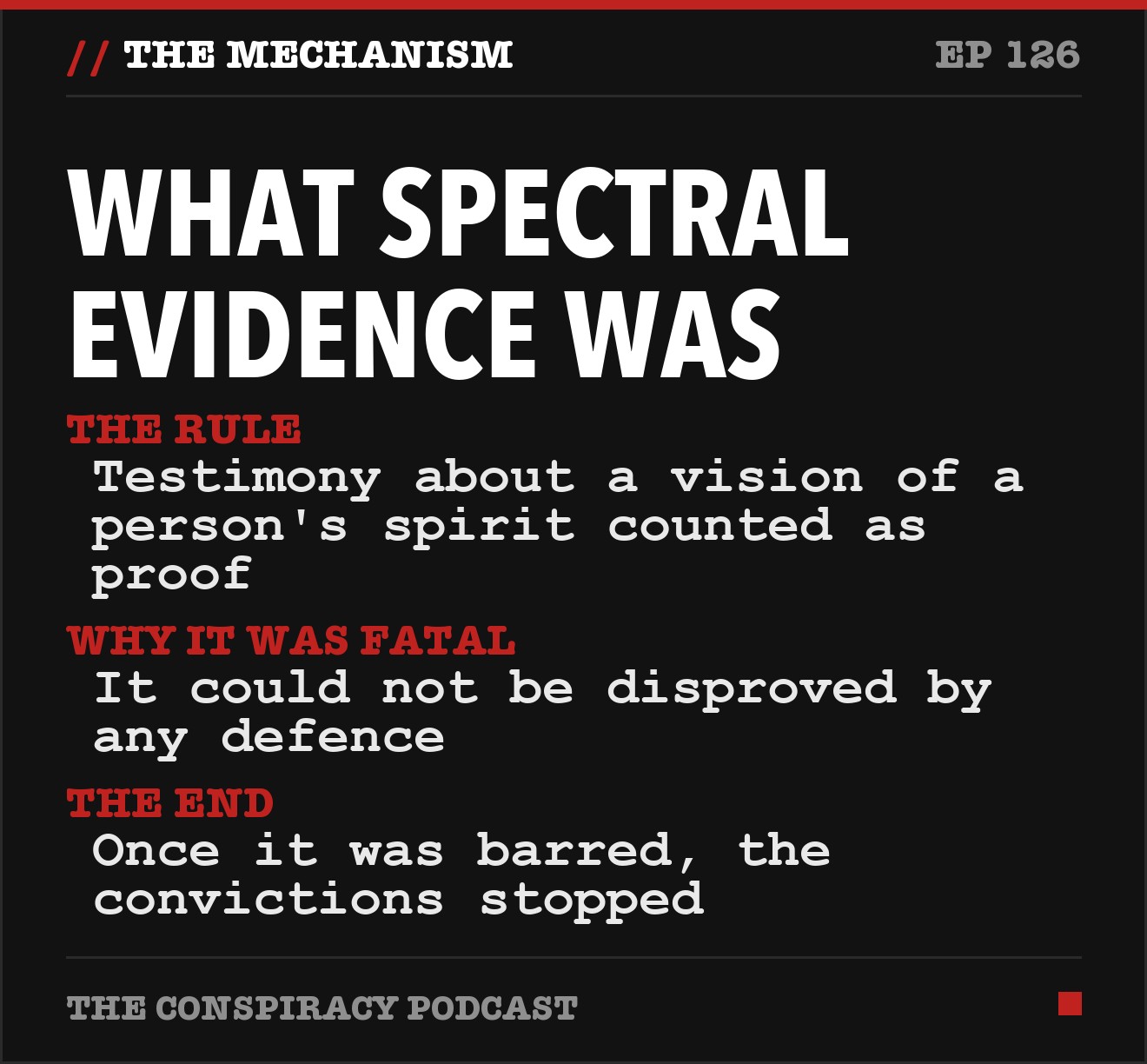
Spectral evidence was testimony that a person’s spirit, or specter, had appeared and caused harm while the accused was somewhere else. Salem’s Court of Oyer and Terminer accepted this as proof of guilt starting in June 1692. It could never be verified by anyone but the accuser, and its use is what let the trials spiral out of control.
The idea rested on a theological argument. Ministers had long debated whether the devil could take an innocent person’s shape without permission, but Deputy Governor William Stoughton’s court sided with the view that a witch’s specter could not act without the witch’s own consent. In practice, if an accuser said she saw someone’s spirit biting her in a dream or a vision, the court treated it as evidence the accused had willingly sent it.
Spectral evidence is what convicted Bridget Bishop, Salem’s first execution, and it filled the courtroom in nearly every trial that summer. It is also what ended the trials. By January 1693, a new superior court ruled spectral evidence inadmissible, and the remaining cases collapsed almost immediately, with grand juries refusing to indict dozens still in jail. Once the court stopped accepting testimony nobody could verify, the convictions stopped too.
Did ergot poisoning cause the Salem witch trials?
Ergot poisoning is a real hypothesis, not an accepted explanation. In 1976, behavioral scientist Linnda Caporael proposed in the journal Science that a fungus growing on rye, chemically related to LSD, could explain the girls’ convulsions and hallucinations. The theory remains contested and has never displaced the religious and social explanations for what happened in Salem.
Ergot is a fungus that grows on rye and other grains, and in large doses it can cause convulsions and vivid hallucinations, symptoms that overlap with what witnesses described in Betty Parris and Abigail Williams. Salem Village grew rye as a staple crop, and the theory holds that a wet growing season let the fungus spread through the grain supply, meaning the outbreak began with contaminated bread rather than anything supernatural. Ergot is chemically related to the compound used to synthesize LSD.
The objection the hosts raise, and one most historians share, is that ergot does not explain why the outbreak stayed so limited. Contaminated grain would have reached many households, not just the small circle of accusers who showed symptoms. Most of Salem Village ate from the same food supply, yet only a specific group of mostly young women and girls produced the fits used as evidence in court. That mismatch is why ergot poisoning is treated as a contributing possibility at most, not the full explanation.
Ergot is only one entry on a longer list of explanations people have proposed since 1692. Here is how the leading theories line up against the record.
| Theory | What the record shows |
|---|---|
| Ergot poisoning. A fungus on rye, related to LSD, may explain the convulsions. | Proposed by researcher Linnda Caporael in 1976. Contested, since tainted grain would reach far more households than showed symptoms. |
| The Putnam land grab. The influential Putnam family accused rivals, then acquired their forfeited land. | Ann Putnam Jr. was a lead accuser, and her father signed the complaints. Many historians treat this as the most credible theory. |
| Satanic bloodline conspiracy. Early religious elites allegedly used the trials to purge a rival spiritual lineage. | No evidence supports this. It circulates online with no basis in the trial records. |
| Social control experiment. Authorities allegedly used the trials to test how far they could push obedience. | Unsupported. Experiments like this were not conceived of until the 20th century. |
None of these theories fully satisfies the guys, and that is part of the point. The hosts land on a hybrid explanation: a personal, fear-driven accusation from Ann Putnam Jr. that snowballed into town-wide panic, which powerful families then used to their advantage. Part two of the series walks through the executions and each of these theories in far more detail.
His will was stronger than their whole thing. That’s going to be our merch, a shirt that just says more weight.
the guys, on the record
Salem was not an isolated event. Fear of witchcraft, and courts willing to act on testimony nobody could verify, shaped legal history across Europe and colonial America for centuries. If this kind of case interests you, our roundup of famous conspiracy theories covers a lot more of it.