
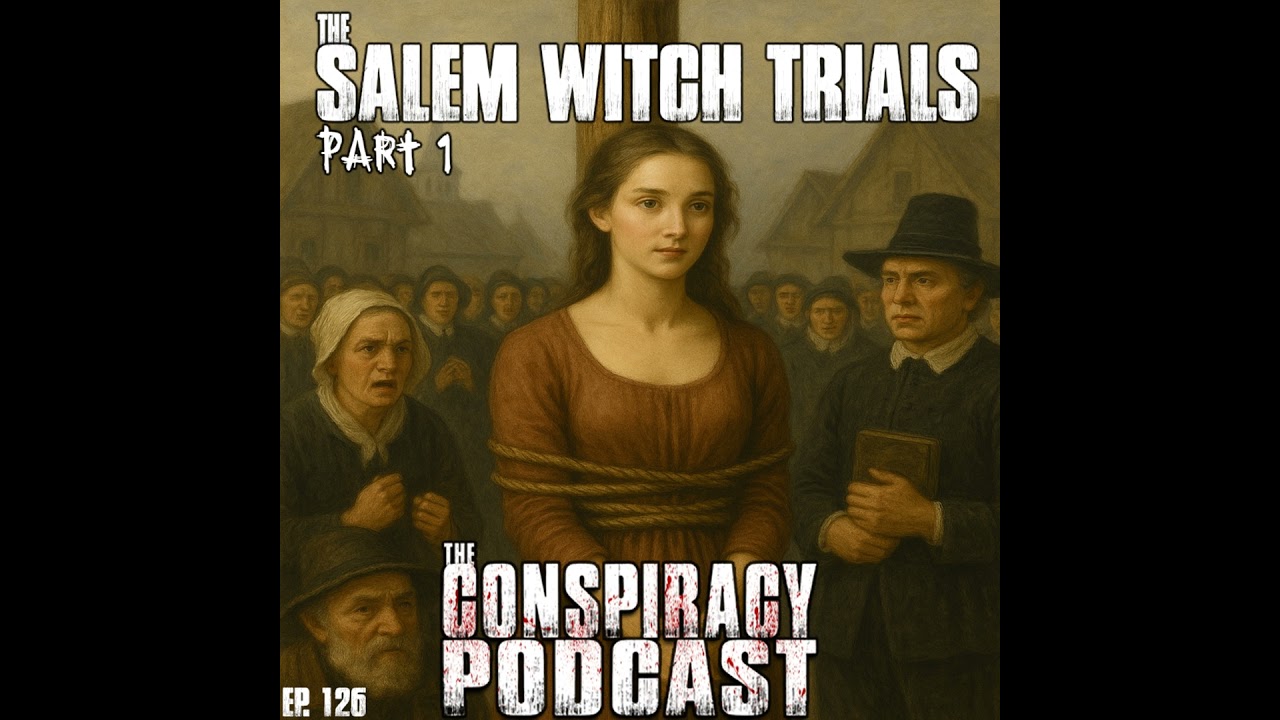
The Salem Witch Trials Part One – EP 126


The Salem Witch Trials Part One
Part one of the guys’ Salem Witch Trials series digs into how a deeply religious, isolated Puritan farming community in Massachusetts Bay turned on itself. Salem Village, a poorer inland outpost next to the wealthier Salem Town, was already fractured by land disputes, generational grudges, and a divisive new minister, Samuel Parris, whose fire and brimstone sermons framed the devil as a constant, literal threat. With no science, no doctors, and no explanation for bad harvests or unexplained illness, the community’s default answer for anything going wrong was witchcraft.
The hysteria began in the winter of 1692 when Parris’s 9-year-old daughter Betty and her 11-year-old cousin Abigail Williams started having violent fits, contorting, babbling, and crying out about being bitten by invisible specters. When a village doctor could find no medical cause, he concluded the devil was responsible. A neighbor’s folk remedy, the witch cake, made by baking the afflicted girls’ urine into bread and feeding it to a dog, only deepened suspicion once Parris denounced it from the pulpit. Betty then named her family’s enslaved Caribbean servant, Tituba, along with Sarah Good and Sarah Osborne, as the source of the torment.
The guys walk through the February 29, 1692 arrest of Tituba, Good, and Osborne, and Tituba’s dramatic confession describing a tall man in black, animal familiars, a flying pole, and a witch coven in Salem, which she said included other named women. That confession convinced magistrates a conspiracy was underway, and accusations exploded outward from there, sweeping up respected church members like Martha Corey and Rebecca Nurse, a bedridden old man, and even four-year-old Dorothy Good, who was jailed in shackles next to her mother. By spring the panic had spread to the town of Andover, where a bizarre "touch test" was used to identify witches and 45 more people were accused.
- The hysteria began in the winter of 1692 when 9-year-old Betty Parris and 11-year-old Abigail Williams, daughter and cousin of minister Samuel Parris, began having violent convulsive fits with no medical explanation
- A neighbor named Mary Sibley suggested the witch cake, a rye meal cake baked with the afflicted girls’ urine and fed to a dog, a folk remedy meant to reveal a witch’s identity
- On February 29, 1692, arrest warrants were issued for the first three accused: Tituba, an enslaved Caribbean woman in the Parris household, Sarah Good, and Sarah Osborne
- Tituba confessed under questioning, describing a tall man in black, animal familiars including a hog and a black dog, flying on a pole, and a witch coven in Salem, and she named other alleged witches
- Accusations spread to respected community members including 71-year-old Rebecca Nurse and Martha Corey, as well as a bedridden old man and four-year-old Dorothy Good, who was jailed in shackles next to her mother
- By spring the panic reached the neighboring town of Andover, where a blindfolded touch test was used on the accused and roughly 45 more people were accused of witchcraft
Read the full transcript
Hey guys, welcome back to the Conspiracy Podcast Halloween special. What up my people? Oh, spooktacular. Dude, I love Halloween. Me too. It’s the best. It’s so much fun. I’m the Grinch. Oh man, the Halloween Grinch. Why? I don’t know. You have to dress up. I don’t like dressing up. Really?
And then my wife and my daughter are like, “We should be this group costume.” I’m like, “No, dude.” Dora the Explorer. I’m supposed to be like the map or some shit. Like, “No, you should be Diego.” Diego. So funny. He’s like Diego’s dad. Yeah. It’s such a girl thing, too. It’s so funny. No, but dude, you got to accept it. We just decided on ours last year. We did one. You just accept it.
And I always just turn every outfit we have into, I’m like the trailer park version, cuz I cut the sleeves off. I’m always like the trailer park version of everything that we are. I realize that’s the time period of Florida that’s different than everywhere in the US. Everyone else is like delightful. It’s fall. Everybody’s got like a little long sleeve underneath, and we’re dying. Walking around to death.
I was the Mad Hatter last year. I almost died. I literally was wearing my Pit Vipers and it was like I’m sweating to death. It was the worst. I wanted to be, remember when we talked about this in the plague episode. Oh yeah. You wanted to be the plague? Yeah. Oh, that would be a good one. But I just got laid, like that’s the thing.
For those who are not in Florida, what happens basically is the rest of the country is in full scale fall at the end of October, and Florida is at the end of its summer. We’re in the slightly toned down summer, but it still sucks. So our fall doesn’t begin until like November, until December 26th. We got spring and summer. There is no fall.
I’m super pumped. I got invited to what’s going to be a bit of a murder mystery mansion set in the early 1900s. What the heck, really? Yeah. And the invite, for example, is a small book written by the host. I’m super pumped to go and I have a whole outfit, and we’re going to post it. I can’t reveal it now. And for those listeners, oh my god, we did an episode about it. We did a mini one.
The party is set in an early 1900s, late 1800s mansion of a dark mystery and murders. It’s perfect. It’s going to be perfect. And we did an episode about it. Can I give a clue? No. The clue will definitely give it away. I’ll use a more obscure clue. The name of the episode. Drunk. There you go. That’s a very obscure clue. Great clue, Sean.
Also, what’s crazy, I got to get rid of my beard, too. You do that? No way. What? I don’t think I’ve ever seen you without a beard. Oh, it’s going to be wild. Why do you think I’ve been trying to lose so much weight? When I buzz the goatee down, I’m like, “Oh my god, I’m disgusting.” It’s a goatee. It’s not even a full beard. Even my kids are like, “You’re ugly.” One time they were like, “I’m gonna look like that.” Oh my god, this is what I have to look forward to. I was like, man, that sucks.
Sorry, we digress, guys. Anyway, so it’s Halloween. I hope you guys go out, get dressed, get silly, get wild. Why not? Except Jorge. Jorge’s dressed as Jorge. So we’ve, I’ve actually been wanting to do these episodes for about two years. And finally, here we are. And it’s about the Salem Witch Trials. Oh, we’ve got a nice ambiance in the background. What a time to be alive. I wish we had a bonfire going right now.
Hopefully you guys learn a lot on this, because I actually learned a lot going into the actual details, going what do we know from Hollywood compared to what’s the actual real, what’s the real real. I wanted to go to Salem for this. I did, but we’ll settle for my backyard I guess for now.
So the episode, let’s get into it. Salem in 1692 was not just one place, a singular place, but it was rather two adjoining settlements. Cuz this is pre, this is like the pilgrims. These are villages and settlements, and everything is literally made of wood. So Salem Town was a bustling port on the Massachusetts Bay, and Salem Village was a small outpost a few miles inland. Most of the witch hysteria erupted in the village.
So you have a Salem Town and then a village. It’s got to be smaller for them to be like, you only have like three authority figures, you get behind it. It was a bit more isolated and it was a deeply religious farming community that lacked the economic growth and stability of the coastal town that also bore its name. You tracking so far? Yep. Got it.
Salem Village was a world of thatched roof cottages. Basically exactly what you’re talking about. Straight wood, dirt roads, and smoke curling from chimney tops. Life was hard. Life was cold, especially in winter. God, life sucks. Sean and I, we were up in Boston and it was summer for us, but it was still nippy. The first day we were there it was like, I didn’t pack for this. And then the next day I was like, I’m sweating to death. Point being, winters are rough. Especially when you’re living in a thatched roof cottage.
Families rose before dawn, and they prayed before every meal, and they worked from sun up to sun down just to survive. Farmers, carpenters. You’re washing your clothes in a barrel. This is rough life. There’s no social media managers and AI developers. No Wi-Fi, no central AC structure. They farmed crops like corn, beans, rye, and the New England soil wasn’t exactly the most fertile premier soil of America. Men hunted and built their own homes. There’s no Door Dash. You’re living off what you cultivate.
Men hunted and built while the women gardened, cooked, and bore the children. They all obeyed God and husband. And that’s an important part of this. At that time men were like the law. The head of the house. And we’re not saying like, oh, this is the way it should be. This is the way it was. This is the way of the time. I just don’t want it to be misconstrued. People are sensitive. So I should not make the good old days joke. I mean, you can. My wife is the lord of my household and there’s nothing I can do about it. And actually it works out great cuz I prefer her making decisions.
So the people of Salem were Puritans. They were strict Calvinists, who believed they were chosen by God to build a holy society in the new world. So it’s very religious. I mean that’s hyper religious. This is the time period of the pilgrims, and the pilgrims came over because they wanted to escape persecution and follow what they believed to be the way of God.
Their laws were deeply entwined with scripture, and their theology was rooted in the notion of mankind’s depravity, salvation for a few select who were not sinning. And that the devil was actively present in the world everywhere. Every time you thought a bad thought, the devil’s knocking on your doorstep. In this village, attending church was mandatory. You get exiled. But on the lighter side, there was dancing, colorful clothing. But those things started to go against the church, because at that time even colorful clothing started to fade into the world of, this is actually the devil. It’s too much. You’re getting too vibrant, you’re not wearing gray, like what are you doing?
And strangely enough, if you’ve ever seen Footloose. Oh yeah, of course. The premise of the story is outrageous. The town bans dancing. I can’t even understand who had the concept for the screenplay for this movie. But if you study history, you actually see that it came from something. It used to be like, even closer to present, like in the early 1900s, it was taboo. You’d go to jazz clubs and it’s like, oh, it’s taboo, they’re dancing. It’s been a running trend for a while.
So the population was extremely small and everybody knew everybody else’s business. Not a town I want to live in. And the grudges, like say you had a dispute with Jorge’s family, that would go to your father. Oh, they hold the grudge. Generational grudge. You’re not going over to Timmy’s house. His grandfather wronged us. So say I was out dancing really late, and we were nowhere. Then Jorge goes to the other cousin and goes, oh, that dancing was the devil. The devil’s dancing. That was the devil’s work, right? And then that grudge would stick there forever. The townspeople are whispering. Eric disrespected. Don’t sell Eric that corn. God doesn’t want his family to have this food. Don’t you dare sell that corn cuz it’s spited by the devil. And so that would go on for generations.
And the reason why we’re harping on this is because this is part of the lead in. It’s also like, obviously everyone’s interpretation of their spirituality is their own personal thing. But in these older societies, it was like the law. The religion was the law. And so there wasn’t room for interpretation back then. There was no, well for me it’s cool. They’re like, no, no, no.
So Salem Village in particular was rife with division, and some residents wanted independence from the richer Salem Town. Others depended on its trade and influence. But the village had just managed to install its first and only minister, Samuel Parris. And that was in 1689, after years of wrangling and trying to get somebody. But even he became a divisive figure, seen by many as greedy, rigid, and obsessed with demonic influence. So it’s like everything’s the devil. But he was now pretty much the leader. We went over how important church was. If church is how you’re living your life and the law, the person who is speaking that truth would be the de facto voice of reason for everybody.
His arrival and his fire and brimstone sermons deepened the fracture between Salem Village and Salem Town. Factions formed, some pro-Parris and some against. At the time of the witch trials, the community was already primed for conflict, resentment, and paranoia. So he gave these sermons as, the devil is here with us right now. Those lectures were over the top. Any sin that you do is the devil whispering in your ear and separating you from your family. Hell’s on the doorstep, baby. You’re next. So it’s almost like you are the devil at that point. If somebody did something wrong, some sort of sin, you are the devil now. You’ve been taken over.
Same time during this time period, keep in mind this is 1690, 1689, there’s not a lot of science. These houses are made of wood. So people, remember we had gone over a lot of these in our episodes where they’re trying to find solutions to things. They go, remember the incense, of trying to cure the plague with smell goods. And so a lot of people at this time believed in curses. And they believed in witchcraft. A hundred percent they believed this. People possessed by demons, by the devil. Well, it’s also the only way they explain it. Why are they doing bad stuff? It’s got to be the devil. That’s the only explanation.
What is witchcraft? Witchcraft is defined as the ability to do incantations and curses on people. But it is derived from demonic intention. Some sort of demonic influence. You’re harnessing the power of these demons to cast spells on fools. Exactly. So it would be anything that is not natural to humanity. Like a curse driven by the devil. I can say something, I can do something, and then now you’re cursed. You can imagine also in the 1600s, if you had a bad crop haul that year, oh, you’re cursed. A hundred percent cursed. Who cursed me?
Or even bringing it down to basic, if you had a bad season, you would be like, what did I do to go against God? Why did God make this happen? And that’s the basic level. They didn’t have soil science or pesticide or herbicide. They’re like, oh, well, this is not doing well. And it’s just like a bug that’s killing all their crops. And that’s when Monsanto started. Trust me, boys, we got the solution for you. Also, what’s called GMO?
What’s not brought up in the story a lot is that there were not very many doctors. Let us say that you got a pretty basic illness, and let’s just say you got pneumonia. And there were no doctors around to say, hey, you just got this from farming in 12 degree weather and you are low on vitamins. Then it’s like bloodletting. Well, then it would be like, okay, Jorge’s got the pneumonia, he’s obviously not following the path of God. I mean, they’re sinners, they’re sinning. So Jorge’s entire family, they’re on to some sketch. And then the gossip goes, Jorge hasn’t been to church in like six weeks. I know he was sick and dying, but he could still have made it. So you get this weird gossip line mixed with no doctors mixed with illness, and then you fill the void. You have no other solution. So it has to be they’re doing bad stuff.
So again, there was no antibiotics, no human understanding really, like basic biology. So all of this made Salem in 1692 a powder keg, a deeply religious, politically unstable area, economically stressed and socially fractured community. And it was a place where the devil was not a metaphor, but the devil was lurking, and anything that was not happening the way that you want in your life was the devil. Of course. It’s the only solution. The devil.
Then we get into the winter of 1692. A bitter winter wind rattled the timbers of Reverend Samuel Parris’s parsonage in Salem Village. Inside, 9-year-old Betty Parris. Oh, so she’s the daughter of the preacher. Yeah, that’s right. She was on the floor, her body contorted in pain as if unseen hands were pinching and twisting her limbs. Oh my god. Her cousin, 11-year-old Abigail Williams, collapsed next to her. Both girls started convulsing and they started babbling incoherently. They’re having seizures. And they’re in pure pain. There’s just rambling. You’re rambling in pain.
Their skin burned with fever one moment, then turned pale the next moment. Family and neighbors looked on in horror as the girls emitted guttural sounds. Guttural is like from within, like the Exorcist. Some witnesses say they started barking like small dogs, and they were crying out that they were being bitten and choked by invisible specters. Specters is another word for spirits or ghosts. I totally feel like this is add-on hearsay. The spectators are like, well, they were definitely talking about specters. And the girls were probably like, oh my god, my stomach hurts. They’re like, demons? Is that what you said? You said demons.
Now keep in mind this is 350 years of campfire stories. When I say the word witnesses say, this isn’t a voice recorder. This is not a documented witness. It’s not like YouTube. So no prayer offered any relief. The village doctor, summoned in desperation, could find no natural causes for these afflictions. Finally, after witnessing the girls’ unnatural fits and hearing them complain of sharp pains and visions, the physician gravely concluded that the evil hand of the devil must be at work. So this is the professional doctor saying the devil is afoot. Can you imagine? You’re like, God, I’m having really bad abdominal pains. And you go to the hospital, and they’re like, it’s pretty much the devil. We tried Advil, didn’t work, so it’s the devil. Also, now when we say the physician or the doctor, I don’t know their credential. Pretty much a colonial, let’s call it a farmer. He read a pamphlet. He saw a doctor working on somebody before.
By flickering candlelight, Reverend Parris knelt beside his daughter’s bed. He pressed a trembling hand to Betty’s forehead as she thrashed and screamed that a specter was looming over her. In his other hand, Parris clutched the Bible so tightly his knuckles went white, and the Puritan minister’s voice cracked as he prayed for deliverance. He had preached often of Satan’s plot against the godly. Now the devil’s work seemed to have invaded his own household. Wide-eyed villagers whispered amongst themselves, if the minister’s own kin were to be bewitched, what hope do we have against the devil? They have no concept of fevers, nothing. Zero.
So trouble had come to Salem Village, and we entered winter. This is awesome. Now things are going to get so much better. It’s like the Donner party. Look, so who’s getting eaten first? Man, we should do an episode, a Donner party. So as winter was here in February of 1692, more locals began reporting odd disturbances. 12-year-old Ann Putnam Jr. from a prominent family and their servant, Mercy Lewis, soon exhibited the same violent fits, an illness, or if it wasn’t an illness, a demonic presence.
Ann’s mother, pressing for answers, begged her daughter to reveal who in the community might be afflicting them. Who’s doing this? Who got the devil on them? Who put the curse on me? The anguished girl eventually blurted out names in pain. Oh wow, those people just got named. According to witnesses. Solid witnesses. This is like this strange communist time period where you’re like, oh man. Oh, it was Chad Stevenson, who was my direct supervisor. Of course. I saw one time Jorge had a communist pamphlet. So the state’s going to need to absorb your shares of the podcast.
So once the afflicted began to name names, hysteria set into motion. In a darkened corner of the Parris kitchen, a different kind of folk magic was attempted. A neighbor named Mary Sibley privately suggested a homemade remedy called the witch cake. Why would she name it that? You’re just asking for trouble. Women are starting stuff even back in the 1600s. You got to stir the pot. So Reverend Parris’s enslaved Caribbean servant was instructed to mix rye meal with the girl’s urine. Wait, wait. Did you say enslaved Caribbean servant? Yeah. Did you hear the recipe? Oh, with her own piss. There’s a lot to unpack here. Okay. Continue, please.
So they had a servant, and the servant was a slave from the Caribbean. You can think Columbus coming in, cuz it was also 150 years earlier was Columbus. So she was instructed to mix rye meal with the girl’s urine and bake it into a cake. Who instructed her to do this? The neighbor. God, these people. This is crazy. Just wild. According to folk belief, if a witch had cast a spell on the girls, her own piss would wash it away. Feeding this cake to a dog, an animal that was thought to be a witch’s familiar, might draw out the witch’s identity by supernatural means. So whoever the dog, they’re giving a dog treats and then he’s going to go back. Whatever, cake delish. He’s like, whatever, my dog eats cat poop.
So I was actually going over this research with my son, and we were talking about, what is an animal familiar? Like the Pokemon detective movie, Pikachu, they have an animal spirit, right? Like they’re connected to them forever. No, you’re talking about, it was on HBO, His Dark Materials. An animal companion that’s actually tied to their spirit, and they talk to them and they’re literally spiritually linked. It’s a great show. It’s a great book, too. But that’s the idea. Witches have their familiar. Dogs are their familiar. So you feed the witch cake, the piss cake, to the dog, and it draws them out supernaturally. There’s no logic in this. You can’t rationalize this. It’s insane.
So late one night, the cake was fed to the Parris family dog under secrecy. When Reverend Parris found out about this, he was furious. To the strict Puritan, the witch cake itself smelled of devilry. A blasphemous attempt at counter magic. So you’re acknowledging that the magic exists because you’re doing the counter. It’s like you’re participating in the devil’s work. In a Sunday sermon, it was documented he denounced the baking of diabolical bread, or witch cake. It’s literally in a sermon he had to bring it up. Can you imagine making the sermon? I’m going to digress from the word of God. I denounce the baking of witch cake. It’s so out of control.
The failed charm only intensified suspicions. Not long after, Betty Parris pointed a finger at the Caribbean slave, accusing the enslaved woman of bewitching her. I feel like they’re taking this so out of context. She’s probably like, she brought me food, I’m so happy. And they’re like, she’s now claiming witchcraft. Two other local women, Sarah Good and Sarah Osborne, were likewise named by the girls as the sources of their torment. In the eyes of Salem Village, the devil had arrived and enlisted agents from within their midst, and those agents now had names as witches. Oh my god. So while she’s going through this pain and just barking out names, this is going through. Who did this to you? Who spited you? Eric did. Give me the morphine. Where’s the milk of the poppy?
So on February 29th, 1692, arrest warrants were issued for three women, the slave, Sarah Good, and Sarah Osborne. Charge: witch. Grand jury. Guilty. Witch. A constable dragged the suspects through windblown snow to the Salem Village meeting house, where an examination would be held. Inside that plain wooden meeting hall, a crowd gathered shoulder to shoulder. Men in heavy coats and steeple-crowned hats, women in plain woolen shawls, all craning to witness the extraordinary proceedings. The air was thick with the smell of tallow candles and nervous sweat.
Magistrates John Hathorne and Jonathan Corwin presided from a table at the front, stern faces lit by weak winter light. Before them stood the shivering accused: the slave, the Caribbean woman from the Parris household; Sarah Good, a pregnant destitute beggar with an infant at her breast; and Sarah Osborne, an infirm widow who had scandalized neighbors by her absence from church. So it’s pretty much all like they took the lowest of the community and they’re like, well, clearly it’s them. It can’t be any of the upstanding citizens doing this.
The moment the examinations began, pandemonium erupted. The slave woman, her name was Tituba, was ordered to face her accusers. Betty Parris and Abigail Williams shrieked and fell into wild convulsions on the floorboards. I feel like these are being so dramatic. They’re like theatrical. They’re literally playing into it. She probably didn’t give her a sweet when she wanted one. Have you ever seen those videos of a church exorcism, the demons, and they put their hand and it’s like? Do you think that’s all fake, theatrical? I think it’s theatrical. I’m not here to, you know, anyone’s, maybe they believe it. I mean, her convulsing when she sees her, let’s be real. She had a fever and now she sees her servant and then she goes into convulsing, kicking out, the one that she saw every day her whole life.
This is the quote from the records, the one that was convulsing on the ground, Abigail Williams. She said, her specter bites me. I can’t even do this. Her specter bites me, said no one ever in the history of mankind. So Magistrate Hathorne leaned forward and demanded, are you in league with the devil? I love that this is the evidence in the court of law. Her specter bites me. Can you imagine this chaos happening right now, like 2025? Her specter bites me. They’re like, well, she said it, so it’s got to be real, right? It’s the PDD trial. His specter bites me.
He followed it up with, have you bewitched the children? And she’s like, no. At first she weakly denied it. Sarah Good and Sarah Osborne likewise proclaimed their innocence. Osborne protested feebly from a sick bed chair that she never harmed a soul. But the afflicted girls only redoubled their performance. They started contorting on the floor as if pins were being stabbed into them, crying that specters of these women perched on the rafters or flew above like birds. The village onlookers watched horrified as spectral evidence played out in real time.
So basically the witnesses, quote unquote, are doing this thing. And so then everybody who’s watching is like, oh my gosh. They’re freaking out. I can understand the crowd’s perspective being like, oh wow, this is out of control. You don’t know what’s going on. It’s pretty intense. But were they like talking to the boys that they were interested in or something? What prompted this? I think it’s just like they were sick and then all of a sudden there’s at least starting talks of, are they possessed? So they got to divert it away. It’s not me, it’s them. They got to find somebody. And who would you go for? The people who are contributing the least. You’re not going to get the main farmer and be like, it was him. You’re going to go for the people like yourself. The lower tier. That chick that my husband looked at weird. Got him.
The girls claimed to see the accused witches’ spirits tormenting them right in the house. It’s like when kids get a lie and then they don’t want to admit it’s a lie and then they just double down on the lie. Dude, I literally dealt with this this morning. I put my daughter’s shoe on, and then she, I’m staring right in front of her, she literally takes her foot and peels the shoe off, and she’s like, oh, my shoe fell off. I’m like, well, you just took it off. She’s like, no, it fell off. I’m like, with your foot? You took it off. And she’s like, no, daddy, you cursed me. Then she starts crying. Her main thing is, you upset me. I’m like, why? What did I do? I literally watched you do it. I’m not crazy. But yeah, it’s like that.
So to the magistrates and the crowd, this theatrical performance was their proof that there was an unholy demonic thing. It’s like if you saw somebody going through the exorcism, what are you going to think? I would be weirded out. But it’s also back in 1695. It’s not like they have a lot of deductive reasoning, like, well, how do you know it was their specter? How do you determine whose specter is whose? How do you know it’s from them?
After hours of relentless interrogation, the dam finally broke. The slave Tituba, exhausted and sensing that telling the magistrates what they wanted to hear might save her life, confessed. I mean, yeah, at that point you were just like, yeah, sure. Under duress. Of course. In halting, frightened tones, she wove a lurid tale to satisfy their suspicions. She said, yes, the devil had come to her. She said a tall man in black, a dark master, had appeared and demanded she serve him. He had shown her cruel animals, a hog, a great black dog, that he said were his familiars. She spoke of witches, a witch coven in Salem. Damn. She just named everybody. She claims she wasn’t alone in the coven of Salem. She’s like, I’m taking everyone down with me. So she had a plan. I’m going to vent, but I’m taking this whole thing down with me.
She said witches were everywhere. She claimed she had even flown on a pole through the night sky. In the flicker of lamplight, she dramatically recounted signing the devil’s book in blood and seeing the marks of other witches. She said, and I quote, there were several strange women’s names. When pressed for identities, she named names. I’m taking everyone. Some of the villagers were recognized, others were mysterious. Her confession unfurled like a nightmare and validated everybody in Salem’s worst fears. The devil had infiltrated Salem Village. Damn, dude. You can just see this chaos. This is chaos. Honestly, this is like, remember we were doing the time travel episode, I kind of would want to be in the back. You’re like, this is crazy, man. You’re like, iPhone, don’t mind me.
Her unexpected confession electrified the magistrates. Here was a self-professed witch in their midst, confirming that a diabolical conspiracy was afoot in Salem. As she spoke, the afflicted girls suddenly fell still, watching her intently. The crowd crossed themselves in murmured prayers. And by the time she finished her confession, Hathorne had gotten what he needed, evidence of a witch plot. Sarah Good and Sarah Osborne stubbornly denied the fantastical accusations against them. Poor girls, dude. Just sitting there. Got a kid, too.
Good vehemently cursed her accusers even as she was led away. Osborne, frail and ill, maintained her innocence, but it hardly mattered. The elaborate confession cast a deep shadow of guilt over all three of them. As they were led off to await trial, chained and under guard, a hush of fear fell over the meeting house. If what she said was true, witchcraft was not the work of a lone individual. It was an infestation of Salem. Witches could be hiding at any household, any person. Your friend, your relative, and it trembled on the cusp of a nightmare.
In the weeks that followed, the witch panic spread like an epidemic beyond the Parris home. The afflicted circle of girls seemed to expand. Everyone’s possessed, because you’ve opened the door to going, what is possessed? There’s a thing about getting attention. If you’re a young child, young boy, young girl, sometimes if you have kids, you’re fully aware of this. Kids will blow things out of proportion just because of the attention factor. They want you to look at me, talk to me, I want the attention. But it’s also like anything wrong, you could just easily blame it on, I’m possessed, I’m cursed, it’s a witch’s fault. Oh, I didn’t do your chores. Possessed. It almost becomes like an excuse. Why aren’t you in the fields today? I’m possessed. I’ll take some stew, though.
Teenagers and even adults in neighboring families claimed they felt the prick of an invisible pin or the flash of specters in the night. Under pressure from magistrates and ministers, the afflicted began accusing more townsfolk by name. It’s just literally non-stop. No one was beyond suspicion at this point. And strangely enough, why is it only women? This is mostly just women. Now, at the end of part two we’re going to go over a lot of the statistics, there were men accused as warlocks, but it was about 80 to 85 percent women.
So there were a few. Martha Corey, a sensible matron who had publicly scoffed at the girls’ antics, soon fell under the blame as well. You’re not on the same page. Martha had warned her husband, Giles, not to attend the witch examinations, fearing it would all come to mischief. And the opening of the door of accusation becomes fact, anything. Like, oh wow, you have such a great head of hair, Sean, how did you do that, while everybody else here is bald. Well, it’s also like welcome to Nazi Germany, where they’re like, Eric’s harboring Jews. Send the SS over there. It’s just the way it is.
And I know we brought it up again, but in the ’60s there was a major hunt for communist connections, right? And it’s a very similar exercise. Where you’re put, like, your whole family, Jorge, I’m gonna put you on the stand, your whole family is ruined, we’re pressuring pressuring pressuring you until you go, okay, Eric one time said, hey, wouldn’t it be cool if we all had Medicare? And you’re like, oh, he is economy, Medicare for all. And Eric’s talking about health care for everybody, and that’s a very socialistic kind of, sounds like a red man. So then you’re fearing your whole life being ruined and then you go, screw it, dude, I don’t really like Eric all that much anyways, and he’s done. So you go, Eric. Well, this is also in an age where there is no real due process. They’re not trying to find actual facts. It’s all hearsay.
So Martha had warned her husband Giles, don’t go, don’t even go. But Giles, he’s like, I’m the man, don’t tell me what to do, girl, would you shut up, have some dinner ready for me while I’m back at the witch trials, where’s my corn? Maybe some of that piss cake. Thank you so much, you whipped me up some of that piss cake. But Giles did go. Of course he did. And gossip later whispered that Giles himself had muttered doubts about his own wife. Oh my god, dude. This is like a small affluent LA town and they’re just talking trash about everybody.
So when young Ann Putnam Jr. cried out that Martha’s specter blinded her one night, villagers gasped. Blinded me one night, I can see now, but I was temporarily blinded by her specter. Martha was a good church member. So if somebody like her could be a witch, then nobody was safe, and she was the good one. The devil’s got her on the payroll. She’s infiltrated us. It didn’t matter though. Two men rode to the Corey farm to question her. They found Martha calm and defiant. She even laughed when told that the afflicted claimed her spirit attacked them. She’s like, this is ridiculous. Not long after, she was arrested and hauled to jail, protesting her innocence the entire time.
Could you imagine? You’re working on the farm, sweating, hard labor, and they’re like, so, you know, Marie said that your specter was biting her. And you’re like, what? I’ve literally been on the farm the whole time. They’re like, why are you being so defiant? And you’re like, what? This is laughable. They’re like, get in the back of the wagon right now. Guilty.
By early April, the accusation bubble widened. Everybody’s under the microscope. There was a woman considered a respected elder. She was 71. Going to get her. Her name was Rebecca Nurse. She was known for being a devout, steadfast character. She was a beloved matriarch of a large family. She was accused and arrested, and that news of her accusation sent chills through the community. If Rebecca Nurse was a witch, another one. And this is the slogan, like, documented. If Rebecca Nurse is to be a witch, then let us all be devils. But homegirl, 71 in the 1600s, 71 is like 2,000 years old. She’s like the oldest person on earth, and literally she’s like, oh, magically now I’m a witch.
The charge against such a sane grandmother made it plain. Witchcraft could be charged against anyone. And despite a petition signed by dozens of townspeople vouching for her character, the magistrate kept her in custody, and the judges and accusers pressed on, confident that Satan’s brood was being exposed across Salem. There’s only six of us who are really safe. Everyone else got to go. Happens to be the elite. The actual elite.
So spring came and the ice thawed. But almost daily there were new warrants going out for new people to be arrested. I mean, how do they have enough housing in this prison? A couple of the men, a bedridden old man named George Jacobs Sr., he was named by his own granddaughter. He’s bedridden, homie. Can’t even move. How are you going to cast a spell at this point? You know, it’s like Grandpa Joe from Willy Wonka and the Chocolate Factory. He’s just laid up. Witchcraft. John Willard, who had expressed doubt about the girls, found himself accused in retaliation. So he was like, hey, they’re being dramatic. See you. If you’re not on board, you’re part of the problem. This sounds very reminiscent of COVID times. Oh, wait, you’re not on board? You’re part of the problem. You’re a spreader. Super spreader.
A four-year-old. Are you kidding me? No. No way. Yeah. Arrest a four-year-old. Dorothy Good. How does she even have the capacity to do witchcraft? She was the daughter of Sarah. Remember Sarah Good, who was one of the first three. She was not spared. Little Dorothy was questioned by officials after other children claimed that her specter bit them. Under leading questions, the terrified four-year-old mumbled that she had a little snake as her friend. Taken as a confession of having a demonic familiar. Remember the whole familiar thing? So she goes, oh, I have a little snake. It’s like, oh man, I guess my daughter’s, you know how many Pokemon friends she has? They’re not even real. And the wild part is she was literally put in a jail cell next to her mom. Dude, these people are psycho.
So at this point now even children were witches. It’s like, now not even chaos, it’s hysteria. Question the newborn. She’s babbling. There’s even records that they had to make custom shackles. They were witch proof. Well, no, four-year-old Dorothy. So they literally put her in shackles. Oh, where’s she going to go? She can’t run away. You’re just going to pick her up and put her back in. Sarah Good, which is the mom, later testified that her once bright little girl had become mentally damaged from the ordeal, having little or no reason to continue governing herself. Oh my god, dude.
So the contagion of fear spread to neighboring communities as well. In the nearby town of Andover, villagers initially skeptical of the Salem witch hunt were drawn in when one local family fell ill under strange circumstances. Desperate, they invited several of the afflicted Salem girls to visit them, because they wanted to identify which witch was tormenting them. This is a contagion. You’re bringing in the, we have an expert witness here. They’ve felt the bite of a specter before. They know what’s going on. Like homie just ate bad meat and it’s like, oh my god, I feel like shit. They’re going to start bringing in the specters now. Like, well, obviously it’s specters.
So the Salem girls, caught up in their roles, soon pointed out Andover residents as witches. Now within days the witch hunt in Andover spiraled beyond Salem. Before it was over, 45 other people in Andover were accused of being witches. It’s like, witch. Yep, that’s definitely a witch. Obviously. The methods of identifying witches grew even stranger in Andover. The magistrates employed the so-called touch test. So accused witches were blindfolded and made to touch the afflicted. If the afflicted person’s fit stopped at that moment, it was seen as proof that the accused’s touch broke the spell, therefore confirming them as the witch.
So let’s play it out. So Jorge is having the convulsions, he’s afflicted. So they would bring in the accused, blindfold them, and then touch Jorge, and if you stopped, they were a witch. But don’t you see how, even using that logic, wouldn’t it be more logical to blindfold the afflicted? Not the accused. The accused, you can’t see who you’re touching. But wouldn’t you blindfold the afflicted person, and then whoever the random person who touched them, they stopped, that would be the person, instead, like they can see. They’re like, no, Jenny’s fine, nah, Stevie, she gave me trouble about my coloring book the other day. So, yeah.
These strange, dubious tests only fueled more accusations. Under these private interrogations, many in Andover confessed to whatever the examiners wanted to hear simply to get out of there. I just want to go home. Children as young as six were coerced into confessing witchcraft in Andover. Husbands accused wives. I know you’re hungry, sweetheart. Nephews accused aunts. It was chaos at this point. The witch hunt had become wildfire, leaping from village to village. This is what we call psychosis. This is what we call the spread, the contagion of psychosis.
So going forward, in May of 1692, they were overflowing with witches. Everybody’s a witch. 60 percent of the population’s a witch. So in the next episode, we’re going to go over the trials. We’re going to go over what happened to people, and the next episode is pretty gruesome. We’ll do a little extra disclaimer on the next episode. It’s really the trials, and what has been documented, and then going into who was killed and how they were killed. We studied about one method which is called death by press, and it’s brutal. They literally put a board on you and then they just start putting weights until you’re crushed to death. Why? Like, the most unnecessary thing ever. We’re literally just going to slowly crush you to death. Press you to death.
And then we’ll also go into, I did put together some stuff on conspiracies, which is like, why? Why did this occur? Is this just a crazy situation, or is there some sort of ulterior motive, because women were attacked at this. This is predominantly women. Like they’re the problem for all our problems. Well, look at the time. Men were seen as the superiors, and if something was wrong, why would you as a man take the responsibility for that? You would just pass on the responsibility to a woman. It’s strange how you have a wrong piece of information and then you go down this whole path because of that one piece of wrong information, which is, you don’t know why they’re sick. That’s why it’s so wild.
Imagine that played out on a scale like now, where we have 8 billion people. Imagine during COVID it’s not like a pandemic, it’s witchcraft, and you imagine 20 million people were burned at the stake for witchcraft because of the spread of this thing we don’t know. Could you imagine that? It gets so out of control. And then we’re also going to go into actual witchcraft. Like what does it mean? I know we kind of touched on the basic definition, but what is it actually? Is there is there some legitimate thing with witchcraft? I want to keep my mind a little bit open. I’m not at the scale where it’s like everybody and kids. I’m not an active practitioner, so I don’t even know what’s, but is there some semblance of truth?
The question is, is there a semblance of truth involved with the concept of witchcraft, which is, can you do something, can you cause something that’s not human? Something that’s supernatural, extrasensory, some sort of non-normal perception or ability to do something. And we’re going to take it even to the low scale, which is like, can I put a thought into Sean’s mind? Like, can I convince you to do something without convincing you to do something? And maybe it’s telepathy or whatever, but it does kind of seem into the possibility of the concept of witchcraft. The basis of witchcraft, the uses, is usually get someone to do something or make someone feel bad. Make them lesser. It’s not like, hey man, I want to witchcraft me rich, make this guy rich, it’s always like, get that person. I want Jorge to feel good tomorrow. I’m going to cast an excellent spell. Wake up, no back pain. Please cast that one on me. That’s right, curse me. Your lower back is fixed.
So there you go. That is part one of Salem Witch Trials. And like I said, we’re going to get into the gruesome next week. So definitely stay tuned.