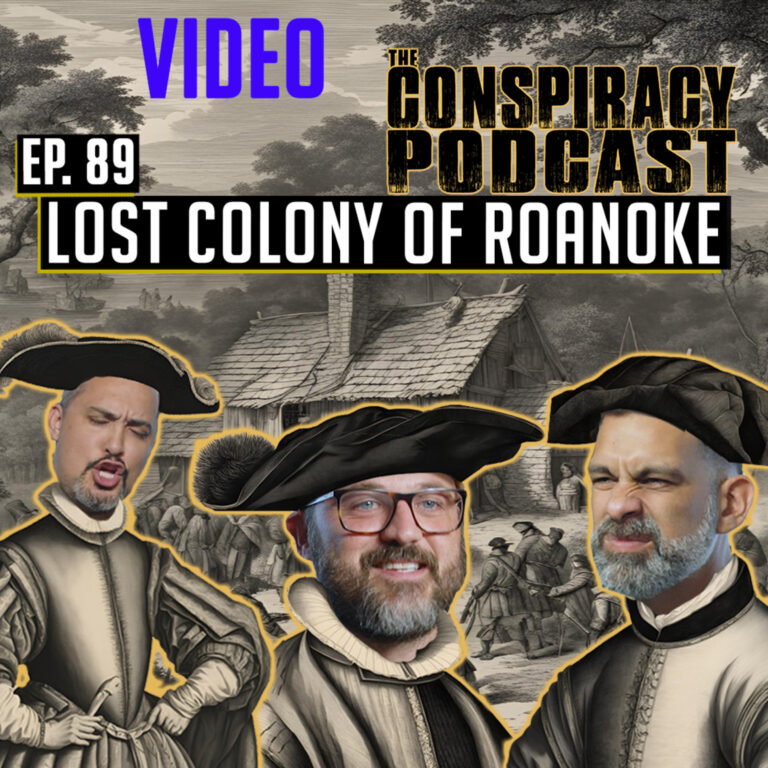
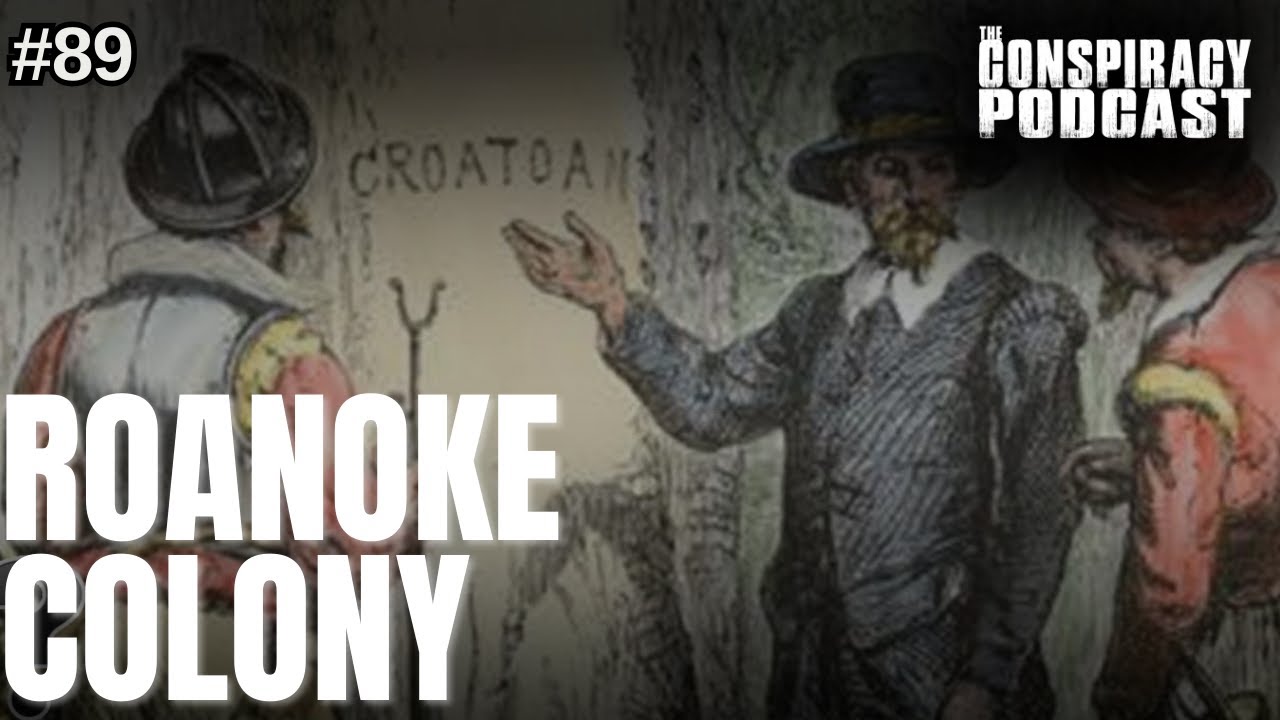
The Lost Colony of Roanoke – EP 89


The Lost Colony of Roanoke
The guys cover the Roanoke Colony, founded in 1587 on Roanoke Island in what is now North Carolina under a charter granted by Queen Elizabeth I to Sir Walter Raleigh. Governor John White led 115 colonists, including his daughter Eleanor Dare and granddaughter Virginia Dare, the first English child born in America, as they rebuilt a fort left behind by an earlier 1585 expedition.
As supplies dwindled, White sailed back to England for reinforcements, but England’s war with Spain delayed his return for three years. When he finally reached Roanoke in 1590, the colony was deserted, its fort overgrown and its houses collapsed. The only clues left behind were the word CROATOAN carved into a fence post and the letter C carved into a tree, which led White to believe the settlers had relocated to nearby Croatoan Island.
No bodies, graves, or personal belongings were ever found, and no follow up search was ever organized. Theories about the colonists’ fate range from integration with local tribes and relocation to Chesapeake Bay to conflict with the Spanish or being lost at sea, and the guys weigh in on which theory they find most convincing. More than four centuries later, the disappearance remains one of the oldest unsolved mysteries in American history.
- In 1587, Sir Walter Raleigh sent 115 colonists, under a charter from Queen Elizabeth I, to establish a settlement on Roanoke Island in present day North Carolina
- Governor John White’s daughter Eleanor Dare and granddaughter Virginia Dare were part of the colony, and Virginia Dare is considered the first English child born in America
- White sailed back to England for supplies in 1587, but war with Spain delayed his return until 1590, by which time the colony was deserted, its fort overgrown and its houses collapsed
- The only clues White found were the word CROATOAN carved into a fence post and the letter C carved into a tree
- One theory holds that the colonists integrated with the Croatoan or other local tribes, a theory some point to English artifacts such as pottery shards and a possible sword hilt found at nearby Native American sites
- Other theories propose the colonists were attacked by the Spanish, who had a presence at St. Augustine, Florida, tried to relocate to Chesapeake Bay, or were lost at sea, but no bodies, graves, or belongings were ever recovered
Read the full transcript
Hey everybody, welcome back to the Conspiracy Podcast. What up. What’s up, everyone. Hope everybody’s doing good. As we move into October, October, Halloween, The Day of the Dead. Here we go. I know, big birthday coming up next week. Next week. No, two weeks. Two weeks. Two weeks. But we’re, we’re next week. We’re doing, we’re going out. Yeah. Oh yeah. Oh, I’m there. One, my only, definely only friends. I’m definitely there. Good. Sean has a thing. I’ve been waiting for an excuse to go out and like [bleep] drink. Sorry, honey, I gota go. Uh, so before we do Sea’s birthday, we’re going to do something. It’s called The Lost Colony of Rowan Oak.
Yeah. I don’t know, I think I’d rather do the birthday and that’s it. Night, peace out guys. So if you’ve ever driven up to DC or New York, you have passed Rowan Oak. You’ve seen it, you’ve, you’ve driven by it. It’s, it’s a, it’s an exit. It’s an exit on the highway all the way up to DC and it’s, it’s Rowan Oak, right. And um, so we should have done that on our road trip. I know, I know, know. Uh, so this is kind of like very similar to an episode that we did uh on the De of Pass. Yeah, I love that, you know, where episode?
Yeah, where it was a mystery story, you know, that sort of thing. So but then we like see like, what could, what did happen? Yeah, what happened exactly. So this is one of the, this is one of the oldest ones of the US. This is the very beginning, the birth of America. This is, you know, at the very beginning. So and I want to give you a little orientation of where we are. So we’re going to take you back. Yeah, we’re going to take you back. Right, so this was around 100 years after Columbus. Okay, so Columbus, the great [bleep] piece of [bleep]. So this is in the 1500s.
Yeah, so Columbus already came and, you know, a little bit of time has passed. Yes, exactly. I’m sorry, I just like cuz Columbus Day is on like the 14th, it’s coming up. Yeah, and I’m like, why don’t we celebrate this piece of [bleep]. He was the worst. He was a total scumbag. I know, what a weird part of history. I know, but like that we still like, I wonder who was the guy who was like, he found America. I know, like all the indigenous people. Yeah, they didn’t see [bleep]. Like, I found it, also [bleep] Leaf Ericson. I know, right, literally. Yeah, another Eric. I mean, let’s be honest, we’re, we’re a diamond.
He was Eric, he was Eric son. Yeah, I know, we’re, we’re Elite, we’re Elite. Yeah. Okay, so the 1500s saw the reign of the Tutor Dynasty. I don’t know if you’ve heard of the Tutors, but it’s like Henry, Henry the Eth, Elizabeth the um, this is like the King Henry who had many wives and he killed a bunch of them. Yes. Okay, and uh, I’ve actually been to the, if you go to um, in England, I’ve been to numerous times, it is, oh, he, he Castle. Okay. And that was where Marie Antonette and all, that was where she lived at that castle. And it’s and they have, it’s very cool, super cool, beautiful castle, beautiful grounds.
So I’m just laying the land, like laying the time, like we’re, we’re, we’re transporting you back to this time. So this is Henry VII, Elizabeth the um, Henry VI broke from the Catholic church and he established the Church of England, yes, which was the separate from the actual church. It was the government being like, we are the church. Yes, separate from the actual church. Yeah, it was crazy. Uh, this was, was also during the time of the Spanish Armada. Um, and you know, this was the age of exploration and the heart of the Renaissance. Shakespeare was writing his plays at this time, supposedly, supposedly, supposedly.
So that just to give you an idea, by the way, if you guys haven’t heard it. So just to give you an idea of where we are, like that’s what’s happening in the world, right. And America is the new, the new, new. Yeah, it’s like the, it’s like new club. Yes, exactly. Yeah, and it’s also the third largest line, it’s massive expans and like on little island, like idiots. So also, this is 200 years before the Declaration of Independence. Yes. Yeah, so it’s we’re not quite there yet. Right, no, it was just they were like, this is like discovery. Yes, exactly. So in 1587, under the ambitious charter granted by Queen Elizabeth the, Sir Walter Raleigh dispatched a group of 115 colonists to establish a new English settlement in the new world.
And this was called the Rono Colony, often called The Lost Colony. And it was not actually the first English settlement, but it was the first attempt to make an English settlement. Yeah, you imag being on like, being on that crew list. They’re like, look, check it out. Yeah, it’s completely undeveloped, totally fine. Yeah, it’s going to be totally fine, bring your kids, it’s going to be fine, there’s gold everywhere, I’m in. Yeah. So the colony was established in 1587 on Ronoke Island in what is now North Carolina. Okay, yeah. H, okay. The first successful permanent English settlement was Jamestown, and that was founded a little bit later, in 1607.
First successful, yes, Rono was a huge fail. So Ronoke Island, located in North Carolina, and this hopeful community sought to lay roots in America. However, shortly after its establishment, the entire colony vanished, leaving behind nothing but enigmatic clues and sparking one of the greatest mysteries in American history. Yeah, so that’s essentially the story, and then we’ll dive into it, but basically 115 people went to settle this place, disappeared. God, and it’s every time I think about things back in this time, I, and maybe I’m a weirdo, but I’m like, God, it must have smelled so bad. Like, oh, just a bunch of, and they’re wearing like, that’s what you’re worried about.
Yeah, I know, that’s what he thinks about, [bleep] bonnets and like [bleep] wool coats. I’m like, oh God, that’s sweat in the, they did not know about the humidity that’s about to hit us, dude. I know, you fools. So Governor John White, which is, I don’t understand why you would be so basic of a name. I mean, that is like, yeah, it doesn’t get, doesn’t get more, it’s almost Ang, Ang. I wonder if he was White. I wild, again. So he was tasked with leading the colony with 115 colonists, including men, women and children, and they arrived on the island in 1587. Upon the arrival, the colonists found that there was a fort abandoned and which had been constructed by a previous expedition in 1585.
Oh man, I would have been so pumped. I’m like, hell yeah, I build [bleep]. Yeah, it was like a pre-constructed fort. They’re like, let’s do it. I know, it’s like they, they got four clothed on and like, we’re in a squat here. Yep. So the new settlers began rebuilding the fort and establish relations with the local Indians or Native American tribes, some of which were strained due to previous encounters of the white man. Oh yeah, they don’t speak the same language and they were just getting constantly like, oh, here, look, this, I have this beautiful hat, here, give me all of your buffalo. And they brought [bleep] syphilis and clamidia, just [bleep].
Yeah, and they just start banging everybody. And like, how do you get, so it’s absolutely insane, like did they come over and just start banging people. And yeah, 100% crazy, classic English. I know. So together with his fellow settlers, including his daughter Elanor Dare, uh, his daughter was named Elanor Dare, then his granddaughter, Virginia Dare. Virginia Dare became the first English-born person in America. Oh [bleep]. So if you wanted to know who was the first person born in America, like a white person, it’s uh, Virginia Dare. Yeah. Okay, uh, they work to rebuild the fort and foster relations with the, the Native American tribes. However, the relationships were complex and strained because of the previous settlements that tried for the last hundred years.
Oh [bleep], yeah, so it’s like a never ending, like, I don’t know, just imagine you come over and you’re like, there’s a hundred years of Indians being mad at you for, for a hundred years of you coming in and just taking, actually more years. Remember, like it’s funny, my, my great, my great great grandfather, was my great great great, I think it was my great great great, he was a Buffalo Soldier. Really. And it was cool because the Buffalo Soldiers, were, they were union military men, but they were black dudes and they called them Buffalo Soldiers because the Indians did not trust white people. So they would send them, they were like, okay, guess you guys are cool.
Cool, they’re from the Bahamas or something. All right, cool, Buffalo Soldier. They would, they would be the ones that would have the interactions with the, the Native Americans, because the Native Americans were like, white devil, and they’re like, we, this over hundreds of years, they’re like, we cannot trust you [bleep]. Yeah, Eric, interesting, Eric, John Eric White. So it’s like that joke. So as time went on, resources dwindled, they didn’t know necessarily how to farm, they didn’t know how to procure supplies, and their resources started to dwindle to where they started to starve, cannibalism. So John decided that he had to leave the settlement and go back to England to get more supplies.
Oh yeah, good job. This is for you, I’ll be back, I promise, trust me. How [bleep] up is this, it’s so messed up, like taking a one man ship, I’m out of here. So he went back to England, he left his family there. Left his family, what a piece of shape, by a side. And he’s like, hey, I’m going to be back, 90 days I’ll be back. Days, don’t worry about it, I’ll be back. He went back to England, they were at war with Spain, and so like there was a naval war going on, so it wasn’t like you could go. Yeah, it’s like straight shots.
Yeah, like there wasn’t like a go, like around. Yeah, it wasn’t like Spirit Airlines, and you just [bleep] pop over real quick? Yeah, uh, so it was significantly delayed due to that war, and it prevented him from securing a ship back to America. Three years? Oh wow. It took… wow. So then he finally return, days, this 900 days? Easy PE. Can you imagine, you just leave your family and it’s like, “Sorry Virginia, I’ll be back.” You like go to Paris and you just [bleep] Bing, drinking bunch of hookers and [bleep] Jack the Ripper and [bleep], just [bleep] back, he like 90 lbs heavier. So he finally made it back, but when he came back it was gone.
He found the colony was deserted. I mean, they were already dwindling supplies. I mean, 3 years, wow, they’re [bleep] toast. So that, so he noted that the fort was overgrown, grown, the houses collapsed, indicating that the site had been abandoned for some time. The only Clues Left Behind were the word croin, which is c, croin, c, r, o, a, t, o, a, n, carved into a fence post, and the letter c on a tree. The [bleep] does that mean, some like a National Treasure code here? So White took these Clues to suggest that the colonist may have moved and left to a crotin island, which is now, now it’s called hus Island, but at the time it was called croon Island.
Oh okay, that makes, that makes sense. Where the cro toan tribe, which were friendly to the colonists, they lived. Oh, they were, we’ve, we’ve, we’ve now married all of our women off to the cotone people. So, in like, so what he thought was that they decided to go onto a tree, write the letter cro, and be like, “Hey, this is where we went.” Yeah, yeah, kind of makes sense. I mean, with that, he then went to that Island. His efforts were thwarted by a series of misfortunes. Weather turned bad, he had, there was a hurricane, one of the ships were damaged, and eventually the captain of the ships that he was on said, “We cannot go further, we’re returning to England.” Damn, oh [bleep].
So this gu is father of the year. Just a few miles down, I mean 50 miles down, okay not like a few, but like 50 miles down, yeah, another Island. Lot shorter than England, yeah, another Island. So apparently white was devastated, as his family, after three years, of like piecing out of his family, his entire family was gone, including his daughter and his granddaughter Virginia, the, the first born, ier was like, they not shed one tier. [bleep] this guy. I’m like, “All right, sorry sweetheart, 90 days, promise you.” Here’s what’s the crazy part, he never returned. He went back to England, he never came back to America, settled into his new life.
The fate of the colonists remain unknown to this day. No Rescue Mission or thorough search was undertaken after by the English. The mystery lingered and became a tale, and a mystery, and a legend of America. And no bodies were found, no clothing was found, no personal belongings of the Rono colonists were ever found at the site of the deserted colony. Did they ever, to this day, did they ever explore this croo in Island? Yeah, like, and nothing, nothing. I mean, they didn’t have, no, they didn’t have any ships or anything, right? They like, and it’s not like swim, it’s not like, it’s Jorge, Sean, and Eric, yeah, and we got like a little Camp thing, we didn’t find any [bleep] modellos, we can’t survive.
Yes. And then Eric’s like, “I’m going to 7-Eleven, I’ll be back in 90 days.” It’s 115 people, yeah, women, children, men, yeah, damn, nothing. Yeah, I mean, it does. Like the thing that sucks though is like, since he was gone for 3 years, it’d be different if he was gone for like 6 months. Yeah, there might be some signs of like tracks, or maybe you might find like, yeah. So the English were ruthless, um, and they, their Ambitions to colonize America was, uh, very strong, and so they just said [bleep] Rowan Oak, play sucks, no. And then a few years later they established, um, Jamestown, yeah, which was the first permanent, like if you wanted to go to the oldest town of America, it’s Jamestown.
I think they also like, they, this was like the, this is like the test case, they’re like, “Let’s see what happens.” Yeah, and they’re like, “Oh [bleep], we should probably bring more supplies and learn how to cultivate.” They straight up just pieced him out. Oh, so damn. Yeah, so this is, uh, this is 500 years of speculation, of mystery, of, uh, I mean they’re the, some of the dumbest documentaries you’ll ever watch in your entire life. Uh, can’t wait to watch those. And they’re like digging, literally like 17 hours of them digging, like, “Oh, there’s an arrowe head, maybe this was the Rowan o Arrow Head.” You know what I mean, like, like I watched about s hours, and I was like, I, I feel like a lesser person now, having watch, actually know less about.
Yeah, yeah. So there you go, that’s really the story of a ronoke. And, and you can go there, and, and there’s all these theories, and we’re going to go over the theories, and, and but they, they, they range from, uh, murderous Indians to, uh, to jealousy, and, in, you know what I mean, all sorts of stuff, but no evidence, likees the problem, is looking good, exactly. So over the centuries, numerous theories and investigations have been proposed to explain the Fate. One of which is the integration with local tribes. One of the the most widely, uh, accepted theories is that the colonists, they were facing starvation, MH, and isolation, and they may have maybe integrated with, that’s what I mean.
That’s what seems like, that’s what I say, seems pretty legit. We got these, we got these fine white wom here, my man, y Indians are like, “Okay, all right, we’ll feed you.” You got cheeseburg over there, I got a white woman over here, like, look, fair trade, same, same. Now there’s some, like, I mean this is very loose Witnesses that say, yeah, no, I, I mean like they say, oh, you know that tribe of roke, and the Indian tribe that was nearby had some white qualities to them. So then that means they Define as a white quality? I mean, you know, receding hairline, blue eyes, big dick, you know?
Well, this seven, seven of the sheans are bald, are bald, bearded white man, we think got some quality. Yeah. Another theory poses that the Spanish, who had established a presence in Florida, St Augustine, they destroyed the colony, wiped them out, and that’s the theory. Is that, my thing is, but there’s no evidence that shows that. I don’t know how they, all I know, how the Spanish survived when they got to like St Augustine, I like, how the [bleep] did they survive? Cuz like, I mean, you could put me in St Augustine with, with actual supplies, and I would die. Dude, it’s the most humid place.
Me and my wife have been there multiple times, and like we go to like the fort, and like I walk around, I’m like, I’m soaking wet. Uh, let’s go to the super hot bar. That the AC, how is that different from here? Yeah, it’s a little different, it’s a little more. Also, just, just imagine wearing like a petty coat, or like some [bleep], some like wool, yeah, some wool [bleep], and you’re living in a [bleep] like a microwave. Oh gosh. Some believe that the colonists attempted to relocate to Chesapeake Bay, uh, as suggested by some maps of the era, showed that there was maybe a fort nearby, and they went to ches Bay, so that’s one.
Um, another possibility is, is that, is that the, I like that one. Another possibility is that the colonists decided to peace out of America, and they got on a boat, and just went, and they got lost in sea, in like the ber triangle. Oh, it comes like that, I mean, cuz it’s kind of close, and you kind of is, I mean you kind of go, they’re like, they’re not like people, they’re like, this way, this is like the right way. It’s run by a bunch of women, can’t drive, just kidding, it’s a joke. Yeah, we’ll keep that then. Yeah, I don’t, I don’t, problem, I’m in, uh, recent archaeological digs have provided some evidence that may support the integration Theory.
I like the integration. I think artifacts, such as English Pottery shards, have been found in Native American sites, suggesting that some interaction between the colonists and local tribes. They, they noticed that they had blood sausage and beans for breakfast, and the Indian, I don’t know what’s going on here, saage [bleep] Eng. Every time I go to England, I’m like, I just can’t, like, why is it so heavy? I don’t need like this much density in my breakfast. I’m, every time I go to Europe, I’m constipated by like 11:00 a.m. Dude, it’s crazy, I’m like, “God,” and then I’m like, “Oh, I guess we’ll have a Guinness with this.” I guess, guess, like, yeah, we’re like the fat ones, I don’t understand it, understand, how are you all not a beast?
This is crazy. Anyways, the story of Rono has captivated historians, archaeologists, Etc, contributing to a broader understanding of the early colonial Endeavors on American soil. But there are, there are hundreds of books, movies, documentaries, uh, fictional movies, uh, all this sort of thing. It’s a very much like a Campfire Story. Yeah, because there’s no data. Yeah, nothing. They were there, we know that. Yeah, and then they weren’t. Yeah, and we know that modern archaeological techniques, such as ground penetrating radar, DNA analysis. Now these are part of the the the documentaries that will, you’ll want to kill yourself after watching. Yeah, because they’re like, you know, we’re going to [bleep] put it in the ground for 12 hours, and it was like, nope, nothing here.
Yes, 100%, and that’s it. Yeah, and you move on, and you’re like, [bleep], it was a $2 million Grant. Meanwhile, you invested like a few hours, a few, a few, like Heinekens in, and you’re like, “God damn, nothing here.” I, you’re like, cool. Yeah, uh, down, like thumbs down on Netflix, you piece of [bleep]. While some archaeological findings Suggest potential integration of native tribes. Others proposed that environmental factors may have played significant roles in the disappearance. I mean, yeah, like America is not England. Yeah, it’s not overcast all the time. Yeah, it’s not like, like I mean some places, this is North Carolina too, so there’s like, there’s storms, it’s humidity, it’s a little bit of Florida and a little bit of North.
Yeah, you got cold [bleep] ass weather, all of the things. And like if they’re coastal, yeah, they going to get like hit. But again, it’s it’s very strange to me because no graves, no, uh, yeah, you think there would be like one [bleep] died there. And yeah, but but very little, very little things, and then they just gave up on him. And like the people gave up on them, the family gave up, any like clothes or nothing, like nothing, nothing. And so a lot of, a lot of things, maybe they were [bleep], maybe the Indians have merked them and they took all their [bleep]. But there be bodies though.
Yeah, exactly, maybe they took the bod. Unfortunately the difference between this and say D’Ieteren passes, we have like photos and we like we saw like what pass, you know what I mean, like all happened like, yeah, 50 years ago. True, true, true, true, true, true. So I don’t know. I mean, you know, there’s a lot of like, uh, I mean we don’t even have to get into the whole like theories of, of, you know, how they treated the Indians wrong and the Indians butchered them. And then, but we don’t know because there’s no, there’s no data. No, I could also see, like even if they didn’t treat him wrong, I get to see, let’s say like you’re, you just like happen to run into them.
Yeah, you’re in a tribe and you’re like [bleep], yeah, and they’re like, you see all these people that are like, you know, to you they’re alien. Who the [bleep], like what the hell is this? And you’re like, well, they got to be enemies, [bleep] them, like you know, you don’t know this, you’re not going to like risk it. And maybe like you have like heard stories, maybe their campfire tales are like, yeah, these [bleep] pale [bleep] come here, they got muskets and [bleep]. So here, here are a couple, um, like this would be the stuff that we would talk about at the campfire. Yeah, here are a couple like little anecdotes about the story, you know.
Okay, one is the Virginia Dare symbols. Okay, and she was the, the first born. First, she was the first born on American soil. She’s technically realer, she’s the first real American. Technically the Native Americans, yeah, I mean, first, never get any credit. Never. The first human born on American soil are like, yo, we’ve been here for thousands of years, losers, never getting cred, even by brown people. I know, right? Sorry, Virginia was the first. So, uh, her name and the circumstances of her birth have become emblematic of the mysterious disappearance of the colony. Over the years her story has intertwined with, um, American folklore, including a legend where she is transformed into a white doe by Native American magic.
The myth symbolizes the merging of English settlers with the native, enir, reflecting deeper, deeper themes of adoption and survival. Yeah, so we’re going to check that one off. The scratch, hell no. Indian witch doctor turns home girl into. I mean, I’m, I’m not even kidding, this is like where like we have like pee and we’re [bleep] smoking the PIP. Maybe this is what happened to Virginia, she became a [bleep] doe. In Harry Potter’s [bleep], she’s the elder one. Yeah, she’s [bleep], yeah, made from her femur. Uh, then there’s the Dare Stones. In 1937 a stone, allegedly, allegedly inscribed by Elanor Dare, which was the mom of Virginia, was found in North Carolina.
The stone, known as the D Stone, claimed to relay the fate of the Ronoke colonist. On like a little stone, like suggesting small, like, okay, here’s what I’m suggesting, they suffered a series of misfortunes. However, the authenticity of this and subsequent stones found later remains controversial. These stones, if authentic, would offer a direct account from a colonist about their fate. But again, the authenticity, about that is like, we would, we carve cro into a tree and then she’s like, I’m going to chronicle this all on a stone. Right, right, check me out, you’ll never know the difference. Next one is John White’s map. Okay, remember John White, right?
He’s a, he’s a [bleep] dick. I think John White is like, organized like, he was like, yeah, was like, I’m going to invite all my homies I hate, and then, and then like I’m going to dump my kids off and like peace. What, like a, like an intricate way to get rid of your wife. I mur, I came back. And he like, sar, years later he’s like, nope, no one’s here, got to go. John White, the governor of Ronoke Colony, created a detailed maps of the region. Modern technology revealed a hidden fort symbol under a patch on one of the maps, suggesting that the colonist might have moved inland to a location previously planned for fortification.
Did, how much you want to bet that John White knew where they were and was like, can’t find any, back to England? He like, all he like, oh [bleep], back to Paris, back to the, where’s the wine, back to the city. This discovery directed recent archaeological efforts inland, like Site X, in the hopes of finding evidence, uh, providing a potential clue to their fate. But again, nothing was, no real evid. So it’d be kind of like, you, you came back, you looked for your family, you made a map and then you put a little X. And then later on Sean’s like, I found [bleep], John White’s map, and then there was an X on it.
And you’re like, what the [bleep] is that X? Like 500 years later, that X, like where you like took his [bleep]. I know, don’t stay here, took [bleep] at this. It’s it’s like he buried his diary. Gold. Cool. Okay, good. The next one, Spanish involvement. The Spanish Empire, competing with England for domination in the Americas, because at this time it was, yeah, you know, real real heated. Uh, he, they kept detailed records of their Rivals Colonial activities. Spanish documents reference Roanoke, but intriguingly do not report any direct interference with the colony. The absence of Spanish involvement in the colony’s fate, despite their knowledge and proximity, adds another layer of mystery.
Meaning they were pretty far away though, like they had to send, like, well, they were up there too. I mean, they were, they were like, again, it goes back to, not having any info is suspicious. I know, they’re like, it’s sus that they didn’t do [bleep] about it. Yes, like, well, America is like 12 times the size of both of your countries can buy. Exactly. So again, you know what I mean? Yeah, I love, it’s like literally like it’s so weird that they, it’s so weird that they didn’t know that, they let them be. Exactly, sketch. I love those, I love him so much. Okay, good.
Then we, we go back to the tree carvings. When John White returned to Ronoke in 1590, he found the colony deserted, no trace of the colonist except for the word Crotin carved into a post and C on a tree. Mhm, that’s got to have some significance. These carvings suggest that the colonist might have moved to Crotin, cro, am I saying that right, Croonin, Croin Island. Other, less well-documented carvings, supposedly bearing the initials of colonists, could indicate their paths or fates, uh, but have not been verified as the same certainty as that original message. Meaning there were other carvings, but the most, everybody agrees that somebody wrote Crotoen, okay, into a post and C into a tree.
Okay, okay, good. The next one. But then yeah, why? See, my thing is like, okay, you do the full word into a post, but only C into the tree? Mhm. Well, you, I mean it’s hard to ride on a tree, like it’s game. Yeah, good enough. Have you ever tried to carve anything into a tree? It’s [bleep] hard, dude. The 1500s, dude, it takes a long time, takes a long ass time. Long time, three, three letters, probably took them all day. I know, they’re like, I’m starving, I can’t, doing this. Okay, so then there’s something called the Sder Field site, and recent archaeological excavations on Hatteras Island, which was formerly Ctoan Island, uh, having covered English artifacts dating from the late 16th century, which could belong to the Ronoke settlers.
Mhm, yeah, items such as parts of a sword hilt and pottery fragment suggest a possible relocation of the colonist to this area, supporting the hypothesis derived from the Croonin carving. Yeah, I mean that, it’s most obvious choice. These findings potentially connect the physical movements of the colonist to a specific location. But then the question then becomes, if they move to Croo and Island, did they just absorb into that tribe and then disappear? I mean, disappear, it’s either, I mean not disappear, like after, like just, it’s either that, like I don’t, I don’t know, I don’t ever foresee like them fully integrating into the tribe. I see the tribe being like, kill the dudes, yeah, like you know, like make them slaves or something.
You’re cool, you’re cool. Uh, come here, Viria. Virginia Dare, huh? Steve, why don’t you come beat me by the fire? I dare, I dare you to come to my tent, real qui. Huh? Stupid, put on this blindfold. The story, the story of Roo has captured the imagination of many, uh, it’s become literature, books, film, television. I mean, it, you can, you could go do ghost tours. Oh yeah, Ronoke, right now. It’s so funny, you do ghost tours, but there’s like no bodies there. You’re like, where are the ghost? It’s it’s honestly, it’s it’s one of the ones that are, it’s just American folklore, it’s Ronoke, you know, at this point it’ll never be solved.
Yeah, unless we solve it tonight, which we might. Uh, so let’s get into the [bleep] wild ones, the real wild ones. Yeah, finally, one of the more outlandish theories suggests that Colin were abducted by Aliens? What did I say? What did I say? Or a no [bleep] left, no [bleep] clothes, not a one pot, not a one teacup, or uh, vanish due to Supernatural forces, kind of like an xfiles kind of phenomenon. But is an xfiles aliens? Well, no, it’s also like it’s also like demons and uh, [bleep] weird. I mean, they did talk about the Indian witch doctor, to. Yes, exactly, where clothes go?
Yeah, I don’t know. Some theories propos that Rono colonists left the island to live with indous tribes, but were later taken by explorers or Traders from other non-European countries that made contact with the Americans before Columbus, as slaves. Yeah, they’re like we’re saved slaves, godamn. So then they, uh, made that transatlantic travel, I mean, to Africa, and then became slaves. God, you imagine [bleep], and then they were wiped, imagine, different country, on a, on a wooden ship, [bleep]. God, have you seen Amistad? D, yeah, that’s, that’s a hard one to watch. Dude, brutal. Set us us, set us us. Oh my god, dude, it’s so good though, like it’s all the acting, everything is good.
Yeah, so good. God, [bleep]. Um, another theory, like with him on the sh, yeah, another, yeah, another theory poses that the colonists were either Massac by the Native Americans, but they left no traces, or by the Spanish that were nearby in Florida. Maybe, see, like maybe, like one of the things that I talking about, like maybe the Spanish just took him, maybe the Spanish came in, they’re like, [bleep] you, you’re coming with us down to the Glades. I like that, I like that. So maybe that’s why there’s no, they took, conspiracy part of it, inod you to a COC, to an alligator, a conspir. The conspiracy part of that is that they were massacred, and then the English covered it up because they didn’t want to deter new settlers, the new Settlers of Jamestown, they disappeared.
Oh, maybe like, oh, maybe like they gave John White. John White, like, found the [bleep], like had to clean up the evidence. That’s actually legit, I like that, I like that, because if you think about it, they’re trying to get people to settle America. No, like, what’s the TR record? We, well, the first one, they all got slaughtered and everybody got raped, by the way. Yeah, but we got a new plot looking real hot. So that’s the, that’s the conspiracy theor that the English government, or, or royalty, covered it up and said, oh no, they just disappeared, whatever, we’re not talking about that. Would about, have you heard of jamest town?
Like, what did you say, fot killed? Yeah, in it. Ain, it crazy, right? We’re going about Jamestown, right? In it, it’s wild, a it, it’s in it. Bo chees [bleep] socer. Sorry, gamer Dave. Sorry, gamer Dave, where you at, baby? Even football, right? Well, they like all accent, ancient fuing Engish. Some suggest that The Disappearance was orchestrated or later covered up by the English government. Um, you know, what if the government’s involved, and it’s, that’s what it was, solved as, as a military strategy against the Spanish, and about settling, because they needed settlers coming. So that’s talking. I like that theory, super Fringe. On the extra Fringe, Time Travelers?
Oh, that’s not even Fringe, that’s just like it’s a different Universe. Some have suggested, some have suggested that colonists disappeared because they traveled through time or found a portal to another dimension. Stargate. The theory is often supported only by fictional accounts, we don’t have any evidence of that. No [bleep], we have, damn it, we didn’t find, we didn’t find portal, [bleep], no evidence. But it, l, what was that? But how would we have evidence, cuz they went to a different time? We, we, we will have evidence soon, it’s coming up. They’re like five years in the future, is going to be like the whole, like uh, uh, like the DB Cooper thing that people up.
I got time. Oh my God, last one. Um, witchcraft link to the supernatural. Theory: some narrative suest just that the colonies fell victim to occult practices or witchcraft, which led to The Disappearance. Uh, this ties to into the broader fears and stereotypes of that time, which was the Pagan practices attributed to both Native Americans and the Misunderstood elements of the elizabethian religion, and moving into Salem, and moving into like the witches, and you know what I mean? I, I think a lot of that is, honestly, that’s like propaganda by, like, the C. So, like, these pagans are doing all this weird [bleep], and they’re like, what, what?
I’m sorry, I didn’t, like, isn’t that one weird? We should do Salem pretty soon. Oh yeah, that one’s a weird one. You know, it’s super [bleep] weird, cuz I’m, it’s like I’m, I’m pretty sure it’s like the [bleep] goal propaganda machine, you know. Oh, you’re wit, like there’s all those me too, they’re like, you know your girl cheats on you, back in the, you like [bleep] [bleep] string her up as a witch, like it’s so [bleep]. And it’s really easy, cuz people were very, like, devout in the time, and obviously the church ran the country. I mean, in Ence, and same with Spain too, the Catholic Church ran Spain.
That’s why, like, a lot was going on with Henry VII at the time, CU he was trying to sep, he, he wanted to get a divorce from one of his wife, and they wouldn’t let him. So he’s like, [bleep] that, he’s like, [bleep] it, I’m going to make it my own church. Divor, and it’s separate from divor. Totally, exactly, cuz he thought he was Godlike. And yeah, I, K, I just killed my wife. Oh, I didn’t get a divorce, you died. So there you go, that’s the Lost Colony of Ronoke, and uh, you know, all our, all, all our truck driver listeners who are driving through the North Carolina and South Carolina areas, and you pass Ronoke, and uh, I don’t know, I mean, just know that there’s nothing there, there’s really nothing there, it’s just a bunch of islands.
And um, it’s kind of like, if you went to, you know, if you went into Tampa Bay and you found one of those islands, and it’s got like a few, yeah, it’s, it’s got like a few trees, that sort of thing. Just imagine that, but a little bit longer, maybe a mile or two, of a little island with, you could camp there, like a little calc Island, one of those. Yeah, yeah, yeah, and that’s about it. Yeah, that’s about it. That is like not a good place to settle. I know, idiots, I know, there’s like a whole land right there. Wonder. No, no, no, no, this is the, this is the spot.
You’re like, bro, there’s no dirt, it’s just sand, it’s just sand, like water, and it’s fine, we’re going to build a house here. Look, there’s a fort. Yeah, there a for, no problem. Yeah, have you heard of a sinkhole, John? John, like John, know, I am the governor. He’s like, it’s fine, I’m leaving, and like I’m, I’m leaving like Friday. I was like, oh [bleep]. Oh, Supply run, sweetheart, sorry. All right, so, so I don’t know, this is, I know there’s not a lot of data, but what’s crazy about this is, if you went and you were like I want to look into this more, you could watch 50 hours of documentaries and provide no more data than inform.
Yes, literally the same spot as we started. Exactly, was more confused. Yeah, so I mean, I apologize if it’s condensed into a, like, this is just what I got out of all of that. Yeah, and so, I don’t know, 115 people, and the main dude pieced out. Three years later, came back, oh, nobody’s here, I’m out, again. I think that, well, a go to the middle here, I definitely think the, the English government covered it up 100%. I like that, I like that. The, I think they covered it up. I think, actually, what happened is, might be like, maybe a little vanilla, but I think they, they probably were starving, and then they probably tried to integrate in, like, or, or go with, and maybe they took some of them, but not, but I think that there was probably, there was probably bodies there, people who died of starvation, because, like, yeah, some, there had to be a body there, one person had to have died there, minimum.
Yeah, and they weren’t going to, like, take it on, like the car. So I think that when John White came back, and they probably had like a fleet of dudes, I think they were like, yo, get, bring the body, clean it up, make it look like nothing, we have to get Jamestown going, in like, yeah, post haste. Yeah, we post, like this logistical nightmare, like are going to, to come here, like just take the bodies, they vanished, they actually went, all went to heaven, boys, that’s what happened. So I think that, I think that it, bury them, just like get rid of, right? Like, would have found, they would have been, they would have found something, they would have found a bone or a grave, or even like a little cross.
I don’t, they, they would found something, I think they took the body. But what is the, what’s the words in the, in the tree, is there some dude leaving his thing? I made, like, Cassie, Richard, Oswaldo, osalo, I don’t [bleep]. So you think that’s just not Rel? A kid just [bleep] hatching [bleep]. And I don’t know, like, be, it’s, it could be nothing. I mean, granted, the crow toan thing is like pretty captivating, but, like, maybe, like they went, and they’re not Sailors, and they just died at Sea. Yeah, true, I mean, that’s the only other log, they tried to go home. Yeah, they’re like, [bleep] it, we got, but they didn’t have a boat, because John follow the sun, they went up back on the island, [bleep].
When your destination is Discovery, there are no wrong turns, that’s why, at is very cold, the new 2025 Lincoln Aviator SUV provides momentum. Beyond mere transportation, in this thoughtfully crafted and confidence inspiring SUV, your destination is not about where you can go, but who you can be. Explore More at lincoln.com. Lincoln and Aviator or trademarks AFF for its. Affiliates: Starbucks iced apple crisp oat milk shaken espresso, made with blonde espresso, creamy oat milk, and spiced apple flavor. It’s icy, crisp sip you can enjoy all Autumn long. Order ahead on the Starbucks app. Damn it, it’s true. The World is Flat. I mean, we joke, but that’s literally like, could be.
Yeah, we didn’t think America was here. I like the idea that, um, you know, they just got to a point where they was like, [bleep], we’re starving, nothing. Like, what are we going to do? So they started making their way to, to this island that they knew was there. So that’s why they kind of left, you know, word behind. By, by, cuz you got to leave your, you know, your guy. Yeah, yeah. Well, after like two years later, like he, like he’s a band, this also. But did they not have paper? Could you just like tie, like, like, you know what I mean? Why do you got to do like a coded message?
I know, just leave a letter. Like, hey, John, he John him, South 50 miles. Damn, that’s like no big deal. Like, but like, also, it’s like, if you’re going to leave, like, we only have enough time to write one word, three letters, one word. What the [bleep] are they doing? They just gave up. It’s too [bleep] hard, I’m telling you. You ever tried the tree? It’s [bleep] hard, meanwhile, I’m telling you. Meanwhile, [bleep] Shakespeare’s writing Romeo and Juliet like across the pond. Yeah. And he’s across the pond writing the [bleep] greatest play of all time. They’re like Crow, not even Crow, it’s, yeah, the [bleep] is going on.
What do you think? Sorry, no, no, no, finish your thing, finish your thing. Yeah, I mean, I was, what do you think happened? I just think that they went on their way to this island, yeah, and either, a, all 115 of them, like, I’m out, yeah, all of them [bleep] it, like, there’s nothing here, like, cap that, that, that was, I don’t know, I’m fighting between, that’s one Theory, and they made it, they somehow made it out there, but they got a, they got lost at se somewhere, okay, that’s like version one. Like, I, maybe took a boat down, cuz it’s 50 mies. Yeah, it’s a bit of a truck, ran into the Spanish or something.
Yeah, it’s a bit of a truck, [bleep], no, I don’t think, I think they just ran into some, like, not knowing what to do with at se and they just got lost and they got, and they died. Right? Sparrow. Yeah, yeah, raise the sheet. Or they went Inland, and then, I mean, like, this [bleep] country is huge, and then they just kept going, they just kept going, like, far enough deep in that you just never, you’re never going to see them, the original Trail of Tears. Yeah, there you go. Okay, all right, all right, uh, I, I really like the, the theory. I think a lot of them got sick, um, and then, uh, it was covered up.
Oh, definitely think it was covered up. Oh, that’s true. I do like that theory. So maybe, maybe half of them got sick and died, oh, then they found, but where they end up, and then they all just scattered, like, meaning, like, they didn’t all go together, like, oh, there was, like, I’m taking my, my family’s, like, I’m out, and I’m going to go find my way. And they went to, like, the Blue Ridge Mountains, and with Indians, and some with this, and some went this way, and some went that way, and then half of them died. And then when they back, and they were like, we got to kick these bodies out here, yeah, and then they covered it up.
I definitely think there was a cover. I really think there was a cover up, because they are trying to, like, you’re trying to get people to go, and if, like, if you’re not, yeah, unless, like, you, like, owe taxes to the government, and you’re like, they’re like, you’re going, yeah, and I think they’re not going to hard press to, to really get people to go. They’re like, well, like, my [bleep], next my neighbor to die there, bro, the [bleep] would I go, I’m living pretty good, I’m like, uh, I don’t really understand the, the tree, it really doesn’t make sense, that part doesn’t. Well, they’re leaving, they’re leaving word behind, they’re leaving a note behind, to where they’re leaving a, like, not incomplete word, but it’s also, it doesn’t mean they did the full word in the fence, but it doesn’t necessarily mean that all 115 did that, like, it could have been just some crazy ass [bleep].
Oh, maybe, maybe, maybe Governor took over and, like, this what we’re doing, yeah, like, it didn’t, like, I know, like, like, if we were all in a commune with 115 people, and we were like, okay, we’re all dying, just so you know, I would be like, I’m not really following you anymore, buddy, I’m like, out on my own, and maybe he did something on a tree. Yeah, I mean, makes sense. Like, it doesn’t have to, well, when [bleep] gets, like, yeah, when [bleep] gets wild, like, maybe, like, he’s like, he just takes all the supplies for himself, exactly, does a little diversion with the crow, meet me at the croo, folks, he, like, dips, he’s like, I’m out.
And they all, like, oh, we got to go to croo, and he’s like, peace. So, uh, the last thing on it, the last thing on it is that, uh, haunted, uh, there is theories that, that the island is, the island is super haunted now. So then I have two questions, I have two questions. One, it’s haunted after, like, some traumatic, you know, no, no, I mean, if disease, and then, but why the Hun, as a disease, you’re like, pissed, ah, yeah, yeah, the [bleep] out of this place, got sepsis. So, but I have two questions on that, sh, out of you, so I have two questions onia, damn it, so I have two questions on it.
One is, do you believe in ghosts? And two, like, haunting ghost, and then two is, r, no, haunted, dude, I do, because my, my, I lived in, so when I lived in Ohio, and one of the houses we lived in, of the street called Observatory MH, it was the first house on the street. It was like, like, dude, it was literally like 200, think it was 200 years old, it was like, [bleep] dude, it was like so old, old, it was old as [bleep], and it was used to be a farmhouse. And, dude, there was, you like crank the electricity, and dude, weird [bleep] would always happen.
And, like, my parents had multiple stories of, like, my mom was not one to, like, get [bleep] scared, and my dad too. My dad’s like, hey, whatever, like, my [bleep] scary [bleep], yeah, and he literally told me the story of how he was in bed. And my mom had a very similar thing happened to her, and he said, like, he’s in bed, and, like, he, like, he, like, feels my mom get out of bed. He’s like, oh, okay, it’s, like, oh, she’s going to like bathroom or something. Yeah, and then, uh, then he feels her, you know, like, [bleep], feels her get back in bed, and he rolls over, and there’s nobody there.
And he’s like, J, where the [bleep] are you? And she was like, downstairs in the kitchen. Really? Yeah, bro. Like, literally said he [bleep] freaked the [bleep] out, like, he actually freaked the [bleep] M, yeah, I was like, oh my God, can you imagine that? Feel in the B, and you’re like, oh, hey, you feel their, uh, their aura, or, like, the weight? No, like, the weight, yeah, you physically feel someone get into the bed. Like, I can feel, I can feel, like, when my wife gets in the bed, and it, like, rolls over, and she’s not there, and my mom’s downstairs in the kitchen, like, that is terrifying.
So I think that there’s some, like, I think we had this conversation before about ghosts, St ghost, and, like, like, how the effects that, like, how much effect can they create, I don’t know, I think there’s some, yeah, we, it’s like, it’s like Patrick sey with the penny, or he’s like, man, someone embracing me right now, and I’m like, making this Pottery, I don’t know what that song is, but, yeah, I would sing it right now. Yeah, I know, I don’t want to. Close, no, no, not that one, definitely not it. Okay, um, as far as ghost, I, I, I actually, and roke, like, okay, well, as far as ghost, like, I do, I want to believe in it, but I just, I’ve never had an experience, I’ve never ran into anything.
Right there with you, buddy. I’m right there with, but not even, like, somebody that, that I knew, like, you, no, nothing, so, but I don’t know, I feel like, I like, it’s got to, got to, it’s got to be, got to exist somewhere. I’m with you, man. I’m glad you were honest about it too, though, huh. I’m glad you were honest about it. Oh, I remember we did have this conversation because I told you about that, that one, um, that one thing in, in San Antonio about the, the ghost of the kids, kid pushing. I actually, I don’t remember if it was in San Antonio or not, but it was like somewhere in Texas, no, I forget what episode it was, but we talked about ghost.
Yeah, we did, we did, we did, I do remember that. But ronok, I mean, I know you guys haven’t been there, but, yeah, apparently it, apparently hasn’t thing, definitely not, no one’s there, there’s no one there to hun, they’re just like there, like [bleep]. I’m to damn not, I’m not buying that one. All right, definitely. All right, well, there you guys go. Um, I think we solved Rowan Oak. Yeah, frankly, cover up. Yeah, I mean, trick of the book, I think we, I think we, I think we kind of all agree, like, they got sick, or they got murdered, and then died of starvation, and then the people who came after were like, we’re not telling anybody about this.
Yeah, they’re Like, you know what I mean? I mean, the prop, we can’t, can’t drive the property value, can’t do this. You got to keep it on the UPS. So there you go. Uh, prove us wrong. Yeah, I dare you, I dare you, sons of [bleep]. Not D, I don’t want to hear your shitty comments Tik Tok anymore. I don’t want to Tik Tock you, Tik Tok, we will answer, but stop doing it. All right, there you guys go. Night, and night. Hey guys, are you obsessed with us? I am. Can you just not get enough? That’s all right, we don’t blame you. We just launched a patreon, patreon, and, and Spotify exclusive content.
There are two ways you can sign up for exclusive content. The first is through Spotify. There’s a link in our profile description that links you to the Spotify Premium page, and that’s only $2.99 a month, and it gets you an adree experience, and it gets you extra episodes that come out every month. The other way is through our patreon. All you got to do is go to patreon and search The Conspiracy podcast, and you’ll find us. There are many different levels there, all giving different amounts of content, and you get a lot of bennies with this, like maximum bennies. No, no ads. You get some exclusive discounts on our merch.
Oh yeah, you get access to our, we got, we had a Discord. You want to like talk to us in real time? Do you want to yell at us constantly live? Yeah. Do you want to have free access to cuss us out without any repercussions whatsoever? Or just simply suggest a new episode that we got to do? There you go. And on top of it, you get five free mini episodes right out the gate, and then a month from then on. What is a mini episode, real quick? A mini episode is basically a conspiracy or a mystery where it just doesn’t warrant a full hourlong episode.
So go to conspiracy podcast.com patreon.