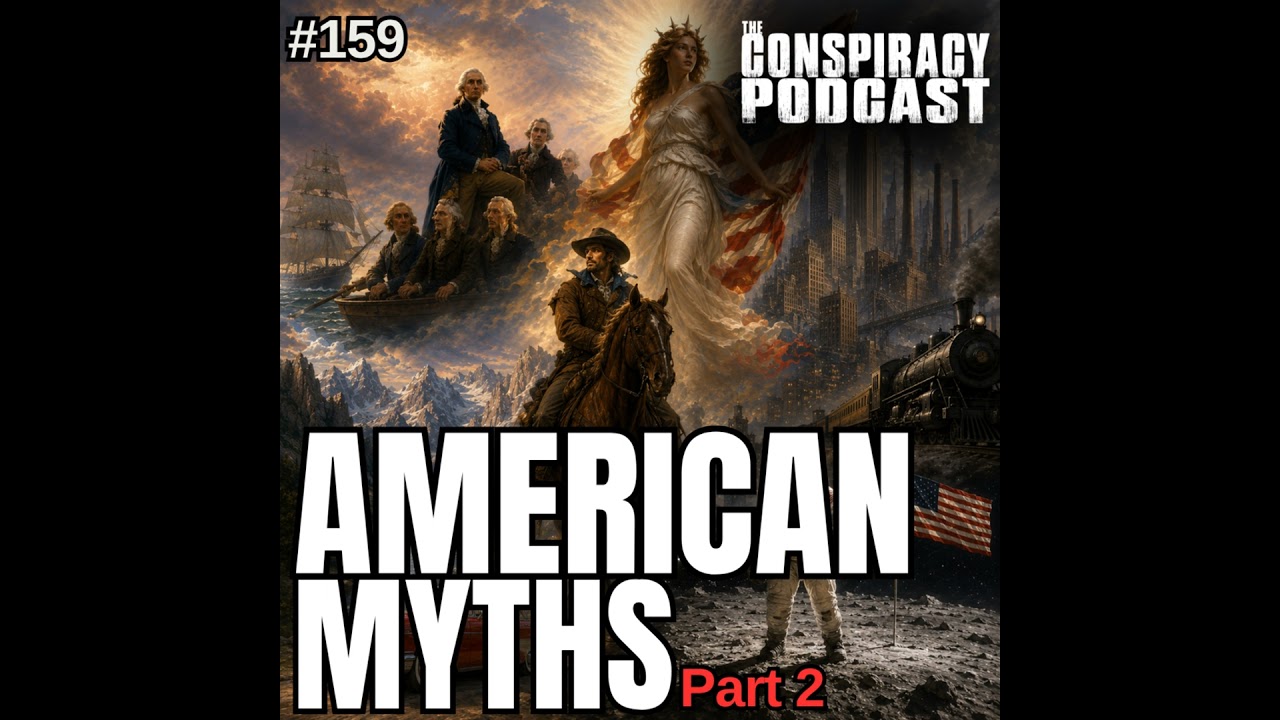
American Myths Part Two: Columbus, The Alamo, Pocahontas & The Liberty Bell – EP 159


American Myths Part Two: Columbus, The Alamo, Pocahontas & The Liberty Bell
Part two of the guys’ American myths series moves past the individual founders covered in part one and into the myths that became the backbone of American identity: the discoveries, the symbols, and the founding stories the country tells about itself. As with part one, the documented history behind each story turns out to be more complicated than the version taught in school, and in at least one case far darker.
Christopher Columbus is still taught as the man who discovered America, with a federal holiday and statues across the country built around that claim, but the documented record does not support it. When Columbus reached the Caribbean in October 1492, tens of millions of people were already living across North and South America, including the Taino and Arawak peoples of Hispaniola, the Aztec Empire in central Mexico, whose capital was among the largest cities on Earth, and the Mississippian cultures of North America, which had been building complex societies for centuries. Columbus was not even the first European to arrive: the Norse explorer Leif Erikson reached the continent roughly 500 years earlier and founded a settlement called Vinland, now confirmed as the L’Anse aux Meadows site in Newfoundland, Canada, a UNESCO World Heritage site dated to around 1000 AD. Across all four of his own voyages, Columbus never once set foot in what is now the United States, landing only on Caribbean islands and the coasts of Central and South America. The heroic version of the story, including the popular tale of Columbus proving the Earth was round to skeptical Spanish scholars, traces back to a fictionalized biography written by the American author Washington Irving, who also wrote The Legend of Sleepy Hollow. Educated Europeans already knew the Earth was round in 1492; Columbus’s actual and mistaken argument was that the Earth was small enough to reach Asia by sailing west. Columbus Day became a federal holiday in 1937 after lobbying by Italian Americans who wanted a national hero of Italian descent, but the documented record of Columbus’s own conduct includes enslaving indigenous people, sending hundreds of Taino captives back to Spain in chains, and beginning a colonization process that killed millions of people through disease, violence, and forced labor.
The Liberty Bell carries a similar gap between legend and record. The popular story has it ringing out from the Pennsylvania State House on July 4, 1776, the moment the Declaration of Independence was adopted, but no contemporary diary, letter, or newspaper account documents that happening. The bell itself is real: it was cast in London in the early 1750s and hung in what is now Independence Hall, where it was used for ordinary civic purposes like calling legislators into session. The Continental Congress did adopt the Declaration on July 4, but the first public reading of it did not happen until July 8, and what limited evidence exists of bells ringing points to the 8th rather than the 4th. The dramatic image most people know, an old bell ringer and a child racing up the stairs to deliver the news, comes from a short story written by the fiction writer George Lippard for a magazine in 1847, more than 70 years after the fact. Even the bell’s famous crack does not date to the founding; it developed sometime in the mid-1800s, with accounts differing on the exact year, long after independence rather than at the moment of it. The bell was not even called the Liberty Bell until the 1830s, when abolitionists gave it that name for the anti-slavery cause, not for independence from England.
The Alamo holds up better as a factual matter, but the myth still leaves out what the fight was actually about. The basic outline is accurate: in 1836, defenders including Davy Crockett and Jim Bowie died in a San Antonio mission fighting the Mexican army under General Santa Anna, and Texas went on to win its independence. What usually gets left out is that Mexico had already abolished slavery years before the revolution and was moving to enforce that ban in Texas, where many Anglo settlers had brought enslaved people with them and had no intention of giving them up. Slavery was explicitly named as a grievance in the Texas Declaration of Independence, adopted while the Alamo was under siege, and several of the men who died there were slaveholders. The Texas Revolution was fought over land disputes, taxation, and cultural conflict with the Mexican government as well, so slavery was one grievance among several rather than the sole cause. The story also tends to erase the Tejanos, Mexican Texans in San Antonio who in many cases wanted independence from the Santa Anna government too. Juan Seguin, one of the more significant figures of the Texas Revolution, was a Tejano who fought at the Alamo alongside the Anglo defenders and later became mayor of San Antonio. Even the most famous scene in the legend, commander William Travis drawing a line in the dirt and asking every man willing to die to cross it, has no contemporary account behind it. It surfaced 34 years later from a single secondhand story, since everyone who was actually inside the Alamo during the final battle was killed.
Pocahontas needs more correction than any other myth in this episode, because the popular story is not simply exaggerated, it replaces a real child with fiction. Her name was Matoaka, and she was the daughter of Powhatan, the paramount chief of a confederacy of Algonquian-speaking peoples in what is now Virginia. She was roughly ten or eleven years old in 1607, when the English colonist John Smith arrived at Jamestown. The only documented link between them comes from an account Smith wrote decades later, in 1624, describing his capture by Powhatan warriors and Pocahontas intervening before what he believed was his execution; most historians who have studied the account read it as a ritualized adoption ceremony rather than a rescue. What is well documented is what happened to her as a young teenager: in 1613, around age seventeen, English colonists took her captive and held her hostage to pressure her father during negotiations. While held captive, she converted to Christianity, was renamed Rebecca, and married the English tobacco planter John Rolfe, in a marriage historians describe as being of unclear consent given her circumstances. In 1616 she was brought to England and presented at court as a diplomatic curiosity, evidence of the colonial project’s so-called civilizing mission. She died there in 1617, only about 21 years old, before she was able to return home.
Each of these four myths traces back to someone with a specific reason to prefer the tidy version over the documented one. Washington Irving needed a compelling hero for a biography. George Lippard needed a dramatic scene for a magazine story. Italian American organizers in the 1930s needed a national hero to rally a federal holiday around. In every case, the real history is messier than the legend, and in Pocahontas’s case considerably darker: a real Powhatan girl taken captive as a teenager, pressured into conversion and marriage, and dead in a foreign country by 21, a life that bears little resemblance to the animated version most people know her from.
- When Columbus reached the Caribbean in October 1492, tens of millions of people were already living across North and South America, including the Taino and Arawak peoples of Hispaniola, the Aztec Empire in central Mexico, and the Mississippian cultures of North America
- The Norse explorer Leif Erikson reached North America roughly 500 years before Columbus and founded the Vinland settlement, now confirmed as the L’Anse aux Meadows site in Newfoundland, Canada; Columbus himself never set foot in what is now the United States across all four of his voyages
- No contemporary diary, letter, or newspaper account confirms the Liberty Bell rang on July 4, 1776; the Declaration of Independence was adopted that day, but its first public reading did not take place until July 8, and the bell was not even called the Liberty Bell until the 1830s
- Mexico had abolished slavery years before the 1836 Texas Revolution and was moving to enforce that ban in Texas; slavery was explicitly named as a grievance in the Texas Declaration of Independence, and several of the men who died at the Alamo were slaveholders
- Tejano leader Juan Seguin fought at the Alamo alongside the Anglo defenders and later became mayor of San Antonio, complicating the myth’s framing of the battle as simply Americans against Mexicans
- Pocahontas, whose real name was Matoaka, was about ten or eleven years old when John Smith arrived in Virginia in 1607; she was taken captive by English colonists in 1613, converted to Christianity and renamed Rebecca, married English colonist John Rolfe, and died in England in 1617 at about 21
Read the full transcript
Hey guys, welcome back to the Conspiracy Podcast. Hello. What up? Hope everybody’s doing well. Happy 4th of July. Oh yeah. Oh yes. Hopefully the 250. Yeah. Hopefully the Americans are well advanced into the FIFA World Cup by now. I hope so. Obviously, we’re recording this in advance. Today, right? They play today at three. Today against Australia at three. What the [bleep] Why are we not putting it on? Cuz it’s not three yet. Good luck. Good luck, Australia. Losers. [laughter] We love you. Especially our new Patreon. [laughter] But I mean, we can not be friends for the next, you know, 90 minutes. Well, there you go.
Okay. So, last week we went over the This is American myths part two. This is America. And this is a little bit more expanded out to American myths overall, not necessarily the the beginning of America. You know, last time we kind of went over the founders. Uh, last time was a good one. I was learned some uh I like that. Anytime Jorge learns something, [laughter] I’m like, you know what? It makes it all worth it. Little uh little feather in the old cap or the old [laughter] capers. That’s right. Oh, by the way, and quick quick shout out to our Patreons. If uh you guys want to support the show, you know, further than clicking on those ads over and over and over again, uh go Oh, that helps you.
Yeah, that helps a lot actually. Go to patreon.com/theconspiracy podcast. So last week we talked about the founders, the myths that got built around the specific men and women of the revolution time period. Uh this week we’re going to expand that a little bit more and we’re talking about the myths that became the backbone of American identity. Like the stories that this country is and how we got here, the discoveries, the symbols, etc. And like last week, the truth underneath them is a little bit more complicated, more interesting, and in at least one or two cases, extremely dark compared to the actual legend that we learned in schools.
So, let’s start with the person who Americans are told started it all. Started it all. 1492, Columbus sailed the ocean blue. You learned the rhyme. Everybody learned that rhyme. Christopher Columbus sailed west from Spain, found the Americas, and in doing so discovered the new world. That’s the story. Columbus Day today is still a federal holiday. There are statues of him across the country. And he’s the man who found America supposedly. Allegedly. Allegedly. So, here are the problems. The first one is the obvious one. The Americas was not empty when he found it. Meaning, did he find it? No, you can’t find something that’s already population.
It’s kind of like coming to Sean’s house and I’m like, I found his house. [laughter] I know. I was like, I found it. Well, it’s mine now, right? I lay my claim. When Columbus arrived in the Caribbean in October 1492, tens of millions of people were already living across North and South America. The island where Columbus first landed, Hispanola, Hispanola, was [snorts] home to the Tino, who had been living for centuries. The Arowok, the peoples of the Caribbean, had extensive trade networks, sophisticated social structures, and they fully settled the communities. This is not like Yeah, there wasn’t like just like nothing [bleep] Buffalo only. The Aztec Empire in central Mexico was one of the largest cities on Earth at that time.
Oh yeah, they were like [bleep] enormous. The Mississippian cultures of North America had been building complex societies for centuries. None of them technically needed to be discovered. They knew they were there. But I I’m here. I’m here. [laughter] No, no, I found you. I found you the first time and end up we’ve lived here for 200,000 years. What the [bleep] I’m here like [laughter] that. My grandpa’s buried right there. The second problem is that Columbus wasn’t even first. Mm- A Norris explorer named Leaf Ericson reached America approximately 500 years earlier. Mhm. He established a settlement called Vinland and it was on the northeastern coast of the continent.
We know this is true because we found it. [laughter] He was like leaf was here. No. Uh, lonos. That’s I butchered that. It’s supposed to be French. Lonzos lanza modes. Anyways, it was in New Finland, Canada. And it’s a confirmed Norse settlement dating to around a 1000 AD. Jesus. It is in fact a world heritage site. You can go there. Leaf Ericson in North America in the year 100 and Columbus in 1492. It’s not a complicated math problem. [laughter] It’s not like we’re arguing about perhaps it was a couple of Yeah. Yes. 500 years. No, it’s a long time. The third problem is the one that tends to make people uncomfortable.
Columbus didn’t land in North America at all. Not once. In fact, four voyages to the new world, he set foot on the Caribbean islands and on the coasts of Central and South America. He never touched the US. Okay. The country that made him a national hero, [snorts] he never visited [laughter] the [bleep] So, how did Columbus become the discoverer of America? The answer again involves a specific person making a specific decision at a specific moment in history to write about a writer. Yes, exactly. Classic. In the late 1700s, a writer by the name of Washington Irving. Now, if you don’t know who Washington Irving is, I don’t.
He also wrote The Legend of Sleepy Hollow. Oh, what a what a classic. He decided to write a fictionalized biography of Christopher Columbus. He invented large portions of it, including the famous story of Columbus proving the Earth was round to a group of skeptical Spanish scholars. The story is completely, utterly made up. Educated Europeans in 1492 already knew the Earth was round. Columbus’s actual argument that the Earth was small enough to sail around it was considered incorrect by most scholars. And those scholars were right. He just simply underestimated the size of Earth. Mhm. It is biggy. [laughter] Earth is big. He thought it was like 10 miles long.
I’ll stay there like by Tuesday. I think I’ll be there. I’ll be right there. [laughter] Mhm. He reached the Americas because a continent was there that he didn’t know existed. Yeah. Wasn’t he like trying to go to like India or some [bleep] He wasn’t even trying to like go there like on accident. Irving’s Columbus was a heroic lone genius fighting ignorance and superstition and he fought through it because he knew he was going to find he was a bold and I love genius. [laughter] Genius. He literally had his entire ship alone. Um, it’s a great story. Sure. We went over the other ones. This is a great story.
Although this one’s a little bit lamer. It’s much. You know what I mean? Yeah. Uh, Columbus Day became a federal holiday in 1937 and was pushed in large part by Italian Americans. Oh, fancy that. Who wanted who wanted a national hero of Italian origin. Tony Soprano. They didn’t have Rocky. Yeah, they didn’t have Rocky yet. They didn’t have like who else? Like Soprano. Yeah. Tony. They didn’t have the Godfather. But they’re all criminals. No, I know. But I mean, [laughter] so many people look up to the legend. So many people look up to the Kolone family. Yes. Yeah. [snorts] Coneri. The real Columbus was a skilled navigator who also enslaved indigenous people.
Mhm. He sent hundreds of the Tano back in Spain in chains and whose arrival initiated a process of colonization that killed millions of people through disease, violence, and forced labor. Yeah. I mean, I think the biggest killer was was disease. I mean, there’s a there’s a theory that’s why like there’s a theory that the like in the Amazon Mhm. There was like this massive insane like bustling civilization like hu like largest civilization on earth and then the like the Spaniards came and they brought like [bleep] smallox and like all this like disease and like their immune systems couldn’t handle and they all [bleep] killed everybody.
Yeah. Um there’s a really good book and now granted the book is very conspiratorial because it’s it’s taking which makes it good. Yeah. Yeah. I mean it but they bill it as history. So just a heads up if you were to read it like we’re not condoning the facts that it may be in this book but it’s called the people’s history of the United States and and one of the first chapters is about Columbus and it’s worth reading because he’s a he’s a dick. Kind of a piece of [bleep] Piece of [bleep] Well he was he was uh very much personal gain. Oh for sure.
Yeah. So he would [bleep] over his friends, his shipmates. anybody for personal gain, you know what I mean? So, anyways, that’s Columbus. So, we’re not going to do an entire episode on that, but maybe, you know, maybe one day we will. Yeah, maybe we’ll realize that he wasn’t [clears throat] uh So, yeah, he wasn’t all who he’s cracked up to be. Well, he’s such a hero. So, a couple questions on this one is um do you think we should abolish everything about it? I don’t [snorts] think everything I don’t think everything about it. No, I mean this guy’s got statues. We don’t go to work that day.
The banks are closed. I’m just saying, you know what I mean? I’m just putting it out there like should delete him. Should he be should he be cancelled? Yeah. Should be Exactly. Well, also [clears throat] like the Redskins like you start [laughter] you start canceling one thing everything starts getting cancelled. I think I should know the truth. I don’t think we should like erase him from the histories, but we have a day. Yeah, but the history. Yeah, they’re telling a lie basically. No, but the thing is like if you look at the history of the world, the entire world exists via conquest. That’s what it is.
Like if you’re going to cancel that, you’re canceling everybody. Yeah. You’re canceling the the entire the entire country of Spain. You’re canceling all of England. You’re not canceling the conquest. [clears throat] You’re just canceling the [bleep] lie. No, but I’m saying like you’re canceling. But but that’s my point is like all of history is written as this like when you’re writing the history books and you take over and invade like you you don’t spin it like you’re the bad guy. You make it so that you’re the good guy. And so if we’re going to do that, we have to do it fully and then the all of history changes.
Trouble. Yeah. Every part of every single part of history becomes different. And so I think it’s impossible to do that. on a on a real scale. Yeah. So like whether we should or not isn’t really in question. It’s just I don’t think it can be done. Yeah. Although I would say that those other stories, they’re close enough to the actual story. Yeah. It’s like they only changed a little bit. You’re talking about Yeah. So if you didn’t listen to part one, go back, listen to part one. But like for example, the Paul Revealer story, we shouldn’t cancel the story. Yeah. Because it was inaccurate. No, cuz it was some rando.
But I hate Columbus so much that I actually I’m going to vote for canceling cancelling him. And that’s fine. I’m not I’m not opposed to that. But I’m just saying like you see my point. Not somebody that should have a holiday. I agree there shouldn’t be I agree there should have be part of history. I’ll give it that. That’s what I’m saying. You can’t just cancel him and like no more history on this guy. But I mean comparing Washington’s accomplishments compared to Columbus. Oh, it’s not even close. Not even remotely close. All right. We should just make it George Washington day. Yeah, I’d be I’d be [bleep] super I’d be super down for that.
President’s Day. Yeah, but that’s it’s too they all get credit. Like Gub gets his [laughter] George Dub gets his own little Bush. Even Bush one gets his own. I know. Like get the [bleep] out of here. [laughter] Uh, okay. The Liberty Bell. The Liberty Bell is one of the most recognizable symbols in American history. It hangs in Philadelphia. It’s cracked down the middle. It’s in textbooks and coins, patriotic imagery for two centuries. And the story most people know goes like this. On 4th of July 1776, as the Declaration of Independence was adopted, the Liberty Bell rang out from the Pennsylvania State House in a jubilant proclamation of freedom.
I love that word jubilant. [clears throat] It was beautiful. It was one. Yeah, I know. I would love to be the guy like that that’s tasked with I know with dong gonging the You don’t have to do all the other hard [bleep] like figure out like human building it. H it’s a beautiful image about America, but unfortunately there’s no real evidence that it actually happened. What? Here’s what we do know. The bell does exist. Philippines. Yeah. It was cast in London actually in 1751. Oh. And it was hung in the Pennsylvania State House and what we now call Independence Hall. It was used for various civic purposes, calling legislators to session, announcing public events, marking, you know, big momentous.
Did it ring on July 4th, 1776? We literally don’t know. There’s no account of it. There’s no diary written of it. There’s no letter written of it. The newspaper didn’t even report of it at the time. That seems odd that like the newspaper wouldn’t be like on this day. [laughter] This momentous occasion, America begins a new. I love that we’re going with the transcontinent. [laughter] It’s like not the same. The Continental Congress did adopt the declaration on July 4th. Yes. But the formal public reading of the declaration didn’t happen till the 8th. So technically speaking, nobody even knew about it until 4 days later. So this is like a this is like a Macy’s propaganda.
Yeah, they just they tweaked it a little bit, you know. Uh there is some evidence of bells ringing on July 8th, but not on the 4th. Okay. But you’re celebrating the fourth. You’re celebrating Maybe symbolism. Maybe that’s what it is. It’s like it wasn’t on the that day, but it was for that day. Exactly. Yeah. So, 71 years later, in a story written by James Lippard for a magazine, Liippard was a fiction writer, of course, all these [bleep] writers. It’s always 100 years later. His tale featured an old bell ringer waiting [clears throat] anxiously in state house tower and a child running up the stairs to tell him the declaration had been signed.
I’m like, that’s his only job. He’s a bell ringer. He’s just waiting there like baby. And it’s like give me the cover. There’s like suspense. So there’s an old bell ringer. Exactly what you were talking about. A cloak. Yes. [laughter] He’s sweating cuz he’s in the bell house. It’s July. It’s [bleep] hot as [bleep] And a young child runs up and he says, “The declaration was signed.” And the old man starts ringing the bell. His his entire life is crescendoed in this moment. Mhm. How long do you ring it, by the way? Oh, you you That’s until your arms get tired [laughter] until you get out.
30 45 30 40 ring. [laughter] They’re like, “Shut that [bleep] [bleep] up, Jonathan.” That’s why I cry. Stop ringing over. [laughter] Uh but the story spread and somehow in the spreading the label or the the legend fell away and it became more of a history. The crack itself has its own mythology. Most people assumed it was cracked at that moment. Yeah. So he just WON’T STOP LIKE in reality it cracked around 1835 just like which is 50 years later. Of course you know everything is [bleep] 50 years later. And it was apparently it was just like a routine day. It was the routine Tuesday at high noon.
Imagine being the guy who did it and it cracks. He’s like, “Yeah, oh shit.” Um, yeah. There there’s many accounts. Uh, some people say in 1836, uh, it was George Washington’s birthday. Uh, some people say it cracked in 46. Nobody really knows. Um, and it didn’t actually get the name Liberty Bell until 1830. Okay. Really? So it wasn’t even called that and 60 years later they’re like and it was it was in order to promote anti-slavery and it was when the anti-slavery was starting to to build. So uh an anti-slavery pamphlet featuring the bell gave its the name the liberty bell. Yeah. So it’s not liberty from England.
It’s liberty from slavery. Yes. It’s it’s all men are created equal. Yeah. The irony. a bell hanging in a building where the founders declared all men were created equal while many of them owned slaves in their outright. Yeah. But the bell became an icon not because of what it actually did but because of what people needed it to represent becoming one of the most famous American traditions. Now I will say you need a good story to sell. You know I will say I’ve been there twice. It doesn’t get better the second time. The second [laughter] It’s it’s just there. It’s a bell. It’s not nothing more.
History is cool. Li Independence Hall is really cool. Yeah, for sure. Which is like a block away or Yeah, I’ve also been there twice. Same same thing. But it’s the second it’s like you want to see the bell. It’s like going I was going to say like I think the last time we went we like looked at it. We’re like cool. And then we’re like which Philly cheese steaks place like who sells beer at 11:00 a.m. [laughter] Where’s the [bleep] bar open? [laughter] That’s true. Okay, the next one, and this one tends to generate a little bit of push back. Uh, the Alamo pushing back [laughter] is already pissed.
So, remember the Alamo. Yeah. Yeah. You’ve heard that that quote, right? That saying. Yeah. Remember the Alamo. You’ve heard that phrase your whole life. You probably know the basic outline, which is 1836, a small band of American heroes, including Davy Crockett and Jim Bowie. They make their last stand against the overwhelming Mexican army of General Santa Ana. It was in a crumbling mission in San Antonio and they fight to the last man and they die. Their sacrifice inspires Texans and they it it inspires like to fight no matter what to your death for independence. Oh yeah. Most of that is accurate as far as it goes.
There was a battle. The defenders do die and Texas does eventually win independence from Mexico. But the myth of the Alamo, the story of freedomloving Americans fighting tyranny for the right to govern themselves, leaves out the central question of what actually was were they fighting for? I mean, I can already see the writing on the wall. It’s like 60 years later, a book seller. [laughter] Yeah. An influencer on Tik Tok. Exactly. We’re really happy. Remember the Alamo? Trust me. Remember the Alamo? [laughter] You know that’s their little heart. Is there a little dance for it? Yeah. In 1836, Mexico had abolished slavery. Did you guys know that?
I did not. Mexico abolished slavery before America. I know that. [bleep] Yeah. By 30 years. They’re like, “We already work really hard. We don’t need these [bleep] [laughter] years. Everybody [bleep] works. I know. We’re grinding. Everyone’s already on the grind.” The Mexican government had made this clear and had been attempting to enforce the abolishment of slavery in Texas. Many of the American Oh, because they like owned Texas at the time. Yeah. Yeah. Many of the American settlers who had moved into Texas had brought enslaved people with him and they had no intention of giving it up. Mhm. Now, this is why a lot of people will fight back because it’s kind of a touchy subject.
You know what I mean? Like were your ancestors [bleep] or no? Yeah. The Texas Revolution though was fought for many reasons. It wasn’t just that. It was land disputes. Taxation without representation. Oh, that’s a classic one. Which America had already won that situation against Britain. Yes. Exactly. Like 750 years earlier. Uh cultural and language conflicts between Anglo settlers and the Mexican government. So they were like, “We’re not Mexican.” Yeah. You know what I mean? Yeah. Yeah. We’re texting. Yeah, we’re different. Yeah. Text Max, not [laughter] Max. Chipotle. Chipotle. [laughter] Chipotle. Yeah, man. But slavery was explicitly among the stated grievances. The provisional Texas government’s declaration specifically mentioned the threat to their slaveolding rights.
Several of the men who died at the Alamo were in fact slaveholders. The Texas Declaration of Independence was signed two weeks before the fall of the Alamo contains language specifically attacking Mexico’s policies on slavery. That’s wild. Like you’re willing to die just to keep your slaves. Like that’s crazy. That seems like a lot. Now granted, it wasn’t just that. I understand. So it seems like there were five main grievances. Man, this is my land. taxation without paying all the difference things. So it’s it’s not this is part of the part of it. Yeah. This is not like Eric’s liberal agenda here. [laughter] This is actual historical documents.
Yeah. Yeah. There’s also the matter of who gets left out of the Alamo story in San Antonio 1836. It had a substantial tahano population which were Mexican Texans who in many cases also wanted independence from Mexico from the Santa Ana government. Okay. You know what I mean? Some tahanos. Tahanos now. Huh? I mean, we still call Yeah. [laughter] Some tahanos fought and died at the Alamo alongside the Anglo defenders. Juan. Okay. Little united front here, boys. Yeah. Juan Siguan, Siguin, Sigin, Sigin, Sigin, there you go. Juan Sigin, one of the most significant figures in the Texas Revolution, was a Tahano who fought for Mex for Texas independence and later became the mayor of San Antonio.
So, the mythologized Alamo story of Americans versus Mexicans isn’t like black and I don’t want to use that. No, it’s not black and white. It’s not like brown and white. [laughter] But it’s so funny. You know what’s weird is every time you keep saying San Antonio, I just keep thinking about tropic thunder. He’s like, I was associ. [laughter] So the actual Alamo is more complicated. Texans of various backgrounds, Anglo, Tahano, European immigrants, even all against the centralist Mexican government over issues that included but were not limited to slavery. Right. So yes, there is in the extreme side that some people go, “Oh, it was really like, you know, a bunch of white guys protecting slaves.” But no, not fully, but a little bit.
I don’t think that people go to war just to have slaves. I think it’s it’s over money. Yeah. And land, right? Like wars are fought over money and land. Yeah. Like I think they feel they like slaves are like a benny, but like I don’t think they’re willing to die. Well, we did have a revolution. Yeah. But I think that was that I don’t think that was solely over slaves either. Like the Civil War I don’t think was like solely over SL. Are you talking about like the American Revolution? No, he’s talking about the Mexican Revolution. No, no, I was talking about Sorry, I called Revolution, but I meant the uh he meant the Civil War like because like this the North versus South.
Obviously that was a big key point. But I think they were like you’re trying to you’re trying to like put your government into our [bleep] like Yeah. type thing type vibe. Obviously slaves were a part of that. There’s one more detail that tends to get dropped from the heroic version, which is that William Travis was the commander of the Alamo garrison and he reportedly drew a line in the dirt and asked every man willing to stay and fight to cross it. Every man crossed it. Is it the line in the sand reference? Like a line in the sand. No one tried to leave. They all chose to die rather than surrender.
Damn. That’s the conviction. So this straight out of a movie like you don’t have to be here. No, a lot of movies 300 a lot of movies were based on that. The line in the sand, you know, that sort of thing. But that story was told 34 years later. Well, what do you know? [laughter] The playbook. [bleep] wait [bleep] 30 to 30 to 70 years. Yeah. And uh it was told by a single survivor or he said he was a survivor, but he wasn’t actually in the Alamo when it happened. So he was at Alamo. He was a survivor like at home. Yeah. No, it would be kind of like a witness of 911, but they were in New Jersey [laughter] with like binoculars.
Sure. Yeah. Okay. You were there. Yeah. Yeah. I survived. Yeah. Uh there is no contemporary account of the line in the dirt. Okay. The only people who were actually there died. So you can’t Mhm. You can’t forward the story. There were no survivors. There were no survivors of the LML. They all died. So, this story is a little different because it may have happened, but it may not have. Great. So, I don’t know. It’s so ambiguous. [laughter] Like, wait, what is it? No witness to forward the story. So, somebody else made it up. Yeah. I don’t know. So maybe the I would maybe subscribe at the end of this to the Alamo happened.
People stood their ground until they died. Yeah. But why did it happen? Yeah. So maybe there was no line in the sand. Be there to forward the story too. You know, it’s like we weren’t 911. Obviously different times. Yeah. But different times like you can live through something and then like somebody else tells the story. So maybe the specifics of the story are not real. Yeah. Yeah. the line in the cross this line if you want to fight. It’s also that sounds nothing like a Texan. Oh, but like [laughter] the Do you mean to cross the line? Cross this line if you’re willing to fight.
Sound a little more cowboy. Are you Mexican? Are you Mexican? [laughter] Cross the line. What the [bleep] is [laughter] that? No, but I think it’s like it’s embellished to make it like a It’s just the classic thing like you make it dramatic. You add like the drama effect to it. Yeah. I’m sure there was like something like that. They’re like, “Hey, you’re either going to be with us or you’re not.” Yeah. And like they did it, but like did Homie draw like a line in the dirt? I probably not. Maybe not. Yeah. Hey, that’s the Alamo. All right. Okay. I mean, yeah. It’s It’s like a classic embellishment.
Embellishment. Yeah. Do you think we’re going to have embellished stories about ourselves? [bleep] We already do. Yeah. I mean, look at 911. The most embellished story in the history of [bleep] mankind. [laughter] We’re going to get to that. We found one of the passports. I know. OH MY GOD. OH MY GOODNESS. And it’s completely cut perfectly and it’s in a great shape. I know it’s in great shape, but the metal was liquefied into molten metal. Like, what the [bleep] the uh I saw remember when the blue horizon or blue horizon. Yeah. Or whatever. Blue origin. Blue. Yeah. It exploded. Oh yeah. Oh my god. Somebody posted something and they’re like, “Oh, so metal beans.” Oh, don’t melt with [bleep] rocket fuel.
Yeah. Yeah. I know. Cuz like Yeah, I was like And that was rocket fuel. That’s not even jet fuel. That’s like more high octane. Okay. The last one. uh is personal in a different way because this myth was not built by writers or book sellers. It was built by a corporation in 1995 and it was watched by hundreds of millions of people and it reshaped the story of a real woman so completely that most people who know her name almost know nothing about her. [snorts] I know it. Yeah. Pocah, dude. I just we watched that movie like a couple months ago with my daughter really and I’m like what is this [bleep] this movie is out of control dude what’s the main song in it the whispers of the wind [laughter] some [bleep] like [bleep] I’m trying to figure it out at first I was like the hills are alive [laughter] with Pocahontas I think it’s like whispers of the wind or some [bleep] the eagle source or something you know um so Pocahontas was a real person.
Her name though was Mataka. She was the daughter of the poet Poaton. Was she also super hot? The par [laughter] Well, you’re going to regret that statement in a second. God, the paramount chief of a confederacy of Algo Inquan speaking peoples in what is now Virginia. She was born in 1596. She was approximately 10 years old. Never mind. I repeatedly retract [laughter] my statement. I did not say that. How could I have known this information? [laughter] What the [bleep] Is this like a setup? Is this a setup? Do not edit this. I literally feel like this is a setup. [laughter] This is like that reality show where they go get pedophiles.
Oh, you’re like, “What? What’s your name?” Chris something comes out of the kitchen all and he’s like, “So, what were you doing in your video?” He’s always like, “Hey, how’s it going?” Yeah. So, uh, what are you doing? What are you doing with those wine coolers? [laughter] was like like [bleep] She she told me to bring them. Uh they’re for me only. [laughter] Okay. She was approximately 10 years old when John Smith arrived in6007. This isn’t this is so [bleep] up. The main story is there’s a romance. He do he dived to save or the diving that she dived into the water to save his life.
The wind colors and the talking tree and the songs about the blue corn moon. That’s what it is. Oh, is it like they’re on like blue corn? I think there was on shrooms. Yeah. [laughter] It didn’t happen. No [bleep] It could not have happened. She was a child. The one story that does connect Pocahontas and John Smith that has any historical basis is the account Smith himself wrote decades later in 1624 in which he described being captured by Poeton warriors and brought before the chief and then feeling he was about to be executed and then the child Pocahontas intervened to save his life. Oh, okay.
So, maybe that’s like all right, that’s where they’re pulling it from. They’re like, well, they’re obviously in love clearly. [laughter] She saved him. Most historians who have studied this account believe it describes a ritualized adoption ceremony, not an actual execution attempt. I I just can’t see them in adopting some like some super blondair white dude. But you’ll if you learn a little bit later, it’s possible. The adoption thing might be possible. So, okay. Whether Smith understood what was actually happening is up for debate. And whether his later embellishments were self fabrication, oh dude, it totally was. He goes back. He goes back and then he’s like, “Oh, you didn’t understand what happened.
You weren’t there. They adopted me. I was the chief.” Legit. What What is not a matter of debate is what actually happened to the Motaka in 1613 when she was around 17. She was taken captive by English colonists. And held as a hostage to pressure her father into ongoing negotiations. Oh, that’s so [bleep] up. Classic tactics. While captive, though, she found God and converted to Christianity and changed her name to Rebecca. What? She was then married. It’s unclear how consensual the marriage was, though. She married an English I know, right? like the Stockholm. Yeah, super consensual. I love you. So, she married an English tobacco planter named John Ralph.
She was then taken to England in 1616 as kind of a diplomatic curiosity, which was a converted engine. Yeah. Oh, let’s look at what these savages are like. I know. [laughter] I know it exactly like that. I’m going to see one of those savages myself. So she was then she was then displayed at English court as a proof of the colonial civilizing mission. Oh my god. It’s such [bleep] But what’s crazy is she died in England in 1617 at approximately 21 years old. Oh man. [bleep] And so if you wanted to visit Poconus’s grave, it’s in England. That’s crazy that she only died at 21.
Was it like of like some weird disease or something? Yeah, I think she died of some sort of like like typhus or something like that. Yeah. So, her real story is the story of colonization itself. A young girl instrumentalized by every adult around her changing of her name or was it stripped of her name, stripped of her culture, her family, and eventually her life in the service of other people’s political and economic goals? Or did she do it on her own accord? I don’t know. We don’t know. That’s so hard to That’s so hard to tell. But what we do know though is the Disney movie that came out in 1995 about a Disney princess who falls in love with a blonde English soldier and saves him with the power of nature and of love and of music is wrong.
Like you know that she was like under duress. Yeah. Like when she was captive like oh of I love God of course my name is Rebecca. Yeah. [laughter] And so this what this story is a little different because the myth didn’t erase Pocahontas because Pocahontas was a real person, but it replaced her with who knows if that is the right story of Pocahontas. It’s not. It’s 100% [bleep] Yeah. Like I can say that with 100% certainty that it is [bleep] [laughter] I’m so confident. Nothing can change my mind on this. Although it’s a good story, but it’s hard to actually believe that anything close to that happened.
Yeah. You know what it is? It’s it’s just like also men were not the most righteous individuals in regards to women. Especially these sailors. It’s like, oh, I’ve been on the sea with dudes only for 6 months. Yeah. These guys are [bleep] pieces of [bleep] Yeah. Yeah. So, I’m just going to go out on a limb and be like the story. This story is probably far worse than we’re even talking about. It’s probably true way. It’s probably way worse. Oh my gosh, you’re totally right. All right, there we go. That’s uh some of the main American myths. Uh over two weeks, we went over eight eight main myths.
All of them built by real people with real moments and for real reasons. But the question then is how true are they? How are they? How true are they? Yeah. So, it was a poet who needed a national hero, a loyal grandson who wanted his grandmother remembered, a book seller who wanted to sell books, a fiction writer who needed a good story for the magazine, need some cash, a corporation that needed a marketable princess in Pocahontas. Politicians who needed a founding myth that served their interests. When it’s time to scale your business, it’s time for Shopify. Get everything you need to grow the way you want.
Like all the way. Stack more sales with the best converting checkout on the planet. Track your chuch-chings from every channel right in one spot and turn realtime reporting into big time opportunities. Take your business to a whole new level. Switch to Shopify. Start your free trial today. We’re not arguing that the country isn’t worth celebrating. Yeah. 250 years is something. I love America. Uh the ideals in that document, all men are created equal. Life, liberty, and the pursuit of happiness. Those words have been used by every civil rights movement in American history to this day. Uh and they demand that a country lives up to itself.
And almost so much so that it has spread across the planet, which was everybody has the right to live. Mhm. Yeah. the right to [bleep] prosper and be happy and like [bleep] That’s right. and to communicate like what you feel is the truth for you. That’s right. Even if we disagree, it’s still your right to say it. So maybe if this American experiment or this American story hasn’t been right the whole time, uh maybe it is something to celebrate and to go, you know, perhaps this should be everywhere, which is that humans have the right to live and to pursue their own happiness. And I whatever way that is without hurting others, even if that’s creating a biography book that gets you all the credit.
And I mean, I would I would actually go out on a limb to say it. It’s not it’s not like, oh, American history is skewed. It is history in general. Yeah. Correct. Like I would I would go out to say that like all of recorded human history is is a fabrication. All of it. every single piece of it has been altered in some way, shape or form. I I highly doubt there is one pure true form of history that exists today. And I will say that with like 99.99% certainty and everything happened the way it was told. Of course, because almost every time it’s the history is being written after the fact.
Yeah. And it’s being written by someone who wasn’t involved in some cases 7500 years later. how you know you’re going to lose some of it. And when you’re writing, you’re inherently writing from a bias from like you’re like so true. And these histories are being written by someone who is in that kingdom or sect or religion or whatever. It’s being it’s being written from their perspective. And then you’ll get the inverse like cuz if you look at you know countries let’s say countries who are like have a conflict like who’ve had a conflict for years like okay good one Palestine and [bleep] in Israel like they’re being told there’s two stories there completely different stories these and they’re both like REAL OR NOT NOBODY DOES because it’s [bleep] all [bleep] Yeah.
Like nobody actually knows what actually happened. The only thing I don’t like though is that [clears throat] like I don’t mind changing some like things to make it a little bit more dramatic, but I don’t like when it’s fully I don’t like I don’t like the Pocahontas story. I don’t like the Columbus story, but but I don’t mind the Paul Rivere story. I don’t Yeah. Or the Ben Franklin story or or the Gdub story. Yeah. Like that one I’m like, “Oh, he didn’t tell a lie.” Like that’s great. That doesn’t actually affect anyone negatively. It’s like it’s not like George Washington conquered the aliens and [bleep] like you know like so I guess that’s Yeah, but Pocahontas doesn’t affect anybody either like No, it does.
It does in the sense of like how we treated Yeah. Well, Pocahont Yeah. Pocahontas denounced her own [bleep] tribe to become everything. It’s completely skewed in the one favor. It’s like, oh well, I’m going to leave my savage culture. I found God, too. See, it is. So it is not just God, but Christian God. Yeah. So that’s why it’s that’s why it’s affecting because it’s like, “Oh, well, my entire culture that I grew up with is [bleep] [bleep] and this one’s right.” Yeah. Yeah. Well, there [snorts] you go, guys. Uh, happy birthday to America. [bleep] yeah. America rules, baby. I hope you I hope you uh go out, have a barbecue, go just fireworks, you know, do what you want to do, but also, you know, I would ask that you study more about American history so that you know what we went through in order to get here.
Yeah. Also, please be so much be responsible. Yeah. Take an Uber. Like, don’t [bleep] drive. Like, please don’t be stupid. Pay the 25 bucks. It’s It’s so much worth it. Like, it’s going to Just do it. Please, I app I implore you to just take an Uber. So, there you go guys. Uh for the Patreons though, we have a couple extra episodes about the American 250 250th anniversary. So, uh look out for those. One is the the first real president, uh the dollar bill, and also the Wild West. That may or may not Yeah. That may or may not be accurate based based on our Hollywood uh consumption.
Don’t ruin it for me. Yeah. Oh, it’s ruined. Get in there. OH, THERE WE GO. YOUTH. Let’s go. We’re going to keep that in. That’s an American goal. That’s an American goal. American goal at the end of our W. He called off sides. Are you [bleep] kidding me? How was that off sides? Everyone’s down there. How was it off sides? It was a free kick. How can you? Ah, it’s We’re going to rewatch it live. We’re rewatching this live cuz he’s he’s forward. Mhm. But they all move forward, so how is that their fault? Okay, that’s [bleep] [bleep] Like, soccer rules are ridiculous. [laughter] All right, anyways.
All right, we’ll catch you next time on the Conspiracy Podcast. Night night. What’s up, guys? I hope you enjoyed this episode. I want to invite you to join us for our Patreon. So, what that is is an exclusive membership. We’re going to be able to get exclusive discounts like 15% off on all our merch, and you won’t have to listen to these ads ever again. Ads ever again. Plus, you’re going to be able to access our minis episodes. So, that’s something that nobody else is going to get access to. They’re just short podcast episodes where about 15 minutes long or so. So, cool. You know, extra content that you’re going to get access to.
I know. and all those other suckers waiting for next Tuesday that you’re going to hit some minis up, you know, fill the void. That’s right. Instead of, you know, having to wait the rest of the peasants for the next episode. All you got to do is go to patreon.com/theconspiracy podcast and you’ll find us. There are many different levels there, all giving different amounts of content. That’s right. All right, ladies and gentlemen. Night night.