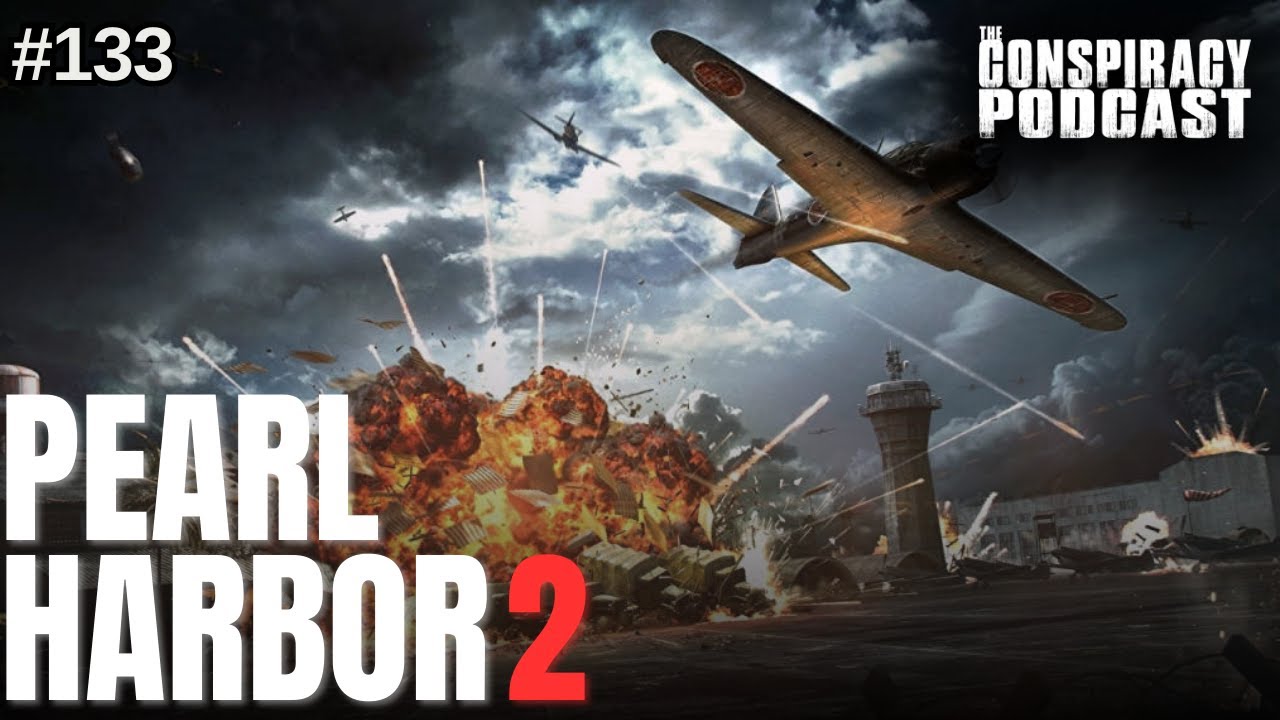
Pearl Harbor: Part Two – EP 133

Pearl Harbor: Part Two
Picking up right after Pearl Harbor, the guys trace how national shock curdled into fear of Japanese Americans, culminating in Executive Order 9066 and the forced removal of roughly 120,000 people to camps like Manzanar, Heart Mountain, and Tule Lake. They walk through the paradox of Japanese American soldiers, including the 442nd Regimental Combat Team, volunteering to fight for the same government that imprisoned their families, and note Congress did not formally apologize until 1988.
From there the episode covers the official response to the attack itself: Admiral Kimmel and General Short were blamed within a single month by the Roberts Commission and forced into retirement, while eight total inquiries followed over the years. The guys are skeptical of how fast that first commission moved compared to the two-year Warren Commission on JFK.
The back half lays out the case for the most famous Pearl Harbor theory, that Roosevelt knew an attack was coming and let it happen to justify entering World War II. They walk through the real evidence for it: the cracked Purple code intercepts of Japan’s 14-part message, Secretary of War Henry Stimson’s diary entry about maneuvering Japan into firing first, and the 1940 McCollum memo outlining eight ways to provoke Japan. They’re careful to note there is no proof Roosevelt ever saw the McCollum memo, and land on the idea that provocation for some attack is plausible even if targeting Pearl Harbor specifically was not.
- On February 19, 1942, Roosevelt signed Executive Order 9066, leading to the forced removal of about 120,000 Japanese Americans to camps including Manzanar, Heart Mountain, Tule Lake, Poston, and Minidoka
- The 442nd Regimental Combat Team and 100th Infantry Battalion, composed almost entirely of Japanese American soldiers, became two of the most decorated units in the US military
- Congress did not formally acknowledge the internment as an injustice, citing race prejudice and war hysteria, until 1988, 44 years after the camps began closing
- The Roberts Commission concluded in January 1942, in about one month, that Admiral Kimmel and General Short were grossly derelict in their duties, and both were forced into lower-rank retirement
- US codebreakers had cracked Japan’s Purple diplomatic code and intercepted Japan’s 14-part message ending negotiations with Washington on December 6 and 7, 1941, hours before the attack
- Secretary of War Henry Stimson’s diary records a November 25, 1941 White House meeting discussing how to maneuver Japan into firing the first shot, and a 1940 memo by Lt. Cmdr. Arthur McCollum outlined eight actions to pressure Japan toward war
Read the full transcript
Part two of Pearl Harbor. We are recording this pretty much on the anniversary, the seven Sunday anniversary. It was so funny. It’s literally, I kid you not, it was like two days after we did the episode. I’m looking for something to watch before bed and it’s like Pearl Harbor. I was like, okay, it’s close to the anniversary, either that or they’re listening.
Somebody commented or sent a message, and I did watch it for the individual who commented. It’s called Pearl Harbor Minute by Minute, and it’s the minute-by-minute playbook. It’s on Netflix and it was really good. It doesn’t go into much of before and it doesn’t go much into after. It’s just what was happening when it’s happening, every minute. Which is pretty much where we’re at with this. So if you have not listened to the first one, go back and listen to part one.
Again, we kind of closed out the episode last time with Roosevelt’s speech, and then a little bit of what happened at the end, meaning Pearl Harbor happened and then people almost didn’t even believe it. Like at parties they were like, what, we were attacked. And we also touched on the Japanese internment camps. The hell, it was rough.
In the hours after Pearl Harbor, shock gave way to fear across the United States. Not just fear of Japan as a foreign enemy, but fear of those who looked like the enemy. Overnight, Japanese immigrants and Japanese Americans, many of whom had lived in the US for decades and owned businesses and sent their kids to American schools and pledged loyalty to the same flag as us, found themselves viewed with suspicion. This is like 9/11, bro. If you were any sort of brown, people were like, what are you doing on my plane. Even right now it’s going on with the whole ICE situation, and that’s what I hate about it.
It’s just an interesting exercise because we also can’t forget that America is the melting pot. So for us to be afraid of diversity or other culture, it’s just a strange thing. Regardless of what people say about America, statistically we are the single most diverse place on earth. And if you’re new to listening to this podcast, all three of us are completely different. I’m predominantly European and white. I am African American and Native American. Mexican over here and straight Hispanic. So we are the American melting pot.
But these Japanese after Pearl Harbor found themselves viewed as suspicious even if they were Americans. Which is such a tough thing, because you understand why, but it still sucks, especially for them. They’re like, bro, I love it here, this is my spot. Either I’ve been here for so many years or I’m born here. Can you imagine. For being a white person it’s hard to imagine, but back then I did feel a little bit like, damn, did you get targeted just because you’re brown. So there’s definitely this stigma or feeling.
I feel like society is so influenced by the media. The second it’s like ooh this is bad, then everyone gets all freaked out. And now that’s times ten with social media. So you can imagine right after Pearl Harbor we all wanted vengeance, and I understand that. It was almost 3,000, like 2,400, a crazy amount of people there. So newspapers started printing wild rumors of saboteurs, of Japanese that were within our society, like spies, sleeper agents. Politicians even came out warning that the next attack could come from the enemy within, which was our Japanese culture.
That’s where regular media spreads like wildfire and creates this unnecessary anxiety and fear. But maybe that was the plan, the division. You create the fervor and in essence your constituents make the decision for you. Like we had discussed in the first episode, we had this non-aggression pact. Isolationist. But then immediately afterwards we’re like, look, maybe that’s the conspiracy theorist in me, but okay, cool, that’s what they want. Obviously what are you going to do, you can’t be like, no, we’re just going to chill, when they literally just attacked our military base.
Within weeks, the pressure on President Roosevelt grew and it was impossible for him to ignore. Military officials and West Coast politicians insisted that people of Japanese ancestry, regardless of their citizenship, were a possible threat simply by proximity. This is wild. Also, aren’t the Germans doing this, and we’re like it’s totally cool. What’s crazy too is you see the similarities to the communist frenzy in the sixties. Oh bro, if everybody you talk to, you had a cup of coffee with that guy, oh you’re a communist. Dude, it’s just like Salem witch trials. I saw him talking to Stacy, Stacy was like communist all the way.
We always talk about how history repeats itself. This is exactly what that is. You look back, it’s so obvious, but it still keeps happening, again and again. We’re like, wow, I would never fall for that stupid trick, and it literally happened. So most people don’t know this, but on February 19th, 1942, Roosevelt signed Executive Order 9066, and it authorized the removal of 120,000 Japanese Americans from their homes. Families were given a few days to pack all their stuff. Homes, farms, fishing boats, small shops, personal belongings were sold off. Many had lived freely in the US for generations, yet were now labeled enemy aliens of the state.
So even if you were a US citizen, they pretty much did this like the Patriot Act. They’re like, well, I know you had the Constitution, but now you’re a terrorist. Additionally, the threshold was two-thirds American born. That’s crazy. So if you’re of Japanese descent, and then two-thirds American, you could still be removed. Can you imagine. Especially because American isn’t even really a thing. It doesn’t, we took this like this.
So these people were relocated to camps after we sell all their stuff. Now keep in mind, we did not know or have any understanding of the concept of a concentration camp at this time, meaning what was happening over there. We didn’t see it at that time. But the military-industrial complex, they had to have intel. I know it was the forties, but they had to have the intel. That’s why again they’re repeating the same thing from the other side of the world. So they created these camps, and they were basically in remote deserts and plains. Here are some of the names of those camps: Manzanar, Heart Mountain, Tule Lake, Poston, Minidoka, and others.
These camps were surrounded by barbed wire and armed guards, and they were not death camps, meaning they weren’t killing people, but they were internment camps. They were imprisoning people against their will, against their constitutional rights. Can you imagine being born here, you don’t even sound Japanese at all because you’ve been American your whole life, and they’re like, well, you just look a certain way. It’s the wrong place at the wrong time. It’s also the wrong solution. Why don’t you just have surveillance on them.
But again, in their defense, and I could be on the wrong side of history on this, there’s a huge amount of fear, and you don’t know, you were just attacked, surprisingly attacked. We can think back to 9/11. We were all afraid, but we weren’t putting every Muslim into internment. Also, in this instance you’ve got to take technology out of it. There’s no CCTV, there’s no iPhones. Actually, off the top of my head, home phones were absolutely common in 1942, common although not widespread, about 35% of American homes had one. Not universal, but normal in a middle-class range. But again, you were right that they were mainly a desk phone, rotary dial.
Families lived in cramped rooms with cots and blankets for furniture. Meals were served in mess halls. Privacy was non-existent because you shared with everybody. And everyday life became a constant fight against boredom, literally doing nothing. It’d be like imagine us with no internet, what are we going to do. I go ten minutes without my phone and I’m like, what is going on with me. Reports also say it was a slow decline of dignity. Especially, I didn’t realize they sold their stuff. Who got the cash for selling their stuff. The war machine.
So just imagine, let’s say it’s two or three years of you in a room with a hundred people, sleep on the floor, your privacy is gone. It’s dehumanizing. It feels like a prison, which happens at the end. They’re like, okay, well, go back and try to restart your business, thanks, peace. By the end of the war, internees built their own schools, they had their own newspaper systems. It is like prison. They had a baseball yard, different things. All in this attempt to get back to normal, create your own community.
So one of the greatest paradoxes of the war emerged. While the families were incarcerated, thousands of the husbands volunteered to fight. Thousands of Japanese soldiers in the American army in World War II. Isn’t that confusing and crazy. You’re a spy, yes, join the military, wait, what. I think for them it makes more sense, because you’re like, I want to show that I love this country and I want to support it. Back then things were different, but now you wouldn’t want to leave your family in a prison camp to go fight where there’s a high probability that you’re going to die.
You know, another interesting thing, in the Civil War you had thousands of African Americans fighting for a country, and they were still slaves. No, they were fighting for the North, for the idea of free. I wonder if these Japanese Americans thought that was the only way out, hey, if we prove we’re not here to mess around, we’re here for this play. But I don’t understand that. It’s like imagine the US is like, we caught these Russian spies, they’re spies, let’s let them enlist. Wouldn’t that give them more intel. What we don’t know is the one for one, did those soldiers have family in the camps. I would assume that there’s some. If there are thousands enlisting, then yes, there’s got to be some, or at least cousins or extended family.
One example, the 442nd Regimental Combat Team and the 100th Infantry Battalion, composed almost entirely of Japanese American soldiers, became two of the most decorated units in the US military. The samurais, baby. One story, they rescued the lost battalion in France. They fought through Italy. They earned hundreds of Purple Hearts. My boys were okay. I love the Japanese world. They’re doing this thing.
As the war turned in the Allies’ favor, the US quietly recognized that the internment system had been built on fear rather than evidence. So by 1944 they began dismantling them. The war ended in 45, but in 44 they were like, we’ve got to fix this one, boys, we were a little harsh, we overreacted. So by around late 44 they were allowed to leave, and they returned to nothing. Their farms were taken over. Oh, you had an apartment, sorry, bro, that’s gone now. Apparently neighborhoods were completely transformed because you have all these communities fully removed.
Here’s what’s crazy. The US government never acknowledged it, they pretended it never happened, until 1988. Congress admitted injustice and said it was race prejudice, war hysteria, and a failure of our own political leadership. That happened 44 years later. That’s so messed up. It took 40 years for the US government to acknowledge that they messed up.
Now back to the aftermath of Pearl Harbor. American unity afterwards was remarkable. Public opinion previously was divided on the war, but after the speech we were like, let’s go, everybody, everyone enlist. Teenagers were lying about their age so they could join the war. There were many that were 16, 17 and they were lying. The same thing happened with 9/11. Homies who were retired from the military were trying to re-enlist. There’s a certain personality that’s just like, get me in the fight. Thousands of young men flocked to recruiting stations, galvanized by patriotism and anger and revenge.
Within days, Germany and Italy declared war on the United States. So we have December 7th is Pearl Harbor, December 8th is the speech by Roosevelt declaring war against Japan, December 11th is Italy and Germany declaring war on the United States. The US was now fully involved in both major fronts of World War II. In Hawaii, the immediate aftermath of the bombing was frantic and somber. Rescue operations continued for days as workers tried to save sailors that were trapped in the wrecked ships, which was the capsized vessel Oklahoma. That’s the one that’s still there, the one that submerged, and the memorial is over it.
What happened, and I don’t know if you know this story, but multiple hours later there was tapping on the hull. That’s like my actual nightmare, my worst possible fear, being in a submarine. Imagine you’re in there and you just have this little pocket of air trying to survive. So if you could imagine the ship overturned, and the harbor was so shallow that only part of it was above water. But they couldn’t get out, you can’t cut through that steel. Rescue teams were trying to cut through the steel plates, and unfortunately a majority of them we just never got to. There are still hundreds, they call it their grave, and the bodies were never recovered.
The scene was ghastly: sunken and listing ships, ruins of planes scattered on runways, and thousands of casualties being tended to in naval hospitals. Hawaii was placed under martial law, and the military commanders braced for the possibility of what they thought was going to be a full-scale follow-up invasion. Everyone’s on edge. You don’t even know where they are. Unbeknownst to the public at the time, Japan did attempt a couple of small follow-up actions against Hawaii. One occurred on the very night of December 7th when a Japanese submarine shelled a marine base on Oahu, and it caused a tiny bit of damage, but it wasn’t that big of a deal.
There was a notable secret mission in March of 1942. Japanese long-range flying boats undertook a bombing run over Oahu. In this second strike on Pearl Harbor, only a few bombs were dropped near Honolulu. Bad weather foiled that entire operation. The weather was on our side. But remember when we went over in part one that they didn’t take out enough of the fields and the oil tankers, meaning we could repair. Because the sun was there they weren’t hitting their targets, and if they were successful it would have been irreparable. Like, cool, this base is done, nothing can happen here anymore. So the US fleet started to repair, building it up and getting it out to sea.
Back in Washington, the shock quickly gave way to the following questions. How did this happen. How did they sneak up on this, especially when we’re under war alert. Who, if anyone, was to blame for the lack of preparedness or the lack of getting the communication messages across. Why are we locking up the ammo, boys. Because they did know about this. There was a war alert. Ten days later, December 17th, Admiral Chester Nimitz was appointed to relieve Admiral Kimmel as the new Pacific Fleet Commander. In early 1942, Roosevelt commissioned an official inquiry led by Supreme Court Justice Owen Roberts. It was called the Roberts Commission.
See, this is the only thing I don’t like, here we have another inquiry. This is all the political stuff where they’re like, well, we looked into it, we didn’t find anything suspicious. So they’ve got to put the show on. Back to the playbook. Now here’s what’s crazy. If you remember the JFK episodes, and if you’re listening and have not listened to our JFK episodes, go back, it was legendary, one of our top listened-to episodes, like four hours on the Warren Commission. And if you remember, the Warren Commission took nearly two years. This commission was done in January, just one month. Maybe because there was a lot of pressure.
So here’s what they concluded. In January they concluded that Admiral Kimmel and Short, in short, were grossly derelict in their duties, essentially blaming them for not being on higher alert and not taking the proper defensive steps in Pearl Harbor. So either they were derelict or they’re the scapegoats. This finding made Kimmel and Short, in the eyes of many or all, the scapegoats of Pearl Harbor. They’re like, sorry, you’ve got to take the fall for this one, both of them. It’s not going to go all the way up to Washington. Of course not. Both of them went down in rank and they retired in disgrace. So you went from admiral to lower. They weren’t dishonorably discharged, but they were shamed, and officially they are responsible for Pearl Harbor.
That’s rough, because here’s the thing, and I’m not trying to save these guys, I don’t know these guys, but remember Kimmel’s first name was Husband. So it’s like, imagine, I’ll give you a very simple example. I’m responsible for my house, and it’s my thing, but if a random dude decides to throw a grenade through my window, am I responsible, how could I be prepared for that. But if there were people outside that could potentially see it, it’s different. I do think that they have responsibility for the defenses not being manned. They didn’t have the torpedo nets up. All the ammo was locked up. All the planes were tip to tip. So I think they did do a lot of things wrong. They didn’t do anything, that’s the thing.
But they can’t be the only people that messed up. There’s definitely a higher echelon of, okay, you had intel that something was happening, why wasn’t it acted on. Because military guys, they follow orders, that’s just what it is. My whole family on my mom’s side is military. You do what your CO tells you to do, you don’t ask questions. But if there was a legit war alert, I have a hard time believing that these guys would be super lackadaisical, unless it’s totally possible that they were like, okay, sure, they’re going to go to Oahu, never going to happen, bro, 3,000 miles away. So that is totally possible. Credit to the Japanese too, they definitely caught us off guard, and they got stomped for it.
As the war went on, further investigations would revisit Pearl Harbor. In total, eight official inquiries occurred both during and after the war, an Army board, Navy court, congressional committee, and others. These inquiries uncovered various intelligence and communication failures. They revealed that important information had not made it to Hawaii in time, and that Washington and local commanders had suffered from false assumptions and poor coordination. But despite these nuances, the early narrative stuck: Pearl Harbor was a result of surprise and unpreparedness by the US, no conspiracy. The fact that they said no conspiracy makes me a hundred percent sure it’s a conspiracy now, boys.
The American public largely saw it as a sneak attack that caught our military sleeping. Obviously it was a sneak attack, that is a fact. And it actually became a marketing thing to sell bonds, remember Pearl Harbor. So they would later try to raise money for the war effort, and the marketing flyers were remember Pearl Harbor. Follow the cash. I think there are too many people that profit from war. The main one is Wall Street. Wall Street profits from everything, it doesn’t matter if it’s war, they’re making cash regardless. You look back to the George Bush days and to Iraq, it’s like they want the money. They’re like, we need to bring them a little piece, bro, we need a little American Eagle over there, so I can get a piece.
Okay, so now what we’re going to do, and we don’t normally do it this method, but there are so many conspiracies that are detailed that we’re going to actually start with the conspiracies now. And then we’re going to take them up each individually and go through some of the data that’s supporting it, because there’s a lot of, okay, was that message actually delivered to the general or was it not. If it wasn’t, then the general’s not culpable that much. I think there’s more to it. And I always never trust the inquiries, the commissions.
Even as the US mobilized for war, a nagging question lingered in some minds, which was: did the government in Washington know more about the coming attack than it had let on. In the following years and decades, numerous theories and conspiracy claims have emerged regarding Pearl Harbor. These range from well-researched historical revisionism to wild speculation, which is our forte. So we’re going to explore the major theories and what evidence or lack thereof supports them, all while keeping a balanced perspective. And we’re going to try to keep all politics out of it. Keep in mind, politics was much different then. We’re almost at 100 years. It was 41, so right now we’re at 80, 85 years. All the parties were not the same.
While politics was hella corrupt still, it wasn’t like it is now. Now it’s like you’re just openly a criminal and no one even cares. Do you think politics are more corrupt now than then. A hundred percent. I think they were corrupt then and were able to get away with a lot more because there wasn’t all the social media. But that let them get brazen enough to then just start doing more and more, and now it’s just insane. You weren’t seeing your senator worth $400 million. Factor it for inflation, he wasn’t worth like 50 mil. Most of the guys who are running were already kind of rich and they wanted political power. You can’t just up and say, I’m running for Congress, while I’m working at Walmart.
Back then it was reverse. Back then it was, cool, you were already rich and powerful, but this was a way to get more influence over certain areas of existence. But now it’s, how do I get rich, and I’ll get bought by whoever wants to throw it at me to get the cash. They know now that if you get in that position you have the power to get rich. Coming from that whole world in Mexico, the most corrupt, it’s just so open, everybody knows, nobody cares because you can’t do anything about it. It’s also a contagion thing, an apathy. Remember we brought up that the president who won, there were 20 presidential candidates killed in a row in one election. So friendly towards the cartel. It wasn’t over 50 years, it was one election. So open. Nothing happened though.
There’s not a strict enough law. Everyone’s corrupt, because the cartels are so deeply ingrained, they have all the money, and everyone’s in fear. That’s why they hang up the bodies on the bridges. The solution is the SEAL team, the US military comes in and stomps them out, like what’s happening in Venezuela right now. Compare that to the US. The US has always been corrupt, but not to that degree, or at least not that overt. So was it corrupt back then more than now. I would say yes, but now you just see it a lot more and you have more access to the politics. You know when he’s golfing. You know what their trades are.
We didn’t even know Roosevelt was in a wheelchair. He stood up at a speech and that was it. We didn’t know until later. Polio. Okay, the first claim: President Roosevelt knew in advance and let it happen. This is the most famous Pearl Harbor conspiracy theory. It asserts that FDR wanted the US to enter World War II, particularly to aid Britain against Hitler, and he saw provoking Japan as basically a backdoor into the war. So that’s why they were like, oh, we’re going to cut all your trade off. Because they knew that they only have one option. What a weird strategy though. It’s genius, actually. The reason being is because you don’t want to be the guy who starts the war, you want to be the guy who ends the war.
It’s like that guy when you were in grade school and you just kept bumping chests and you’re like, do something, do something. You get nuked, his political career, all the polls, the ratings, if he just goes and attacks Japan out of the blue, the people are going to be like, what’s wrong with you, why’d you get us into this war, we’re isolationists. But then now it’s like the people will beg you for it. You set up situations so that the people literally implore you to take it away. According to this theory, Roosevelt and his inner circle knew the Japanese were going to strike Pearl Harbor, but allowed it to proceed, even withholding the warnings, in order to generate public outrage and unify the country for war.
Some proponents go as far as to claim the US even provoked Japan deliberately through the oil embargo and aggressive ultimatums, fully expecting and desiring a Japanese attack that would justify entering the US into World War II. We talked about this as well when we were talking about the Russia situation with Ukraine, and how it’s like, I think Putin’s a psycho and a criminal, but the UN always had an agreement. He’s like, don’t put your missiles on the border, and they were like, cool, no problem, and then they put the missiles on the border. He’s like, bro, stop doing that. Putin’s crazy for sure, but you provoke it, but then you’re not the bad guy, right, we’re defending, you didn’t start the fight.
Some evidence that supports this conspiracy. We actually have evidence here, for once, it’s not wild speculation. The US intelligence had actually cracked Japanese diplomatic communications. It was called the Purple code. By late 1941, American codebreakers were reading their secret messages often within 24 hours of the transmission. These intercepts indicated that Japan was planning something big. For instance, on December 6th and 7th, 1941, US analysts intercepted and translated Japan’s 14-part message to its Washington embassy ending negotiations, effectively a signal that Japan had decided on war. So they basically intercepted codes days earlier saying break all communications, all peace talks are done over.
They even intercepted instructions for the Japanese diplomats to deliver that message precisely at 1:00 p.m. on December 7th. Of course, hindsight is 20/20, we can look back now and be like, that’s the sign right there. But while all this is going on, you just kind of see it as another sign of the same. Now, interestingly enough, Washington time on December 7th, 1:00 p.m., that’s 6 a.m. in Oahu, 6 hours behind. They attacked at 7 a.m. So they’re like, deliver the message, get on a plane, and get out. Supposedly Roosevelt realized this and said, this means war with Japan.
Here’s the thing, imagine we were super dependent, we weren’t this ultra nutrient-rich country like we are. Let’s say we had no oil and we needed oil from the Saudis, we didn’t have all the reserves we have, and then they’re like, no, you get none. How long do you think it takes, especially for America out of all places, for the people to be like, why aren’t we bombing these guys. I’m giving it like two weeks and then we’re like, all right, boys, get the war going. And in this scenario we had one hour. Keep in mind all communication is slow.
If that was at 1:00 p.m., or 6:00 a.m. Hawaii time, and this happened at 7:00 a.m., you don’t have time. Even if he says this means war, you think that’s going to happen in one hour for them to get ready, to get a message from Washington to Hawaii in 1941. No, maybe with runners. The example I was giving is the provocation. We did provoke the heck out of them. And on the provocation point, if they knew they were provoked and then he declares, he doesn’t declare war but says this means war, they don’t have enough time to get ready. It would realistically take at least a day back then to mobilize everything. I don’t even know how communications worked, how you got messages especially to Hawaii, like a radio tower or something.
You guys are on to something, because the next part is Stimson’s diary. Now Stimson was the Secretary of War. And you guys use this word over and over and it’s in this: provocation. So this is a major piece of evidence for conspiracy theorists, which is that later on in his diary it was found that Secretary of War Henry Stimson wrote, after a White House meeting on November 25th, that the question discussed was how we should maneuver them, the Japanese, into the position of firing the first shot without allowing too much danger to ourselves. A deliberate provocation. That’s a smoking gun. They’re like, don’t attack the homeland, attack this island over here, boys. Two weeks before, they had a meeting discussing that.
They suggest that Roosevelt was actively seeking a way to get into the war without being the first strike. This just makes me think of 9/11. Every single line we go through, terrorizers, terror, weapons of mass destruction, trust me. Look at the whole Iran thing, they’ve been saying those guys are going to have nukes for legit 20 years, and they still haven’t gotten them. They’re like, they’re on the cusp, they’re about to get them. They’re waiting for that provocation.
There’s another piece of evidence which is called the McCollum memo. Decades later, a memo written by a Navy intelligence officer, Lieutenant Commander Arthur McCollum, came to light, and it was dated October 1940, well before this. This memo outlined eight suggested actions the US could take in order to pressure Japan into attacking, some of which were embargoes, moving fleets, aiding China, such measures, provoking Japan into war, so much better than attacking them first. That was the quote, so much better than attacking them. The military is always trained on how do you engage or when do you engage, the rules of engagement. You want the PR of being the good guy.
You want to be justified in your actions, and you want your troops to feel justified in their actions too, because even if you’re the most elite general, you’re relying on millions of your own beings to fight on your behalf. And if they don’t feel good about it, that’s the whole thing with, oh, is the military going to take over the US. I’m telling you, those homies aren’t going to kill their family and friends, they just won’t do it. You say that, but we had 2020. People were patrolling the streets. That’s not military, that’s just people. I’m talking about the National Guard, the police. If you honestly think you’re going to take a battalion of dudes and tell them, go to your hometown and shoot anyone who’s there, I have a hard time believing that millions of people are going to be cool with killing.
Well, see, in 2020 they had a different catalyst. You know what it was, they’re going to kill everyone else, if they’re without a mask that stops nothing, they’re going to kill everybody, like the whole outbreak movie situation. There’s a book called Day of Deceit, and it argues that the McCollum memo proves that Roosevelt knowingly followed this sequence of actions to trigger a Japanese attack. So if you want to read further, check out Day of Deceit. But just as a point on the non-conspiracy side, there’s no proof that Roosevelt ever saw the McCollum memo. Of course there’s no proof. Whatever you say, Eric.
But mainstream historians note that taking strategic precautions or even pressuring Japan diplomatically is not the same as expecting or desiring an attack on Pearl Harbor. I agree that you can’t specifically instigate an attack on a specific place by putting an embargo in, because there are too many wild cards. I don’t think the plan was, oh, hit Pearl Harbor specifically, but I think something, hit anything. And I think maybe what they thought was, Japan would never think they could hit us in any fashion that would do anything at the mainland. It’s too big, there’s too much happening, you couldn’t do anything that would actually make a dent.
So they’re probably thinking, okay, what are our most remote actual bases that could be hit, those homies aren’t going to come into San Diego. I even heard stories of the submarines making it there, but not of any magnitude. Maybe you take down one rogue submarine captain, maybe you take down two ships max before you get stomped out and all your people are dead. So that’s why I think maybe that was the plan. Again, there’s not actually any proof of this McCollum memo reaching Roosevelt, but the fact is that he’s a lieutenant commander in the intelligence office, that’s pretty legit. It’s a memo, the memo goes out to the important people. Let’s call a spade a spade.
I actually went to Roosevelt’s presidential library and museum in New York. It was fantastic. And it was cold, I had a full coat. My kids were like, let’s go, and I was like, no, we’re staying until dark, until they light the lanterns. But really, what I got from it was there were so many decisions in his presidency, at least in that time period, that were impossible decisions. From coming out of the depression to, do we go to war, all these things. The reason I bring it up is, I don’t know, what would you do in that situation. It’s an impossible question. You’re the United States, you’re not in the war, you’re trying to stay out of it, but there’s an element of it being just good versus evil. It’s not like we’re trying to get oil for some reason.
I really believe that even without Pearl Harbor, I think we would have eventually gotten into the war, it would have inevitably happened. Per the memos and all this, they were looking for a way to instigate this. And I also think, did they expect Pearl Harbor, no, but did they expect something, yeah, they expected something. But don’t forget, 2,300 people died. So if the conspiracy theory holds, that’s the choice you have to make, which is at that point there is no choice. There’s not one president who’s ever lived or will ever live that wouldn’t be like, we’re going to war, otherwise you’re getting impeached, and then they’re going to get the next guy to go to war. The American people would be going to war without you. Playbook. That’s exactly what happened on 9/11, everybody was behind the idea of, we’ve got to do something about it.
We’re going to kind of end off here, and there’s going to be a part three. We’ve got a lot more to go over, a lot of other conspiracy theories, and then also our final summation of what we think happened at Pearl Harbor and leading into the war. It’s such a fascinating time to me. These kids had to step up, they were forced to step up. No, a lot of them volunteered, it wasn’t even forced, a big majority were happy to do it. This is not like Vietnam where everyone was like, what are we doing, drafted. These are people volunteering, and the whole country was just riled up, kicking the hornet’s nest. There’s a big part of society that is in that fight-or-flight mode, and there’s a fight that ignites in a lot of people, they’re like, put me in.
It’s weird too, because obviously my stance is always, oh, the government. But if you look at America after the war, it’s probably the single most premium time to be an American ever. You make 20 grand a year and you literally have the dream house, you got a fridge, you got a TV, and you’re just killing the game. The wife’s making cherry apple pie on the window sill, you’re throwing the ball with your kid. A lot of this is 20/20 hindsight, you’re not going to know that when you’re in it. But it’s funny how it repeats a lot. This reminds me of 2008, when we started printing a lot of money and there was this whole bunch of people that just was prosperous, but it was printing money off of a situation that was catastrophic. And then we have this affluent time. It’s kind of sad that that’s the way it works, but that’s the way it works.
Nowadays everybody likes to put generations into categories, you have millennials, boomers, Gen Z. The ones in the war are called the greatest generation. I like to end with that, because we’re paying homage to December 7th, this memorial date on Sunday. Think about the greatest generation, imagine that happened now, there’s like 1% of people volunteering. Everyone’s like, no, I work at an IT job, what are you talking about. Have you heard that, soft men make hard times. Hard times make hard men, hard men make good times, good times make soft men, soft men make hard times. It’s very true. They came out of the Great Depression, the worst time ever, made everyone out of granite. Then you go into the war, they’re like, let’s go, boys, can’t get worse than this, let’s go stomp these fools out. They made the greatest time ever, and then everyone got fat and happy, and then we all became soft. And then, what do you know, 2008, Wall-E came true, almost. And by the way, we’re still on that trajectory.