What Is the Mandela Effect?
What Is the Mandela Effect?
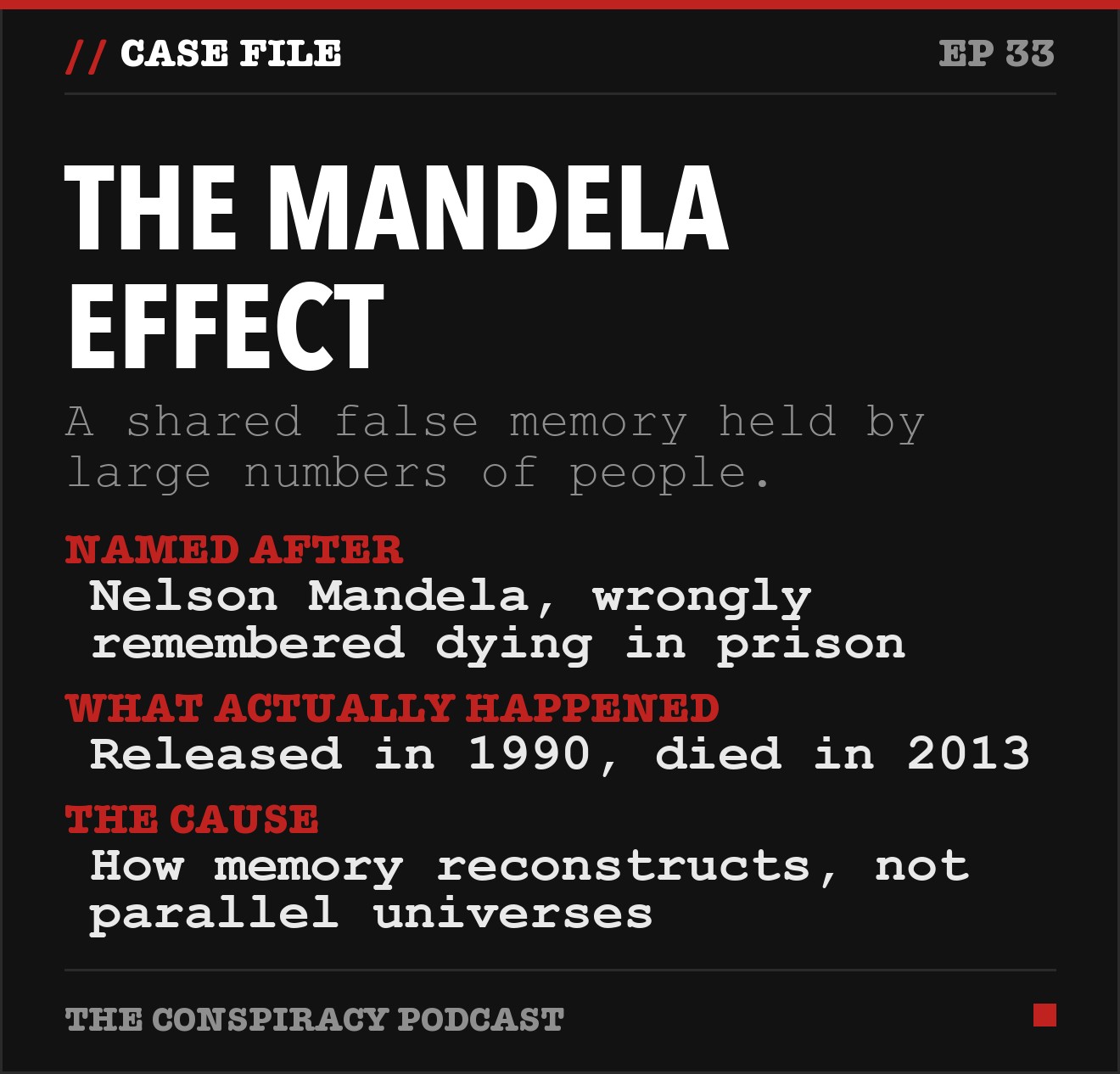
The Mandela Effect is when a large number of people share the same false memory of something that never happened, or happened differently than the record shows. It is named after Nelson Mandela, who many people wrongly remember dying in prison in the 1980s. He was released in 1990 and died in 2013.
By the Conspiracy Podcast team | Last updated: August 2026
Nobody disputes what actually happened to Nelson Mandela. What is strange is how many people, independently and with total confidence, remember it wrong the same way. The same pattern shows up in movie lines, cereal logos and cartoon titles, which is why the Mandela Effect keeps getting argued: it is either a very human glitch in memory, or evidence of something stranger.
What is the Mandela Effect?
The Mandela Effect describes a case where many people, unconnected to each other, recall the same incorrect version of an event, quote or detail with real confidence. The term comes from Nelson Mandela, whom thousands of people falsely remember dying in prison decades before his actual death in 2013. It is a shared memory error, not a single person’s mistake.
What makes the Mandela Effect unsettling is not that one person misremembers something. Everyone does that. It is that total strangers, who never talked to each other, land on the exact same wrong version. Normally, when a lot of people remember an event the same way, that agreement is treated as proof it happened. The Mandela Effect breaks that assumption: the agreement is real, the memory is not. It shows up in history, but just as often in something as small as a cartoon spelling or a candy bar name, which is part of why it spread so fast once people started comparing notes online.
The hosts spend the better part of an hour running through their own list, and they are honest that some hit harder than others. A cartoon title feels different from a childhood bear book their own kid still reads. The full Mandela Effect episode plays out the reactions in real time, including the moments a host stops mid-story to Google a claim because he does not believe what he just said out loud. That instinct, refusing to accept a correction until you check it yourself, is basically the whole phenomenon in miniature.
Where did the name Mandela Effect come from?
Paranormal researcher Fiona Broome coined the term Mandela Effect around 2009. At a conference, she found that she and many other attendees shared a vivid, detailed memory of Nelson Mandela dying in prison in the 1980s, widow’s speech and all. None of it had happened. A publisher encouraged her to write about it online, and the name stuck.
Broome’s own account, retold on the show, is that she was talking with other people at the conference about remembering Mandela’s death in prison and finding out they all remembered the same news coverage and the same speech from his widow. That kind of detail, several strangers independently recalling specific broadcast moments, is what convinced her something worth documenting was happening. A book publisher who heard about it suggested she build a website to collect more examples from other people, which is exactly what turned a personal mix-up into a named, catalogued phenomenon.
The strange part is how public the real story was. Nelson Mandela was released from prison in February 1990 after 27 years, elected president of South Africa in 1994, and remained one of the most photographed statesmen alive until his death on December 5, 2013. That is not a quiet decade. It is a reminder that the Mandela Effect is not really about obscure facts slipping through the cracks. It is about a very well documented life getting overwritten by a false ending that a lot of people happened to imagine the same way.
What are the most famous Mandela Effect examples?
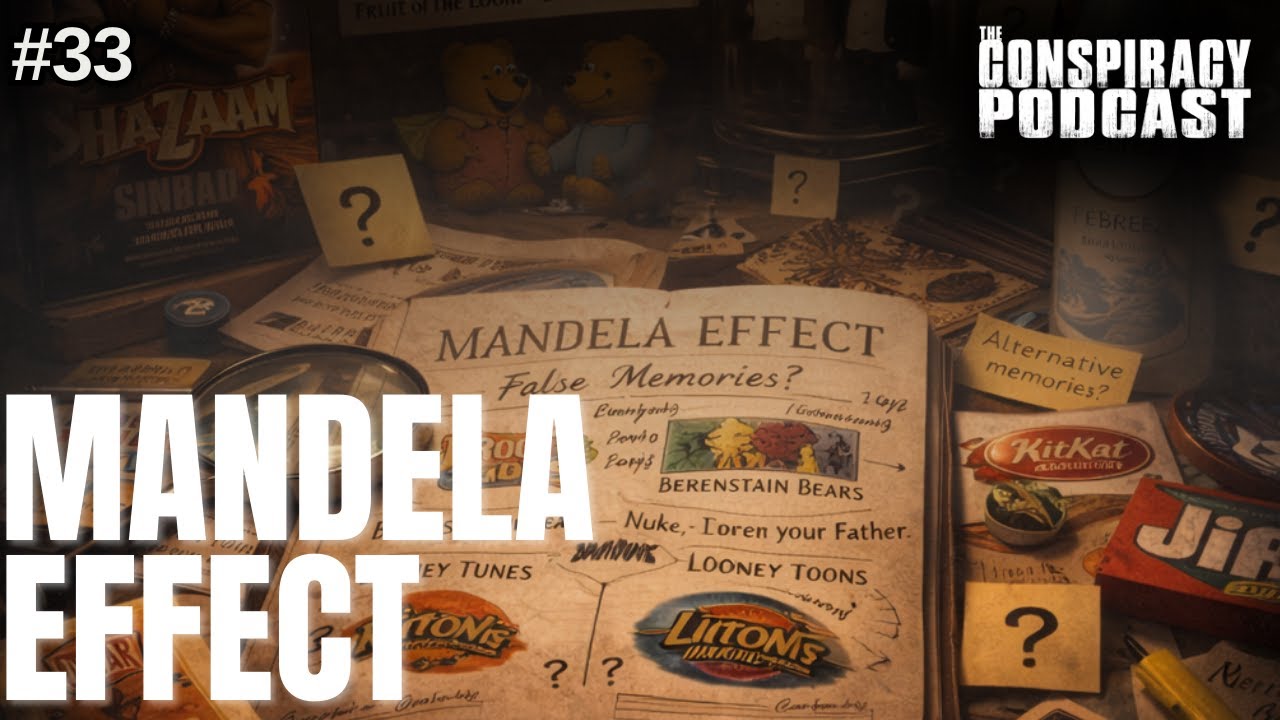
The most cited examples are the Berenstain Bears, which people insist was spelled Berenstein, the peanut butter brand Jif, which many remember as Jiffy, and the Monopoly man, who never wore a monocle. Misquoted lines fill out the rest, led by Darth Vader’s line in The Empire Strikes Back, ‘No, I am your father,’ not ‘Luke, I am your father.’
The brand and logo mix-ups run deeper than the big three. People remember Looney Tunes as ‘Looney Toons,’ even though the cartoons were always spelled with a musical ‘Tunes.’ The hot dog brand is Oscar Mayer, not ‘Oscar Meyer,’ a mistake close enough to a real pronunciation that it is easy to see how it spread. The Fruit of the Loom logo has never included a cornucopia, just fruit, despite how many people picture a woven basket behind it. Curious George, the popular children’s book monkey, has never had a tail, no matter how clearly some readers picture one.
Song and movie lines round out the list. Queen’s ‘We Are the Champions’ actually ends on ‘no time for losers,’ with no ‘of the world’ after it, no matter how often a crowd sings it that way. The line everyone remembers from The Silence of the Lambs, ‘Hello, Clarice,’ is not what Hannibal Lecter actually says; his greeting is closer to a plain ‘Good morning.’ None of these are historic, and none matter much alone. What matters is how consistently strangers land on the same wrong version, the real mystery underneath the trivia.
He’s like did I crack the Matrix. I was like oh my God.
the guys, on the record
Is the Mandela Effect proof of parallel universes?
No. Every documented Mandela Effect example is fully explainable by ordinary memory science, and no physicist has ever shown that colliding particles can shift people between realities. The parallel universe idea is a theory some people, including one of the hosts, find genuinely appealing. It is a belief, not something the evidence actually supports.
The theory the episode spends the most time on involves CERN, the European research organization that runs the Large Hadron Collider on the France-Switzerland border. Its first major particle collision happened in 2008, a year before Fiona Broome named the Mandela Effect, and some online theories connect the two dates directly. CERN’s own published goals are studying particle physics, including the Higgs boson, sometimes called the ‘God particle,’ along with dark matter and antimatter, not reality itself. One host argues that smashing unknown particles together at that scale means nobody can rule anything out. The episode treats that as fun speculation, not a finding.
The other host in the room is not buying it. His read, stated plainly at the end of the episode, is that these are cultural mistakes that caught on and then hardened into false memory, nothing more exotic than that. Cognitive scientists agree with him: no peer-reviewed physics research connects particle collisions to altered memories, and every named example in this piece has a documented, mundane explanation. That is the actual split at the center of the episode, one host chasing the exotic answer, the other one settling for the boring one.
| Theory | What the record shows |
|---|---|
| Alternate timeline. Our consciousness slipped into a slightly different reality, changing some memories. | No experiment has ever detected a person moving between realities. A belief, not a tested finding. |
| CERN split reality in 2008. The Large Hadron Collider’s first collision, a year before the term existed, gets treated as the trigger. | CERN’s published goals are particle physics: the Higgs boson, dark matter. Nothing there claims to alter memory or timelines. |
| Ordinary memory error. A mistake spread widely enough, early enough, that it hardened into a shared false memory. | Matches documented psychology on false memory and repetition. Where most memory researchers, and one host, land. |
What actually causes the Mandela Effect?
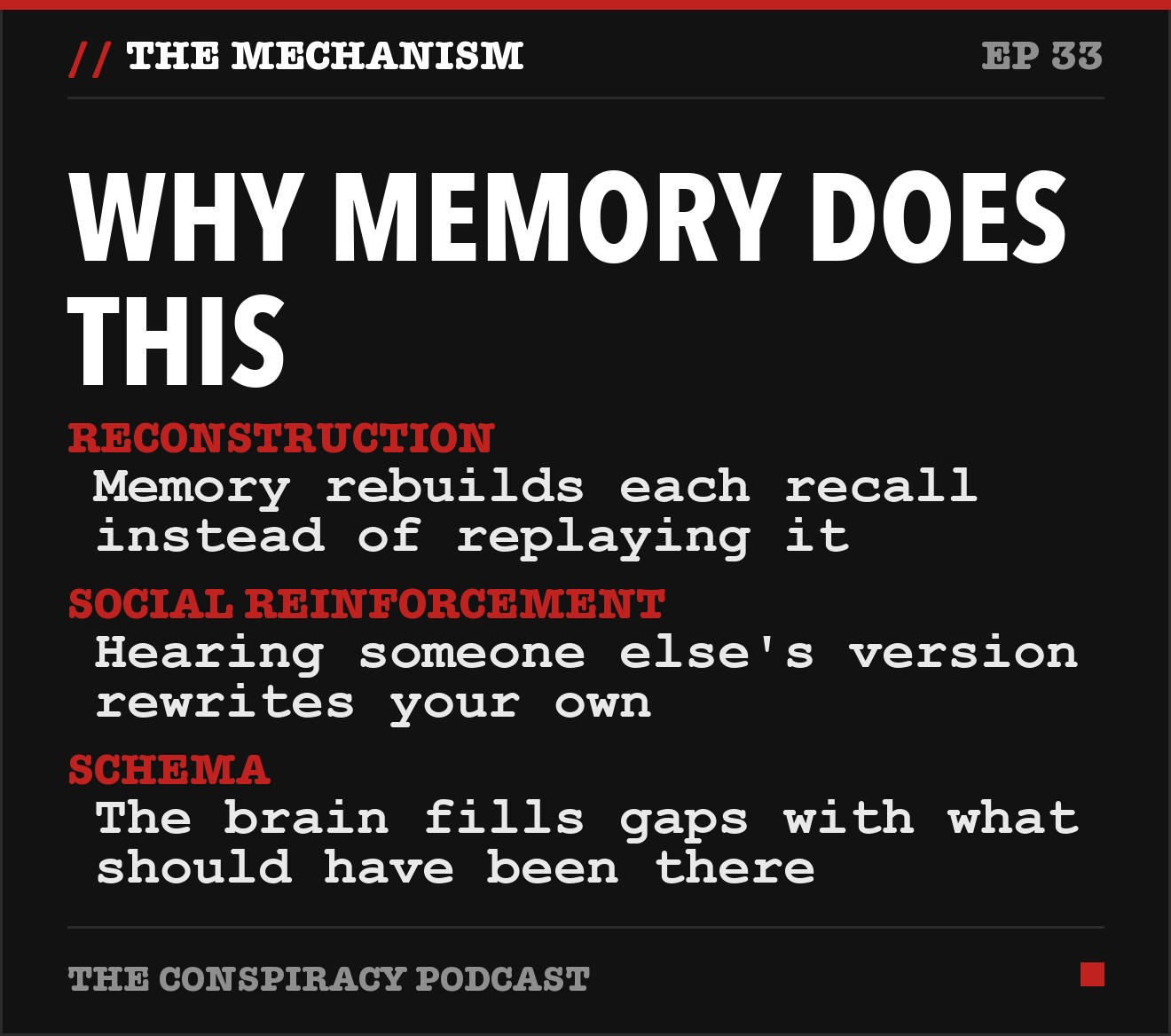
Memory is not a recording, it is a reconstruction. Every time you recall something, your brain rebuilds it from fragments, and documented mechanisms including confabulation, priming, the misinformation effect and social repetition can all push that rebuild toward the wrong answer. The Mandela Effect is what it looks like when thousands of people make the same small error at once.
The episode’s own host explanations line up with real cognitive psychology. Confabulation is the brain filling in gaps in an incomplete memory so the story makes sense, which is exactly how a half-remembered movie line gets patched with a version from a parody seen years later. Priming is different: the way a question or image is framed quietly shapes what you recall, the same way asking how tall someone is nudges a different memory than asking how short they are. Neither requires a bad memory, and the episode breakdown walks through both with examples straight from the transcript.
Two more pieces complete the picture. Psychologists call the tendency to store a gist rather than a full recording schema-driven error, a concept that traces back to memory research from the 1930s. The misinformation effect, documented through decades of research by psychologist Elizabeth Loftus, shows that a confident retelling from someone else can quietly rewrite a person’s own memory to match it. Add social reinforcement, an internet that repeats a wrong version until it drowns out the right one, and a personal glitch becomes a shared one. Our list of famous conspiracy theories is full of the same pattern at a bigger scale.