How Did Marilyn Monroe Die?
How Did Marilyn Monroe Die?
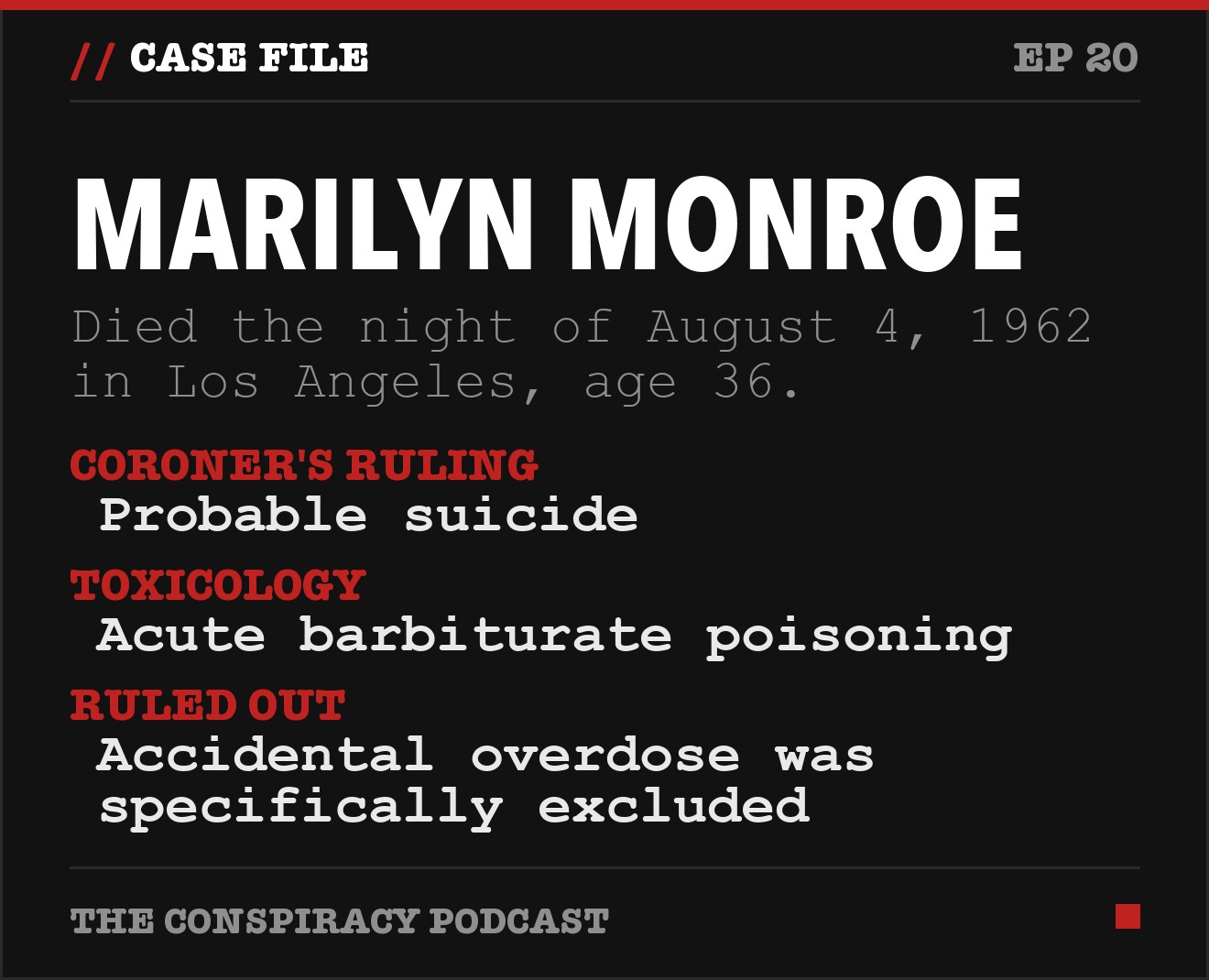
Marilyn Monroe died on the night of August 4, 1962, at her home on Fifth Helena Drive in Los Angeles. She was 36. The toxicology report found acute barbiturate poisoning, and on August 17 the coroner announced a verdict of probable suicide. Accidental overdose was specifically ruled out.
By the Conspiracy Podcast team | Last updated: August 2026
That verdict has never settled anything. The week before she died, Monroe was buying trees for her garden and firing the people around her, which is not what the end usually looks like. Here are the questions people actually search, answered from the record.
What was the real cause of death for Marilyn Monroe?
The toxicology report found acute barbiturate poisoning, and on August 17, 1962 the coroner announced a verdict of probable suicide. There were no external wounds and no bruises. Accidental overdose was excluded because the amount in her body was several times a lethal dose and had been taken in a very short span.
The word doing the work in that verdict is “probable.” A coroner’s verdict records the most likely explanation, not a proven one. No formal inquest was ever held, and this conclusion was reached fast on a case that had obvious holes in it.
The pathologist who performed the autopsy later published a memoir in 1983 raising discrepancies in his own case. The one that matters most: the barbiturates were in her bloodstream, but her stomach held no pill residue at all. Explanations were offered, including her tolerance as a long-term user. He still concluded she probably died by suicide, but the fact that the man who did the autopsy felt the need to write a book about it twenty years later tells you how unresolved it was.
What was Marilyn Monroe doing when she died?
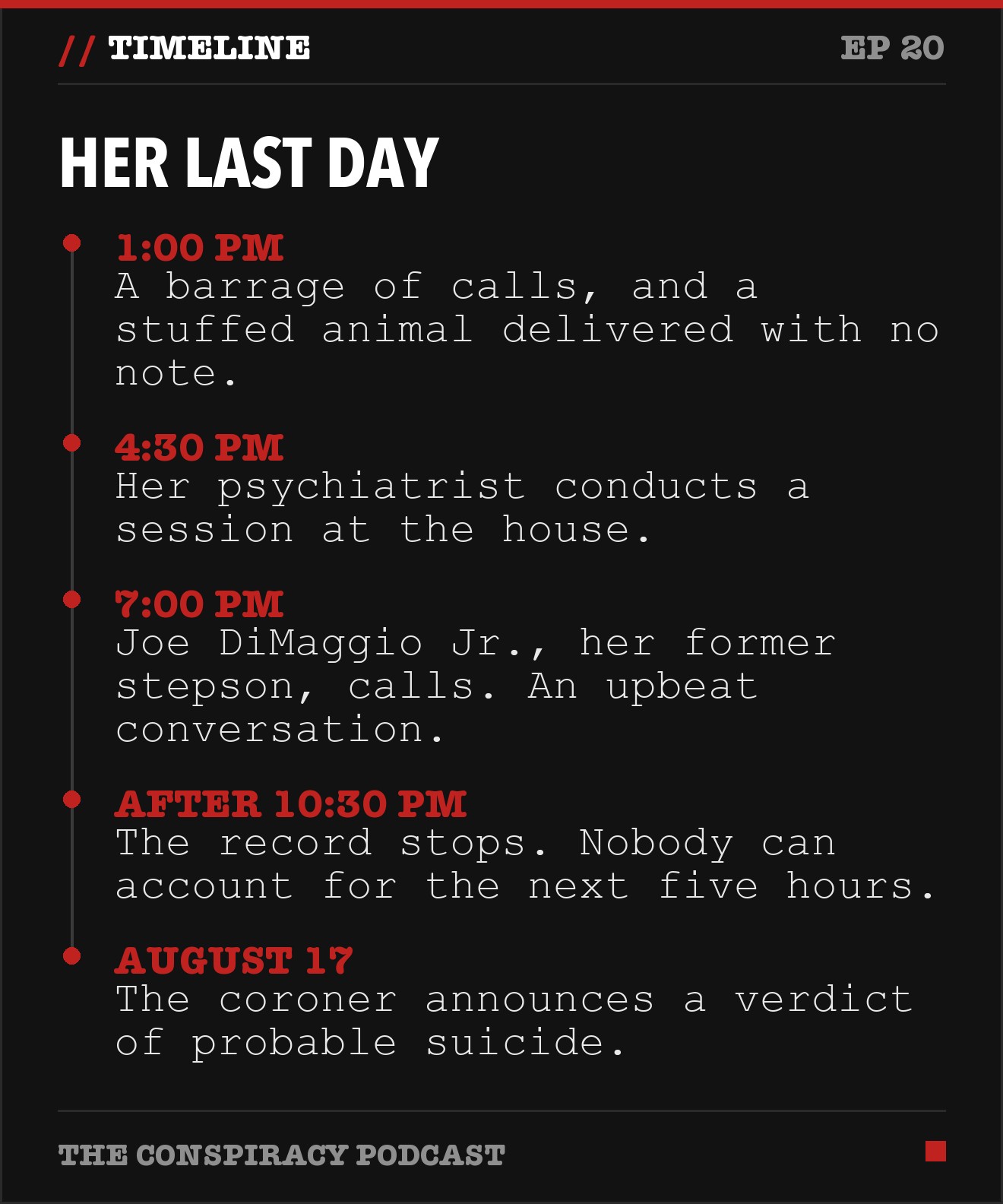
Her last day was a strange procession of visitors and phone calls at her Brentwood home. Her housekeeper arrived at eight in the morning. At one in the afternoon a barrage of calls came in, along with a delivery of a stuffed animal with no note, which upset her. At 4:30 her psychiatrist conducted a session.
At seven that evening Joe DiMaggio Jr., her former stepson, called with news that he had ended his engagement. By every account it was an upbeat conversation. Between eight and nine, the actor Peter Lawford called about a dinner party. She declined, and her closing line to him is the one people remember: say goodbye to Pat, say goodbye to the president, and say goodbye to yourself, because you are a nice guy.
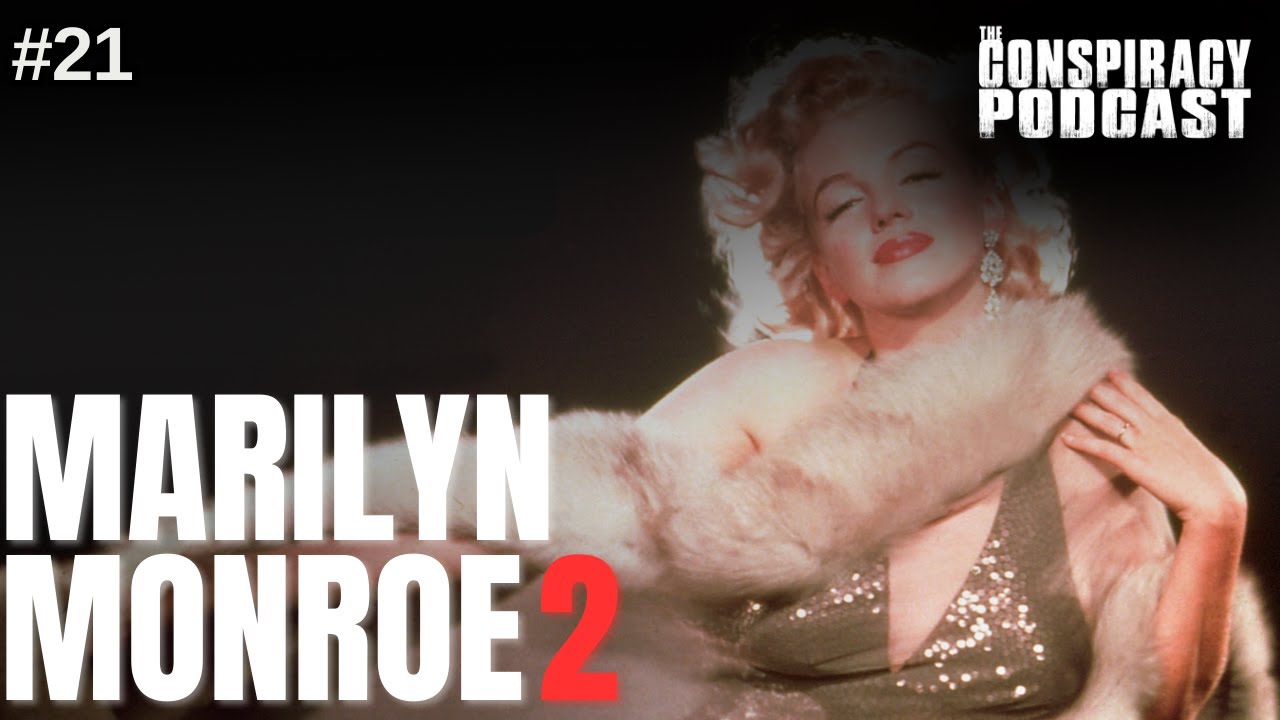
Then the record stops. After roughly 10:30 at night, nobody can account for what happened in that house until three in the morning. The guys build the timeline hour by hour in part two of the Marilyn Monroe episode before they let themselves speculate about any of it.
What was mysterious about Marilyn Monroe’s death?
Three things, mainly. There is an unexplained gap of about five hours in the timeline. The autopsy found drugs in her blood but no pill residue in her stomach. And she spent her final week behaving like a woman rebuilding her life, not ending it.
The last one is the part the hosts cannot get past. On August 2 she spent four hours at a nursery choosing trees for her garden. She had just bought the house. In the same stretch she fired her drama coach and planned to remove her publicists, her psychiatrist and her housekeeper, whom she had come to suspect was placed in the home to watch her.
None of that is proof of anything. People who are about to die by suicide do make plans, and the hosts are careful to say they are not experts on that. But stacked next to a warm phone call from DiMaggio hours earlier and a garden she would never plant, it is a hard week to read as a decision.
What secrets did Marilyn Monroe know?
The episode traces alleged relationships with both John F. Kennedy and Robert Kennedy, drawn from witness accounts and later reporting rather than from any acknowledgement by the Kennedys. In her final weeks she was cut off, and phone records show she tried to reach Robert Kennedy eight times in one month, at home and at the White House.
Two details give the question its weight. Returning from a weekend at Frank Sinatra’s Cal-Neva Lodge, she placed an eight minute telephone call to the Justice Department. Nobody knows what was said. And frustrated at being shut out, she told someone to arrange a press conference, saying she had plenty to talk about, and indicated she knew about connections to the mob boss Sam Giancana.
In mid July 1962, J. Edgar Hoover met with Robert Kennedy. The following day, Kennedy cut contact. That sequence is the closest the record comes to a motive, and it is still only a sequence, not evidence of a crime.
What are the theories about Marilyn Monroe’s death?
The main ones are suicide, an accidental overdose, a deliberate killing tied to what she knew about the Kennedys, and a cover-up of the scene rather than of a murder. The official record supports the first. The autopsy discrepancies and the missing hours are what keep the others alive.
| Theory | What the record shows |
|---|---|
| Probable suicide. The official verdict the coroner announced in August 1962. | Supported by toxicology showing several times a lethal dose. Undercut by the empty stomach and by her behavior that week. |
| Accidental overdose. A long-term user who lost track of the dose. | Specifically excluded by the coroner, because the amount was too large and taken too quickly. |
| Killed over what she knew. Tied to the alleged Kennedy relationships. | No evidence has ever supported it. Nobody was charged, and the surrounding facts are a timeline, not proof. |
| The scene was managed. That the house was tidied and the story shaped before police arrived. | The five hour gap is real and unexplained. What happened inside it is not documented either way. |
There is also a former ambulance driver’s later claim that Monroe was alive and comatose when he moved her, an account that conflicts with the official record. Our full breakdown of the road to Brentwood covers how she got to that house, that doctor and that circle in the first place, which is its own strange story.
I don’t think she wanted to die, I just think she was, she didn’t know what else to do, and she had no one else to turn to.
the guys, on the record
Do the hosts think Marilyn Monroe died by suicide?
No. They are careful to say they are not experts and cannot know another person’s mind, and they do not claim to know who else might be responsible. Their position is a judgement about the evidence: the garden, the firings, the DiMaggio call and the missing hours do not add up to a decision to die.
That is worth stating plainly because it is where a lot of coverage overreaches. Doubting the verdict is not the same as naming a killer, and the episode never takes that second step. No one has ever been charged in connection with her death, and no evidence has emerged that would support a charge.
If you want more of this kind of case, our roundup of famous conspiracy theories collects the ones that have stayed unresolved the longest.