Was H.H. Holmes Jack the Ripper?
No. The claim that H.H. Holmes was Jack the Ripper comes from one descendant, and the documented record puts Holmes in Chicago in 1888, when the Whitechapel murders happened in London. The hosts of the Conspiracy Podcast give the theory zero validity: the Ripper worked to a pattern, and Holmes was chaos.
By the Conspiracy Podcast team | Last updated: October 2026
It is an irresistible pairing. America’s first celebrity serial killer and London’s most famous unsolved one, both active in the late 1880s, both tangled up with doctors and knives. Here is what the claim rests on, and what the record says back.
Who claims H.H. Holmes was Jack the Ripper?
The claim belongs to Jeff Mudgett, a lawyer and Holmes’s great-great-great-grandson. He says he inherited two diaries written by Holmes that place him in London, wrote the 2011 book Bloodstains, and was the subject of the 2017 History Channel series American Ripper. His stated evidence is medical training, a facial resemblance and a handwriting analysis.
Holmes has been on the suspect list for a long time. As the hosts point out, if you heard their Jack the Ripper episodes you know how many men have been named as the Ripper, and Holmes is one of them. What makes Mudgett’s version different is the family connection and the diaries he says came down through it. Those diaries are the heart of the case. Without them, the argument is a resemblance to sketches and a shared profession.
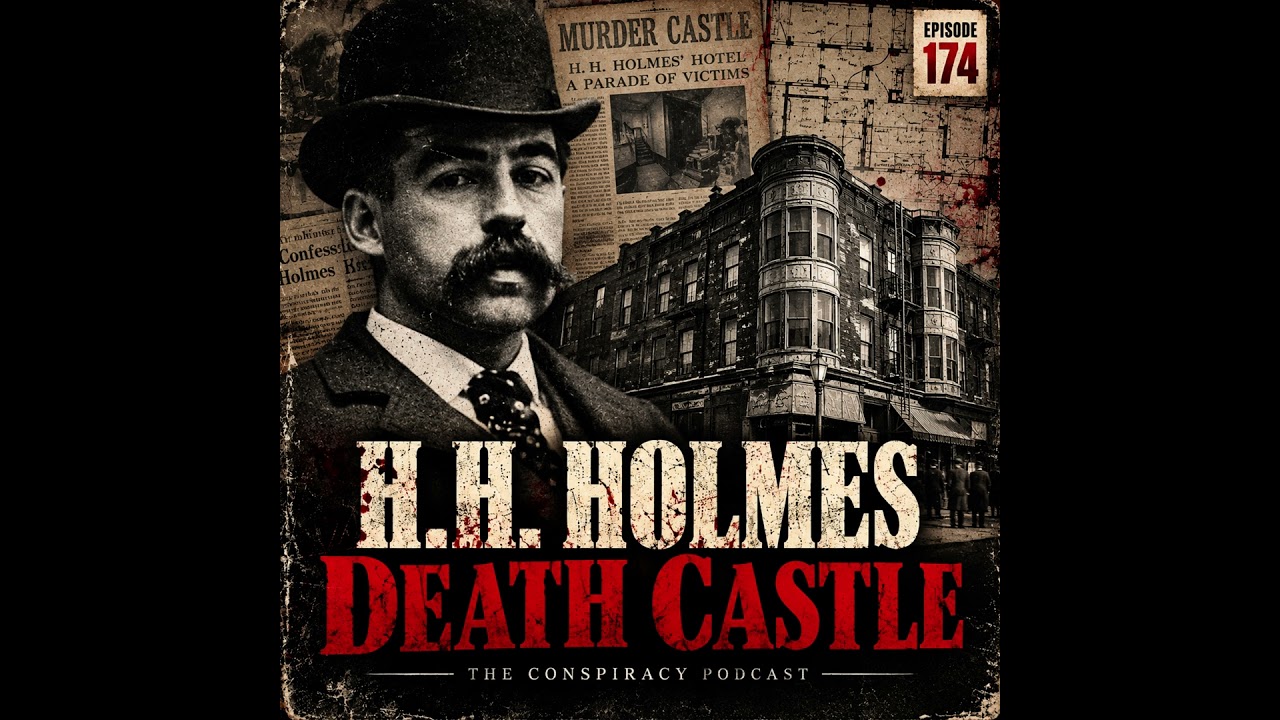
The hosts treat it the way the show treats every theory, as a question to test, and they lay out Mudgett’s case in full before answering it. If you want the whole Halloween special, including the Murder Castle, the Pitezel insurance murders and Detective Geyer’s search for the children, start with the H.H. Holmes episode. The Ripper claim is the first theory the guys take apart at the end of it.
Was H.H. Holmes in London in 1888?
Not by any documented record. The Whitechapel murders ran from August to November 1888. In that stretch of his life Holmes had married Myrta Belknap in Minneapolis in January 1887, was running his Englewood drugstore in Chicago, and had started building the castle across the street in 1887. By 1888 his own suppliers were suing him.
The lawsuits are the useful detail, because they are paperwork. According to the episode, the architects sued Holmes in 1888, then the steel company, then the drug suppliers, all over a building he was putting up on credit and never paying for. A man being sued in Chicago over a construction job is a man with a Chicago address. The researcher Adam Selzer has argued that the documents place Holmes in Chicago through 1888.
The hosts raise the travel idea early in the episode and immediately hedge it. One says there are some records that show Holmes traveling in the same period, and the connection gets called a bit loose, then super loose, before they move on. The diaries Mudgett describes would be the only source putting Holmes in London, and they would be in the hand of a man the episode calls one of the greatest liars America ever produced.
Does the handwriting evidence hold up?
Mudgett says a handwriting analysis matches Holmes to the famous Jack the Ripper letters. The hosts are not persuaded, and the underlying problem is bigger than the analysis. Nobody has ever established that the Ripper letters were written by the killer, so a match to the letters would not be a match to the murderer.
The hosts’ reaction on the record is short. One says everyone wrote in a very whimsical way back in the day. It is a joke with a point under it: handwriting then was taught from standard copybooks, so two educated men of 1888 producing similar flourishes proves little. Handwriting comparison is also an expert opinion, not a fingerprint, and the result depends on who is comparing and which samples they chose.
Then there is the source problem. The letters signed Jack the Ripper reached a London news agency and the police during the panic of autumn 1888, and senior Scotland Yard officers of the era, Sir Robert Anderson among them, later wrote that they believed the best known one was a journalist’s invention. If so, matching Holmes to the letters would at most make him a hoaxer in London, which the Chicago record rules out anyway.
How did Holmes kill compared to the Ripper?
Very differently. The Ripper attacked women working the streets of Whitechapel at night, with a knife, and left the bodies where they fell. Holmes killed people who trusted him, mostly for money, inside buildings he controlled, and then hid the bodies. One had a method. The other, in the hosts’ words, had no plan whatsoever.
The hosts put it in terms of pattern. Jack had a pattern for sure, one says: the same kind of victim, the same hour, the same kind of attack. Holmes improvised everything. He insured Benjamin Pitezel for 10,000 dollars, killed him in a rented Philadelphia house in September 1894, identified the body himself and collected 9,700 dollars. He then took three of Pitezel’s children and killed them in two countries while moving their mother through the same cities under different names. That is a con man covering a con, not a ritual.
Even the castle, the part that sounds most like a serial killer’s workshop, cuts against the theory. The hosts believe Holmes killed people there, and say so plainly. But the women who vanished around it, Julia Conner and her daughter Pearl, Emeline Cigrand, Minnie and Nannie Williams, were employees, lovers and business partners who disappeared one at a time over two years, often with property or money changing hands first. The Ripper killed strangers in a four-month burst, and no money changed hands.
What did the police say about the theory at the time?
According to the episode, the Chicago police were laughing about the idea as far back as 1895, while Holmes was in custody and the castle was being searched. The men who knew his crimes best, and who had every reason to pile on, did not take the London connection seriously.
Context matters. In July 1895, police tore the Englewood building apart and found, according to the episode, a blood trail near the elevator shaft, a child’s bloodstained clothing, items tied to Minnie Williams and part of a child’s skeleton in the basement. Reporters were filing stories about trap doors and a hotel of death. In that atmosphere almost any accusation stuck to Holmes, and investigators with his timeline in front of them still did not buy the Ripper link.
That reaction carries weight because it came from people with the records in hand. Pinkerton agents had arrested Holmes in Boston in November 1894, and Detective Frank Geyer spent the summer of 1895 reconstructing his movements city by city to find the Pitezel children. Nobody tracing that trail reported a trip to England. The record does not support the London claim, and that is the most that can be said.
| Theory | What the record shows |
|---|---|
| The diaries. Two inherited diaries are said to place Holmes in London. | The 1887 marriage, the drugstore and the 1888 lawsuits keep him in Chicago, as Adam Selzer has argued. The episode calls Holmes one of the greatest liars America ever produced. |
| The handwriting. An analysis is said to match Holmes to the Ripper letters. | Scotland Yard officers of the era believed the best known letter was a journalist’s work, so a match would not point to the killer. |
| Medical training. The Ripper was thought to have anatomical skill, and Holmes was a doctor. | Holmes’s University of Michigan degree is real, but a shared trait is not a location. It puts him in a profession, not in Whitechapel. |
| The resemblance. Holmes is said to look like some of the sketches. | The Ripper was never identified. The sketches are newspaper drawings built from witness descriptions, not portraits of a known man. |
| The method. Two brutal killers in the same decade. | The Ripper had a pattern. Holmes killed acquaintances for money, in buildings he controlled, with no fixed method. |
| The police reaction. Investigators in 1895 heard the London idea. | According to the episode, Chicago police were laughing about it, and nobody reconstructing his movements reported a trip to England. |
Even the Chicago police were laughing about it back in 1895. Even they were laughing about it.
the guys, on the record
What do the hosts think?
Zero validity, in their words. One host says Jack the Ripper was calculated and Holmes was chaotic. Serial killers usually have a pattern, and the Ripper had one; Holmes would burn you, put you in acid or use a trap door, with no plan at all. The guys do not doubt Holmes was a killer, only that he was that killer.
The hosts are careful about the numbers. The confirmed count is four: Benjamin Pitezel and his three children, Alice, Nellie and Howard. Some historians accept about nine, adding the women who vanished around the castle. Holmes sold a confession to 27 murders in April 1896, and some of the people he named were still alive. The 200-victim figure traces back to a single line in Herbert Asbury’s 1940 book on Chicago’s underworld. The hosts believe he killed more than four and say his lying makes an exact number impossible.
That lying is the real answer to the Ripper question. Holmes told the skeleton story about his own childhood, sold a confession he then denied on the gallows, and lied right up to the rope. A theory built on documents in his hand starts from the least reliable witness in the case. For the full hour, including the fire that gutted the castle while he sat in a Philadelphia cell, listen to the Death Castle breakdown, and for more cases where the legend outran the record, browse our guide to famous conspiracy theories.