The Voynich Manuscript – EP 82


The Voynich Manuscript
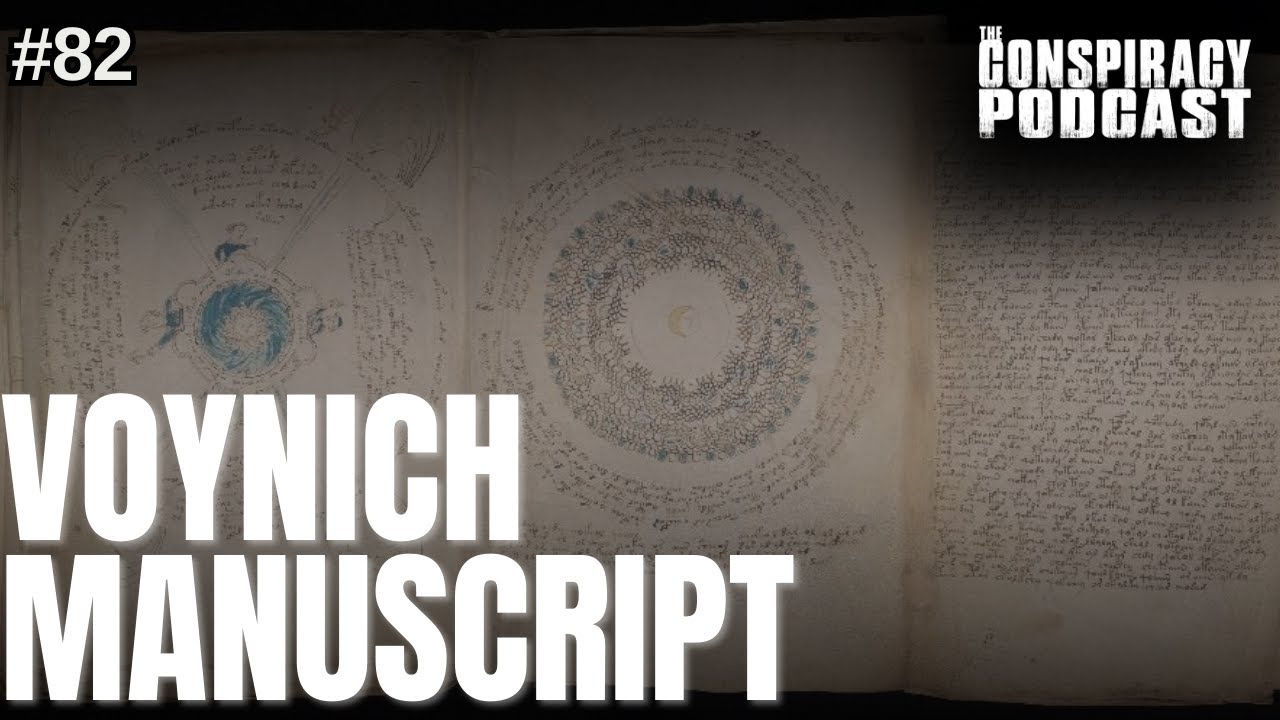
The Voynich manuscript is an early-15th-century codex carbon-dated to between 1404 and 1438, written on calf-skin parchment in a script of 25 to 30 characters that nobody, not even the WWII code breakers who cracked Enigma, has ever deciphered. It runs about 170,000 characters across six sections of unidentifiable plants, astronomical diagrams, and women bathing in green water connected by pipes.
It bounced from a Prague alchemist named George Baresch to scholar Johannes Marcus Marci to book dealer Wilfrid Voynich in 1912, who slapped his own name on it, and now sits in Yale’s Beinecke library. The boys land on the big debate, an elaborate hoax versus a real lost language.
- The carbon dating to 1404 to 1438 and the test confirming it was written on entire calf skins
- The 170,000 characters and 25 to 30 distinct letters that WWII code breakers still could not crack
- The six sections: herbal, astronomical, balneological, cosmological, pharmaceutical, and recipe
- The naked women bathing in green pools connected by a network of pipes, and nobody knowing why
- The ownership chain from alchemist George Baresch to Marci to book dealer Wilfrid Voynich, ending at Yale’s Beinecke library
Read the full transcript
This is the episode on the Voynich manuscript. I’m going to keep trying to say Voynich because for some reason I’m struggling with it, but it’s the Voynich manuscript. If you have not heard of the Voynich manuscript, it’s a huge mystery that has been around for about six or 700 years. Well, these are older than that. I mean, we’ll go into it, but here’s what it is right out the gate.
It’s a manuscript that is obviously intellectual and it’s obviously in a language that humanity has not determined. I mean, it literally looks like Elvish. Me and Eric were talking about this before the episode, this looks like Lord of the Rings, this really looks very Lord of the Ringy. Now what’s important to know is, and we’re going to put it on our Patreon, all the images of the actual manuscript, but it’s not like gibberish. It’s not like scribbles that you put on a cave. No, this is like script.
This is not like Sean and I had a bunch of mead and then we scribbled something on the walls. No, this is very articulate, and there are pictures. Like look at this, a bath house. And there’s a bunch of naked women in here, like I mean they’re clearly women. They’re all ladies. So essentially this manuscript was found and nobody to this day has been able to decipher it because it’s in a language that doesn’t exist anymore. It’s like a dead language.
It just says that it’s a text purported to be a script that is not immediately recognizable, resembling the undeciphered script of the Voynich manuscript. So basically everything you just said, even AI doesn’t know this. The Voynich manuscript remains one of the most mysterious artifacts in human history. Its origins, content, and purpose have puzzled scholars, cryptographers, and historians for centuries. The Voynich manuscript is believed to have originated in the early 15th century, based on carbon dating placing its creation around 1404. I was thinking this was like 12,000 years old, like before human records.
So based on carbon dating, which we assume is legit, radiocarbon dating conducted at the University of Arizona in 2009 determined that the parchment of the Voynich manuscript dates between 1404 and 1438. Now subsequent protein testing in 2014 confirmed that the parchment was made from calf skin. Oh, so that’s why it’s legit, it’s not like wood, old school. Like a young calf, wagyu, premium calf skin.
Multi-spectral analysis indicated that the manuscript was the first and only text written on this parchment, confirming that it is not palimpsest, which is essentially a reusing of paper. So what they would do in olden times, they would take parchment on a calf skin and they would reuse it because it’s not like they had tons of reams of paper from Amazon. They would clean the ink off and reuse it. So they determined that it was the original. So it wasn’t like a Kinkos situation.
While the parchment quality is average, showing typical imperfections, it was meticulously prepared. If you look at it, there was a lot of effort that went into this. Why do they even draw this? There’s no dudes at all, it’s all a bunch of chicks. It was determined that the parchment was made from 14 or 15 entire calf skins. That’s a lot of calf. Additionally, the binding is made out of goat skin, but the binding is not original.
They date back to the time when the manuscript was held by Collegio Romano, and the presence of insect holes in the first and last of the folios and tanning discoloration along the edges suggest that the manuscript originally had a wooden cover, which was later replaced. Now I just wanted to clear up what folio is. If you were to do printing or papers in the 1400s, the folio is the full paper, and so it was two or four pages. So if you have a book that’s 100 pages, it’s actually made of like 50 pages. So the folio is two, front and back.
The manuscript is characterized by unconventional content, which is a series of illustrations depicting unidentified plants. These are strange plants, and here’s the confusing part. A lot of people say it’s a plant book or a book on botany, but why are all the naked women in there? And when was the last time you saw a plant that looked like that, that looks like a bonfire, like a quadruple carrot? What kind of root vegetable is that? And then what are these like wedding cake things? And then why are they in between the words? Like they’re in between all the words.
Additionally, in some of the pages they have astronomical diagrams, intricate human figures, the women that are in the bath. And the problem is that nobody can translate it, nothing really makes any sense. Despite its European appearance, the exact origin and authorship of the Voynich manuscript remains intense debate and speculation. Some theories propose it was created in Central Europe, possibly in German-speaking regions, while others suggest an Italian origin due to the stylistic and historical clues within the manuscript itself.
Since its discovery, the Voynich manuscript has been subjected to rigorous examination and analysis by scholars from various disciplines, basically linguists, cryptographers, botanists, astronomers. The Voynich manuscript has attracted attention by both professional and amateur cryptographers, including notable American and British code breakers from World War I and II. The same guys who broke those codes, and they couldn’t figure it out. Benedict Cumberbatch could not break this. The cryptographers were Prescott Currier, William Friedman, Elizabeth Friedman, John Tiltman, but all of them failed.
They figured out the Japanese codes or the Nazi codes, but they couldn’t figure out this. The Enigma, they had to build a goddamn computer to solve it. Despite centuries of effort, the Voynich manuscript’s text remains undeciphered. The script consists of an estimated 25 to 30 distinct characters arranged in a consistent yet incomprehensible manner. Efforts to decipher it have included statistical analysis of letter frequency, comparisons with other known languages, and the application of computational techniques. However, these efforts have yielded no results, leaving the manuscript’s language and meaning as elusive as ever.
The manuscript features 170,000 characters, that’s a long book, divided into about 35,000 groups that one would consider words, because you see there’s like a space. The only thing that they did figure out is that it’s not gibberish. It’s clearly script. If you and I got smashed out and we’re like, let’s make up our own language, I can’t even type in a straight line. But look how perfectly straight it is, it’s so coherently written. There’s no lines on the paper.
Multiple researchers say that it’s written by more than one person, like the handwriting analysis, but no more than three. Now granted, I only printed out like 10 pages, the chicks look the same, whoever was drawing the chicks is the same guy. So you think one guy was drawing the women, and then one dude was drawing the plants, and then another dude doing the writing, the guy on shrooms doing the plants.
So the manuscript is organized into six main sections, each characterized by distinct types of illustrations, with the drawings and the actual wording. Section one is the herbal section. It displays illustrations of plants with accompanying text typical of European herbal works. The plants are not identifiable, which is the problem. Some illustrations seem to be refined versions of sketches from the pharmaceutical section, so there’s a pharmaceutical section.
Another section, which is 21 folios, is the astronomical section, and includes circular diagrams related to astronomy or astrology, featuring symbols of the Zodiac, constellations, and diagrams with female figures, some nude, holding or connected to the stars. Maybe these were guys that traveled in from some far distant land, and there were like three homies, and people were like, what land are you from. These are the plants in my homeland, brother, look at this Imperial plant here. Is that a sunflower? It’s unearthly.
There’s another section which is 20 folios, so 40 pages, and it’s called the balneological section. And balneological is the study or relation to springs, water, hot springs, et cetera. And as you can see in the women in some sort of water, it looks like a bath house. And there are words in between, and those are connected by a network of pipes, suggesting a theme of water or bathing. It looks like they’re bathing, but then they’re all touching each other. And none of them look like Kim K, so this is definitely like 14th century European women.
Another section is the cosmological section, and it features more circular diagrams, including a foldout showing a map of islands, causeways connecting to castles. I wonder if they were able to identify those actual lands that they were depicting. The other section is a pharmaceutical section, it shows detailed drawings of isolated plant parts and then how to use them for medicinal purposes. But how do they know they’re used for medicinal? They can’t even discern what it’s saying. But it’s more like apothecary jars.
An apothecary was like an ancient pharmacist. You would go and they have all little drawers, and you’d say I’m constipated, and they go, this is the plant, the herb of the 17th century, you take it and you rub it on your chest, like Vicks VapoRub. And then the last main section was a recipe section, and it consists of full pages of text divided into short paragraphs, each marked with a star, almost alluding to it being a recipe. I love how they broke it up into sections based off what they potentially may be.
If you look at this, it looks like it’s going into jars, and then somehow it’s eventually pouring into the tub. These photos are wild, and literally then they’re bathing in it. What if it’s like blood? Well no, in the photo it’s actually green. They had colors back then. The water is green that they’re bathing in, it’s like algae bloom.
So the manuscript has a complex history, and it’s rooted in European materials and practices of the time. Its journey through ownership began with George Baresch, a 17th century alchemist from Prague, who found himself puzzled by a manuscript, and he called it the Sphinx, which was taking up space uselessly in his library. And it all comes full circle now. The Sphinx was buried head deep for a long period of time, and it was almost like a red herring of the pyramids, because you think it’s part of the pyramids, but it was completely dated in a different time period.
So he had it in his library, and here’s part of the problem with this guy. This is the first known person who owned this, but we don’t know where he got it, it was just in his library. He was aware of a famous Jesuit scholar named Athanasius Kircher, and his work was deciphering Egyptian hieroglyphics. So he was very famous for accomplishing that, so he sent him a copy of the script seeking insight, though there’s no record of the response.
The exact details of how George Baresch acquired the manuscript are not clearly documented. As an alchemist in the 17th century in Prague, it was a hub for scholarly and esoteric studies. George likely obtained the manuscript through the intellectual circles of the time, kind of like buy it on the black market. Unfortunately historical records do not specify how he got it, so we still don’t know.
So upon his death, the manuscript was passed to Johannes Marcus Marci. He was a Rector, like a teacher or somebody who’s high ranking in a school or religious school. He was a Rector at Charles University in Prague, so they’re both in Prague. So he eventually sent it to Kircher, which is the guy who was the Egyptian hieroglyph guy, and we have the letter of him sending it to him. This was in August of 1665. The letter expressed Marci’s deep respect for his intellect, suggesting that the manuscript could be read by nobody other than Kircher.
Here’s just some of the letter. It says, Reverend and distinguished sir, father in Christ. This book, bequeathed to me by an intimate friend, I destined for you, my very dear Athanasius, as soon as it came into my possession, for I was convinced that it could be read by no one except yourself. The former owner of this book asked your opinion by letter, copying and sending you a portion of the book, from which he believed you would be able to read the remainder, but he at that time refused to send the book itself.
To its deciphering he devoted unflagging toil, as is apparent from attempts of his which I send you herewith, and he relinquished hope only with his life. But his toil was in vain, for such sphinxes as these obey no one but their master. Accept now this token, such as it is and long overdue though it be, of my affection for you, and burst through its bars, if there are any, with your wonted success. I mean, I would read this book, straight up.
He does mention that the book was purchased for 600 ducats, which at that time was like a European gold coin back in the 1600s. He believed the author was Roger Bacon, the Englishman. He says, on this point I suspend judgment, it is your place to define for us what view we should take thereon, to whose favor and kindness I unreservedly commit myself and remain at the command of your reverence. This is suck-up back in the day.
So the manuscript continued to intrigue and confound through the centuries, eventually, through a series of people, it made its way to the hands of Wilfrid Voynich in 1912. So then he named it for himself, it’s his manuscript. That’s why it’s called the Voynich manuscript. He was an antiquities dealer, or a rare book dealer. I mean, isn’t that the number one cover for a drug lord, antiquities? It’s like, $18 million for a piece of paper, it’s really rare, trust me.
So in 1969 it found its final place, and it’s located at Yale University, and it’s part of the Beinecke rare book and manuscript library. I wonder if you go to school there, if you can look at it, touch it. It’s probably in the restricted section. I do know that you can see online, you can see every page. So disregard the printer ink, that’s how I got this. And you said it was in color, so some of these plants are also full color. I think it’s amazing that the color preserved over that long. Calf skin is the win.
So to this day there are never-ending people trying to decode this, and nobody has. The first and foremost theory is that it was a hoax, the most time-consuming hoax of all time. You know how long it must have taken to do this hoax. One prominent theory suggests that the manuscript is an elaborate hoax designed to deceive readers into believing it contains valuable knowledge, but it doesn’t. Alternatively, it may be an encrypted document intended to protect sensitive information using a sophisticated cipher that we have yet to decipher.
Who would spend this much time to do this? Some ultra-rich person is like, I’m going to spend literally thousands of man hours writing, and it looks legit, these letters are all the same. There’s no way that’s a hoax, no one would. It would be one folio if it was a hoax, not 100. Other theory, lost language. Another hypothesis proposes that the manuscript is written in a lost language or a constructed language, possibly invented by its author for secrecy, or by a civilization that just disappeared. Maybe this is tied into the hollow Earth, these are the underground people, that’s why they all have these weird plants.
The thing is that whoever the author was, if he wanted to keep it a secret, then why did he go through all this trouble to encrypt it and put it into precious calf skin in color. If you were a hoaxing it, why would you make it in color and difficult, all the elaborate naked women. Next theory is an herbal or pharmaceutical guide. Some researchers speculate that the Voynich manuscript is a medieval herbal or pharmaceutical guide, akin to contemporary herbals that catalog plants and their medicinal uses. The detailed illustrations of plants and herbal baths depicted in the manuscript support that interpretation.
But why was it written in a language that nobody understands? Maybe it was a wild dude up in the country, little Anunnaki come down, they’re like, hey, I’ll teach you herbal science, my dog. Another theory is astrological or alchemy related, due to the presence of intricate astronomical diagrams and celestial charts. Another theory suggests that the manuscript is an astrological or alchemical treatise, possibly containing hidden knowledge related to celestial events or mystical practices. I’m definitely in the vibe of the mystical practices, because in the occult everyone’s always naked and they always got to be doing some weird stuff.
Next up is extraterrestrial or supernatural origin. Among more speculative theories, some believe that the Voynich manuscript contains messages from extraterrestrial beings, advanced civilizations, or supernatural entities. This theory attributes the manuscript’s cryptic nature to its otherworldly origins and purposes. While I do think that’s cool, I don’t think this is the one.
And then the last one is historical figures and secret societies. If you think about it, if we were in the secret club, this is what I would be wanting. Skull and Bones. Maybe this is all medicine and they’re like, check it out, bros, hoba root, for a small fee I will give you what you need to stay erect for four hours or longer. Certain hypotheses connect the manuscript to historical figures such as Da Vinci or Roger Bacon, both known for their interest in cryptography and esoteric knowledge. According to these theories, the manuscript may have been created by a secret society or individuals seeking to preserve or transmit hidden knowledge or hidden technology of medicinal help.
I totally believe that, especially with all the plants too. One thing throughout history, super rich and powerful people have always been obsessed with eternal life. So you can see this is like some sort of Fountain of Youth type thing. Definitely some created language so that they wouldn’t get intercepted. It’s back to the Holy Grail, which we need to do an episode on. They’ve been trying to do it forever. Like even the Spanish, they put all this money into find, want to live forever. That’s why it’s only the rich people.
So in conclusion, the Voynich manuscript continues to defy understanding. As technology and scholarship continue to advance, new techniques in code breaking and perspectives may unlock this, but up to this day it remains a mystery, and nobody knows why it was created, what language it was created in, and why it was hidden. I really want to know what it says, super bad. I just want to know what these plants are. What’s going on with these girls over here, they’re all touching.
So the question then becomes, is this super secret society? This is reeking of secret society. It really messes it up when we know it’s from the 1400s. If this would have been pre like 2000 BC, I’d have been like aliens 100 percent, found in the pyramids. But the fact that it was literally from the 1400s, 1500s, this is a little secret society to me. They would go through the time and effort to create a language to pass on stuff secretly, and maybe they just all died off and that society didn’t make it.
In my perspective, I’m kind of leaning more towards mystical. But here’s what’s crazy, my first inkling is that it’s a civilization that was lost. But how is that barbaric? That stuff is not barbaric, it’s sophisticated, literally the opposite. Do you know how much ink it took with a quill to write this? So let’s break it down. It’s 1400s, it’s a massive book, it’s huge, that’s why I’m saying it can’t be a fake. No one fakes that with that many pages.
So if it was a civilization that spoke this language and had that writing, then that means that civilization’s gone, and we never translated it. But this looks and feels European, it was passed around Europe. I don’t think it’s Italian, I’ve seen Italian writing, it doesn’t look Italian, zero percent. This writing itself looks like it’s from, I would say, Middle Eastern, like ancient Middle Eastern kind of writing. That’s the first thing I thought. I was thinking Sanskrit, it looks very Sanskrit. And Elvish, it literally looks like Elvish.
So I don’t think it’s an ancient hieroglyphic type thing that you see in the pyramids. It literally looks like regular words with regular letters, but it’s just too scripty. Why can’t we translate it? Either one of two things. So it was some civilization, some society that just died off and then we never knew the language, or did they do this on purpose. Those are the two points, or is it extraterrestrial.
I like where you’re going with the community that was completely wiped out, fully wiped out. Maybe it’s like some cataclysm, but even then, we can translate Pompeii writing. But you’ve got some Amazonian civilizations that you don’t know what kind of language. And who knows how it made it to the guy’s library, we don’t know. So maybe this is, I don’t know who knows.
Some of them have writing on the spine or the side margins. So where are you at? I think because there’s so many plants, it definitely seems very apothecary-ish. That’s like the medicinal, pharmaceutical, hey what does this plant do to help you. But then it makes me think secret society, why are they only naked women, they’re everywhere, and they’re all in pools. And just so you know, in the colorized photos these are all green pools. So it makes me think there’s some hidden civilization, these plants look like they’re in the center of the earth, like the hollow Earth theory.
Maybe it’s from the center of the earth, it is a hidden civilization, like the Atlanteans. These are the Atlanteans, and maybe the water down there is all green. I like the whole idea of the medicinal, like maybe it was somebody’s diary, or somebody logging their own language. How did we not translate it? I think maybe we have to come to terms with there were civilizations that we lost everything from, the last 800 years. The only explanation that makes sense is that there’s a little society that maybe was an offshoot of the Middle East.
Maybe they were some little village and they were like, we got some cool plants up here, and this is the medicine man’s book, he’s a witch doctor, this his book. And he was in a village of women. Well, I think we just might need some help, I’m at a loss. If you guys have ideas, theories, if you have any idea what any of these plants are, honestly this is one of the ones that kind of stumped us a bit. I’m super baffled, and I don’t know why there’s got to be some reason why all the women are touching, they’re butt to butt to butt. And what are these pipes? It’s clearly a flow, but it’s flowing from an acorn, a pine cone.
There is one theory that somebody started to get into biology and science, and these are zoomed-in cells, and it was the first time of microscopic viewing. A bit of a farfetched idea. They can make microscopes, but they’re drawing stuff like this? Obviously we’re grasping for straws. So that’s the Voynich manuscript, guys. Definitely look at the pictures and you’ll understand, because we do a lot of talking about the pictures, it’ll really make sense when you see them. It’s like grandma’s recipe book, if grandma was a schizo.