The Vatican Library – Episode #69


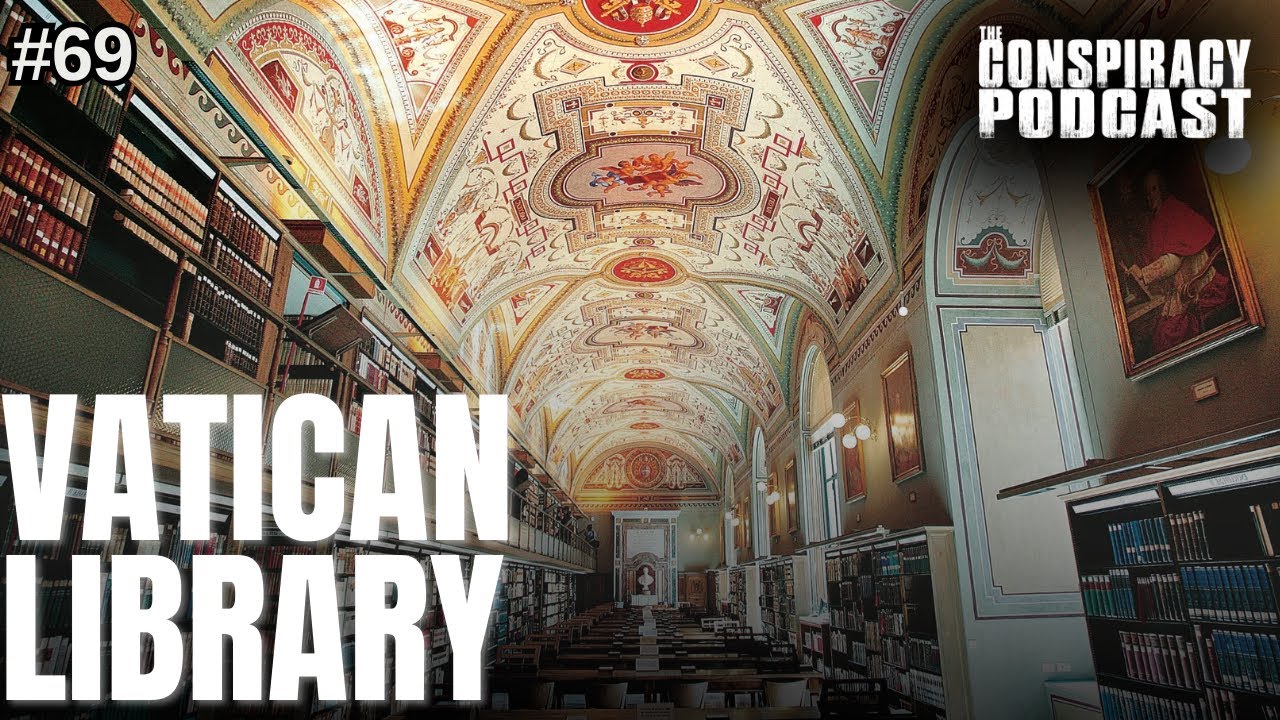
The Vatican Library
The Vatican Library has roughly 53 miles of shelves and a private wing literally called the Secret Archives, which the church swears just means private, not hiding spaceships. The crew runs through the locked-up oldest Greek Bible, lost gospels, Knights Templar treasure, and the theory that ancient tech got stashed in Rome.
The real argument is whether the church is sitting on something that would blow up the whole story. Jorge says release it and let people think for themselves, Sean says one wrong detail collapses everyone’s faith, and Eric figures the story is just mistranslated.
- The Codex Vaticanus, the oldest near-complete Greek Bible, locked away from the public
- The Secret Archives and the debate over whether secret really just means private church paperwork
- The Lost Gospels theory, that writings like the Gospel of Thomas got cut from the canon
- The Knights Templar treasure pipeline, including the Ark of the Covenant supposedly smuggled into the Vatican vaults
- The ancient-astronaut bit where hidden artifacts end up locked in Rome
Read the full transcript
Welcome back to the show. Hope you guys are subscribing and doing all sorts of sharing and liking and listening. Just on repeat, nonstop, like while you’re at work, just in the car, just leave it in there. Get like six computers set up on a VPN, just listening to us.
So what do we got today? We have a pretty awesome episode and it’s from one of our VIPs, one of our rich person Patreon members, and it’s one of the OGs. He’s actually our official historian, he is the director of archives. Just to clarify, if you sign up for the rich person level on our Patreon, you get to pick your own episode, and so this episode was picked by the Duke himself, the legend. He’s really great because he’s listened to every episode 17 times, so he knows all the ins and outs, he’s the master of the trivia. His selection tonight was the Vatican Library, and what is going on at the Vatican Library?
So we’re going to do a little quick history, a little learning. Religious beliefs and practices have been a part of human society since ancient times, shaping cultures, laws, and worldviews. The earliest known religions were polytheistic, which is basically that there are multiple gods, like the Romans, the Greeks, obviously even the Egyptians, the Sumerians, the Babylonians, the Assyrians. They had gods like Enki, Marduk, and Ishtar, and they held sway over different aspects of your life. There’s a god of agriculture, a god of death, a god of life, a god of everything.
Also in ancient Egypt they had gods like Ra, Osiris, Horus, Anubis, the sun god and the god of the underworld, the god of war, a god of love, a god of harvest. So there was a major change in the world when it became monotheism, which is essentially just one singular God. And Christianity was rooted in the teachings of Jesus Christ. It emerged within the context of Judaism but offered a revolutionary message of salvation, love, peace, and redemption. The life and death and resurrection of Jesus transformed a small Jewish sect into a global faith, spreading throughout the Roman Empire and beyond.
Christianity’s emphasis on love, forgiveness, and salvation attracted followers from all different social backgrounds, from the high ups to the low down. You could be a peasant and still be somebody, still be important. It wasn’t like the god of commerce only gives a damn about the rich guys. And so a major thing happened in 325 AD. Basically imagine the birth of Jesus and then 300 years later, the Roman Empire, which was the biggest civilization of the time, adopted Christianity under Emperor Constantine the Great, and it became the official religion of Rome. Which is interesting because the Romans were the ones who killed Christ technically.
Essentially Emperor Constantine the Great implemented it into the Roman Empire, so they got rid of the Roman gods, like Zeus or Jupiter, who are in essence the same thing. You get the Roman and Greek gods, which are the same exact gods with different names. I believe the Greeks named them after the planets and the Romans named them their name, so like Zeus and Jupiter, Neptune and Poseidon, and Venus. In essence same gods, just different timeline.
So then they created the Vatican. The Vatican Library actually was like two rooms, it was very small, just a couple rooms where they put stuff. The Vatican is the epicenter, the epitome of the Catholic religion. It is where the pope is, it is the hub, it’s the mecca. The Vatican is in Italy and it’s in essence its own city, its own country. It has its own law, its own law enforcement. It’s a separate country. The Vatican is the headquarters in Rome, Italy, the government of the Roman Catholic Church. It’s also the city state that’s ruled by the pope, and it’s considered the center of the Roman Catholic Church.
So the establishment of the Vatican Library can be traced back to the early days of Christianity, when the church recognized the importance of preserving and disseminating knowledge. Pope Julius the First’s acquisition of the Lateran Palace provided a physical space for storing manuscripts and documents, laying the foundation of what would become the Vatican Library. So at a certain point they were like, knowledge is important, we need to preserve it. You can imagine the Library of Alexandria that burned down, the amount of information that was stored in that place. There’s something like 50,000 scrolls, just done burned up. Can you imagine the life-changing information that’s in there, probably like how they built the pyramids, the blueprints, schematics, the details of the aliens coming down.
Pope Nicholas V’s formal establishment of the Vatican Library was in 1448. It marked a turning point in the church’s commitment to scholarship and intellectual inquiry. Under his patronage the library began to amass a vast collection of manuscripts, codices, and artifacts, drawing on resources from across Europe and the Mediterranean world. Manuscripts were meticulously copied, cataloged, and preserved to survive for future generations. So basically it became the place where everything came. Just so you know, codices is just plural for codex, and a codex is an ancient manuscript text in book form.
The Vatican Library’s collection encompasses many different subjects: theology, philosophy, history, science, literature, art, from ancient papyri and medieval manuscripts to Renaissance masterpieces and modern publications. The library’s holdings reflect the breadth and depth of human knowledge across the planet. Papyri just means paper, guys, just papyrus paper. I just want people to get what does this word mean.
Among the Vatican Library’s most notable holdings are its collection of ancient manuscripts. These include treasures such as the Codex Vaticanus, considered the oldest copies of the Greek Bible, dating back to the 4th century AD. These manuscripts not only provide valuable insight into ancient languages, literature, and religious beliefs, but also serve as windows into the culture and intellectual heritage of past civilizations. Over the centuries the Vatican Library has been home to countless hidden gems and rare treasures, of which the main one is that early oldest complete manuscript of the Greek Bible, considered the original text.
Now here’s the interesting part about that: not everybody’s allowed to see it. They have let certain people go into it, but they’re high-end scholars and only people within. There’s probably a dude standing right next to them, don’t touch it. It’s probably in a hyper temperature and humidity controlled room because paper and oxygen, much like salt water, oxygen will eventually oxidize the paper and destroy it. It’s almost 2,000 years old. The importance of having the original is hard to explain, it’s like having the Jordan rookie card, it’s the first one, it’s like signed by Jesus. I consider that more the Holy Grail than the Holy Grail, except this doesn’t grant you eternal life. There’s no magical properties, but it’s pretty legit.
It’s renowned for its exceptional quality and completeness, which contains nearly the entire Bible, the books of the Old Testament. It is considered one of the most reliable sources for biblical scholarship. That manuscript has been housed in the Vatican Library since at least the 15th century when it was cataloged among the library’s holdings. Its exact origins and journey to the Vatican are not known. It’s believed to have been copied by scribes in the Eastern Mediterranean region, possibly in Egypt or Asia Minor. So it’s still a copy, it’s the earliest copy that they can find. Obviously no one has the original first edition.
The thing is it’s not in English, so you get these translational differences. The telephone game. Someone’s like, I think this actually means this, and it’s ancient Greek language. They put their own spin on it, their own opinion. Like remember when Clinton said I did not have sexual relations with that woman, he put his own little meaning on it that was different than what we thought. Completely different telephone game.
Despite its prominence, the original has remained largely inaccessible to the public, with restricted access to qualified scholars and researchers. Its presence has obviously gained conspiracy theories, which is that nobody can see it, or at least nobody without a key card, nobody with Q clearance. I’ve actually been to the Vatican. It’s amazing, it’s grandiose. The paintings alone and the wall paintings, there’s more marble than you could ever fathom, the whole damn thing is marble.
When I went I had just finished reading the second Da Vinci Code book, Angels and Demons. In there I went to some of the sites, one of the things in the book and in the movies, the West Wind, that’s in the Vatican Square in the front, and I touched it. But when you go in, there’s all these secret passages. You look through the floor and there’ll be these grates, almost like a storm drain, and there’s grates inside and you can see people walking through the tunnels. Then you’ll see clergy and nuns and they’ll just go into what looks like a wall and then they appear. My point is it’s super expansive, it’s built on top of building on top of building. There’s a whole system that layers and layers that you don’t see, and what you see is wow, but there’s so much more to it.
Some of the artwork is just mind-blowing. You have to be up on a ladder for months doing something that I could never even do. It’s that scene with Robin Williams in Good Will Hunting where he’s on the bench with Matt Damon and he’s like, you haven’t looked up at Michelangelo. It’s amazing.
In addition to the ancient manuscripts, the Vatican Library houses an extensive collection of medieval texts, including illuminated manuscripts, theological treatises, letters between governments, letters between clergymen, a never-ending treasure trove of knowledge and culture. It’s like what you said about the Library of Alexandria, it’s what we have now because we don’t have that. There’s so much information, random crazy stuff that you can only fathom is in there. I think this is probably the largest collection of ancient information that exists on Earth, and some of it is only there.
They probably haven’t even translated all this. There’s probably so much stuff that they don’t even know what’s there. Imagine 100,000 scrolls in a different language that nobody speaks now, but maybe four guys, four historians in the world. So the Renaissance period of Europe marked a golden age for the Vatican Library as popes and scholars alike sought to revive classical learning and culture. Pope Sixtus IV’s patronage of the arts and humanities led to the expansion of the collection even further. So all of a sudden we move into an art age, and then they opened up the library even more to not just scholar information but art and poetry, whatever you considered to be of value. So it just kept building and building.
The Vatican Library is overseen by the prefect of the Vatican Library and Secret Archives, and it’s called the Secret Archives. There’s no qualms about calling it the Secret Archive, it’s secret. They’re responsible for its administration and management. The prefect, appointed by the pope, works closely with a team of librarians, archivists, and scholars to preserve and maintain the collection. Librarians play a crucial role in cataloging, preserving, and digitizing those library holdings, but again it’s about translations and long-term preservation, and it turns into a nightmare project.
Can you imagine if they have ancient Sumerian text, no one really knows that language. One dude is like, I think it means this, I don’t really know, also I have six weeks vacation right now and I can’t do this, and look how much I’m getting paid for this. And even if he does know, the handwriting you’ve got to decipher too. You’re like, is that an L, what is that?
One of the most enduring conspiracy theories surrounding the Vatican Library is the existence of secret archives containing forbidden texts and suppressed knowledge. According to legend, these archives are said to house documents that could challenge the established religious doctrines, revealing hidden truths about historical events or even containing evidence of extraterrestrial life. While the Vatican has acknowledged the existence of the secret archives, which primarily contain historical documents, there’s nothing further about that. So they don’t deny or confirm the extraterrestrial, they confirm that there’s something called the Secret Archives. If it’s a secret archive that’s probably about all I’d say too.
There is a little history of the secret archives, and it’s known as the Archivum Secretum Apostolicum Vaticanum. This is Latin. So it’s like the secret archive of the Apostles of the Vatican, something like that. It’s definitely where J.K. Rowling got all of her spells, and that’s also where Tom Hanks is trapped. It dates back to the 17th century, established by Pope Paul V in 1612. They were intended to store sensitive documents related to the governance of the church. Contrary to popular belief, the term secret in this context does not imply hiding or secrecy but refers to being private. Private docs compared to secret docs, it’s not on the one drive. But again it almost seems like a translation thing, Latin is very, if you look up the word secret it probably does just mean private.
They have everything that you could imagine, like the bills, the power bill, what the church is paying, or taxes. Well, the church isn’t paying taxes. Now of course this is what the church is saying, so we’ll take that with a grain of salt, but it’s the private stuff of their activities. The secret archives also house materials of broader historical interest, such as correspondence between the monarchs and the statesmen and the intellectuals and the royalty.
You can imagine, back in the day there was a point in time where the Catholic Church pretty much ran the world. When the Spanish pretty much ruled the world, the conquerors, the Spanish government and the Spanish fleet would go and conquer and they would dump all the money into the church. That’s why you see the old churches all crazy grandiose, gold everything, solid gold organs. Because they just dumped all the money into it. So while there was the King of Spain, the church was senior to even the monarchy. If the pope said this is what you’re doing, the king would be like, yes sir, yes your Holiness, we’re going to get it done. It was an extremely powerful organization, they could change the course of the earth.
Also there’s dirty laundry, there always is. Somebody does something bad, it doesn’t necessarily mean the religion’s bad. There’s individuals. You’re going to have letters of somebody doing something horrible. Within anything, just like a corporation, there’s like one person in there who does some shady stuff, embezzling, doesn’t mean the whole company sucks, it just means sometimes there’s bad people. Despite its name, access was given a couple times. So in 1881 Pope Leo XIII opened the archives to what he considered qualified researchers. In 2010 Pope Benedict XVI further expanded access by digitizing selected documents and making them available online.
Now it’s very redacted, kind of like the president releasing JFK files but redacting them. It just says JFK files. So I guess what they’re trying to say is that every hundred years or so it’s like a release, they let people in, but it’s so big where are you going to start, and how are you going to even understand all that? So play out this scenario, say us three are determined to get in as qualified researchers and they say okay, we’re going to open up the doors. Let’s say there are 100,000 documents, where do you start, where do you begin? And none of it’s in English. You grab a book, you don’t even know what to do.
Despite these efforts at transparency, misconceptions and speculation persisted, and some conspiracy theorists claim that the archives contain evidence of secret societies, pieces of the Bible that they don’t want anybody to know. But of course there’s no way to know. Here’s the thing too, on that point of hey, we’ll let you in, there’s no 100% given that they’re just going to let you in. They could take the other stuff out, move it to storage room B, and then it’s all yours. What’s in Wing X? What are you talking about, it’s locked, we don’t have that. There’s no way to know either side of it.
Another theory suggests that the Vatican Library holds ancient texts and manuscripts that were intentionally excluded from what you call the canon Bible. Canon means pure, it comes from comics, like when they make a Spider-Man movie, if it’s canon it means it’s exactly as the comics had done it. So here’s a nerd example. Star Wars. The movie is source material, all nine, they’re all from Lucasfilm. Then the animated series that they made from Disney is also canon because it was made by Lucasfilm and George Lucas created the story.
Now there are about a hundred Star Wars books, and they’re dubbed non-canon because they weren’t written by George Lucas. So George Lucas created the concept and the story, therefore it is canon, and only if it was published by the original would it be considered canon within the timeline. One last example: in one of them Chewbacca dies in a book, but he didn’t die in the movies, so it’s not part of canon. The books also depict storylines outside of the timeline. What about the new Disney ones? They’re canon because they’re from the ownership, but George Lucas wasn’t involved in them, so it’s debatable. I don’t consider them canon because they were so dog. They were absolute trash, I spent two hours during and two hours after the movie just complaining about everything that was wrong with it.
So the idea behind this is that things were excluded from what we know of the storyline of the Bible. Let’s imagine Jesus went on to have other kids, that’s not in the Bible we know today. Let’s say hypothetically they find these older texts. Christianity’s already crushing it, second biggest religion on the planet, they’re doing good things, people are happy, saving lives. And then you discover these older texts and it’s off. You’re not just going to be like, hey guys, we know. What do you think from their perspective, are they thinking is it the greater good to not ruin what we started? I’m not saying it’s right or wrong, that’s not for me to decide, but that would definitely take a spin in the wrong direction.
Then they would be like, oh, so what else you been lying about? Everybody would question everything. Let’s take a mundane thing. Let’s say he turned water into apple juice, or let’s say he smoked cigarettes. It doesn’t change your belief structure, it doesn’t change what he did as a great man, he just smoked cigarettes. But think of it from a logistic standpoint too, imagine how many millions upon billions of bibles are in production. Imagine having to recall all of them, we got to change page 64. Cost effectiveness of we got to reprint all these. Every time you do a reprint you get less people going, you know what, I don’t believe you, I’m not going to buy one.
Imagine getting a Toyota recall on your suspension system, you’re like, what. That’s an interesting point. Corinthians is got to go, we got to take it out, it’s a break in trust. No matter what it is, you’ve been living your entire life on this. Can you imagine being in that council and having to make those choices? It’s way too much responsibility for me. But then are you mad that you’re hiding the truth? Let’s go even more mundane than smoking cigarettes, more simple. He was crucified, right? What if just a small part of that story was wrong, like he didn’t carry his own cross, like they had a horse dragging it, and everything else was the same, all the great things he did were the same, but just that was different.
It would instantly, like going in court, the whole point is to reason out, then people are like, well what else is different? It brings a little doubt, it brings it down. It’s a conception, it’s Inception, if you could just put that little thought in there they’re going to be like, wait what, and then it can cause this whole ripple effect of everything else, and everyone starts to be like, that’s interesting. So what they call it is the Lost Gospels. There were other writings about the life of Jesus that were not included. But what if he was doing way more gangster stuff, what if he slayed dragons, what if there was some super awesome legendary stuff.
What if he came back, what if he was from Krypton and he was like Superman, literally invincible. Homie’s like top five goat, easy goat of the time, he is the goat, the original goat. So the idea is we could study this further. It’s part of the whole lost gospel thing because there’s the Gospel of Mary Magdalene and the Gospel of Thomas that are known about and studied but they’re not necessarily a part of what we know today as the Bible. These are lost gospels and lost writings of the life of Jesus Christ.
What I think happened too, and what the Catholic church probably keeps secret, is look what happened already. Look at how there’s 80 or 90 different sects of virtually the same exact religion but slightly different because of different translations, and people thought things were different, so they were like no no, this is what I thought it meant. So it’ll just continue to spiderweb out, and maybe they saw that’s what was happening, it would just dilute everything. The telephone game happened so many times, and then there were so many sects, and it’s going to keep changing. So they’re like, lock it down, this is the truth, this is what it is. Let’s create the secret archives, stash it away, lock it down.
But my thing is, if that is the truth, it’s so weird how you think they would just destroy it. But you can’t, it’s so important you can’t burn it. But we got to keep it. That’s got to be chalked up to they’re so passionate about it. You dedicate your life to something, even if this is going to ruin everything, I’m not going to burn this, I’m just going to put it in the secret archive, door X, like with the vibranium.
Another theory poses that the Vatican Library harbors hidden knowledge or esoteric teachings that could challenge established religious beliefs and reveal suppressed truths about the origins of Christianity, as well as technology. It has to do with, okay, the Egyptians have different gods and maybe the gods taught them certain things, and that would kick speculation on the one God. What if they were aliens and they got the tech from aliens? But then it would still throw into question the one God system because, is it that God, the god of the aliens too, and it could cause things. There’s also they think the Atlantean stuff is in there and they have tech, but wouldn’t they be using that tech though too?
I think the argument is that if there are beings that are more powerful than the god described in the Bible. Well the god described in the Bible is all powerful. But if they have proof that there’s a god that can come down and turn the sun off in body form. So I think that’s the concept of this.
Just the ingenuity of man, you give guys a good salary and good benefits, they’ll build you anything, they’ll build you pyramids. Good management, that’s what built the pyramids. So it’s an interesting concept to take up, which is what amount of change affects anything, and then who decides who to suppress what. The more people involved, the greater that decision becomes more difficult, because if it was 10 people you’d be like, oopsy daisy, little change, no big deal. But if there are a billion people, you change one thing and what if 200 million people are like, you betrayed us, our whole last 10 generations have lived their life this way.
Now as a disclaimer to everybody, we’re not scholars of religion, we’re not theologists, we’re trying to figure it out. But I want to ask, do you believe this should be determined by a person? It has to be a council. Well, the way they have it set up is by a pope, the Supreme decision maker, and obviously there’s the council of cardinals who are involved. I think I like the pope system. I don’t think that a group of people are going to make, it’s going to be so hard to come up with the right decision. It’s like Congress, they’re going to skew towards the wrong decision, and the more people involved it’s like who’s on the take, who’s going to get bought out.
But that even happens with the pope. Why are they getting bought out, they’re in full dedication? Not necessarily money, like hidden interest. Within that type of system there’s probably a lot of politics going on, because when you’re a cardinal that’s a very high position of power, you have a lot of say so. There’s a lot of minutia going on in order to get into that position, you’ve got to have people that got your back and you owe favors. It is like politics, but I don’t think there’s really the monetary portion of it, they have a religious purpose. It’s more like a power thing instead of a monetary thing because they don’t need money, you’re in the government, the government’s paying for it, like you’re in the military. I don’t know the ins and outs of living the life of clergy.
Another theory is the Templar treasures. If you don’t know much about the Knights Templar, these are basically knights who are of a religious order compared to a country devotion. A zealot is someone who’s hyper fanatical about religious belief to the point of happily willing to die for it. And so the Knights Templar were there for the Crusades, the religious Crusades, which is literally a holy war over that. The Knights Templar are considered to be the medieval Christian military order, they were the sword arm of the church.
According to some accounts, the Templars amassed vast wealth through conquering treasures during their time in the Holy Land, which they either hid or smuggled into the Vatican. It’s even thought that the Knights Templar got the Ark of the Covenant. So in the 14th century the Knights Templar were dissolved, so basically before all of that they smuggled everything in, and they were like, okay we’re going to be dissolved and we can’t kill people anymore. Some speculate that these treasures, including priceless artifacts, art, and ancient religious relics, the Vatican now possesses in the library or in the Vatican vaults, which are adjacent next door. These treasures included gold, silver, gems, and all sorts of religious relics.
Some say there’s fragments of the cross that Jesus was crucified on, that is ancient and invaluable, and there’s speculation on the spear that stabbed Jesus and all these super significant pieces of history. So following the suppression of the Templars by King Philip IV of France and Pope Clement V in the early 14th century, rumors started to build, basically because they got rid of the Templars either because they found something or they got too powerful. They were ruthless. The overall idea is that they basically just brought that stuff to the Vatican, they dissolved them and said, give us your stuff, you’re disbanded or we’ll kill you, and then now they have the treasures. Isn’t there also a tie between the Freemasons and the Knights Templar, symbology and all that stuff, like we might have gone over in the Freemasons episode. Who knows.
Okay, so the last couple theories. One is that there’s ancient tech, that they found ancient astronauts and all the tech that was involved and they just brought it to the Vatican. Just imagine, now we have government in every country and it’s not a royal family. There’s still a few, there’s like six monarchs but they kind of have no power. But back then it was the church for about four or 500 years, mainly the church as the overall ruling, and the church ruled multiple countries too, France, England, Spain. So the idea is there were ancient astronauts because in your theories they like to come down all the time, and they came down and all that tech, the ship, the suit, the body, was just brought to the Vatican.
Can you imagine you’re walking like, don’t look to your left, nothing to see here, what is that massive thing with a big blanket over it? I don’t think they have a ship down there. But can you imagine being in the Knights Templar back in history, you’re all sweaty, haven’t taken a shower in weeks, walking around the Middle East and all of a sudden, what is that silver thing over there, let’s walk over there boys, let’s get our swords out, and it’s a spaceship. How are we going to get this thing out of here?
So hear it out. You’re riding a donkey across Northern Africa, land of the Roman Empire, and you come across a crashed ship with an alien in it, a little homie in it. The old school Area 51. And you’re like, what is this, and you strap this alien, and you get a gun, sounds like Independence Day, sounds like Men in Black. So you throw this alien on the back of your camel, and you find a gun and a motherboard from the ship and a bunch of stuff. Imagine finding the gun, you press the trigger, blow up your home. Then you have to take the seven week journey back to Rome, and then you pull up, the alien’s all degraded, decomposed, smells. You pull up to the Vatican, you’re like, what’s up pope, look I found, come inside, send him downstairs.
So he found something that completely changes the history of mankind, and the pope or whatever, the cardinal, says just come on in, put it in the Vatican, keep it on the hush hush. It does make sense though, look what happened with what the government’s releasing to us now, like 60, 70 years later they’re like, okay yeah, maybe we were seeing stuff, whoopsie. But it’s a catch 22. I am all for full transparency, I love it, I want it, because I personally can handle it. But can the world handle that, especially in the 1400s, 1500s? Do you really think the world could have handled it, you get a scribe and a letter and they’re like, we found small green thingies, and chaos.
Now they can, but if they come out with this now then it’s like, well what else you got in there? You got to keep the lie going forever, the lie has got to persist. And also you die. You lie and then you’re like, I’m going to die soon, so screw it, literally 700 years. You go, screw it, I didn’t have anything to do with it, the guy you’ve been training for 20 years, you’re like, your problem now, peace. The chances of that coming out, it would have come out, but the passion that everybody at the church has, it’s like your whole entire life has been devoted to this thing. Most of these guys have been in the church since they were like 15, and you’re 70 now, you’re like, I’m not going to ruin it now.
Because in the grand scheme, religion as a whole and all of its forms is actually a good thing for the planet. It gives people a reason to be good people, a reason to strive to be better than what they are. Religion as hope, religion as a whole is necessary for our lives. So I can see where they’re coming from, do we really ruin that to disclose some new stuff, is it worth ruining this good thing, chaos is going to ensue. There’s nothing worse than a man or a woman with no hope. It’s like that movie where you get the one day and kill everyone, the Purge. Earth Purge. This is why me and Jorge have guns. Eric will come over to our house, he’s got a bunch of kitchen knives that aren’t even sharp.
So I have a couple of crazy anecdotal stories about the Vatican Library that I thought were cool. The first one is a legend. Legend has it that there’s a secret passage connecting the Vatican Library to Castel Sant’Angelo, a fortress located nearby. The passage was allegedly used by Pope Clement VII to escape to safety during the sack of Rome in 1527. While the existence of such a passage has never been conclusively proven, it adds an element of intrigue, that there are secret passageways from the Vatican Library out. I’m on board with that, just go to the Vatican and look down, you watch them walk through it, they’re not hiding it at all, that’s in plain sight.
In 1620 the Vatican Library suffered a major loss when a significant portion of the collection was stolen by a former librarian named Marino sarus of Ancona, who had been dismissed from his position, smuggled out hundreds of valuable manuscripts and sold them to collectors across Europe. It wasn’t until years later that some of these manuscripts were recovered, but nearly half of them remained missing. Imagine that guy, they’re like, what are you doing, he’s like, I’m just doing the laundry, wheeling out a manuscript. This is what rich folks spend their money on, the billionaires. If I was a billionaire I’d definitely buy one of those. Come check out my own Vatican Library downstairs, you go into a cigar room, he hits a little button and it opens up, this is Jesus’s journal, this is Jesus’s pinky.
Another one: one of the most famous incidents involving the Vatican Library occurred in the early 17th century when an astronomer known as Galileo was banned from using the library. One of the most famous humans who’s ever lived. Galileo’s support for the heliocentric model of the solar system contradicted the geocentric model supported by the Catholic Church. What that means is the Catholic Church used to think that Earth was the center of the universe, and he’s like, well technically there’s this giant sun thing that we’re going around. So he was banned from the library. A lot of scientists were at that time, they were considered heretics. A heretic is someone who’s saying things that they consider false truth about things. At the time those things were perceived as a slight against the faith, even though it was just, hey, we’re just perceiving what’s happening in the world.
During World War II, when the Allied Forces advanced on Rome, concerns arose about the safety of the Vatican Library. In a remarkable effort to protect the library’s treasures, Vatican librarians and volunteers worked tirelessly to pack up thousands of manuscripts and transported them safely into Vatican City. Despite the chaos of war, the library’s collection survived, mainly thanks to the dedication of hundreds of people. I would have been moving that into my apartment. Anyways, these are just anecdotal stories of cool stuff about the Vatican Library.
So who’s going first? I’ll go first. I definitely think that there is stuff in there that would change things, scandal paper, a smoking gun, like Jesus had an iPhone. I’ve been kind of saying it throughout the episode, I think that if anything came out it would be cataclysmic. Anything that comes out of there that changes the historical record everybody’s known up until now would result in some sort of upheaval, world anarchy. Everything would just go to chaos, nobody would believe in any religion after that, everybody would question everything. And back to Sean’s point, religion is so key as a stable point for society that without it the world is complete madness. At least I would think that’s what they think, and that’s why they’re not releasing anything at all.
So you’re thinking their intentions are good, whether it’s a wrong choice or not? Yes, 100%, maybe it’s a right choice, we don’t know what’s in there. I don’t think it’s the right choice, I think they should release it, because the right choice is to let people think for themselves, not let the government or the church or anybody think for you. I agree with Jorge. I might not think it’s alien, but I definitely think there is evidence of a technology that has ceased to exist, because if we look in the past at what was able to be done, there had to be a technology available in order for certain things to happen.
I think they did think, hey, we’re doing the right thing, we don’t want to cause massive chaos. But on the flip side, if you can’t trust man to be responsible enough to have information on the truth, then your view is actually a shitty view, because it means you’re taking a superiority complex over the broad spectrum. Like Jorge was saying, oh cool, you don’t trust people enough to handle the truth, so I’m not smart enough and not good enough, the entire planet’s really stupid. So I’m fully on board with, if we can’t handle the truth, we were never going to be able to handle it anyways, and we’re never going to advance as a species.
I don’t even think there’s anything in there that would totally alter what we already know of the Bible, but any detail would just throw everything out the window, nobody trusts anything. That’s why I feel like our government now is like, well we can’t really tell the American people because they couldn’t understand, so let’s just keep making these thousand page bills and they’ll never know. But if there was ever a time, it would be now because Information Age baby. People don’t even give a damn whatever comes out in the news. Even back to the aliens, the Pentagon did confirm. And you’ve got people like Eric that are still nonbelievers, we’re 65 episodes in and Eric is still like, just link me, just email me.
Okay Eric, what’s your take? This might be scandalous. I very much respect Jesus as a person, I feel like he was a man that did amazing things, incredible things, and I think what’s there is just that the story is wrong, they got it mixed up, mistranslated a little bit. He was still a dope dude, just the stories are wrong. Maybe he never got crucified, maybe he was hella persecuted but he overcame. I keep saying this, I have a son and he was asking me about Jesus and I was like, dude, I think Jesus was a great guy, a rad guy, top five goat, who tried to instill love, peace, temperance, all sorts of good things, and I just think that the stories are wrong. That’s what we’ve known for 2,000 years, you can’t change it, the narrative’s gone on so long.
People may hate on it, but regardless, even if hypothetically Jesus wasn’t a dude, you can’t hate on his message. What a great message, love your fellow man, love your neighbor, be all right, be a good dude, an upstanding citizen. So I think there are things there, and I think they’re pretty rough. What’s the extent? I think there’s letters of scandal, oh for sure, we are still talking about humans here. There’s probably some sketchy stuff, like this guy embezzled that money, this guy did this thing. That could be a lot, we’re talking back to the 1400s. There’s records of that, 100%, because they keep track of all the letters. So that’s what I think is all there, that’s the conspiracy.
There you have it. This one’s for you Duke, thanks Duke buddy. If you guys have any questions, any hate mail, go ahead and email us at info at the conspiracy podcast dot com. Give a follow on YouTube, we never shout out YouTube. We actually might have a solution for video soon so stay tuned, a lot of you guys have asked for that, we’ve just been waiting for me to diet for like a year, that ain’t going to happen. We’re going to work out the angles, the high-end angles, he wants a drone, we’re going to be shooting from the sky. All right guys, we’ll catch you next time. Night night.