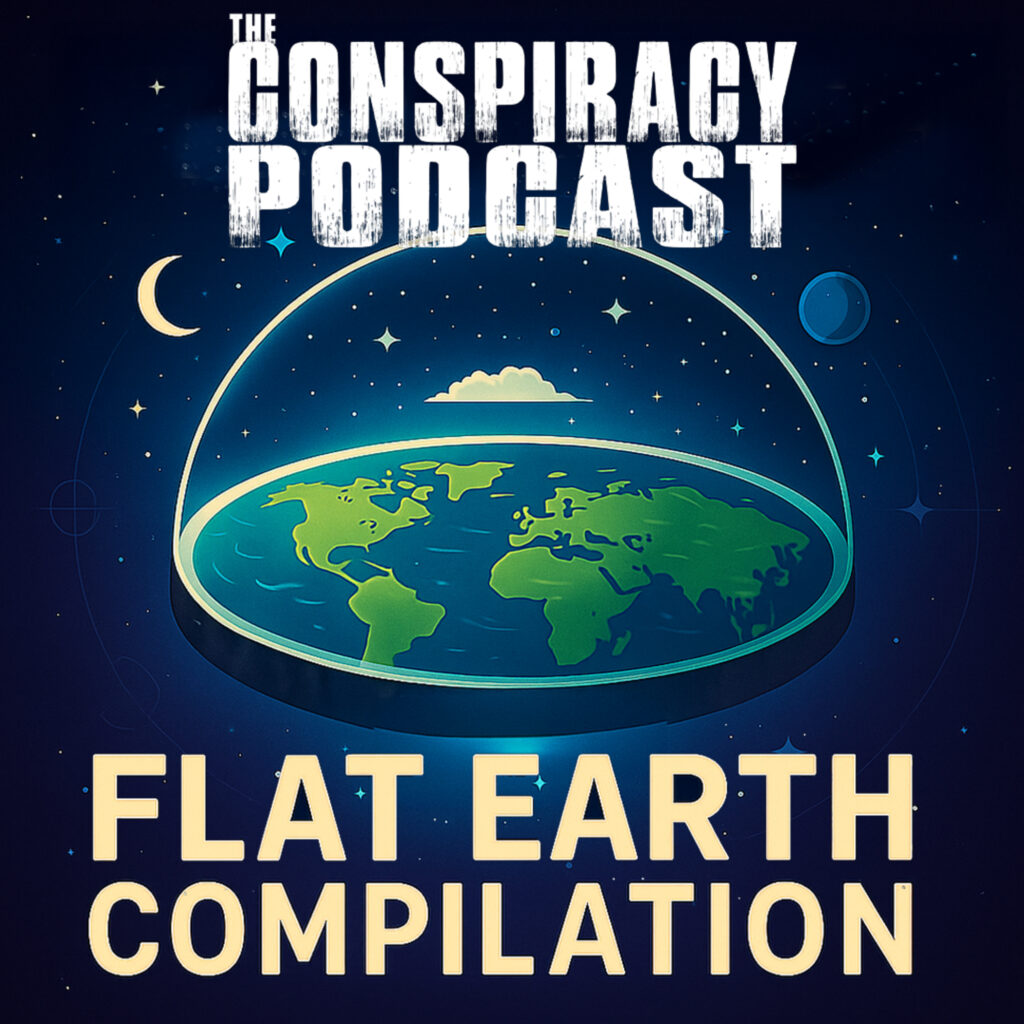




What Is the Flat Earth Theory?
Take a wild ride to the edge of the map and beyond as we explore one of the most enduring and bizarre conspiracy theories of all time: the flat earth theory. Despite centuries of scientific discovery and overwhelming evidence that the Earth is a sphere, millions of people around the world still believe the planet is flat. The flat earth theory proposes that the world we live on is not a globe spinning through space but rather a flat, stationary plane. Believers claim that governments, space agencies, and scientists have been lying to the public for centuries about the true shape of our world. The modern flat earth movement has exploded in popularity thanks to social media and YouTube, growing from a small community of skeptics into a global phenomenon that raises profound questions about trust, authority, and how people evaluate evidence.
Ancient Origins of the Flat Earth Idea
The idea of a flat earth is far older than most people realize. Ancient civilizations across Mesopotamia, Egypt, and early Greece conceived of the world as a flat plane. In ancient Mesopotamian cosmology, the earth was depicted as a flat disk floating on water, with a solid dome (the firmament) overhead. The Hebrew Bible describes the world in similar terms, with the “circle of the earth” resting on pillars beneath a vaulted sky. However, the notion that most ancient people believed in a flat earth is actually a modern myth. By the time of Pythagoras and Aristotle (6th to 4th century BC), Greek philosophers had already concluded the earth was spherical based on observations like the curved shadow cast on the moon during lunar eclipses, the way ships disappear hull first over the horizon, and the changing position of stars as one travels north or south. By the medieval period, a spherical earth was the consensus view among educated Europeans and scholars in the Islamic world alike.
The Modern Flat Earth Movement
The modern flat earth movement traces its roots to Samuel Rowbotham, a 19th century English inventor who published “Zetetic Astronomy: Earth Not a Globe” in 1865. Rowbotham claimed to have conducted experiments at the Bedford Level, a six mile stretch of straight canal in England, which he said proved the water’s surface showed no curvature. His work attracted a small following and laid the groundwork for organized flat earth belief. In 1956, Samuel Shenton founded the International Flat Earth Research Society (later simply the Flat Earth Society), which kept the idea alive through pamphlets and newsletters. After Shenton’s death, Charles K. Johnson took over and grew membership to around 3,500 by the 1990s. Johnson dismissed NASA photographs of the globe as fabrications, a stance that would become central to modern flat earth arguments. The real explosion came with the internet. Starting around 2014 and 2015, flat earth content began going viral on YouTube, with creators producing elaborate videos questioning the globe model. The movement grew rapidly as algorithms recommended flat earth content to millions of viewers. By 2018, surveys suggested that as many as one in six Americans were not entirely certain the earth is round.
What Flat Earthers Actually Believe
Not all flat earthers agree on the details, but the most common model envisions the earth as a flat circular disk with the Arctic at the center and Antarctica forming an ice wall around the outer edge. The sun and moon are believed to be much smaller and closer than mainstream science claims, orbiting above the flat plane like spotlights rather than celestial bodies millions of miles away. Gravity, in the flat earth model, does not exist as a force. Instead, many flat earthers propose that the flat disk accelerates upward at 9.8 meters per second squared, creating the sensation of gravity through what they call “universal acceleration.” Others attribute the downward pull to density and buoyancy rather than gravitational attraction. Perhaps the most elaborate aspect of flat earth belief is the conspiracy required to sustain it. Flat earthers argue that NASA and every other space agency in the world are part of a coordinated deception. All photographs and video footage of a spherical earth are considered fabricated or manipulated. Airline flight paths, satellite technology, and GPS systems are all explained through alternative mechanisms that do not require a globe.
The Science That Contradicts Flat Earth
The scientific evidence for a spherical earth is extensive and comes from multiple independent sources. Satellite imagery from numerous countries and private companies consistently shows a spherical planet. Ships and buildings disappearing bottom first over the horizon can be observed by anyone with a telescope near a large body of water. Time zones, seasons, and the varying lengths of daylight at different latitudes all follow patterns that only make sense on a sphere. Modern experiments have also confirmed earth’s curvature. In a notable incident documented in the 2018 film “Behind the Curve,” a flat earth proponent spent $20,000 on a precision laser gyroscope to prove the earth does not rotate. The device consistently measured a 15 degree per hour drift, exactly what would be expected on a rotating globe. The result was quietly set aside by the experimenter.
Why People Believe the Earth Is Flat
Understanding why the flat earth theory has gained so many followers requires looking beyond the scientific arguments. Research suggests that flat earth belief is often less about geography and more about distrust of institutions. Many flat earthers express deep skepticism toward government agencies, mainstream media, and scientific authorities. The flat earth community provides a sense of belonging and shared purpose for people who feel alienated from or deceived by established institutions. Social media algorithms have played a significant role by creating recommendation pipelines that funnel curious viewers toward increasingly extreme content. What starts as casual interest in an unusual idea can quickly escalate into deep immersion in flat earth communities and content.
Listen to the Full Episodes
In this compilation of The Conspiracy Podcast, we take a comprehensive look at the flat earth theory across two full episodes. We cover the origins of flat earth belief, the key figures in the modern movement, the science that disproves it, and the psychological and social factors that keep attracting new believers. This is one of the most fascinating and polarizing conspiracy theories out there, and we leave no stone unturned. Listen now on Apple Podcasts, Spotify, or wherever you get your podcasts.
Related Episodes You Might Enjoy
Flat earth theory is just one of many ideas that challenge the way we understand reality. Our episode on simulation theory takes things even further by asking whether the entire universe, flat or round, could be a computer program running inside something else entirely. If you enjoy questioning what we have been told about science and history, our episode on the moon landing hoax explores claims that NASA faked the Apollo missions and why millions of people remain unconvinced. And our deep dive into the secrets of Antarctica covers the mysterious continent that flat earth believers say holds the key to the entire model, along with strange discoveries that mainstream science has struggled to explain.