Living in a Simulation – EP 93


Living in a Simulation
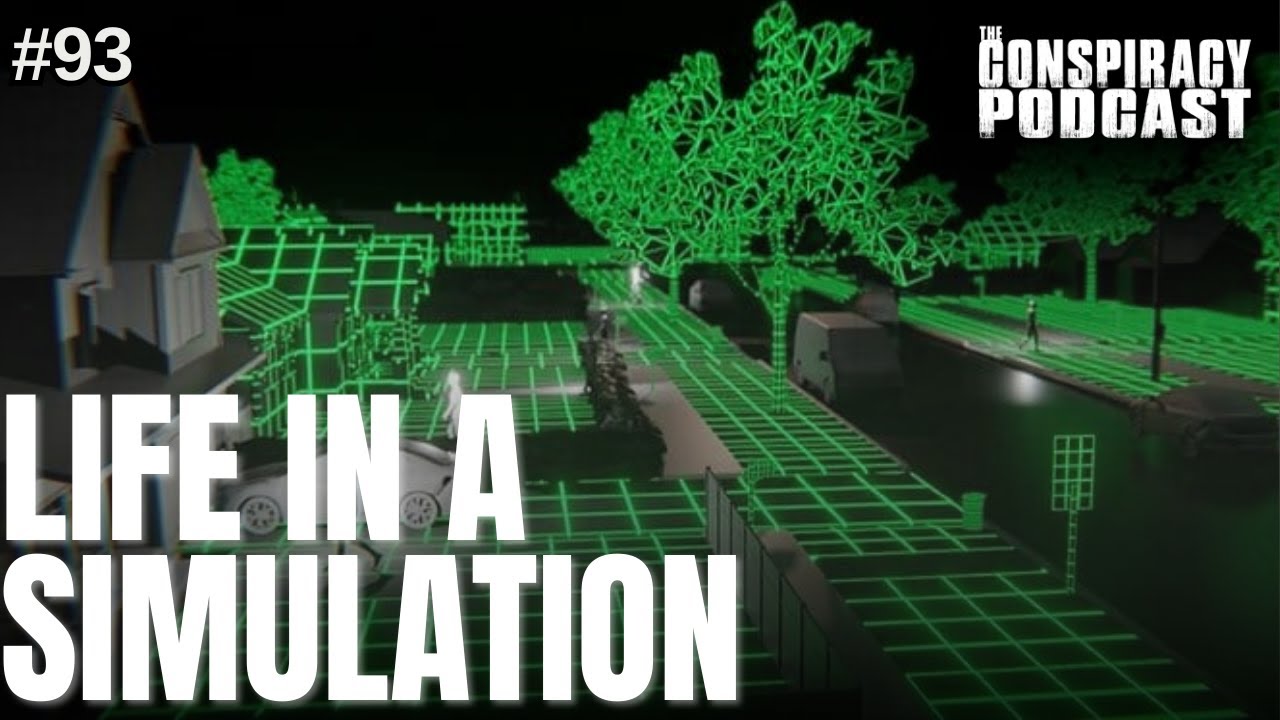
Are we living inside an advanced computer simulation? The guys trace the idea from Plato’s cave and a butterfly dream all the way to Nick Bostrom’s 2003 trilemma and Elon Musk’s claim that the odds of base reality are one in billions. They poke at the speed of light, the Planck scale, and whether math itself is a tell.
Then it gets personal. Glitches in The Matrix, deja vu, planes frozen in the sky, and a creepy guy eating seeds to live to 140. Sean stays skeptical, Eric just knows there’s something more, and the verdict lands on a living simulation where the data you get is the data they hand you.
- Nick Bostrom’s 2003 trilemma, the three statements where at least one has to be true and option three is that we’re almost certainly simulated
- Elon Musk’s claim that the odds of NOT living in a simulation are one in billions, and the math behind it
- Ancient groundwork: Plato’s cave, Zhuangzi’s butterfly dream, Descartes’ evil demon, and Ibn Sina’s floating man
- The physics clues the boys argue about, the speed of light as a constant and the Planck-scale pixelation of spacetime
- Glitches in The Matrix, deja vu, frozen birds and stuck planes on video, and the tie-in to their Mandela Effect episode
Read the full transcript
Hey everybody, welcome back to The Conspiracy Podcast. Yeah, this one almost didn’t happen. Almost Hiatus number two within as many weeks. Miracle on 69th Street, I know, seriously. And it’s a little brisk outside, another outside recording, compliments of the La Casa Rodriguez.
So this one’s cool, and I know everybody’s gearing up for Thanksgiving, but this is something that has been requested by one of our VIP patrons. He’s one of the rich guys, one of the supers. He’s been requesting it for a little while now, a good while, and we appreciate his patience but also his support. It’s for Jaden, you the man, dog. If you guys don’t know, we have a Patreon, and in that Patreon the highest status you can get to is called the rich person, the premier status. As part of your support you get to select your own episode, and he has selected this episode. We’ve been working on it for a bit, and it’s Living in a Simulation, AKA The Matrix but in real life. But there’s no Neo. No powers.
So on this one I really want you to put on your deep hat, because we’re going to talk deep concepts. Double tin foil. This is extreme concepts, this is not a murder mystery, this is very philosophical, very out there. It’s also one that shatters the realities of everything that you think is real. So it’s like everything you’ve believed in your entire life is wrong. That’s why we like it, that’s why we believe in it. It’s a hard pill. Question everything.
Now obviously this theory gained traction when The Matrix came out. If you haven’t seen The Matrix then you’re not here. That last one was trash, I couldn’t even get through it, I watched 10 minutes and I couldn’t get through it. It just ruined everything for me. Thanks for ruining the franchise. But did you like all three of the first ones? I loved the first and the second, the first one was amazing, the second one was okay, then they started getting too deep. The keymaker and the architect, I’m like okay, they’re getting a little too deep.
That back and forth in The Matrix, dude, I literally had to watch that scene like 17 times. He’s just sitting there in his white beard, 8,000 confusing screens, and I’m like, I don’t think I still get it. It’s not like one of those Christopher Nolan movies, Inception, a dream within a dream. And that’s part of this too, living in a dream world. Anyways, we’ll get into it, it’s time.
So over the past few hundred years a question has arisen that would shake the reality of all of us, of all mankind: is our world real, or are we living in some sort of augmented reality simulation? The simulation hypothesis, first introduced in its modern form by philosopher Nick Bostrom in 2003, suggests that our reality might not be the ultimate reality. Instead we could be living inside an advanced computer simulation, one constructed by beings either us and/or other beings that are technologically capable in ways we can’t even comprehend yet. It’s like somehow we’re all in the original IBM computer that NASA used. They’re like, wait, the moon, what if we just put everybody in a simulation?
So this idea at first glance sounds like science fiction, but as we dig deeper the story of simulation becomes a tale of philosophy and of science and the limits of human perception. So what we’re going to do is go back a little bit to the beginning and find out maybe there were philosophers of the past who also thought of this. Everyone’s always on very similar tracks to all the same conclusions, they’re all very close. Even if you look at all religion, most of it is around the same core tenets: be good, live a good life, and also a celestial being, some sort of Supreme Being.
So the story begins thousands of years ago with ancient philosophers pondering the nature of our very existence. Who are we, what are we, where are we, what are we doing. The golden age of being a philosopher. In ancient Greece, Plato presented his famous story of the cave around 380 BCE. In this thought experiment, prisoners are chained into a cave facing a wall. They see only the shadows cast by objects behind them, mistaking these shadows for reality. Plato’s cave is an early metaphor for the idea that what we perceive may not be the actual truth.
So on a rudimentary scale that is the same concept, like hey, maybe what we’re seeing may not be what’s actually occurring. It’s a philosopher test, a different kind of test. They put prisoners in a cave, I don’t know why they’re prisoners, and they make them face the wall, and there’s different shadows and lights, and whatever you make in the background they perceive as real on the wall. But in reality it’s just an illusion. So then the question becomes, what’s real? How do you even define reality? Reality is what you perceive to be real. But it’s not just what you see, it’s what you can touch, all senses, touch, smell, whatever, even perceptions that aren’t tangible. This is also in 330 BC, so they had limited resources. They didn’t have the VR goggles, there’s no PlayStation.
Throughout history many thinkers have wondered whether the world we see is real or just an illusion. While they didn’t have the idea of a computer simulation at that time, their ideas often question whether what we experience is the whole truth, that we see it and that we can touch it. In ancient China the philosopher Zhuangzi, around 380 BCE, same time period, told a story about dreaming that he was a butterfly. When he woke up he wasn’t sure if he was himself dreaming of being a butterfly, or if he was the butterfly dreaming of being Zhuangzi.
It’s like he’s a butterfly thinking, oh man, the simulation is so superior to my actual life, I’ll live for two more weeks in the real world. So here’s the idea. I go to bed, I have a dream, and in the dream I’m a hippo, drinking water at the pond, blah blah. Then I wake up and I’m like, holy crap, I was a hippo. But then the question is, am I really the hippo dreaming about Eric, or did I dream about the hippo? It’s crazy. But what happens when you’re on a late night bender and you get three hours of sleep? You’re like, I’m only a hippo for three hours, isn’t that wild. That means every time I’m the hippo dreaming of this life of Eric. I think it would be different if this Zhuangzi guy, or you, or anybody, had a persistent dream that’s always the same. Are you a hippo just once, or are you always a hippo? If you’re always the hippo, then you actually are the hippo.
Another one: a Greek philosopher named Pyrrho of Elis, similar time period, believed that we can never really know what things are like. He thought our senses are playing tricks on us and that we should avoid assuming that we understand what reality is. This theory connected to the idea that we might not see the full picture, such as living in a simulation. So his concept was that a blind person has a different reality than Jorge, because their senses are missed, but their other senses are probably heightened to a point where there are things they experience that we can’t.
Take a dog whistle, do you really hear it? No. Does that mean it’s not real? Do you see the air molecules bouncing, smashing off your face? Another good example is wind. You can feel wind, you can see the effects of wind, but you can’t physically see it. Anything that you have any sort of perception about, like the air molecules, you can’t see them but we’re obviously breathing. We’re deducing that based on the evidence of the cause of that thing. You’re able to use an electron microscope and see the molecules, that is proven, but back in the BCS, Pyrrho of Elis, you know what I mean.
In Buddhism, which arose around the fifth and fourth century BCE, now I’m not going to go into a lot of it and I’m summarizing it in a paragraph, I don’t want to pretend like I’m giving you a full description of Buddhism. So in Buddhism it teaches that the world we see isn’t permanent and/or completely real. There’s an idea called Indra’s net, from texts compiled around the third century CE, which describes a web of jewels that reflect on each other endlessly. It’s like imagining that everything is connected, similar to how things might work in a simulated reality.
So this is almost like a refraction of light. Imagine a projector shooting light through jewels, or a weird prism, and a reflection of what you’re already seeing, maybe it’s distorted a tiny bit over there but not over here. Just imagine a big wall of mirrors, diamond mirrors. It’s like Doctor Strange, the mirror realm, all different reflections of the same thing. It’s almost like alternate reality theory, different realities that are mirrors of each other.
So in 515 BCE a Greek philosopher named Parmenides thought that nothing ever really changes, and that what we see as movement or difference is an illusion. This is like the idea of a simulation where things might seem dynamic but are really controlled by unseen rules that we don’t know. I’m like, deep, nothing really changes, well why am I getting fat and slow and changing for the worse? I’m assuming the example is that we know gravity exists and gravity is a rule in our world, it’s a law. But what if we didn’t know gravity was real, didn’t know what it was? It’s going to be there regardless of whether you believe it or know it. Gravity came up later on as a law, and now we have a bit more understanding of the laws of the universe. So that means there could be other laws that we’re completely unaware of. Interesting, I like it.
There was another ancient thinker named Plotinus, around 250 CE, and he believed in layers of existence. CE is basically after, like AD. There was AD and BC, and then they realized that history shouldn’t be based off of a religious doctrine, so they changed it to BCE and CE. CE means Common Era, and BCE is Before Common Era. That has changed to avoid religious connotation. Before it was BC and AD, which was religiously related. That’s a very short answer, I’d suggest you go to your local scholar, AKA your ChatGPT boutique. What are we, three high school diplomas, very loose experience.
So Plotinus believed in the layers of existence. At the top was the ultimate reality, which he called the One. Below that were levels of less real worlds, including the physical world we live in. This idea feels kind of like the concept of a base reality beyond a simulation. So it’s pretty complicated and deep, but essentially there are multiple realities and multiple levels of reality. Almost going back to the dream within the dream, layers of realities. If you achieve higher states of existence you gain access to a deeper well of awareness. Imagine as you gain more awareness through life, more knowledge and understanding, you become aware of things you weren’t normally aware of before, or vice versa, life beats you down and you become blank to what’s happening around you.
And then another Greek philosopher, Heraclitus. Meanwhile the Spartans were training for war and the Greeks are like, what are we doing here. He said that everything is always changing, but that a hidden order called the logos guides it all. This hidden order is like the code in a simulation that controls how everything works. This is very much like the Force. There’s some sort of hidden energy balance, some sort of thing that binds us. Like Lord of the Rings, one ring to rule them all. It is funny to see that a lot of our stories and our pop culture lore really comes from the Greeks and philosophy of the past. There’s a reason people gravitate to those types of movies, because on an inherent level it kind of makes sense, maybe some subconscious awareness draw to it. It’s not the powers or the lightsabers, it’s the philosophy.
In the 14th to the 16th centuries the Aztecs believed life was like a dream. They talked about Tezcatlipoca, the god of mirrors, who showed how reality and illusion are connected. They thought we could wake up and understand deeper truths, much like escaping the simulation if you were able to see what the mirrors showed. I mean the Aztecs were also into human sacrifice and stuff, so those guys were on some next level stuff. The Mexicans are making the most sense to me, this is accurate.
Then we move over to Persia. The Persian philosopher Ibn Sina imagined a person floating in empty space with no senses. Even without seeing, hearing, or feeling, the person would know that they exist. This suggests that our sense of self doesn’t depend on the physical world but on the sense and feeling of knowing. You just know. You don’t need to smell to know you exist, you don’t need to see to know you’re there. So that means something else knows you’re there, like a flowing consciousness that’s aware that you are existing. The physical world, you’re not tied to it to know that you’re real. I like that. Persians, what’s up, I knew I liked you guys.
So we fast forward to 1641. A French philosopher named Descartes introduced the concept of a deceptive demon. He wondered, what if an evil demon is manipulating our senses, making us believe in a world that doesn’t exist? While he ultimately concludes that the act of thinking proves one’s own existence, the seed of doubt still remains: could our reality be an illusion? So he started with, is there an evil demon making us pretend that we don’t know the real world, but then he realized that the awareness of thinking proves that we exist.
I actually like that, because that’s the most agreed upon principle, that the ability for thought or consciousness denotes reality. That’s why I can’t imagine ChatGPT being able to have conscious thought, because it’s a program. Unplug the program. Elon Musk talks about that being inevitable, he also believes in this theory. Along this line, have you ever seen somebody pass away, physically in front of you, the moment they depart? I have not, luckily. But it goes back to the spark, the life, the act of thinking, the thinking thing. That goes away and you can see it going. Even if somebody doesn’t pass away, if they’re brain dead, there’s not that much life there, you can see the difference between life still existing and life gone, expired.
I definitely subscribe, and I think you guys are on the same page, that I don’t think the human body is the encapsulation of life. There’s some sort of driving energy force that’s animating it, and that’s where the thought and the consciousness is derived from. So someone who’s brain dead, there’s nothing happening there. And this is not to be rude if you guys have this in your family, it’s our own views and we’re trying to understand Descartes’ philosophy here.
So moving forward, the Industrial Revolution happened, and what did we get? Machines, trains, and the rise of the computers, things that are operating after humans have built them on their own. In 1936 British mathematician Alan Turing introduced the idea of a universal machine capable of performing any computation. This concept laid the foundation for modern computing and indirectly the simulation hypothesis. There’s also a Turing test.
So Alan Turing, from a pop culture standpoint, Benedict Cumberbatch played him in a movie called The Imitation Game, where they were trying to crack the Enigma. He was a code breaker. It’s really good, it’s a really sad story because he cracked the German code with his team, the uncrackable one, and he was treated very poorly. Classic government. In my opinion he started the concept of computers. What he created in itself is what a computer really is, the computing device. If you’ve seen the movie Hidden Figures, they used to call the women doing the calculations computers, because they’d be computing equations, that’s their job.
And he also developed a test, and this is a very bare bones description, which is essentially to tell if something’s human or machine. In theory machines can’t pass this test. It’s like the captcha thing, point out all of the pictures that have a stoplight in them, I can’t even pass that, it’s so blurry.
So fast forward, by the late 20th century the digital age was in full swing: video games, virtual reality, AR, artificial intelligence. This was no longer science fiction, this is now our reality. Games came out like The Sims. The Sims allowed players to create these virtual worlds for the first time, where you create your own life, and other games even more in-depth than The Sims. Then the question became, could our own world be that game? Grand Theft Auto Earth, straight up. But with those games you’re the one controlling it. So we think, oh, I’m technically in control of my own play. Have you seen that new one, a video game with Ryan Reynolds, and he’s an NPC, and so is everyone else.
In 1999 the movie The Matrix brought the simulation hypothesis into the mainstream, nearly two decades after PCs and computing came into the world. The story of Neo, who discovers that his world is a full computer generated illusion controlled by machines to get energy and battery life essentially out of humans, came out and it was massive. I still, every six months or so, give it a little looky-loo. It’s a computer programmer who realizes, or a team of people get him to realize, that everything is a simulation and that AI and machines are creating this world that we’re oblivious to, just to get energy out of us. The machines run the humans and you’re asleep the whole time. That’s the gist of that movie.
So now we’re back to Nick Bostrom, who I talked about at the beginning, in 2003. He was a philosopher who published a paper titled “Are You Living in a Computer Simulation?” Bostrom proposed a trilemma. Not even a dilemma, a tri, I can’t even handle that. He says at least one of the following statements is true, but he’s surmising this, it’s like one of these is true but I can’t prove it at all. Number one: advanced civilizations never reach the technological capability to create simulations of reality. Number two: advanced civilizations reach this capability but choose not to run simulations. Three: we are almost certainly living in a simulation. So one of those three has to be true.
So that’s the proposed thing, it makes you think, well which one is it? But if I was running a simulation would I really want it questioned? Maybe that’s part of the game, the fact that you can question if it’s a simulation. They think they’re not in a simulation because they can question it. Hiding in plain sight, lying through plain truth.
So his argument hinges on the idea of ancestor simulations. If a civilization becomes advanced enough to simulate an entire world, it’s likely they would create many such simulations. If so, the number of simulated realities would vastly outnumber the one base reality that you’re living in. So statistically, he says the odds of us living in the base reality are minuscule. But he’s also basing this off the ability that we’ve achieved to create it, because the way he’s phrasing it is as if we did it to ourselves, it’s not done exterior to us. So in his theory, I think we would all be in it.
Unless we got so advanced and we just grew up in the simulation of frickin’ Earth, trapped in it, don’t even remember that there’s something else outside of it. Now I’m confusing myself. But do you get the concept? Statistically, if they were able to make a trillion realities, your odds are a trillion to one to actually be in the base reality. But that’s a big if.
So here are some of the things that possibly could be part of this. So a couple things: if our reality is a simulation, are there clues hidden within it for us to know that we are in that reality? Because there’s some stuff that happens that people have on camera that’s ultra sketch, that makes no sense. So physicist Silas Beane suggested in 2012 that certain limitations in the laws of physics could be evidence of a simulated universe. Just as a video game has rendering limits, our universe might have constraints, for instance the maximum speed of light or the granularity of spacetime at the Planck scale.
But this is where I think it’s stupid, because we’re basing this off the idea that we have a finite, complete, whole understanding of the laws of physics, which we don’t. The concept that the speed of light is the fastest speed in the universe is ridiculous. Who just made that up? Einstein made that up. There’s no way to prove that. Just because we don’t have the technology doesn’t mean there’s not a speed faster. They create these constants because they’re mathematicians or scientists, they want a constant to base things off of. That’s why everything’s based off the constant, E equals MC squared, C stands for constant, the speed of light. They had to make a constant in order to make the math work. But that doesn’t mean the speed of light is a law of physics. It allowed them to make the math work. Do they make the math work, or does the math work? The math works.
That’s the next part, which is that apparently another clue is that our universe, everything is operating based on mathematical principles. Some speculate that our reality might be the output of a computational process built by a computer. It’s like we’re part of an algorithm. It’s only mathematics, that’s the only universal language we operate on. So they go, well, of course, that’s how you build a video game. Great point. Damn it, we’re in a simulation.
So a couple things, if we were living in a simulation then questions come up, like who created it, where’s the cheat codes. This question leads down the rabbit hole. Some argue that the simulators could be our future selves, or our future descendants. So back to Matrix style, you’re somewhere else, it could be us just messing with ourselves. Literally you in 50 years. Why do you have to be in the future though? Here’s what happened: our wives are all pissed at us, and they’re going in the simulation. No wonder I lose every argument, this is a simulation, it’s all recorded. She got that power-up, that cheat code, you can never win. It’s like NBA 2K, literally infinite argument victory. Why is she always on fire?
So one idea is it’s us in the future, so hear it out. Some scientists say that in 50 years we will be able to live till we’re 150. Not with all the red 40 and all the fruit, lips are dying, but the way technology is, if you look back, you can do math about it. What was the average life expectancy 100 years ago, and you do an exponential mathematic on it. So that means you will be around for another 100 plus years. So what will our technology be? Will you be able to go back and control your previous consciousness? Zero percent chance. There’s no way the technology scales that exponentially.
I mean Elon Musk already got chips going in your brain. There’s a guy, he’s almost there, with your thoughts. We can barely get to other planets, let alone create fake humans. There’s a guy on Instagram or TikTok, he’s super wealthy and he’s totally determined to live to like 140, and he wakes up looking like a vampire, terrifying. How old is he, why is he so pasty? I think he’s like 55 but he looks like 90. His regimen is so bizarre, he’s like, I wake up and I ate like 700,000 cheese seeds, intravenous B12 for like six hours. How do you have fun, it sucks. Can you imagine him having a Modelo, his body would go into anaphylactic shock instantly.
So that’s one concept. The other concept is descendants, and that makes more sense to me, because I don’t think this type of tech in 200 years would realistically be available until long after we’re dead. And then the other one is alien life forms. That’s what I’m on. If it was happening it would not be us. We’re a fart away from nuclear war at all times. It’s got to be other people, because we’re one vote away from nuclear war, we’re on the cusp of destruction all the time. We can’t even get along in our own country, let alone come together to create a simulation.
But again, the dilemmas that exist on all of these theories are crazy, from ethical to logical. That’s why I’m saying if it’s happening it’s aliens, because there’s way too much to get to that conclusion otherwise. But then there’s the concept that it’s not. Would you consider AI robotics alien? No. So then there’s the other theory, which is that we create it, very Matrix. Or, if we got the tech, the huge tech boom that happened 60, 70 years ago, we got that tech from aliens, and that was their plot, oh we’ll help you out, no problem, and then they’re like idiots, you got bait and switched. Like a used car salesman alien. In the contract it clearly states in the fine print that this will take over, get in this nice brand new Kia.
All of this takes a massive leap of faith. Despite the skepticism, the simulation hypothesis has gained traction among even some of our brightest minds. Elon Musk famously stated, oh, Sean hates him apparently. I love Elon Musk, I just don’t think he’s that smart. Who’s smarter? No one, that’s my point, but he’s not smart enough to do the simulation. Can you imagine the computing power necessary to operate that? It’s on a scale far beyond our wildest dreams. You would need a country full of servers, you’d have to requisition Taiwan and make the whole country that, because they make chips.
So what Elon Musk said was the odds of us not living in a simulation are one in billions. What’s the math behind that? Because of that mathematic of, if there was a civilization that created an augmented reality, then they could create infinite augmented realities. So then you have 10 trillion augmented realities, and then to assume that we’re in the base reality is low on that mathematical scale. But it’s all crazy theoretical postulation. I could make up some stuff like that and confuse the heck out of you too. I mean, every single thing is a damn conspiracy.
So a common conspiracy theory tied to simulation theory is that our reality is controlled by the top elite. Just imagine, say the top 10 bad guys, they have Captain America like skills, they’re a little bit advanced, just a little bit more than us, and they’re controlling us through this alternate reality. We sleep somewhere. There’s experiments going on, psychological, environmental, where we’re like in the beta test, frickin’ Earth beta test right now.
There’s another one where some theorists speculate that Earth might be a prison planet, some sort of purgatory where souls are sent to learn lessons or atone for their past actions. That strikes a chord. Entertainment: the simulation could be like a massive game, like the hunting man movies. It’s going to be 10,000 galactic credits to go down to Earth and just nuke it. So there are a lot of different conspiracies about hidden people trying to control humanoids. These are people within our own planet who are some sort of power elite who have injected themselves with a superpowered thing. Just imagine, fit as heck, yes. Imagine that skill was age, or a shot that makes you immune to cancer, or we did the whole genetics thing and they figured out how to unlock a couple more genes, and you’re smarter, you’re faster.
But then again, is it part of the simulation that most of these billionaires are just fat old dudes? It’d be different if they were all like Chris Hemsworth, then I’d be like okay, something’s afoot. Although if we’re going to get into the conspiracy of evil people controlling the planet, I feel like we don’t know their names. There’s people that aren’t on the Forbes list. I’m not going to know the baddest person on TikTok. Some guy made a TikTok video and it’s like, oh, he’s the leader of the planet. There’s no WikiLeaks on him.
So another theory is a pop culture one associated with The Matrix, that there are glitches in The Matrix. Some of this stuff is wild. And this also ties into another episode we did called the Mandela Effect. So the idea is it’s a programming error, they’re like, change it back. If you’ve ever been into gaming, take Halo as an example, you can get in a place where you can’t get out, below the floor, glitches in the flooring and the rendering, the gravity, you jump off a building and you’re just stuck in the air. That’s the idea, that’s how we know it’s a system, because there are so many deja vu things or glitches.
That stuff trips me out, dude. A lot of times when I experience it I’m like, I don’t know when or what, but this moment, right. I consider myself pretty sharp, I know I’ve been here but I can’t remember, I know I have, I’ve seen this before. They changed something, The Matrix. What about the glitches where they’ll have a bird flying that’s just not moving in the air, and they’re like, what the heck, and they’re live filming, or a plane that’s not moving. A plane I could see because they’re so high up, but it does not work that way, that’s not the way physics works. We posted a video, you’d have to go really far back into our Instagram, of a plane stuck. But that was a prop plane, not a jet, not a passenger plane. The birds you can’t explain, I don’t know.
Here’s my problem though, anything that I see on a video I don’t believe is real. But if you and I were there, both videos, exactly. If it was on a video you don’t believe it anyways. I posted one on Instagram and I was like, this is kind of sketch but I’ll post it anyway, that one got like 10,000 likes. Hey, we got some views though. I think in the future you just say, this is not Eric approved, post it all the way but at the bottom tag it.
So I go back to, have you ever had an experience with somebody else where you both have experienced a deja vu moment simultaneously? Where it’s not like you’re out and about peeing in the golf course and you’re like, crazy, last week the same bush. Where you’re with somebody and then you’re like, what the heck is happening. I’m not saying UFOs. I’ve had a deja vu moment where someone else is involved, but they’re not a party to the deja vu, I’m like, what the heck. What about something that’s not deja vu but defies logic? I told you about my UFO story, I tried to rationalize the heck out of it and I could not do it, going over the bridge. But that’s more of a UFO. There are things that happen more often than we would know about. All the improbable things, you just kind of brush it off.
Another theory is that AI has advanced so much that we don’t know about it, and we’re just being run by AI. But where was AI a few hundred years ago? Now, something happened in a recent time period where AI crossed a threshold and we’re being run now by that. Like the Eagle Eye movie. But my thing is, when was it implemented? One day I woke up, oh, everything looks the same and AI is running it. You know how Elon Musk and the Bostrom guy warn of the advancement of AI, so when would we know it’s too far?
My thing with AI is I don’t think it would be a simulation thing, I think you’d see robots walking around and you’d be like, oh, AI is too strong now. But the way I view things, I can’t ever see AI becoming sentient and having a purpose. I think someone would have to give it some sort of goal and it would be like, okay cool, I’ll go outside the parameters of normal activity to achieve this goal, but then once it’s achieved the goal it’s not going to make a decision like, oh, I want a sandwich now. That’s why it can’t actually be intelligent, because it’s only taking data that exists already. So if there’s no more new data it can’t extrapolate new data.
But it is getting a bunch of new data, isn’t that the point of AI, it’s self-serving, it’s creating its own data now. No, all the interaction and data that people are feeding it right now, it’s giving synopses based on the data that it receives. It’s learning from the new one too, but not creating the data, it’s using the data and then giving you solutions or answers based on that data. It’s not like AI is going to be sitting there one day and be like, wait, okay. For example, imagine AI just came out, it doesn’t know anything, it’s not hooked up to the internet, it’s not going to see a lighter fall off the table and be like, what the heck is that.
But that’s not where it’s at right now. Right now it’s already progressed, it’s been learning from video, from images, from text, and if you give it a big enough goal then it will start to think on its own. If you say, take over the world, some thousand year plan, it’s going to start to figure out its own thing along the way. Like, okay, it needs access to internet, so this is how I’m going to do it, I need this passcode, I’m going to try to break the passcode. But once again it’s operating off of user input, do this thing, it doesn’t have its own determinism, it’s not deciding I am going to do this thing.
But then why are Musk or Nick Bostrom warning of it passing a point of no return? Probably because the government would be using it the wrong way. But aren’t they saying it’s going to get to a point where, to Sean’s point, you’ve got to give it that goal. That’s what I think they’re really afraid of. I don’t know if they truly believe it’ll become sentient, I think what happens is it gets to a point where it’s so powerful that one person gets access to the mothership of it and it’s like, okay cool, destroy the power grid, and it fries everything and sends us back to the Stone Ages. So whoever has the main authority access just prompts it and then it goes.
You can already see a difference if you use ChatGPT and ask it any political stuff, and then use Musk’s, I think it’s called Grok, that one gives you a different answer. It could be super abused, you could use it to do anything, you could manipulate financial markets, you could do a lot of heinous stuff. But it would need to be prompted to do that. And then soon it’ll be able to access so much data that you can’t stop it from doing what it’s set out to do. It’s going to win. Very Terminator. What if someone’s like, fire all the nukes. It gets so bad, it weasels its way into private networks. It’s basically that new Mission Impossible movie, the submarine thing. The main fear is not that it’ll do it on its own, it’s that we won’t be able to stop it from doing it, not that it’s going to be like an Ultron situation where Ultron is now the boss.
There’s a few others that are of the same vein, that it’s a cabal running the show and we’re just pawns in that system. There’s not really a lot of evidence outside of it, obviously it’s very theoretical, but obviously it would be rigged so that you can’t find the evidence. Scrub my web history. There’s a lot more we could do, and maybe in the future we will, if we take a specific topic of simulation theory going forward, maybe it’s AI.
My biggest fear with AI, I was never afraid of it being Terminator, and obviously that thought is terrifying but I don’t think it could happen. My biggest fear is Wall-E, that we become so dependent on it that no one learns anything and we become so useless that eventually if it goes and shuts off, we’re done as a race. We can’t survive. We don’t know how to do anything. Do you know how to build a motherboard? No. We couldn’t build a car. I can’t build a fire, the lighter’s out of gas, we’re done.
A funny parallel to that is going to the moon in the 60s. We don’t need to do that anymore, so nobody knows how to do it anymore. There was a really great saying, I’m probably going to butcher it, but it’s always stuck with me: hard times create hard men, hard men create good times, good times create soft men, soft men create hard times. It’s that concept of, we become so spoiled. I give this example to my wife all the time, if I didn’t have GPS I could not get out of the city. I would leave the greater Tampa area and be like, I have no idea where I am. Thankfully I grew up in the MapQuest time, you guys were the paper maps, the Thomas Guide, the first GPS, I think it was called a TomTom.
So the last thing on this is, it’s obvious that throughout everything we went over there’s so much philosophy slash religion mixed together. Since the beginning of time we’ve always been trying to give meaning to existence. It’s almost like finding your purpose in life. Back then I think it was more like, why the heck are we here, and now you just try to question everything. You become accustomed to life and you’re like, okay cool, I’m going to live for my family, that becomes my goal in life. Whereas back in the BCS they were sitting there at night looking up at the stars like, why am I here.
Here’s where I’ll end, and then we can go into what we think. I do believe that what’s real to you, it’s got to be real. I don’t know who said that, I’m sure millions of people have. Why is it not real in your head? As far as an augmented reality, whatever is true in your view is your own reality. To one of the points the guy was saying, there’s infinite versions of reality. In one sense that’s true, there’s eight billion different realities right now. My reality is completely different from yours. We may see and experience the same things, but I see and experience things much differently than you. There’s no way for me to say, who am I to say. I love sushi, but if you hate it, I’m like, well you clearly are stupid, you have poor taste in life. But you can’t force any sort of view onto another person, because they have a different reality.
So now in the sense of, is this being simulated, is it a mask in front of our eyes, is it by some other external force happening? I have an interesting take. I think it’s a simulation in a sense, not what we’re thinking when we think simulation, computer program, things being projected out for us to view. But I do think that at a very extremely high level we’re being shown and given what they want us to know and want us to see. So in that sense we’re in a simulation, like a social simulation. You think that you’re in complete absolute control, but all the data and everything that’s being curated and fed to you is being controlled. So in that sense we’re in a living simulation, not in a computer, not an electronic simulation, a living simulation where you’ll never be able to escape because all the data you can get is what’s being handed to you.
It’s almost like imagine being a gerbil or a hamster and you’re like, yeah man, I’m about to run this wheel, but you’re being locked into a box. You have free thought and it gives you the apparency of unlimited freedom, but from a very high standpoint it’s like you’re only going to get this. I actually agree with that. But I can’t subscribe to the simulation, to the video game type. It’s kind of like, whatever is real to you is your reality. To me, everything that I experience and see in front of me is just the reality, there is no external manipulation, no external influence.
But I do feel that in the future it’s going to get freaky crazy, because virtual reality, augmented reality type stuff is already out, the meta and apple goggles. I haven’t played around with them myself, that stuff gets me motion sick. I have an Oculus, I don’t get to play hardly ever, but when I do this stuff is pretty cool. There’s this game where you’re on an abandoned base on Mars and you’re exploring, it’s hella dark and then a red light turns on and I’m like, what the heck, and I look behind me and I literally pull the goggles off and I’m like, okay, I’m in my house, I’m not about to get abducted in this. It definitely trips you out, after minutes you’re in that world, and you can see in 50 years what it would look like, it’d be hell immersive.
Have you seen the videos with the Apple goggles, where you’re taking a poop and you’re like, turn the TV on, people walking around the city. When I saw it I thought it was pretty cool, you can have a big screen and your other screens over here. I went to the CES show in Vegas years ago and they had that, and I put them on in like the NBA, court side, oh my God it was so amazing, so real. So my point is I could see that in the future we are going to blur the lines. We might get to a point where we might not even want to live in the real.
There’s a movie about that with Bruce Willis, an older movie, where you go in and operate in a different body. Not Looper, that’s a good one though. I do think it would get to the point where it wouldn’t be like, oh you’re being forced into it, it’d be people like, this is way better than my life, I’m just going to do this. We all play Call of Duty, right. Me and Sean used to play for hours, and then by myself I would play for hours, I’d be sweating, sitting up. Or Grand Theft Auto back in the day, I would play that for hours, and you start to drive around and start to think about how the video game is. It starts to, I don’t want to say brainwash, but it’s almost like that dream thing you were talking about, you’re living in that dream, which one’s real and which one’s not.
I have had dreams that are so realistic, it’s like you’re totally in it, I had to check, like, am I actually here. Sometimes something would happen with somebody and then I’d be mad at them, talk to my wife and they’re like, what, I had a dream that I saw this other girl. My wife has the most specific dreams, she’ll tell me this whole detailed thing, we were at a party, I treat her like crap, I’m hitting on her friend, and I’m like, I’m literally right here. Her dreams are hella specific, pinpoint details. My dreams are only like 30 seconds and I wake up, only the last bit.
What is your take though? This is going to be strange, but I actually believe a conspiracy. I believe there’s something else out there, something else up. I don’t believe it’s the same thing. But here’s what I know: there’s got to be something more than this, some world, some knowledge, like an alien. No. I feel like through time philosophers are trying to figure out what it all means, and I feel like there’s some lies, somebody lied, I’m not saying these philosophers lied, but there’s something wrong, and I’m mad about it, I don’t know what I’m mad about. I think there’s something else to this world. There is, 100 percent. So I don’t know if it’s a video game and we’re all VR, but call it religious, call it whatever you want, I believe there’s something else to the world.
And I’m going to keep it that vague. I’m getting older or whatever, but I see that there’s more to life than what we know. A hundred percent. I think it’s extremely conceited and insane to believe that you have it all defined. Don’t get me wrong, I love science, I love physics, I think it’s fascinating, but physicists are possibly the most conceited people that have ever existed. We don’t know what’s going on. That’s why I like Neil deGrasse Tyson, even though he talks big game he still says, we know maybe a fraction of one percent of what’s going on. We don’t know.