Who Built Stonehenge and Why?
Who Built Stonehenge and Why?
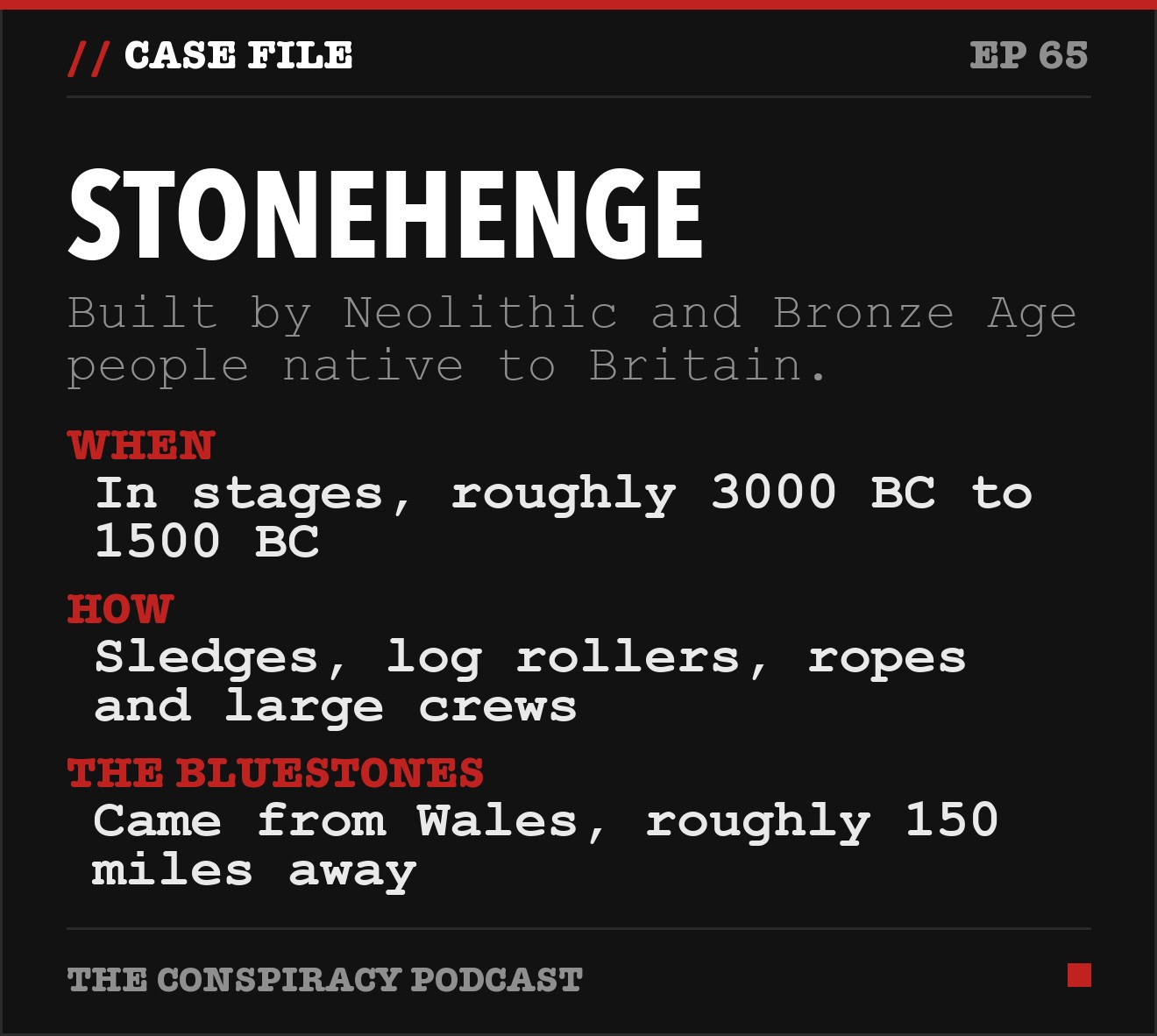
Stonehenge was built by Neolithic and Bronze Age people native to Britain, in stages from roughly 3000 BC to 1500 BC, using sledges, log rollers, ropes and large crews. The bluestones came from Wales, roughly 150 miles away. Why remains unsettled: the leading answers are burial ground, solstice calendar, and pilgrimage site of healing.
By the Conspiracy Podcast team | Last updated: August 2026
Stonehenge has stood on Salisbury Plain for roughly 5,000 years, and the people who raised it left no writing behind explaining why. That silence is exactly where the Druid legend, the Merlin story, and the alien theories all took root. The Conspiracy Podcast crew spent a full episode working through the archaeology instead of the folklore, and one of the hosts changed his mind by the end. Here are the questions people actually search, answered.
Who built Stonehenge?
Neolithic and Bronze Age people native to Britain built Stonehenge, working in phases from roughly 3000 BC to 1500 BC. There is no evidence any outside group, lost civilization, or extraterrestrial visitor was involved. The persistent idea that Druids built it is a much later misconception, dating from long after the monument was finished.
The monument went up in stages, not as one project. The earliest phase, a circular earth bank and ditch, dates to around 3100 BC. The great circle of sarsen stones most people picture went up centuries later, between roughly 2600 and 2400 BC, and activity at the site continued to about 1600 BC. That means the people who dug the first ditch never saw the finished monument, and neither did their children. Whoever started it handed an unfinished project down through generations who kept building on a plan they did not originate.
The Druid idea has a specific origin. A 17th century English antiquarian named John Aubrey surveyed the site and, noting that classical writers described Druids as Britain’s prehistoric priests, concluded they must have built it. The theory stuck in popular culture for centuries. But Druids belong to Britain’s Iron Age, and Stonehenge’s builders were finishing their work in the Bronze Age, many centuries before Druids appear in the historical record. Modern radiocarbon dating settled the timeline, and it points squarely at the ordinary farming communities who already lived on Salisbury Plain.
How were the stones moved to Stonehenge?
Builders used log rollers, wooden sledges and likely stretches of water transport to move the stones, with large crews providing the muscle. No machinery or lost technology was required. A 1995 experiment near Stonehenge moved a 40-ton slab 18 miles using just over 100 people, sledges and log tracks, confirming the method actually works.
The leading theory has stones dragged overland on wooden sledges running over log rollers, with ropes and a large crew supplying the pulling power. A ramp may have helped raise the uprights into their holes before the lintels went on top. For the bluestones’ 150-mile trip from Wales, archaeologists think the route combined overland hauling with stretches of river and coastal water, since dragging two-ton stones the entire distance over hills would have taken far longer. None of this required metal tools, wheels, or anything beyond rope, timber and coordinated labor. The guys cover the full moving debate stone by stone in the episode.
The clearest proof came from a real test, not a computer model. In 1995, a team of more than 100 volunteers pulled a 40-ton stone slab on a sledge across log tracks for 18 miles, from the Marlborough Downs toward Stonehenge, and succeeded, heavier than most of the original sarsen stones. It did not settle every detail, lifting a stone upright and setting a 25-ton lintel on top is a separate challenge, but it closed the door on the idea that Neolithic people physically could not have hauled stones this size across open country.
What was Stonehenge used for?
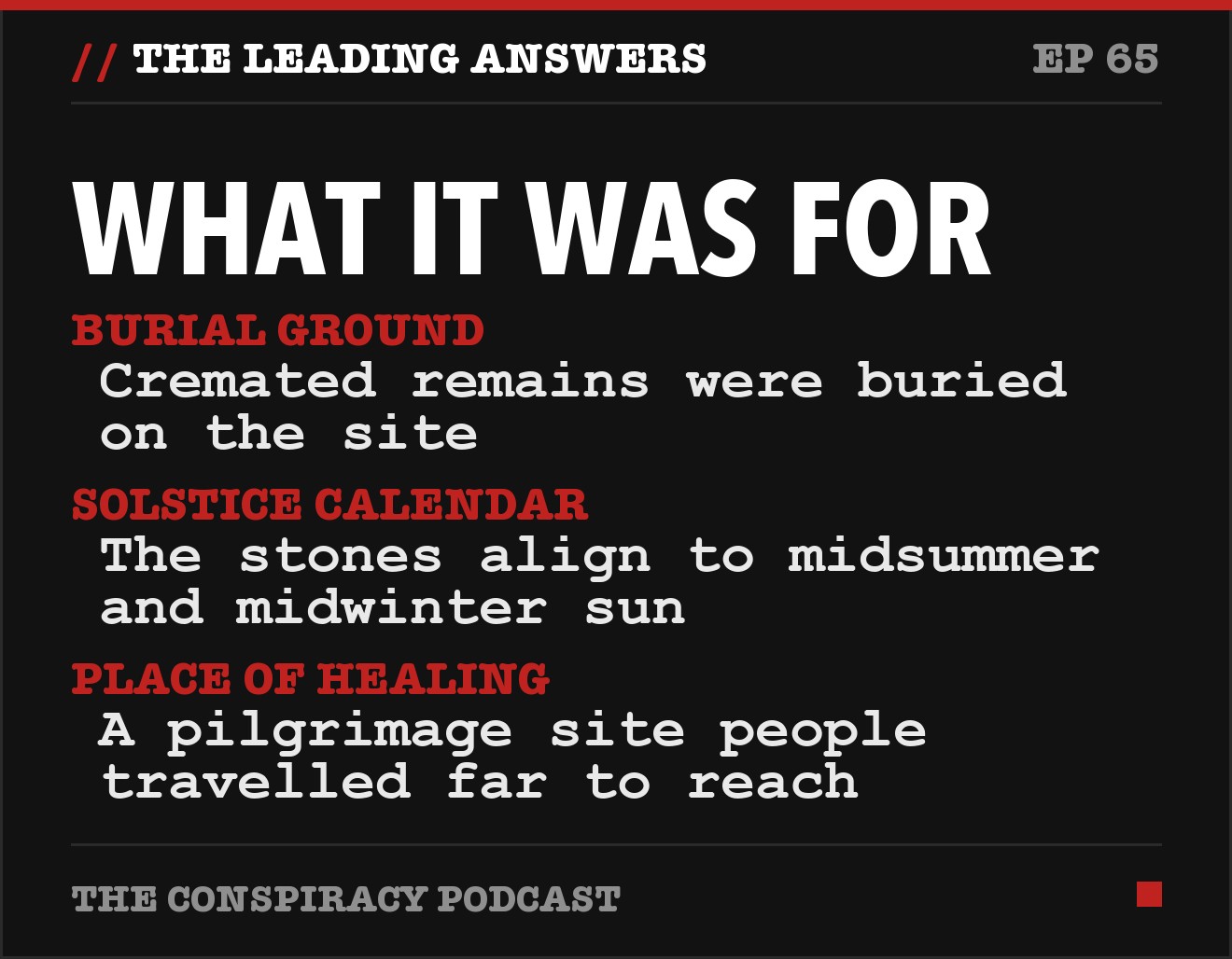
There is no single confirmed purpose, since the builders left no writing behind. The strongest evidence points to three overlapping roles: a solstice calendar aligned to the summer sunrise and winter sunset, a burial ground with cremated remains dating back 5,000 years, and possibly a pilgrimage site where people traveled long distances seeking healing.
The alignment is not in question. The monument’s main axis points at the summer solstice sunrise in one direction and the winter solstice sunset in the other, a deliberate design choice built into the earliest phase. The burial evidence is just as solid. A 2013 excavation led by archaeologist Mike Parker Pearson recovered more than 50,000 cremated bone fragments belonging to at least 63 people, men and women in roughly equal numbers, including children. That combination makes Stonehenge one of the earliest known cremation cemeteries in the British Isles, built around a calendar in the sky.
The healing theory comes from archaeologists Geoffrey Wainwright and Timothy Darvill, who noted the unusually high number of burials and signs of trauma and illness among the remains. Isotope analysis of the bones backs up a pilgrimage picture: people buried at Stonehenge came from far outside the local area, including a teenage boy raised near the Mediterranean and a metalworker connected to the Alpine foothills near Germany. That is a wide travel radius for the Neolithic and early Bronze Age. It suggests people saw the site as worth a long, difficult journey, whether for healing, ritual, or both.
Where did the bluestones come from?
The smaller bluestones, weighing around two tons each, came from the Preseli Hills in Pembrokeshire, Wales, roughly 150 miles from Salisbury Plain. A 2019 study confirmed they were deliberately quarried by people, not carried by a glacier. Recent research has traced the monument’s largest single stone, the Altar Stone, even farther, to Scotland.
For decades it was not clear whether the bluestones were quarried and hauled by people or deposited near Salisbury Plain naturally by a glacier during the Ice Age. The glacier theory has a problem: there is no evidence of glacial deposits anywhere in southern central England. In 2011, researchers identified a megalithic bluestone quarry at Craig Rhos-y-felin in the Preseli Hills, and a 2019 publication confirmed signs of deliberate quarrying at the source, not natural transport. The sarsen stones, the larger 25-ton uprights, came from much closer, a site roughly 16 miles from Stonehenge itself.
The Altar Stone adds a twist. It is the large recumbent slab at the monument’s center, long assumed to share the bluestones’ Welsh origin. A 2024 study published in the journal Nature matched its mineral composition to rock formations in northeast Scotland instead, hundreds of miles beyond the Preseli quarries. Nobody has worked out exactly how a stone that size traveled that far with no wheeled vehicles and no draft animals suited to the job, which makes it the single hardest transport question the monument still raises.
Did aliens build Stonehenge?
No credible evidence supports that idea. Every technique needed, quarrying, hauling with sledges and log rollers, and raising stones with ropes and timber frames, has been demonstrated by archaeologists and confirmed with real experiments. The alien theory tends to survive by underestimating what organized Neolithic communities, working across generations, were capable of building.
It is worth taking the question seriously rather than mocking it, because the doubt comes from a real place: a 25-ton stone with a matching 25-ton lintel balanced on top, using only Neolithic tools, is genuinely hard to picture. The Conspiracy Podcast hosts spend the episode wrestling with exactly that gap. One of them starts the episode convinced aliens were involved and ends it convinced otherwise, once the moving experiments and the phased construction timeline are laid out. The conclusion is not that the achievement is unimpressive. It is that patient, generational human effort explains it without needing anything else.
The practical case against aliens is simple: the methods have been tested and they work. Log rollers, sledges, ropes and enough people can move and raise stones this size, and a monument built in phases over roughly 1,500 years gives many generations to solve one hard problem at a time. None of that requires visitors from off planet, just organization and patience. The full Stonehenge episode walks through why the hosts land on ordinary human ingenuity, and our roundup of famous conspiracy theories covers more cases where the mundane explanation turns out to be the interesting one.
| Theory | What the record shows |
|---|---|
| Ancient astronauts. Aliens or a lost advanced civilization must have helped, since Neolithic Britain seems too primitive for 25-ton stones. | No physical evidence supports outside help. A 1995 test moved a 40-ton slab 18 miles using sledges, log rollers and about 100 people. |
| Druid temple. A 17th century antiquarian’s guess that Britain’s only recorded prehistoric priesthood must have built it. | Radiocarbon dating puts construction in the Neolithic and Bronze Age, many centuries before Druids appear in the historical record. |
| Glacier-carried bluestones. The theory that an Ice Age glacier deposited the Welsh stones near Salisbury Plain naturally. | A 2019 study found evidence of human quarrying at the Welsh source. No glacial deposits have been found anywhere in southern central England. |
| Merlin and the giants. A 12th century legend crediting the wizard Merlin with moving healing stones from Ireland. | A medieval tale with no historical evidence, though some archaeologists think it may preserve a folk memory that the stones came from far to the west. |
I just think it’s a terrible use of alien time. Let’s make trilithons.
the guys, on the record