What Is the Denver Airport Conspiracy?
What Is the Denver Airport Conspiracy?
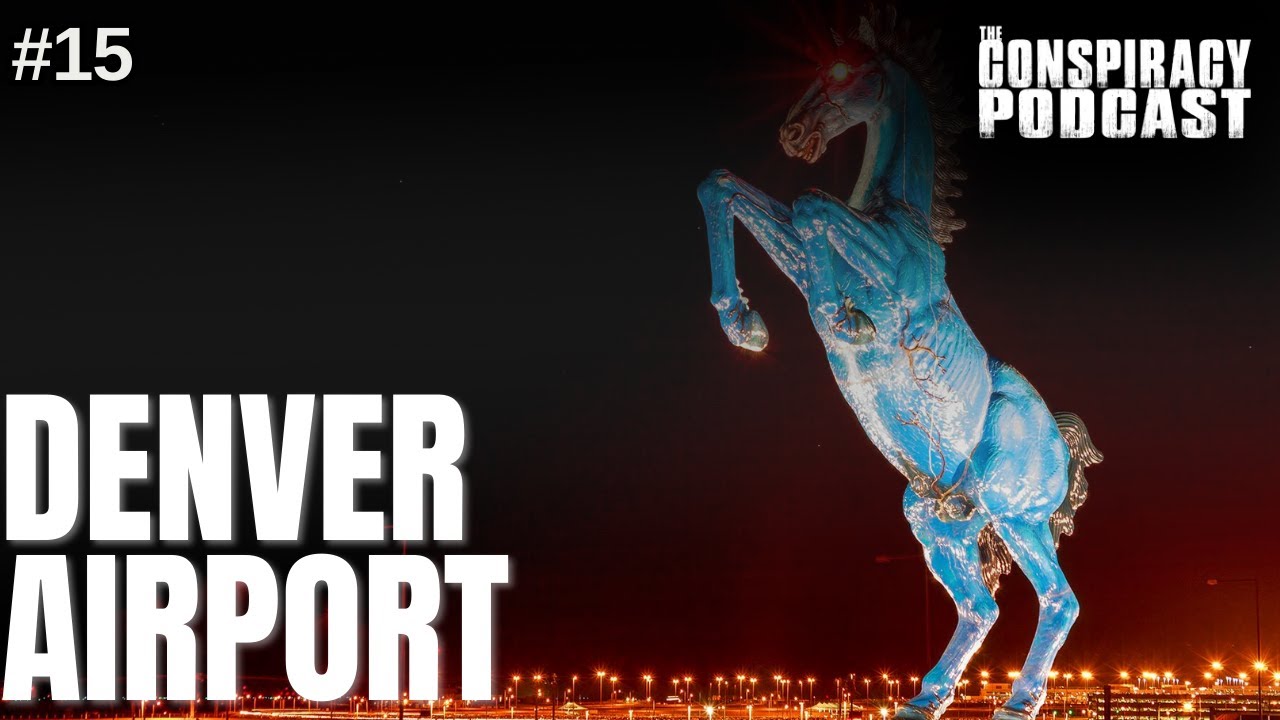
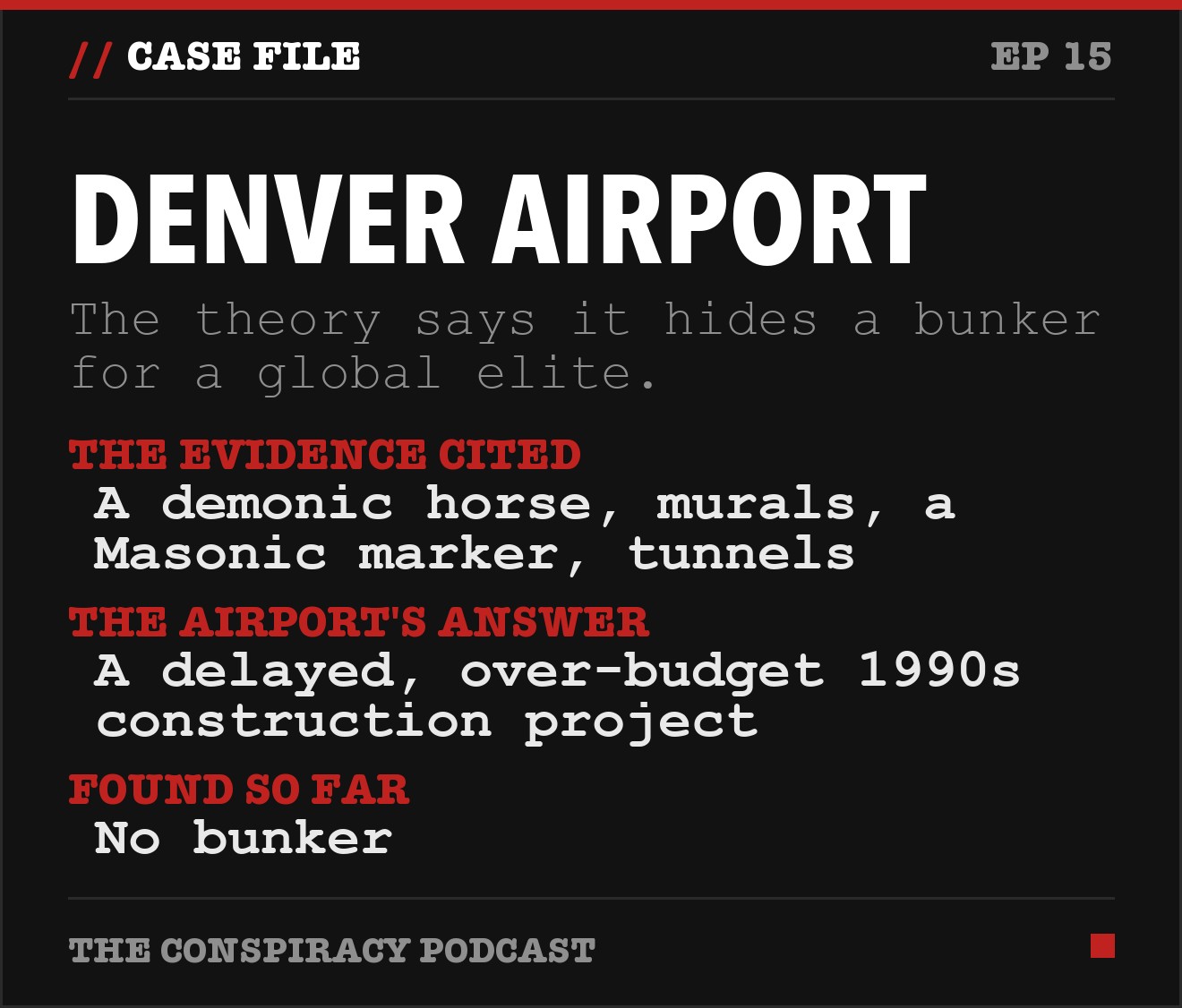
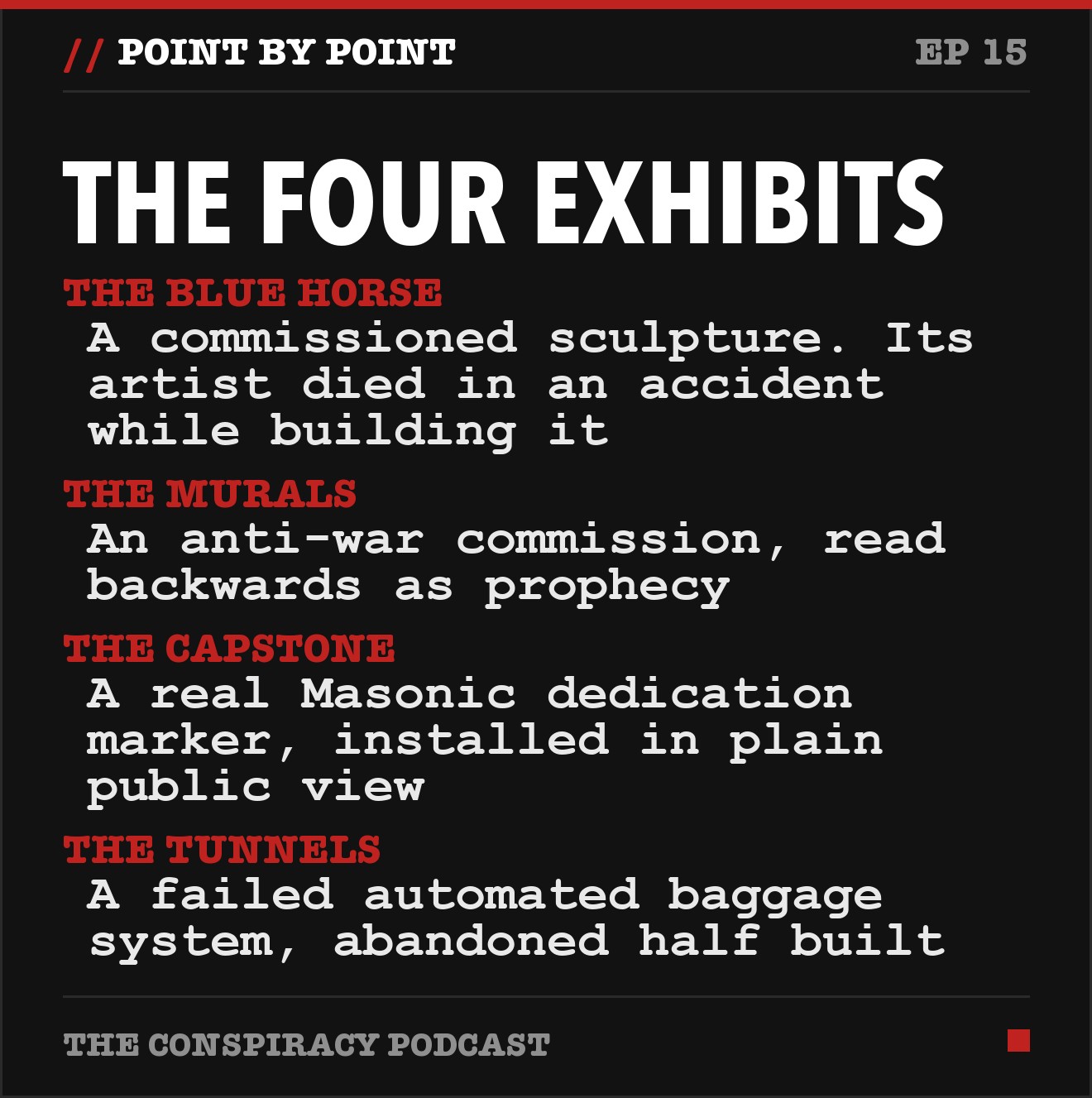
The Denver airport conspiracy is the theory that Denver International Airport hides an underground bunker for a global elite, supposedly tied to a demonic-looking horse statue, apocalyptic murals, a Masonic marker, and unexplained tunnels. The airport’s own explanation for all four is far less exciting: a badly delayed, over-budget 1990s construction project.
By the Conspiracy Podcast team | Last updated: August 2026
None of that has stopped the theories. Denver International crams a demonic-looking horse, two apocalyptic murals, a Masonic capstone, and a maze of abandoned tunnels into one small stretch of concourse, easy to read as one dark story. The airport has leaned into that reputation for years. Here is what the record shows, question by question.
What is the Denver airport conspiracy?
The Denver airport conspiracy claims Denver International was built to hide an underground bunker for a global elite, citing a demonic-looking horse statue, apocalyptic murals, a Masonic dedication marker, and unexplained tunnels as evidence. The airport’s own explanation for all four is much less exciting: a construction project that ran years late and about two billion dollars over budget.
Denver mayor Federico Pena pushed the project after the old airport, Stapleton, drew noise complaints, and in 1988 voters approved annexing 54 square miles of land outside the city for a replacement. Construction broke ground in 1989 with a target opening of 1992. Delays pushed that to 1993, then 1994, then finally February 1995, six years after groundbreaking. Denver International is still the largest airport in the country by land area and the second largest in the world, part of why the scale feels suspicious to people walking through a mostly empty terminal.
On the show, the three hosts do not agree on what it means. One is convinced the bunkers are real and built for the ultra wealthy, another calls it just an airport that blew its budget, and the third sits in between, unconvinced there is enough public information to say either way. That split is honestly a fair summary of the evidence itself: real, documented weirdness with zero documented link between any of it and a hidden purpose. For the full argument, listen to the Denver Airport episode, where the three of them work through each piece.
| Theory | What the record shows |
|---|---|
| Elite bunker or New World Order base. Tunnels beneath the airport supposedly shelter global elites. | The tunnels are real: an inter-concourse train and the shell of an abandoned baggage system, not living quarters. |
| Secret society control. A Masonic symbol on the capstone supposedly proves a secret society built the airport. | Local Masonic lodges donated and helped lay the marker. Freemasonry is a real fraternal organization, not a hidden world government. |
| Coded murals. Leo Tanguma’s murals are said to hide a plan for war or population control. | Tanguma has said publicly the murals depict war and destruction resolving into peace, with no coded meaning. |
| Swastika-shaped runways. The runway layout, viewed from above, is said to trace a swastika. | The layout follows standard FAA wind-pattern design. Even the hosts call the comparison a stretch. |
What do the Denver airport murals actually mean?
According to Leo Tanguma, the living artist who painted them, the two Denver airport murals depict the horrors of war and environmental destruction resolving into peace, not a hidden warning. Conspiracy readings tend to focus only on the murals’ darkest early panels and ignore the hopeful panels that follow in the same sequence.
Tanguma painted two large murals for the airport in the mid-1990s, titled In Peace and Harmony with Nature and Children of the World Dream of Peace. One opens with a soldier in a gas mask bayoneting a dove among refugees and ruins, then resolves with that same soldier dead and disarmed while children celebrate around him. The other opens with burning trees and animals shut in glass cases, then resolves with children and animals gathered peacefully around new growth. Tanguma has said the sequence is deliberate: he paints what he sees wrong right alongside what he finds beautiful, so every dark panel gets a hopeful answer in the same piece.
The conspiracy reading only works if you stop looking halfway through the mural and ignore the resolution Tanguma placed right next to it. He has publicly rejected the idea that the work hides a plot, and reporting on the murals describes real harm that followed anyway: harassment directed at Tanguma and his family, and mural commissions he lost after the theories spread. He kept painting regardless. Nothing about the murals ties them to the airport’s tunnels or its dedication marker. They are one artist’s statement about war and the environment, hung at an unusually large scale in an unusually busy hallway.
Is there a bunker under Denver airport?
Not the kind the theories describe. Denver International does have a large underground network, including a train that connects the concourses and the leftover tunnels from a scrapped automated baggage system. Airport officials say that is the whole story, and there is no public evidence of anything built for people to live in down there.
The tunnels people point to were real infrastructure for a real, and famously disastrous, project. Denver International’s automated baggage system was meant to route bags through miles of underground track on thousands of individually guided carts, sorting them for every airline without a single human hand. In testing, it tore luggage apart and threw bags off the rails instead. The contract, originally about 193 million dollars, ballooned toward 400 million, helped push the opening back by more than a year, and the system was quietly shut down for good in 2005, replaced with ordinary manual handlers.
On the show, the hosts are openly skeptical of the official version, mostly because moving bags underground and back up to ground level sounds inefficient to them, and they are not wrong. That is a fair description of a system that never worked. The honest answer sits in between the two extremes: it really was built for baggage, not for people, but it was such an expensive, public failure that its empty tunnels became the perfect blank space for a much bigger story to grow into.
I don’t know what’s down there, I don’t know if they’re lizard people, I don’t know if they’re for the elites, I don’t know, but that’s my theory.
the guys, on the record
What does the dedication capstone say?
The capstone at Denver International is inscribed with a Masonic square and compass and the words New World Airport Commission, dated 1994. The name sounds like evidence of a secret world government, but records show it was a real, short-lived group formed only to plan the airport’s opening ceremony, not a permanent or secretive organization.
The New World Airport Commission was chaired by Charles Ansbacher, a conductor who led the group tasked with organizing the festivities around the airport’s opening and the laying of its time capsule and capstone. Ansbacher explained the name as a nod to Dvorak’s New World Symphony, framing Denver International as a new airport connecting the world, not a reference to any New World Order. Once the opening celebrations wrapped, the commission had done its job and stopped operating, which is the entire reason no ongoing organization by that name shows up in any record today.
The square and compass on the marker is a Masonic symbol because local lodges donated funds and helped lay the capstone, the same explanation the airport gives for it. Freemasonry is a real fraternal and charitable organization with public lodges, not a hidden hand behind the airport’s design. The hosts read it differently on the show, treating it as a mark of the same secret society people already suspect of running the tunnels underneath. For the full case they build around the capstone and everything else at the airport, this Denver Airport breakdown walks through it piece by piece.
Why does Denver airport lean into the conspiracy theories?
Because embracing the reputation works better than fighting it. Denver International runs official campaigns joking about the theories, including construction barrier signs about tunnels to the underworld and a talking gargoyle near baggage claim, turning decades of internet suspicion into free publicity instead of a PR headache.
The airport has covered its own construction barriers with signs poking fun at the theories. One reads, “Apologies for the noise. It takes really big drills to get to the underworld.” Another jokes about how untidy it gets to build secret underground tunnels. Stephanie Figueroa, a DEN public information officer, has said the airport decided to embrace the conspiracy reputation as part of its identity rather than fight it, calling the signs a way to poke fun at itself and connect with passengers instead of a problem to manage.
The bronze gargoyles from the episode, seated in suitcases over baggage claim, later got their own stunt: a hidden speaker lets one crack jokes about tunnels and secret societies to travelers walking past. That push, called The DEN Files and built by ad agency Karsh Hagan, generated more than 700 news stories and was later named one of the year’s most clever campaigns by Travel and Leisure. It is the same instinct the hosts noticed mid-episode, checking the airport’s own website and finding Denver leaning into its conspiracy horse. If this is your kind of story, our full list of famous conspiracy theories rounds up plenty more like it.