Was Atlantis a Real Place?
Was Atlantis a Real Place?
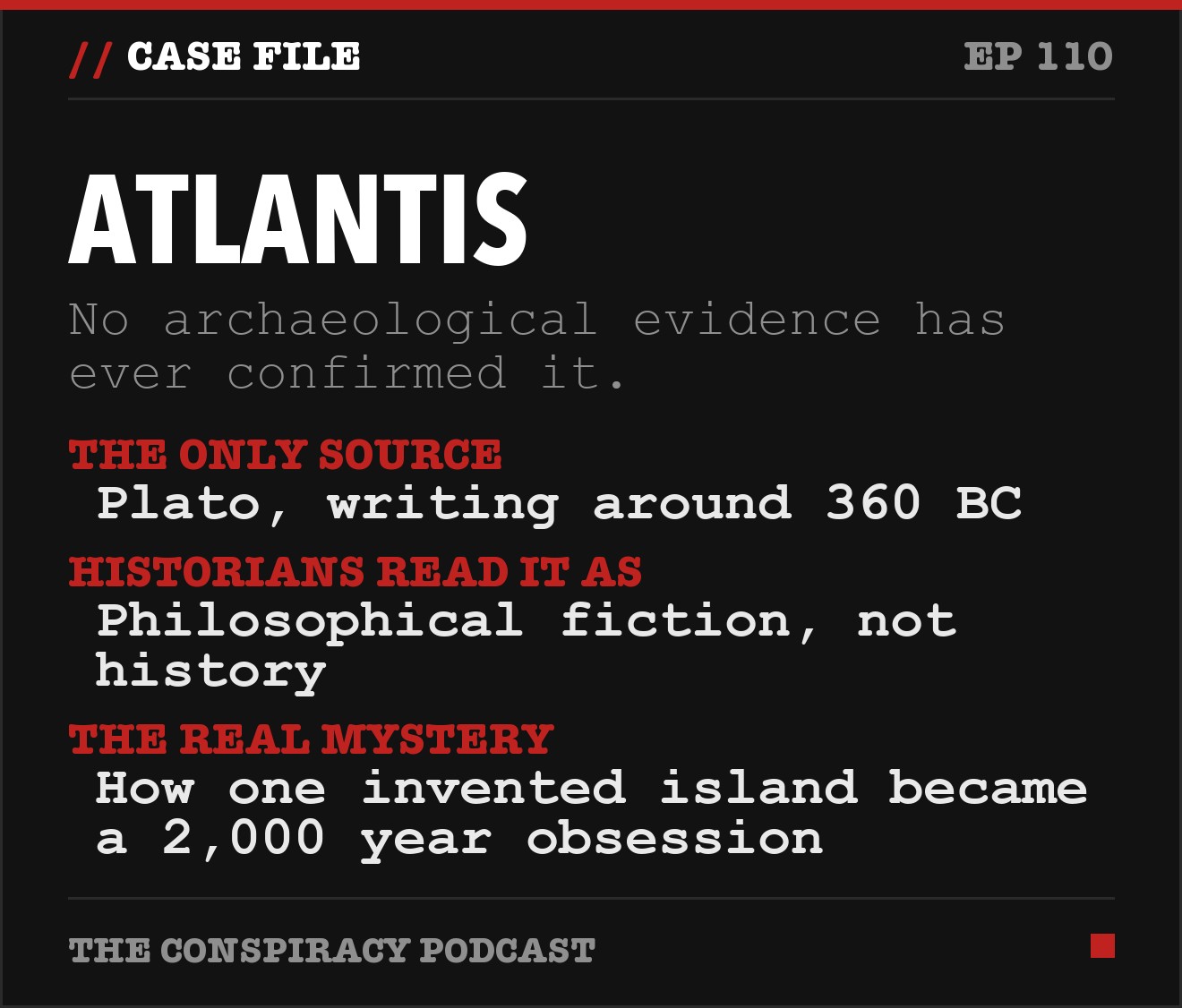
No archaeological evidence has ever confirmed Atlantis. The entire legend comes from one source, the Greek philosopher Plato, writing around 360 BC. Most historians read his account as philosophical fiction, not history. But the story of how one invented island turned into a 2,000-year obsession is its own real mystery.
By the Conspiracy Podcast team | Last updated: August 2026
Plato never finished the tale, and no writer before him ever mentioned Atlantis at all. That combination, extreme detail paired with zero corroboration, is exactly what keeps historians, treasure hunters and documentary crews arguing about it more than two thousand years later. Here is what the record actually supports, question by question.
Was Atlantis a real place?
No. There is no archaeological evidence that Atlantis existed anywhere on Earth. The only source is Plato, writing around 360 BC, and most scholars treat his account as a philosophical invention meant to teach a lesson, not a historical record. No ruins, inscriptions or artifacts have ever been tied to it.
That is the honest answer, but the origin story is the interesting part. Plato introduced Atlantis in two dialogues, Timaeus and Critias, around 360 BC, and did something he never did in his other stories: he got specific. He described concentric rings of land and water arranged like a target, a gold and ivory temple of Poseidon, ten kings descended from Poseidon’s sons, and a glowing red metal called orichalcum. He gave it farmland that produced two harvests a year and a navy. That level of detail is why generations of readers have struggled to accept he made it up.
The story gets stranger. Plato frames Atlantis as history passed down through generations, from Egyptian priests to the Athenian lawmaker Solon around 600 BC, then through Solon’s family to a student named Critias, who tells it at a dinner party. That is several layers of secondhand retelling before it reaches the page. Then, in the middle of describing the gods gathering to judge Atlantis for its greed, the text simply stops. Nobody knows why. The manuscript may have been lost, Plato may have chosen not to finish it, or he may have died first. The hosts walk through exactly where it cuts off in the full Atlantis episode.
Who first wrote about Atlantis?
Plato, the Greek philosopher, in two dialogues called Timaeus and Critias, written around 360 BC. He is the only ancient source for the Atlantis story. His account is unfinished, and he presents it not as his own invention but as a tale handed down to him through several generations of storytellers.
Plato is one of the most influential thinkers in Western history. He studied under Socrates, later taught Aristotle, and founded the Academy in Athens, one of the first institutions of higher learning in the ancient world. He rarely wrote straightforward history or essays. Instead he taught through dialogues, staged conversations between characters that carried a philosophical point, much like a modern teacher using a parable. Atlantis appears inside exactly that kind of dialogue. Before Plato wrote about it, the word does not appear anywhere in surviving Greek literature, and no earlier account of a sunken island empire has ever surfaced.
Plato is specific about where the story supposedly came from, which makes the single-source problem clearer. In Timaeus, Critias says he heard it from his great-grandfather, who heard it from the Athenian statesman Solon, who heard it from priests in Egypt around 600 BC. That is several people removed from the original claim, and none of those middle links left behind any writing that confirms it. Critias was meant to continue the account in a second dialogue named after him, the one that ends abruptly, mid-thought, with no other ancient writer ever weighing in to confirm or deny any of it.
Where do people think Atlantis was?
There is no agreed location, because there is no confirmed city. The leading real-world candidate is Santorini in the Aegean Sea, tied to a Bronze Age volcanic eruption. Other proposed sites include the Richat Structure in the Sahara, the Azores, Antarctica and the Bahamas, but none has produced ruins, artifacts or writing that confirm it.
Plato placed Atlantis beyond the Pillars of Hercules, the ancient name for the Strait of Gibraltar, pointing toward the Atlantic. That detail alone has launched dozens of theories. In Mauritania sits the Richat Structure, also called the Eye of the Sahara, a natural rock formation 28 miles wide whose rings resemble Plato’s description. At the fringiest edge, a 1513 map by the Ottoman admiral Piri Reis is read by some as showing an ice-free Antarctica, feeding claims of an advanced culture, and even outside technology, none of it backed by physical evidence. The table below lines up the leading candidates against what the record actually shows.
| Theory | What the record shows |
|---|---|
| Santorini and the Minoan eruption. A Bronze Age volcano devastated an advanced culture near Crete. | A real disaster and a real civilization, but the date is off from Plato’s own timeline by thousands of years. |
| The Richat Structure. A 28-mile ring formation in Mauritania nicknamed the Eye of the Sahara. | Geologists confirm it is a natural eroded dome, with no ruins or artifacts ever found there. |
| The Bimini Road. A half-mile line of flat stones found off the Bahamas in the 1960s. | The leading explanation is naturally formed beachrock. No artifacts tie it to any lost civilization. |
| Antarctica and ancient aliens. A 1513 map some read as showing ice-free Antarctica, tied to fringe claims of outside technology. | Unproven speculation, with no ruins found and mainstream cartographers disputing that reading of the map. |
He just like made this up. He’s like, so he wasn’t a historian. Going to sell himself, baby. This is going to sell papyrus.
the guys, on the record
Is Santorini the real Atlantis?
Santorini is the leading real-world candidate, not proof Atlantis existed. Around the 16th century BC, a massive volcanic eruption on the island of Thera devastated the advanced Minoan civilization based nearby on Crete. The eruption is real and well documented. Whether Plato was describing it, exaggerating it, or never heard of it remains unknown.
Thera is the modern name for the volcanic island now called Santorini, in the Aegean Sea. Around the 16th century BC it erupted in one of the most violent volcanic events in recorded history, burying settlements in ash and triggering tsunamis that struck nearby Crete, home to the Minoan civilization. The Minoans were a sophisticated Bronze Age culture with multi-story palaces and, notably, indoor plumbing centuries before most of the ancient world had it. The eruption itself is well documented, not myth. What remains of Thera today is a caldera, a collapsed crater filled with seawater that forms a ring shape echoing Plato’s description.
The theory has real gaps. Plato dated Atlantis to roughly 9,000 years before Solon’s trip to Egypt, placing it near 9600 BC, thousands of years before the Thera eruption, and he placed it in the Atlantic Ocean, not the Aegean Sea where Santorini sits. Supporters argue that Plato, or the priests he says told the story, simply lost track of the timeline and geography over centuries of retelling, and that the true source event was Minoan, not Atlantic. That is a real possibility, but it remains a theory built on a hypothesis stacked on another hypothesis. The hosts weigh the Minoan candidate against the wilder options in the complete Atlantis case file.
Why do people still search for Atlantis?
Because the story is detailed enough to feel real, and because nobody can fully rule it out. The ocean covers most of the planet and huge stretches of the seafloor have never been closely examined, which leaves just enough uncertainty for a 2,000-year-old, unfinished story to keep feeling like it might still be found.
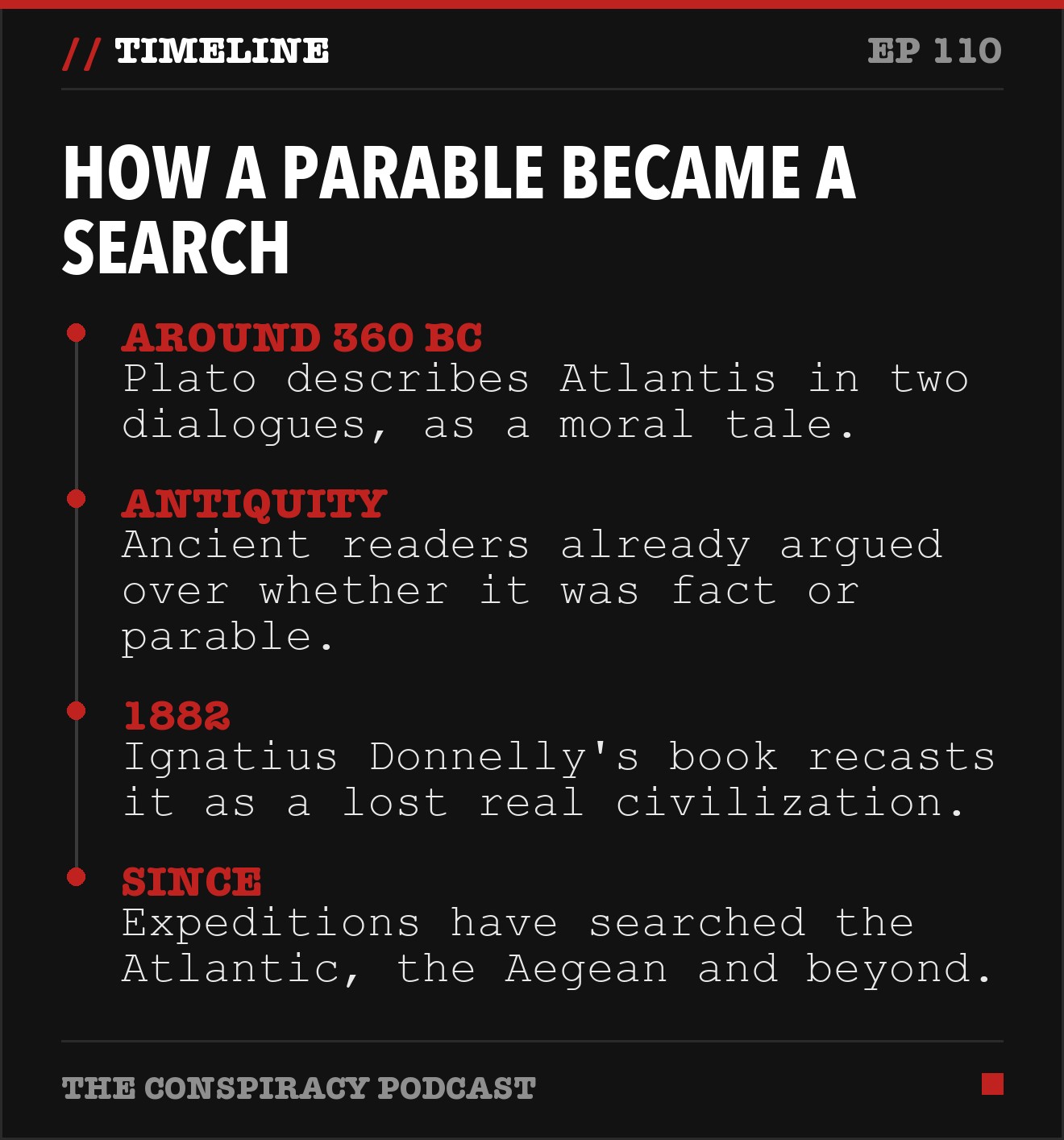
Much of the credit, or blame, for turning Atlantis into a modern obsession goes to one man. In 1882, American congressman and writer Ignatius Donnelly published Atlantis: The Antediluvian World, arguing that Atlantis was not only real but the mother civilization behind Egyptian and Mesoamerican cultures, destroyed in the same event described in the biblical flood story. Modern scholars reject nearly all of his specific claims. But the book was a sensation, and it is the reason Atlantis shifted in the public imagination from a cautionary tale into a lost civilization waiting to be rediscovered. Everything that followed builds on Donnelly’s version of Atlantis, not the one Plato actually wrote.
There is also a simpler emotional pull. The Atlantis story follows the same shape as Noah’s flood and the destruction of Sodom and Gomorrah, a powerful civilization judged and wiped out for losing its way. That pattern repeats across cultures because it is a satisfying way to process the fear that any successful society, including our own, could collapse. Add in real unsolved oddities, like the Bimini Road or the Piri Reis map, and a steady stream of documentaries and films keeps the question alive whether or not the physical evidence holds up. If Atlantis interests you as a pattern of civilizations rising and vanishing, the site’s roundup of famous conspiracy theories has a lot more of it.