How Did Kurt Cobain Die?
How Did Kurt Cobain Die?
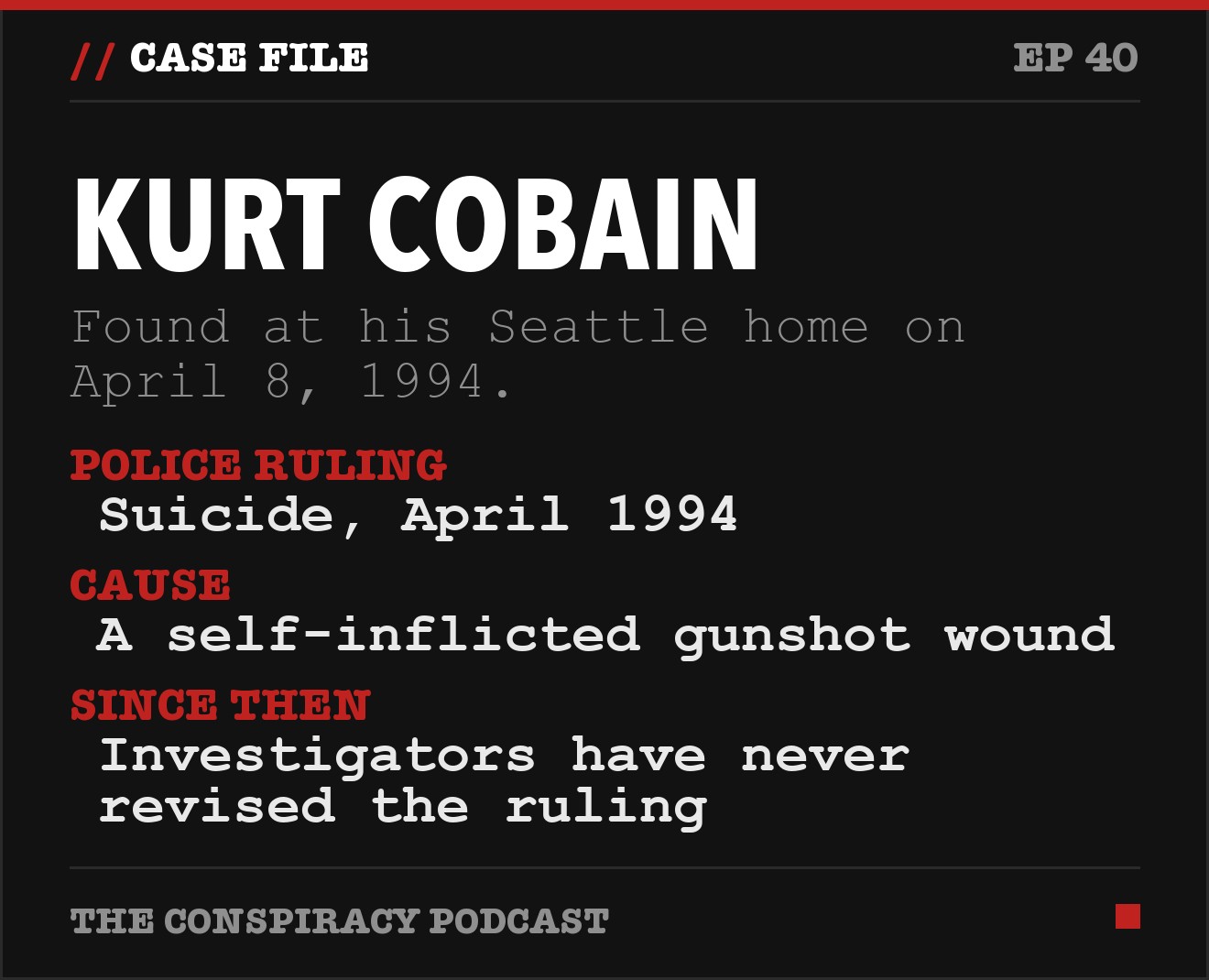
Kurt Cobain died from a self-inflicted gunshot wound. The Seattle Police Department ruled his death a suicide in April 1994, a finding based on the scene, the shotgun, and a note found with his body. His body was discovered at his Seattle home on April 8, 1994. Investigators have never revised that ruling.
By the Conspiracy Podcast team | Last updated: August 2026
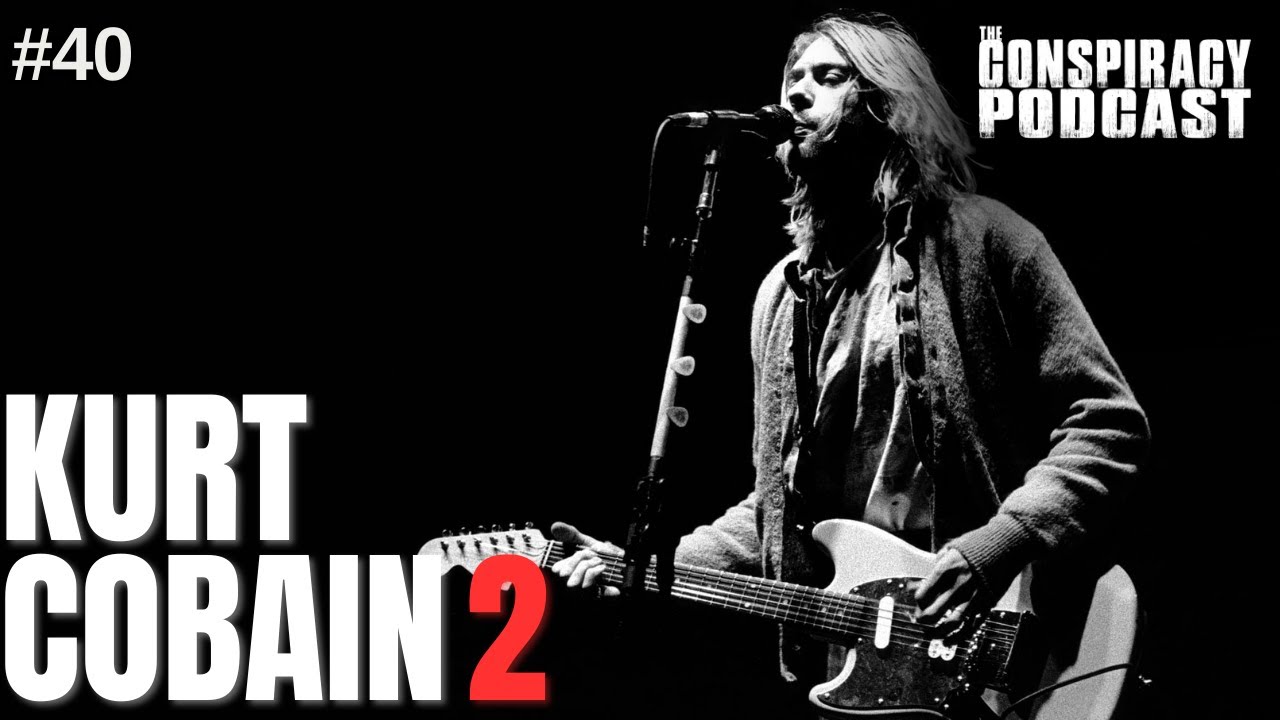
More than thirty years later, that ruling has not settled the argument. Cobain’s own note dealt mostly with exhaustion and fame, and within weeks a private investigator hired by his widow began building a different account of what happened. That theory has never produced a criminal charge, but it has never fully faded either. The hosts spend the second half of their two-part series working through each claim in part two of the Kurt Cobain episode.
What did Kurt Cobain pass away from?
Kurt Cobain’s death was caused by a gunshot wound, and Seattle Police ruled it a suicide within days, a finding they have never reversed. The ruling rested on three things: the room where he was found, the shotgun recovered with him, and a note. The medical examiner placed his death on or around April 5, 1994.
The days before are well documented. In late March, Cobain agreed to enter Exodus Recovery, a treatment center in Los Angeles, after an intervention from his bandmates and Courtney Love. He checked in but left after about three days, scaling a six-foot wall on the property and flying back to Seattle in the early hours of April 2, 1994. Weeks earlier, Seattle police had already been called to the house once, after an argument ended with Cobain locked in a room with guns, and his weapons were seized. Friends and a private investigator hired by Love spent the following days trying to find him. On the morning of April 8, an electrician arrived at the house to install additional security lighting. Looking through a window, he saw a body inside and went to get help rather than entering himself. A first responder broke a small pane of glass to get into the room. Paramedics who arrived shortly after concluded there was nothing they could do.
The ruling has stood since 1994. Seattle Police based their finding on the scene inside the room, the shotgun recovered with Cobain, and a handwritten note found nearby. A toxicology report also found a high level of morphine in his system, a detail that later became central to the theories examined below. Each piece of evidence has been argued over separately in the years since, but none of that debate has produced a different official conclusion. The medical examiner’s office and Seattle Police have both maintained the same finding every time the case has resurfaced in the press.
What did the suicide note say?
Cobain left a one-page handwritten note addressed to Boddah, an imaginary childhood friend. Most of the letter is about music and fame, explaining why he could no longer perform. Handwriting experts who reviewed it agreed the bulk of it is authentically his. The final lines, which read as a farewell, are the most disputed part.
The note runs about a page. By the hosts’ account, most of it, the opening paragraphs, is addressed to Cobain’s fans and focused on his relationship with performing. He wrote about no longer feeling the excitement he once did making music for an audience, and framed the letter as an explanation for stepping away rather than continuing to fake it on stage. Handwriting analysts who reviewed the note agreed that this opening section, the majority of the letter, is consistent with Cobain’s own handwriting, and that part has not been seriously disputed by anyone, including the theorists covered later in this piece. The hosts do not read the note aloud in full on the episode, and we do not reproduce it here. The one detail worth noting on its own: he addressed it to Boddah, an imaginary friend from his childhood, a detail that has stayed with the story for thirty years.
The disputed part is the ending. Some observers have pointed to a shift in handwriting style in the note’s final lines, arguing they look different enough from the rest to suggest someone else was involved. That claim has never been confirmed by any independent handwriting analysis, and it remains a theory rather than a finding. It is worth being precise about what is actually being argued: nobody disputes that Cobain wrote the letter explaining his decision to quit performing. The argument is narrower, and unproven, over whether a few final lines were added afterward. The next section covers how that detail fits into the broader theories about his death, and what the record does and does not support.
Why do people think Kurt Cobain was murdered?
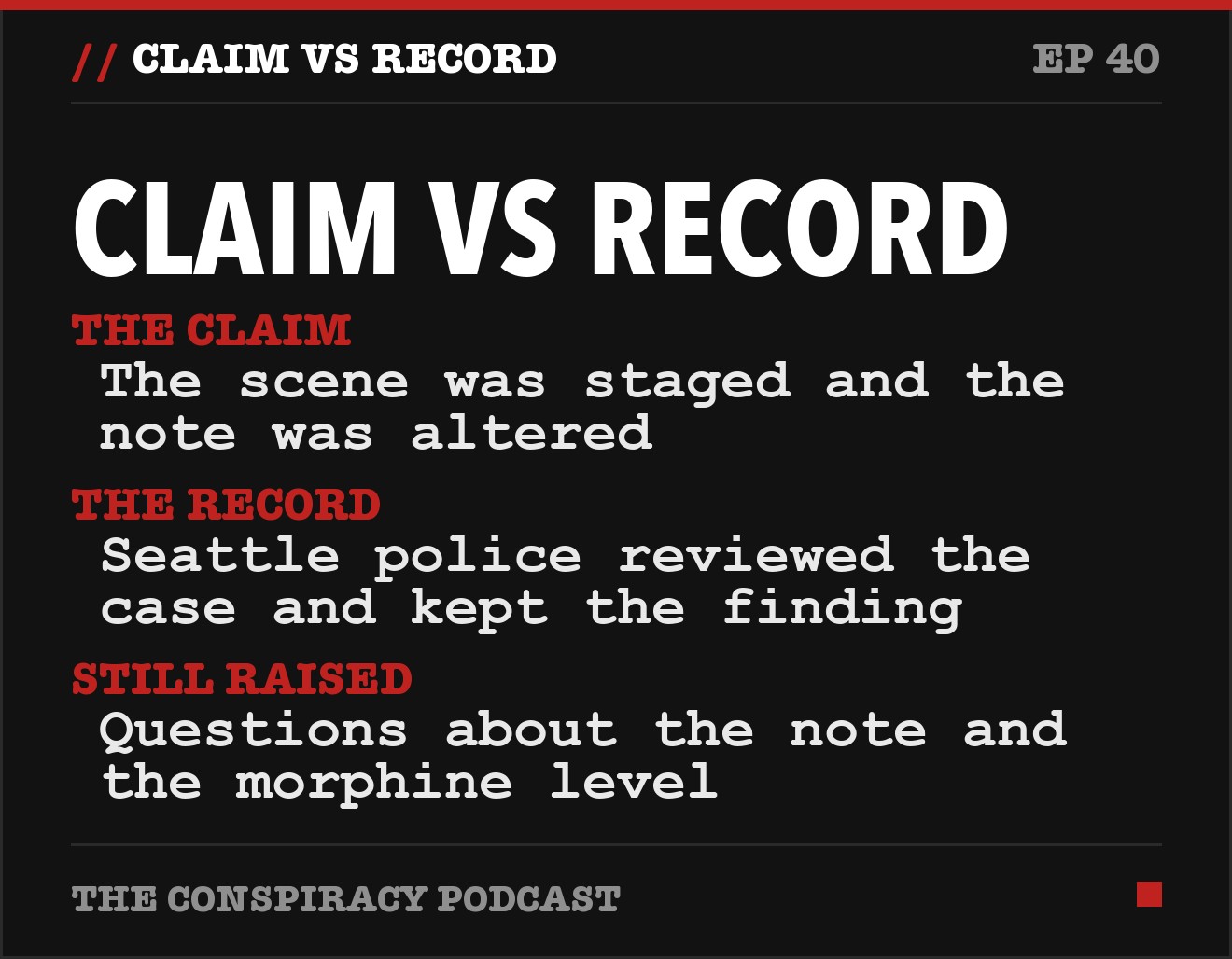
The theory traces mainly to Tom Grant, a private investigator hired by Courtney Love, who argued Cobain’s death was arranged rather than self-inflicted. His case rests on the morphine level in Cobain’s system, the disputed handwriting in the note, and the missing fingerprints on the shotgun. No evidence has ever proven it, and no charges have ever been filed.
| Theory | What the record shows |
|---|---|
| The Tom Grant theory. A private investigator hired by Courtney Love argued Cobain’s death was arranged, not self-inflicted. | No evidence has ever been produced to support it, and no charges were ever filed against anyone. |
| The morphine level. Grant pointed to a toxicology reading of 1.52 milligrams per liter, called roughly seven times a typical lethal dose. | The report never specified whether that number was a free or total morphine count, a distinction that changes how it should be read. |
| The missing fingerprints. No verifiable prints were found on the shotgun. | It was not checked for prints until about a month later, after the scene had already been repeatedly handled by first responders. |
| The El Duce claim. A musician known by that name said he had been offered money to kill Cobain. | He reportedly passed a polygraph, which courts do not accept as evidence, and never faced any legal proceeding before his death. |
None of these points, alone or together, has ever produced a criminal charge against anyone, including Courtney Love, who is named in Grant’s theory but has never been charged in connection with Cobain’s death. Investigating authorities have reviewed the file and repeatedly affirmed the original finding. The hosts themselves land on different sides of how much weight the unproven claims deserve, which is exactly why the record, not the theory, gets the last word here.
I hate to be the guy, but I think he killed himself.
the guys, on the record
Was the Kurt Cobain case ever reopened?
No. Seattle Police have never reopened Cobain’s death as an active criminal investigation, and the 1994 ruling of suicide still stands. What sometimes gets reported as a reopening is something narrower: the release of old case photographs in 2014 and, separately, an FBI file on Cobain, neither of which changed the official finding.
In 2014, twenty years after his death, Seattle Police developed four rolls of film that had sat undeveloped in the evidence vault since 1994, and released the resulting photographs. According to the hosts, the images show mundane details of the scene, including Cobain’s Converse sneakers and a window, and nothing that added new information. That is the extent of what happened: old film got developed and the photographs became public record, and Seattle Police did not revise their original finding. For the fuller story of who Cobain was before any of this, including his childhood in Aberdeen and Nirvana’s rise, part one of the Kurt Cobain episode covers it in full.
A second document sometimes cited the same way is Cobain’s FBI file, which was released separately. The hosts describe it as two pages long and say it added nothing revelatory to the public record. As with the 2014 photographs, a records release is not the same thing as a criminal case being reopened, and no law enforcement agency has treated Cobain’s death as an open investigation since April 1994. The official record has stayed remarkably stable for thirty years: a scene, a shotgun, a note, and a ruling of suicide that has outlasted every theory built to challenge it. Readers who want more cases like this one, where the official record and the popular theory never quite agree, can browse our roundup of famous conspiracy theories.
If you are struggling, contact the 988 Suicide and Crisis Lifeline in the US by calling or texting 988.