Is There a Hidden City Inside Mount Shasta?
No. No city, tunnel or hidden chamber has ever been documented inside Mount Shasta. The legend of Telos and its Lemurians traces to writing, not discovery: an 1864 zoologist’s guess, theosophy, a channeled book published in 1905, a 1925 Rosicrucian magazine, a 1932 newspaper story and later channelers. No Native tradition around the mountain mentions Lemurians.
By the Conspiracy Podcast team | Last updated: November 2026
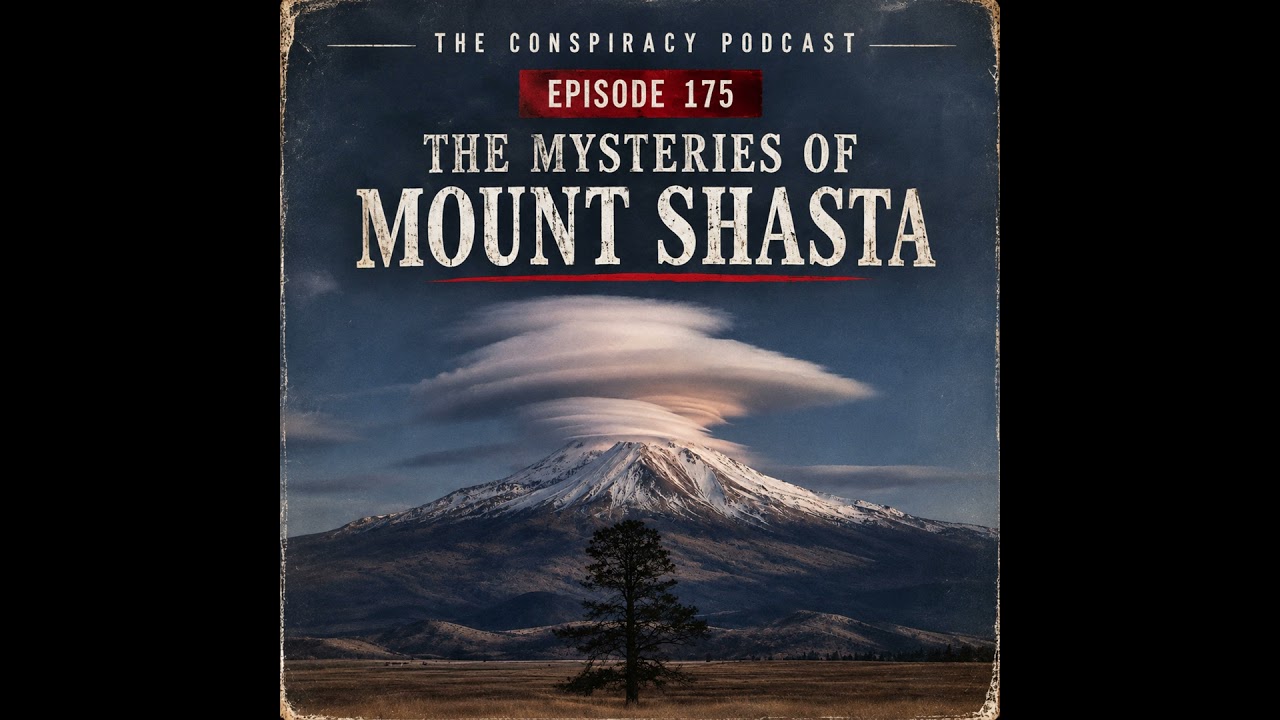
Mount Shasta is a 14,179-foot volcano in Siskiyou County, northern California, and it stands almost entirely alone, rising about 10,000 feet out of the surrounding country. A peak that strange invites stories, and for about 150 years people have been writing new ones onto it. Here is where the hidden city came from, and what the record actually shows.
Is there really a city inside Mount Shasta?
There is no evidence of one. Nobody has ever produced a photograph, an entrance, a map or an artifact from a city inside the mountain. What exists is a chain of books, articles and channeled messages, each building on the one before it. The hosts sum it up simply: every writer quoted the writer before them.
The geology that is real is wild enough on its own. According to the USGS, as cited in the episode, the entire north side of an earlier Shasta collapsed somewhere around 300,000 to 380,000 years ago, a landslide of at least 45 cubic kilometers of rock spread over 260 square miles. Fresh magma last reached the surface about 3,200 years ago. The USGS still rates it a very high threat volcano, with hot steam vents called fumaroles at the summit.
A mountain that steams at the top looks like something is going on inside it, and people have been describing it that way for a very long time. The hosts walk the whole story, from the sky spirit’s lodge to the saucer clouds, in the Mount Shasta episode, and the hidden city is only one stop on the way.
Who are the Lemurians of Mount Shasta?
In the legend, Lemurians are survivors of Lemuria, a lost continent said to have sunk into the Pacific. Believers describe them as tall, graceful people in robes, with large foreheads, living in a hidden community on or inside Mount Shasta. The idea began as a scientific guess about the Indian Ocean, not as a Pacific tradition.
In 1864 the English zoologist Philip Sclater noticed lemur fossils in both Madagascar and India and proposed that a land bridge between them had sunk. He called it Lemuria. As the episode points out, that is the wrong ocean for California, and once scientists understood that continents drift, the land bridge idea died. Occultists kept it alive. In 1888 Helena Blavatsky, founder of theosophy, made Lemuria home to an ancient human race, and later writers moved it into the Pacific.
The classic Shasta Lemurian came in 1931, in the book Lemuria, the Lost Continent of the Pacific by Wishar S. Cerve, a pen name the episode attributes to the head of the Rosicrucian order. It describes the tall, graceful figures with big foreheads and a headband dipping over a special organ in the middle of the forehead, something like a third eye. A 1932 Los Angeles Times story then reported that people in the town of Weed treated a Lemurian village as fact: sunset ceremonies, figures who vanished into the trees, and visitors who bought sulfur, salt and lard and paid in gold nuggets.
Where did the Telos legend come from?
Telos is the most recent layer. By the 1980s and 1990s, the hidden city had a name: a five-level underground city of light, said to have been founded about 12,000 years ago by Lemurians escaping their sinking continent. Its details come from channelers and self-described Lemurians, not from any older source or physical evidence.
In the Telos version, the city belongs to a worldwide network of underground cities called Agartha, the same territory the hosts covered in their Hollow Earth episodes. Its leader is said to be a high priest named Adama, and a channeler published a whole series of books presenting his messages. In the late 1980s a woman calling herself Sharula Dux appeared in Mount Shasta, describing herself as a Lemurian princess from Telos. The hosts do not believe her claims, and say so plainly.
The episode also notes a telling detail about where the city sits. According to a Mount Shasta museum researcher cited by the hosts, some earlier versions of the Telos story placed it under Colorado, and only later was it moved to Shasta. That is the whole legend in one fact: the city goes where the storytellers are.
Has anyone ever found a tunnel or a city inside the mountain?
No. The most famous tunnel claim came from a 79-year-old man calling himself J.C. Brown, who appeared in Stockton, California in 1934. He said that in 1904 he had found a tunnel running 11 miles into the mountain, lined with copper rooms and gold shields. On the day the expedition was due to leave, he never showed up.
Brown signed up about 80 people to go looking for it, and according to the episode some of them quit their jobs for the trip. On departure day in June 1934 he simply vanished, and even the police never found him. The strangest part, as the hosts point out, is that he never took anybody’s money. If it was a con, nobody has ever worked out what the con was. The tunnel itself has never been located.
Other claims followed the same shape. In 1945 a journal described hidden bell makers under the mountain whose ringing supposedly killed car engines. By the 1990s a writer calling himself Commander X claimed there was a UFO base inside Shasta with motherships and a crystal almost the size of a skyscraper. None came with evidence. The hosts do allow themselves one piece of speculation: that a tall tribe might once have lived high on the mountain, traded gold in town, and died out long ago. They are clear that this is their theory, not a finding.
| Theory | What the record shows |
|---|---|
| The Lemurian city of Telos. A five-level city of light founded about 12,000 years ago. | The name and details date to channelers of the 1980s and 1990s. Some earlier versions put it under Colorado. Nothing has been found. |
| A secret brotherhood. Frederick Spencer Oliver’s A Dweller on Two Planets puts one inside the mountain. | Oliver said a spirit called Phylos dictated the book. It was published by his mother in 1905, years after his death in 1899. |
| The Lemurian village. Tall robed figures who paid for supplies in gold nuggets. | A 1925 Rosicrucian magazine piece, a 1931 book and a 1932 newspaper story, which some researchers think came from the same group. |
| J.C. Brown’s gold tunnel. An 11-mile tunnel full of gold shields, reported in 1934. | Brown never showed up on departure day, the police never found him, and the tunnel has never been located. |
| A Native sacred mountain. Creation stories place the sky spirit’s lodge inside Shasta. | These traditions are thousands of years old and the mountain is still sacred, but none of them mentions Lemurians. |
| Just a volcano. A lone, steaming peak that makes saucer clouds. | The USGS rates it a very high threat volcano with active summit vents. This is the one explanation with physical evidence behind it. |
Why do so many legends gather on Mount Shasta?
The hosts give four reasons. It is a lone volcano that steams at the top and makes saucer-shaped clouds. It was remote enough to imagine a city inside, yet a train ran right past it. The Lemurian boom hit during the Depression. And every writer quoted the writer before them, like a never-ending game of telephone.
The train matters more than it sounds. By 1887 trains ran past the mountain between San Francisco and Portland, and thousands of people suddenly saw Shasta out the window. The Native peoples around it, including the Shasta, Modoc, Karuk, Klamath and Wintu, had their own stories for thousands of years. In the Modoc and Shasta creation story, the chief of the sky spirits made the mountain his lodge with a fire inside, which the hosts note is a pretty good description of a volcano. The Winnemem Wintu still treat a spring at Panther Meadows as the place their people began.
The newer legends, in the hosts’ words, are standing on top of the oldest ones. Guy Ballard’s I AM Activity began with his account of meeting Saint Germain near McCloud in 1930, and the hosts float the idea that the 1930s Lemurian stories may have worked like a tourism campaign for a remote town, which they frame as a question, not a conclusion. One host also points to the night sky: before light pollution, standing under that many stars beside a lone mountain, a seeker would feel there had to be answers there. For the full tour, including Bigfoot at Bluff Creek and the 2020 saucer cloud, listen to the guys break down Mount Shasta’s legends, and for more places where the story outgrew the record, browse our guide to famous conspiracy theories.
So, the real mystery isn’t whether there’s a crystal city inside Mount Shasta, it’s how a real sacred dangerous volcano became a screen for 150 years of people to project whatever they wanted onto it.
the guys, on the record