Ark of the Covenant Part One – EP 154


Ark of the Covenant Part One
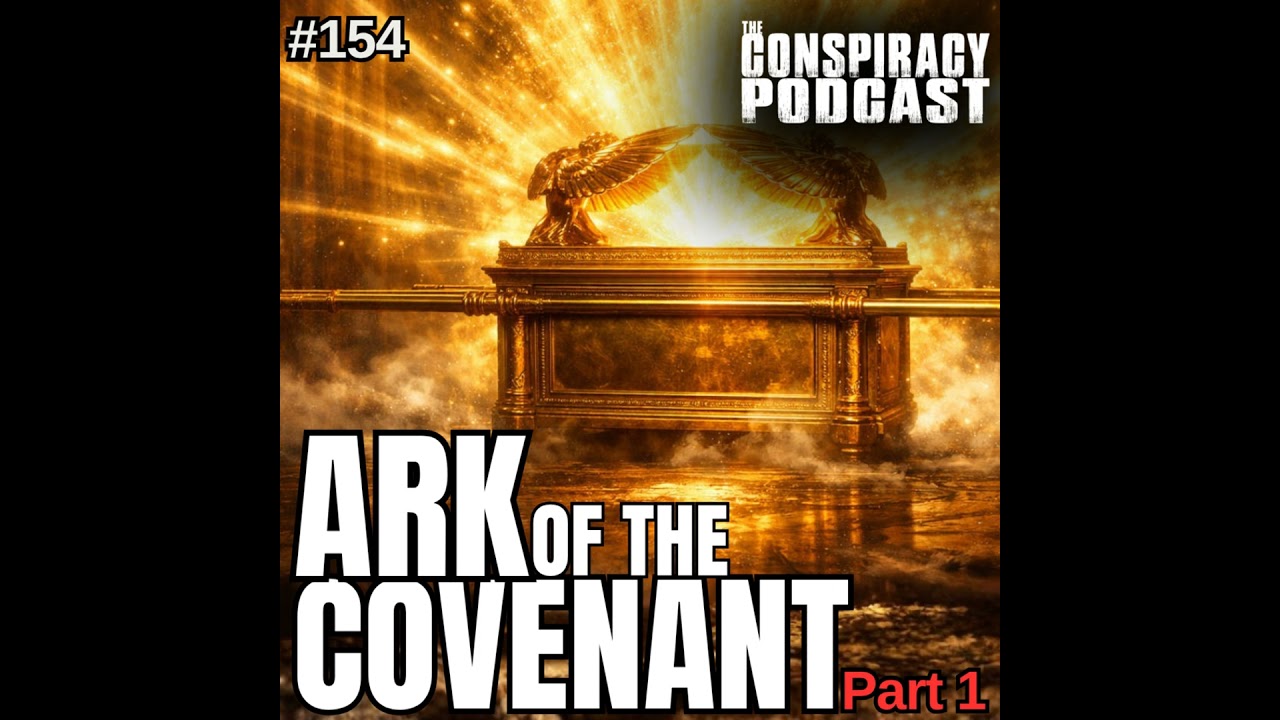
The guys tackle the Ark of the Covenant, a story they say most podcasts skip despite it spanning thousands of years and touching Freemasonry, lost treasure, and later Nazi Germany. Per Exodus, God gave Moses exact blueprints on Mount Sinai for a gold-plated acacia wood chest roughly 45 by 27 by 27 inches, topped with a solid gold lid called the mercy seat and two facing golden cherubim. Inside went the stone tablets of the Ten Commandments, a jar of manna, and the staff of Aaron. The guys question where escaped slaves in the desert sourced that much gold and fine linen, but move on to the Ark’s alleged track record.
The Bible credits the Ark with stopping the Jordan River so the Israelites could cross on dry ground, collapsing the walls of Jericho after seven days of marching, and killing people who touched it without permission, including Uzzah, who died instantly trying to steady it from falling off a cart. When the Philistines captured the Ark in battle, their god-statue Dagon was found face down before it repeatedly, and the town of Beth Shemesh reportedly lost 70 people after opening it to look inside. King Solomon eventually housed the Ark in the holy of holies of his temple in Jerusalem around 966 BC.
Then it disappears from the historical record. The last clear biblical reference places it in the temple around 622 BC under King Josiah. By 586 BC, when the Babylonian king Nebuchadnezzar II destroyed Jerusalem, the Ark is gone, and it is notably absent from Nebuchadnezzar’s otherwise meticulous list of looted treasures. The Jewish historian Josephus later records that the Roman general Pompey found the holy of holies empty in 63 BC. The hosts debate whether the Ark was a literal power source, a psychological weapon meant to intimidate enemies, or simply a sacred container for tablets containing a genuinely revolutionary moral code, and land on agreeing some real object existed even if its reported powers were exaggerated over centuries of retelling.
- The Ark’s construction instructions in Exodus 25-31 specify acacia wood, gold plating, and exact dimensions of roughly 45 by 27 by 27 inches
- The Ark was reportedly used to stop the Jordan River, collapse the walls of Jericho after seven days of marching, and lead the Israelites into battle for centuries
- Uzzah died instantly after touching the Ark to steady it during King David’s procession to Jerusalem, according to the biblical account
- The Philistines captured the Ark in battle at Aphek, and the statue of their god Dagon was reportedly found face down before it multiple mornings in a row
- King Solomon housed the Ark in the holy of holies of the first temple in Jerusalem starting around 966 BC
- The Ark vanishes from the record between roughly 622 BC and 586 BC and is absent from Babylonian king Nebuchadnezzar II’s otherwise detailed list of treasures looted from Jerusalem
Read the full transcript
So, anyways, what do we got on the dock of the day, brother? Okay, so this is the Ark of the Covenant. Now, I feel like we’re going to get mad crap for this one, because people are like, “You don’t know everything I know.” But you know, I was kind of exploring other podcasts, and not a lot of people bring this up. They don’t really do these episodes on the Ark of the Covenant, and I was like, this is a massive story spanning thousands of years.
A lot of people just stay away from this kind of thing. We’ve got Nazis involved. We’ve got superpowers that we don’t know about. There’s hidden treasure. I mean, what’s not to like about the Ark of the Covenant? I think it even ties in Freemasonry, because apparently it was their most holy place, like the Temple of David or something. Yeah, I’ve gone on some real fringy stuff, and I’m like, whoa, I don’t know what’s going on.
So in preparation for this, I did watch last night Indiana Jones and the Raiders of the Last Ark. I wish you would have told me, I would have done a group watch, a community watch. It’s pretty great, dude. I love when they open it and everyone gets obliterated. My favorite is still Last Crusade. I agree. But Raiders is second. Temple of Doom is last, and the new ones aren’t even on the chart. Anyway, check it out, because that’s the basis of literally all of our data. I hate snakes.
This story starts with a box. Not a big box. About the size of a large chest of drawers, roughly four feet long, two and a half feet wide. I love how they have dimensions on it. Where do they get these dimensions from? There’s like schematics. It’s written. There’s written evidence, or at least a description of it. Who knows who wrote that description. But it’s four feet long, two and a half feet wide, two and a half feet tall, covered in gold, and carried on poles. So you know it’s legit.
And according to three major world religions, it’s more dangerous than anything else that has ever existed on planet Earth. So it’s like their version of Pandora’s box. And it’s the Ark of the Covenant. Now, a great question earlier was, what’s the definition of the word ark? So ark is essentially an item or a box or even a boat, something that is a safe haven for something of value, generally of a religious nature.
So there’s multiple definitions. The generalized definition is something that affords protection and safety. This is from Merriam-Webster, by the way. The other one is a boat or ship held to resemble that in which Noah and his family were preserved from a flood. So there’s the boat definition. There’s also their actual religious definition of the sacred chest representing to the Hebrews the presence of God amongst them. And then there’s a repository, traditionally in or against the wall of a synagogue, for the scrolls of the Torah.
So apparently in a synagogue they have a repository for the scrolls of the Torah that they will take out and read from with the little gold finger. So it’s basically something that’s protecting the most valuable thing. In the sense it’s the representation of God amongst you. And then covenant is a solemn binding agreement or promise between two or more parties, typically involving mutual obligations and commitments.
So it’s like, for example, if a public company takes debt, there’s debt covenants. It’s debt agreements that say okay, you’re going to maintain X amount of money on the balance sheet, or make X amount of payments per year, with certain covenants that if you violate them, you are then in default. So it is a legal thing. I do remember now, but I just remembered it from my vows, with the wedding covenant. Exactly, the agreements. So it’s the protection of the agreement between God and man.
The chest God told Moses to build on a mountaintop in the middle of the desert. The thing the Israelites carried into battle for 400 years. The object that supposedly parted rivers, flattened city walls, killed people who touched it without permission, and served as the literal communication device between mankind and God. It’s like the direct line, the hotline. Yo, yo, God, what’s popping? It’s arguably, maybe between that and the Holy Grail, the most important physical object in the history of organized religion.
You get into the goats of it. There’s the Holy Grail, the Ark of the Covenant. There’s the spear that stabbed, the Spear of Destiny. Then there’s the original one, like Mecca, that giant square they go to. There’s the Wailing Wall in Jerusalem, which I’ve been to. It’s legit just a wall, that’s all it is. You go there and it’s like a holy site, and you put your prayers on a little piece of paper and you stick it in the wall.
This is supposed to be like a direct hotline, like a walkie-talkie. So this has got to be the goat. But what about the tablets themselves? I would imagine the Ten Commandments would be what the covenant is holding. So the Ten Commandments have to be more elite, to be held within the cell phone to God. Or here’s the odd part. Nobody has seen it in over 2,600 years. I want to know, when was the last recorded sighting?
Sometime around 586 BC, it disappeared from history so completely that not even the people who ransacked Jerusalem and looted its temple bothered to write it down. The Babylonian king Nebuchadnezzar kept detailed lists of everything he took when he ransacked. The ark was not on that list. I love how he’s like, “I need a ledger, I want to know everything we ransack.” It’s like, why are you going to keep a ledger of this stuff?
Where it went, nobody seems to agree. Some say it was hidden by priests who saw the invasion coming. Some say it was smuggled to Ethiopia, where it sits today in a church guarded by a single monk who’s not even allowed to leave the church. Some say it was never even a physical object at all. It was just an idea, something more powerful. Similar to the whole Holy Grail thing. Is it a cup, or is it a woman, or whatever? Nobody seems to agree.
But before any of that, you need to understand what it actually was, because the story of the ark does not start with the disappearance. It starts on top of a mountain in the middle of nowhere, with a man who had just seen a burning bush and had a lot of questions. The year, by most biblical scholars, is somewhere around 1446 BC. The Israelites, a slave people who had just escaped Egypt through a series of increasingly dramatic plagues and a parted sea.
So they are all camped in the Sinai desert at the foot of a mountain called Mount Sinai. Moses went up alone. The people waited below. Real quick, fun fact, I was born at Mount Sinai Hospital, in Manhattan. Moved shortly after, but just saying, I’m pretty much like Moses. I got the tablet stashed in my safe. So Moses was up there for 40 days and 40 nights. Forty days, no food, no water, no tent, on a mountain. It’s obviously physiologically impossible.
I’m sure he had some beef jerky, some rations, some bread. Some dried meat, some salt meat. The Bible describes the top of the mountain as covered in fire and thick cloud. The people below can see it from the camp. They are terrified. When Moses finally comes back down, his face is glowing so brightly that he has to wear a veil so the Israelites can look upon him.
And he comes down Mount Sinai and he brings two things with him. The stone tablets of the Ten Commandments, carved by God himself, and a set of extraordinarily detailed instructions for how to build a box to house them. I was just about to say, no offense, but that seems super inefficient. Forty days, and slow as hell. It’s one commandment per four days. Anyway, I just remembered the raining was Noah’s ark, that’s nothing to do with this story. That’s a little later on the timeline. We should do Noah’s ark, there’s a lot of conspiracies around it.
So the instructions are written in the book of Exodus, chapters 25 through 31, and they read less like religious scripture and more like a specific construction contract. God tells Moses exactly what materials to use, exactly what dimensions to cut, exactly what direction to apply to the box, and exactly what the finished product should look like. You know how in the Bible it’s very up for interpretation? Yes. But this is very specific.
There is no room for interpretation, and it was not a suggestion but a written instruction on how to build something. Some would say the IKEA of the time. Insert dowel rod into zone B. The box was to be made of acacia wood, a hard, dense, thorny desert tree that resists rot and insects, and it’s the best wood available in Sinai. It was to measure exactly two and a half cubits long, whatever a cubit is, one and a half cubits wide, and one and a half cubits tall.
In modern terms, that’s roughly 45 inches by 27 inches by 27 inches. So to be honest, that’s pretty small. It’s not huge. Man, Steven Spielberg did us wrong. That was a body in that thing. And it had to be gold-plated. So every surface, inside and out, was to be overlaid with pure gold. You think it was because gold is a good insulator? There’s so much power to insulate. A gold molding like a crown was to run around the top edge.
Four gold rings were to be attached to the lower part, two on each side. And through those rings, two long poles of acacia wood, also covered in gold, were to be threaded for carrying. The poles were to be permanent, never to be removed. Nobody was to touch the box itself, ever. My thing is, I thought they carried it for 400 years into battle. But why is he so specific? Why are the pyramids so specific? It’s like the world’s first battery.
Anyhow, the lid was called the mercy seat, and it was a separate piece. It was not wood covered in gold. It was hammered from a single solid block of pure gold. It was beaten by hand into shape, and it was the same dimensions as the top of the box. So wait, quick pause. Okay, they literally started off the Israelites as the slave race. Where the hell are they getting a boulder of gold? Weren’t they living at the bottom of a mountain because they had no home?
That’s what I’m saying. They were the slaves. They literally just escaped slavery somehow, and they’re like, oh, we’ve stumbled upon this gold mine with all this gold. Where’s all the gold coming from? You get the blueprint directly from God, you don’t question it. Can you imagine the builder? He’s like, how many cubits? Honestly, we don’t even have any acacia wood. We only got like half a cubit of this stuff. Is pine going to work? Acacia only, sir. Just get it done.
On top of the mercy seat, also hammered from the single block of gold, stood two cherubim, which were angelic figures facing each other with their wings outstretched and arching inwards over the lid, and their faces were to be looking down toward the center. So it literally just looks like two wings. This is such a big ask, and very specific. I guess maybe some of the slaves could have been craftsmen, so that checks out. I mean, they just parted the sea.
I just can’t get past the gold thing. I don’t know how you get that much, because it’s crafted from a solid block. He’s like, no, you can’t piece this together. No welding. I want a solid block, and then just throw the excess away. It would be a little bit more believable if it was like, whatever you can find at the bottom of Mount Sinai, any material is cool, just make it look good. Have you heard of staining? There’s this great wood we found on sale at Home Depot, it doesn’t have to be acacia.
The space between the wings, directly above the mercy seat, was described as the place where God himself would speak to Moses. So you have to put two wings there and then it’s just the little listen hole, the hello. So think about that for a second. It’s not a temple. It’s not a cathedral. It’s not a throne room. It’s a box that was essentially God’s address. It’s like his PO box, and maybe his phone. It’s like his car phone and the box is the car, and the phone at the same time, simultaneously.
So a craftsman named Bezalel, son of Uri, was appointed by God to oversee the construction. Appointed by God, and they were like, hell yeah. So it’s written in Exodus, and he was described as a man whom God had filled, quote, “with the spirit of God, with wisdom, with understanding, with knowledge, and with all kinds of skills.” Bezalel and his team built it in the desert at the foot of the same mountain where Moses had received the plans.
When it was finished, Moses placed inside it the two stone tablets, the unbroken ones carved by God, along with a golden jar of manna, the miraculous bread that had sustained the Israelites in the desert, and the staff of Aaron, Moses’s brother, which had reportedly budded and blossomed overnight to confirm Aaron’s appointment as a high priest. So he kind of brought some of that manna on that mountain, for sure. He had a little pouch, like the elven bread from Lord of the Rings. One bite can sustain a man.
All right, let’s get back on track here. So Aaron got dubbed a high priest because of the blooming. So the ark was then placed in the center of the tabernacle, which was a portable, elaborate tent temple. So a temporary temple. These slaves got a lot of gear. So it had curtains of fine linen, goat hair. Where are they getting this fine linen? Frames of acacia wood, coverings of ramskin and sea cow hide, a bronze altar for burnt offerings. Doesn’t this kind of poke holes in the whole slave theory?
No, they just escaped Egypt and robbed the whole place. Take it all. But how are they going to get it? They’re in the desert now. Apparently there’s acacia. I’m with Sean on this. How did they get all this fine linen? They just parted the Red Sea, and they’re starving, and all of a sudden they’ve got a bounty of bread and stuff. They went to Mount Sinai, and Moses camped there. So they had 40 days to do this. I just don’t know where they’re getting all this material.
So there was also a gold altar for incense. Of course, for incense. Where’d you get the incense? Who’s making incense? A menorah with seven branches, and at the very center, separated from everything else by a thick curtain called the veil, the innermost chamber called the holy of holies. And it was one room, no windows, no light. Well, of course there’s no windows, it’s a tent. This isn’t a house. Just the ark.
Only one man was allowed to pass the veil, Moses, and that was the high priest at the time, his brother. And only once a year, on Yom Kippur, the day of atonement, he went in alone with incense to create smoke so he could not see the mercy seat directly. And he sprinkled blood on the lid to atone for the sins of the entire nation. And then he came back out and that was it. That was the closest any living human being was permitted to get to the Ark of the Covenant.
But the homies are carrying it, they’re pretty close. This is after they built the resting place of it. But the homies are carrying it, can they not look at it? If you’re carrying it, you’re going to take a little peek. I’m peeking for sure, I’m 100 percent peeking. I’m walking backwards to stare at that thing. You’re going to hell then. Worth it. The end of Raiders of the Last Ark is wild, they literally melt. And Indie the whole time is, don’t look at it. But the thing is, they opened it.
From this story, I can’t really tell, can you look at the outside? They had to be looking at it, you can look at the box. You have to be able to look at the box. If you carry it, you can’t walk blindfolded or backwards, it doesn’t make any sense. You have to look at it. So the ark was not a passive object. The Bible describes it doing things, terrifying, inexplicable, world-altering things, and the pattern is consistent across dozens of accounts spanning centuries. You get near the ark with anything less than absolute reverence and something terrible will happen to you.
Dude, what if inside the ark was just like a kilo of plutonium? It was just the first deposit of an asteroid that hit up there, some radioactive stuff. Moses stumbled up there, he’s like, what is this? I found this giant rock, it keeps talking to me. What if it was some alien tech, and homie was like, build me a box, trust me. It’s some sort of energy source. There’s no other reason for the gold. Why does it have to be gold? I don’t think God gave a damn about gold, he made the universe. My guess is, humans wrote it.
The first display of power came while the Israelites were still in the desert. Moses would approach the ark to speak with God, and the Bible says a pillar of cloud would descend and hover over the entrance to the tabernacle. Did the homies also see this too? Visible to every person in the camp. The entire nation would watch the column of smoke and know that Moses was in conference with God. Nobody approached. Nobody knocked. I also would not approach if I saw something like that. Do not piss Moses off.
Moses was legit. Let’s be honest, he’s a homie. You’re having brewskis at the dive bar with my guy. Honestly, he’s kind of my fave. Parting the Red Sea, up there 40 days, you camp down there, I got this. What a legend. Then came the Jordan River. The Israelites, after 40 years of wandering, were finally crossing into Canaan. First of all, why is everything in 40 years? Jesus in the desert for 40, he’s on the mountain for 40, everything’s 40. There’s got to be some significance with this 40 number.
The Jordan was at flood stage, deep and fast. God’s instructions were, have the priests carry the ark into the water’s edge and step in. The moment the priests’ feet touched the water, the river supposedly stopped flowing. It piled up like a wall upstream, and the entire nation, hundreds of thousands of people, crossed on dry ground. Sorry, there’s so many plot holes here. We got hundreds of thousands of homies in the desert. How is everyone getting fed for 40 years? Manna. How are you making that bread? Where are they getting the water from?
The priests stood in the middle of the dry riverbed with the ark on their shoulders until everyone was across. Then they stepped out and the water came back crashing down. And that’s the story of the Jordan River. Very similar to the Moses Exodus. Yeah, the Red Sea is a lot bigger than a river, let’s be honest. Then came Jericho. Jericho was a walled city, one of the most heavily fortified in Canaan. The Israelite army marched around it once a day for six days. They got an army too?
The ark carried at the center of the procession, the priests blowing rams’ horn trumpets. On the seventh day they marched around it seven times. The priests blew a long blast, the people shouted, and the walls of Jericho, stone walls, military fortifications, collapsed to the ground. The Bible says every man in the army walked straight in. Jericho was the first city they took in the conquest of Canaan, and the ark led the parade.
So these are stories of the ark in action. And later on in the next episode, guys, this is a plug, we’re going to talk about Hitler’s obsession with the ark. Hearing these stories, armies want that power, because what kind of weapon is this thing? This is some otherworldly stuff. But I have to look at the other side of the coin here. If you’re in Jericho and they’re just marching around your walls for seven days, have you ever heard of an arrow? Rain arrows on these bros, problem solved. That’s what archers are for, that’s their job.
So the Philistines found out the hard way about the power of the ark. In a battle at a place called Aphek, the Israelites were losing badly and decided to bring the ark out from the tabernacle. Bring that thing out, the boys won’t mess around. The ark was like the B-52 of the 1400 BCs. The Philistines were initially terrified when they heard the Israelites had brought their god into the field, fought harder out of desperation, but they actually won. The ark was captured by the Philistines.
Plot twist. The two sons of the high priest who had carried it into battle were killed. And the high priest himself, upon hearing the news, fell backward off his seat and broke his neck and died, just upon hearing the news. So the Philistines brought the ark to the city of Ashdod and placed it in the temple of the god Dagon as a trophy. The next morning, the statue of Dagon was found face down on the floor in front of the ark, as if to be bowing. It happened multiple nights in a row, where they put the statue back up.
So one thing you think about is the story being written from one perspective. There’s a dude writing it, like, yes, we were in the desert, it sucked, we overcame. How do we get this insider Philistine information? How do they know what happened inside this Philistine temple? Hundreds of years of accounts, stories passed down, campfire tales and podcasts. The Philistine podcast, podcasting around the campfire.
But it keeps going. So the ark was then moved to the city of Gath. It was then moved to Ekron. Multiple strange deaths happened. After seven months, the Philistine rulers held an emergency council and unanimously decided to send the ark back to the Israelites, because they were terrified of it, because all this death was happening. So they decided to send it back along with gold offerings and all sorts of gold items as a peace offering. With gold, just take it.
So the Philistines put the ark on a cart pulled by two cows, pointed it at Israel, and just let the cows go. They just hit the cows in the ass, like, run. The cows walked straight into an Israelite town called Beth Shemesh, without stopping or turning. The people of Beth Shemesh, overjoyed to see it, opened the ark to look inside. Their heads exploded. Supposedly 70 of them died, melted. God’s like, I didn’t give you permission, how dare you?
Supposedly, the survivors sent urgent messages to nearby towns, and it said, and I quote, “The ark of the Lord has been returned. Who is able to stand in the presence of the Lord, this holy God?” I mean, I would also feel that vibe. Your homies got eradicated. Seventy is a number. And then the most famous individual death came later, and it was during the reign of King David. David had decided to bring the ark from the town where it had been kept for 20 years, to Jerusalem, to establish Jerusalem as the spiritual capital of Israel.
He organized a massive national procession. Thirty thousand chosen men, musicians, celebrations, dancing in the street, a big celebration. The ark was loaded onto a brand new ox cart. As they were traveling, the oxen stumbled. A man named Uzzah, who had grown up in the house where the ark had been stored, was walking beside the cart. He reached out to grab the ark and stop it from falling. He touched it. He died instantly.
And the Bible says, and I quote, “The anger of the Lord burned against Uzzah, and God struck him down on the spot for his irreverence, and he died there beside the ark of God.” Okay, his irreverence? I’m trying to save the ark. Die. Straight dead. How dare you try to save me, I was meant to fall. Like this was all part of the plan. So King David was shaken so much that he stopped the entire procession, refused to bring the ark to Jerusalem, and left it at the house.
And so it was there for three months. Apparently, the Bible records that during those three months, Obed-Edom and his entire household were blessed in every conceivable way. When David heard that, he about-faced and went back to pick it up. I’m going to need that back, I’m going to need those blessings. Actually, now that you mention it, we need it back in Jerusalem. This time the ark was carried on the shoulders of the Levites, which was a priestly tribe appointed specifically for the purpose of carrying the ark, exactly as God had instructed.
The men who carried it stopped every six steps so David could sacrifice an ox. Every six steps. This is actually getting out of control. David himself danced before the ark in the streets of Jerusalem, stripped down to linen, leaping and celebrating with everything he had. And the ark entered Jerusalem and was placed in a tent David had prepared for it. His wife Michal watched from a window and was disgusted by her husband’s display. David told her essentially that he would dance before the Lord and he didn’t particularly care what she thought. And the Bible records that Michal was barren for the rest of her entire life because of those statements.
This just seems like, why is God so finicky on this stuff? No, you can’t touch it, but you can at some point. But then if oxen aren’t dying on the path, I’m going to be pissed. What’s with the strict wrapping? It’s so random. There’s no consistency. It would be one thing if it was like, you do something sus, God’s going to be pissed, you touch it, screwed. But then he’s like, okay, no, you can touch it because I think you’re cool. But then this totally normal woman gets barren, no kids, and the dude trying to save the ark gets dissed.
So okay, now Solomon’s temple. And this is what most people consider the permanent home of the ark. So David wanted to build a permanent temple to house the ark. God told him no. He had too much blood on his hands, having spent his life as a warrior. The job would go to his son. Solomon began construction of the first temple in Jerusalem around 966 BC. The project apparently took seven years.
The Bible’s description of it reads like something between an architectural wonder and a fever dream. Walls of cedar imported from Lebanon. Floors of cypress. The interior lined with pure gold. The walls, the floors, the ceiling, all made of gold. That’s so much gold, where are they getting it? Like where are these mines? The temple was divided into the same layout as the tabernacle that had preceded it, with the holy of holies as the innermost center. A perfect cube, 30 feet on each side, clad entirely with gold.
It contained nothing but the ark and two massive cherubim carved from olive wood, each 15 feet tall, their wings spanning 15 feet, the tips of their inner wings touching each other in the center of the room over the mercy seat. The day the ark was brought into the temple was, by any reasonable reading of the biblical account, one of the most dramatic moments in human history. The priests carried the ark into the holy of holies. They came back out, and then the Bible says a cloud filled the temple so thick that the priests could not stand and perform their service.
Solomon went before the assembly of Israel and said, and I quote, “The Lord has said that he would dwell in a dark cloud. I have indeed built a magnificent temple for you, a place for you to dwell forever.” That same cloud that we talked about over there. He’s got to have a medium. It’s always the cloud. So here’s where the timeline gets wonky, with bigger gaps. So the ark sat in the holy of holies of Solomon’s temple for approximately four centuries.
Apparently the high priest entered it once a year on Yom Kippur. The rest of the time, the room was sealed. The ark was not moved, not displayed, not touched by anyone. And then somewhere in those 400 years, something happened. Because by 586 BC, the year the Babylonian king Nebuchadnezzar II destroyed Jerusalem, burned the temple and carried the people into exile, the ark was gone. It is not in the temple when the Babylonians arrive. It is not on the list of treasures that Nebuchadnezzar takes back to Babylon. The second temple, built by the returning exiles 60 years later, has the room empty.
Maybe he was just like, don’t put this in the ledger, dog, this is going in my personal collection. The Jewish historian Josephus writes about the Roman general Pompey entering the holy of holies in 63 BC out of curiosity, expecting to find the treasure of the Israelites, but he found nothing. The Bible never explains what happened to the ark. It simply stopped talking about it. The most powerful, most sacred, most consequential object in the history of the ancient world walks off the page without so much as a farewell or even a mention.
They were hyper-specific, talking about it, talking about it, and then sitting there for hundreds of years, generations. You can’t keep talking about it that much. It was being used in battle, so the story is about it in action. So this is the last known sighting. I mean, Indie saw it. The last clear reference to the ark being in Solomon’s temple is in 2 Chronicles 35:3, during the reign of King Josiah, around 622 BC. A major religious reformation was underway.
Josiah had discovered a copy of the law in the temple while it was being restored, and had wept while he read it, and had launched a sweeping campaign to restore proper worship. As part of that restoration, he instructed the Levites to, quote, “put the sacred ark in the temple that Solomon, son of David, king of Israel, built. It is not to be carried about on your shoulders.” But weren’t they carrying it on their shoulders? Wasn’t that why the whole pole system was implemented, that God specifically requested? But that is the last time it’s mentioned.
What happened between that moment, roughly 622 BC, and the Babylonian invasion of 586 BC, is one of the great unsolved questions of archaeology and biblical history. It disappeared in those 36 years. The ark goes from being an active part of the temple to being completely absent from the list of treasures looted by one of the most thorough conquerors in the ancient world. Meaning he wrote everything down. Nebuchadnezzar wrote everything down, he was like an accountant.
He even wrote down the bronze pillars, the bronze stands, the pots, the shovels, the sprinkling bowls, the ladles, the silver and the gold, the curtains, the furnishings, everything. The lists are extremely meticulous, but it’s not on the list. Maybe they stashed it. Maybe they knew they were getting invaded and they did a little stash-eroo. That’s what I would do. Before they got there, stash that thing.
So some say it’s not an accident of recordkeeping. Nebuchadnezzar was a king who knew what the Ark of the Covenant was. Its reputation had preceded the Israelites for centuries. If he had found it, it would have been the crown jewel of the conquest, the ultimate trophy, the proof that his god Marduk had defeated the god of Israel. He would have written it down, for sure. It would have been the great crescendo. But he didn’t. So the point most scholars say is, it wasn’t there, because he would have written it down since it would have been such a dub for him.
So that is the question, which is, where did it go? And that’s the question we’re going to take apart in part two. You know who we need on the case? Nicolas Cage. This is National Treasure 3. Look at the clues, I have to break into the White House, trust me, I know where it is. But before we get there, there’s just one thing, which is that we’re not talking about a myth the way we talked about mermaids or unicorns or Atlantis.
The Ark of the Covenant was real. It’s documented as a real thing. Whether or not it had superpowers is the question. But it was a real box. When was the Bible written? Well, that in itself is another debatable episode. So it’s still technically hearsay, like the telephone game. Was there some sort of receptacle for this thing? Yes. Was it blowing up walls, but then all of a sudden when you need the power, it doesn’t work, and they were like, we just lost this super powerful thing?
But what Eric’s saying is it existed then. So you agree, the box. Yes, I believe that there was some sort of vessel that they revered, for sure. Could have just had some rocks in it. Whether it had the powers or not, who knows. But the stone Ten Commandments. Yes, I believe that there was some sort of receptacle for their sacred treasure. So putting it in a non-religious context, is it possible that Moses came up with some great rules to live by, wrote them down? A hundred percent.
He went up on the hill, and he’s like, you know what, I’ve got to put some semblance of society together. There is no question, putting religion aside, that to have a good moral code to live by is super solid, especially back in the day where it was like, I’m a king, I’ll do what I want, give me slaves. So something was in that room, something that people were willing to die for, willing to build entire cities around, willing to carry on their shoulders through 40 years of desert. Something that, when the most powerful army in the ancient world came to take it, was gone.
Where it went, nobody can agree, but everyone does agree it existed. And that is what makes this one of the most genuinely unsettling mysteries in human history. So in part two, we’re going to go over some of the theories. Where is it now? A lot of people say Ethiopia, the Dead Sea, is it hidden in the Vatican City, a cave in Jordan. We’re also going to go over the Nazi search for it, because the Nazis were very into it.
I do think that yes, there’s probably a thing, but I think it gets hyped up to have this power, and so indiscriminately killing people who are reverent to it. Oh, I have to save it, you’re dead. How dare you, you peasant, touch me. It just seems a little, why is it so indiscriminate with its killing? It would make sense that if they had to create some myth around it, that gives you power as a people. Even fear in the others, other countries, other kings.
Maybe it’s the origination of marketing. They’re like, don’t mess with us, we got this box that will do stuff, you have no idea what it will do. You don’t want the smoke. Maybe that’s where that phrase comes from. But on the other side of it, there could be something. The story has lasted for thousands of years. I just have a hard time believing this infinitely powerful being who created the universe would be so like, I will only communicate through this box. Why reduce yourself to a box?
It’s weird thinking about it in the context of technology today. It’s strange to be only talking through a little hole, through the cherubs, and that’s the only way I’ll communicate, and only to six dudes and that’s it. So I think that with almost anything from ancient times, there’s truth and then there’s the spritz of passed-down stories. It’s the fanaticism that gets into it. I’m not crapping on people’s belief systems, but if you’re a radical believer, you’re going to pump it up. Of course that’s legit, my god’s the best.
Is this story part of any other religion that has a cooperative account? Maybe, I don’t know exactly which ones. Now, I always get confused with the difference between Judaism and Christianity. And even Judaism, Christianity, and Catholicism, because they’re all kind of the same, but they’re all different. But I think all three still believe in the ark. I think Catholicism was first, then came Christianity, because remember the Romans and the Catholic Church, the Crusades and stuff.
I think the main difference is that Judaism is more of like before Jesus. And then Christianity, their personification of God on earth is Jesus, as opposed to in Judaism, the pre-Jesus arc. I don’t think they acknowledge Jesus, but I don’t really know for sure. I can see why maybe they don’t, because they killed him. Technically the Romans killed him, but the Jews gave him up. Even though he was born in Bethlehem, and he was the king of the Jews. Well, because he was saying he was the son of God.
It’s so convoluted, they all believe really close to the same thing, but they still believe hyper-differently. There’s still this huge divide, and I don’t know where the lines are drawn. I would love for you guys to write in and maybe teach us, because we didn’t do a deep dive into the religions and their differences. It was mostly, okay, what’s the story of the ark? So at this point, do you believe the ark existed? At this point, I would say yes. I believe there was an ark of sorts. I need to hear episode two.
I think at this point it has now become this myth. You just don’t know if it held any power. I don’t think it had terrestrial, but out-of-this-norm, supernatural power. I think in order to create the hype and the myth, it was made supernatural. In the grand scheme, what would actually make sense is that this infinitely powerful being would just be like, yeah, just keep it safe, and follow the rules. If you believe in the Ten Commandments, God’s like, yo, just be good dudes, be a good person, and keep it safe, follow the rules, that’s all I need.
Well, for example, I believe in Noah’s ark, but I don’t know if I believe in the exact story of how it happened. I believe there was some sort of massive flood, crazy cataclysmic events. The sea was rising. There’s all these theories that there was an ice age 15,000 years ago, and that would track, because what happens when all the ice melts? It’s called a flood. I’m going to need an ark.
There are some cool studies that the sea was rising and there were ice ages, but it was only in certain areas inland. So it wasn’t the whole world, but it was an area. So a guy was like, I need to build a boat. Imagine those mudslides that happen, it’s like a river of mud, but it’s like an ocean and you can’t survive. Those are in isolated areas, so there could have been a huge flood into isolated areas. It doesn’t mean the planet is flooded, because where would the water go? Ninety percent of the planet is water anyway.