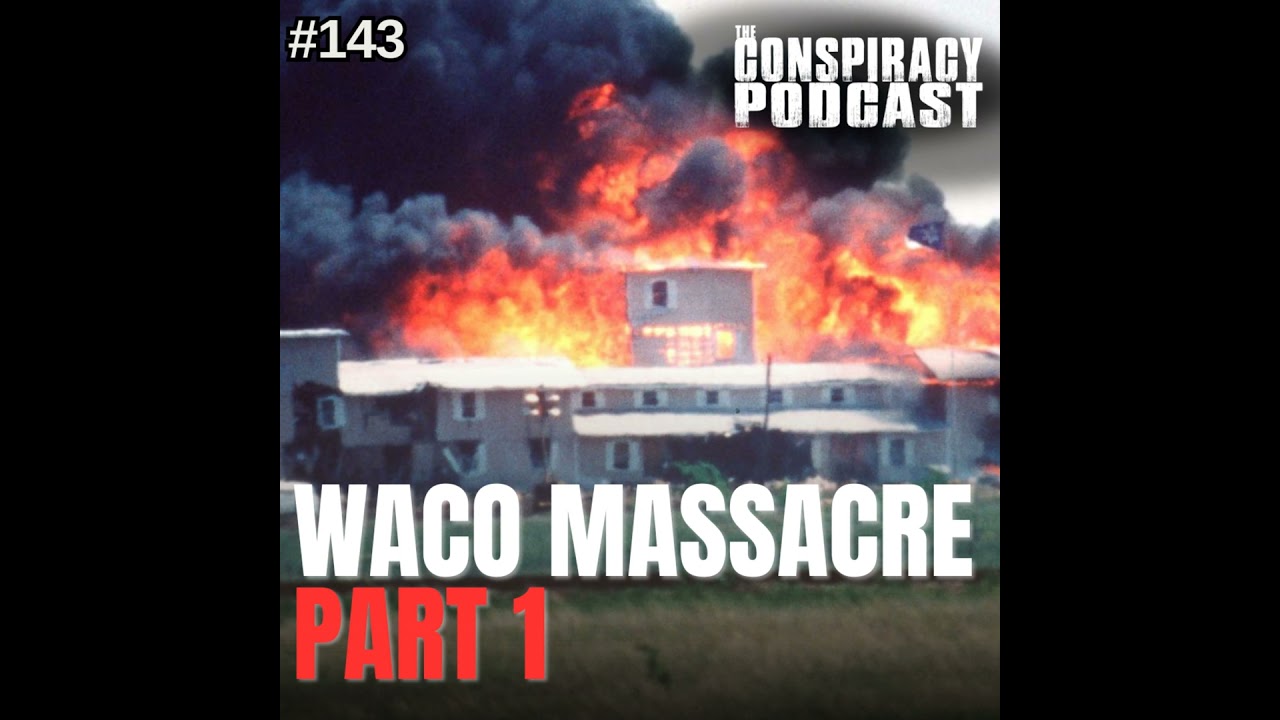
WACO: Massacre Part One – EP 143


WACO: Massacre Part One
The guys open a two-part series on the 1993 Waco siege, recommending listeners start with their Ruby Ridge episode first since the same ATF is involved in both. At the center of the story is David Koresh, born Vernon Howell, who took control of the Branch Davidians, a Mount Carmel offshoot of the Seventh-day Adventists, by 1988. Drawing on the Department of Justice report, they describe Koresh preaching absolute control over the community, separating married couples while claiming exclusive sexual access to the group’s women as the self-declared “lamb of God” uniquely entitled to interpret the seven seals of Revelation. Koresh’s followers stockpiled weapons in anticipation of an Armageddon they believed the federal government, or “Babylon,” would bring upon them.
On February 28, 1993, ATF agents arrived to serve arrest and search warrants after the element of surprise had already been compromised, including a leaked tip to a local newspaper reporter and an undercover operative, Robert Rodriguez, who escaped the compound after Koresh became agitated and said, “They’re coming.” The raid proceeded anyway. A two-hour firefight broke out, killing four ATF agents and wounding sixteen, while multiple Branch Davidians were also killed. Who fired first remains disputed to this day. The hosts walk through the chaos of the agents’ extraction, the disputed claims about helicopter gunfire, and the breakdown in radio communication that left both sides struggling to get through to anyone.
The episode then tracks the first weeks of the 51-day standoff after the FBI took over as lead agency, including the phased release of children, the death of Branch Davidian Peter Gent, and escalating FBI pressure tactics like cutting power, blaring music such as Nancy Sinatra’s “These Boots Are Made for Walkin'” for 48 hours straight, and crushing vehicles with tanks. The hosts also cover the arrival of Timothy McVeigh, who sold anti-government stickers outside the compound years before the Oklahoma City bombing, and attorney Dick DeGuerin’s attempts to negotiate Koresh’s surrender. The episode ends on April 18th, the night before the FBI’s final incursion, which the next episode will cover.
- The siege began February 28, 1993, when ATF agents tried to serve arrest and search warrants on the Branch Davidians at Mount Carmel Center outside Waco, Texas
- David Koresh, born Vernon Howell, led the Branch Davidians, a Seventh-day Adventist offshoot, and claimed to be the biblical “lamb” uniquely able to interpret the seven seals of Revelation
- ATF undercover operative Robert Rodriguez was inside the compound during a Bible study when Koresh grew agitated and indicated he knew agents were coming, then escaped to warn his superiors before the raid proceeded anyway
- The initial firefight lasted about two hours, killed four ATF agents and wounded sixteen, and also killed multiple Branch Davidians, with no agreed account of who fired first
- The standoff lasted 51 days, during which the FBI used tactics including cutting the power, playing music like Nancy Sinatra’s “These Boots Are Made for Walkin'” for 48 hours straight, and crushing Branch Davidian vehicles with tanks
- Attorney General Janet Reno approved the FBI’s final incursion plan on April 17, 1993, and the incursion began April 19 at 5:58 a.m., the point where this episode ends
Read the full transcript
Okay, so this is now we’re doing the episodes on Waco, the Waco standoff, the Waco massacre situation. We had done the OKC bombing and we had done Ruby Ridge. So all of these tie into it, and I would recommend going back and starting with Ruby Ridge specifically. Then you could even listen to this and then listen to OKC afterwards, because OKC happened after. This is a chronology.
Do you guys know a lot about this? Not a whole lot. I just know a little bit of what we touched on in some of these episodes in the past, and then I think I saw some YouTube video about this one time. I don’t know much. But I want to say this is also a Patreon request from Leonidas. He’s been around for a while and he even sent a good amount of research on this episode. We really appreciate everything that you do for the group. It really keeps the show going.
So, without further ado, when this happened, I was eight. So I wasn’t captivated by it when it was happening because I was so young. Hopefully the people who are listening, maybe you learn something here, because our demo probably wasn’t around necessarily for this too much. This is the anniversary of it. This happened on the morning of February 28th, 1993. Today, recording this, it’s February 27th. Federal agents arrived to serve warrants at a religious community outside of Waco and the operation detonated into a two-hour firefight. Four agents were killed and 16 were wounded, while multiple members of the community were also killed.
Then it was a standoff for 51 days. How did they have enough food for that? The FBI became the lead agency and conducted a hostage barricade-style standoff against the community known as the Branch Davidians, and it was at Mount Carmel Center. Now, I’m not going to tell you the end of the story at the beginning, but a lot happened. Most people do know about it in some sense. I would assume that most people go, “Yeah, it was some sort of shootout that happened in the ’90s,” and that’s about all they know.
But at the center of the story was David Koresh. He’s the leader of the Branch Davidians. He was actually born Vernon Howell. That’s a wild change. Complete change, not even remotely close. Long before television helicopters circled a burning building, the place was a community with a geography and a theology. They had outbuildings, plywood storage rooms, a chapel. It was all set apart from the town, and they even had an end-times workshop. It was a full-scale community, a little compound, like a little commune.
So the Branch Davidian movement itself was an offshoot of the Seventh-day Adventists, and it was shaped by an apocalyptic interpretation of Revelation. So they’re like fire and brimstone? It’s definitely Christian Bible based. That’s the starting point. Koresh’s rise was not only about his charisma, but managerial. Now, as we go through these episodes, you’ve got to know that a lot of this data is from the Department of Justice report. So take that with a grain of salt. Remember how we went over the Warren Commission, quote unquote the view of it. So put yourself in their shoes. History’s written by the victors, and that’s a common saying because if you lost, you don’t really get your side told that much.
So the DOJ report describes him as exercising absolute control. He would preach for hours while also depriving people of sleep and basics, policing behavior, demanding their assets, regulating information, movement, and daily life. And his theological claim announced that he was the lamb of God. Well, so it’s kind of like the US government, in a sense. Regulating your assets, auditing you, judging you, policing your behavior. So he said he was the lamb of God, uniquely entitled to interpret the seven seals.
This claim was not abstract doctrine inside the compound. It restructured what we consider family life. We have a set way of life in our community. Husband, wife, kids, that’s your unit. So what if you didn’t subscribe to that? You have unlimited wives. There is no nobody owns the kids. They’re all the community. It’s like a village. We’re all one big family. Bunch of uncles.
Now the claim gets a little strange, because the DOJ report states Koresh ordered the separation of men and women and prohibited sexual relations between married couples. It was almost like abstinence, but you’re married. So how do you propagate? How do you continue the commune? Well, the children were already born. The only person who had access to the wives was him. Of course. Classic. This is the playbook right here. Only I get to do it. Trust me, I’m the lamb. Only the lamb gets to lay the pipe.
So he believed that he was the lamb, which was from the Book of Revelation, and he was destined to unlock divine truths amid impending end times. So he didn’t even have the truths yet. He was just trying to unlock them with your wives. And if you remember, if you go back to Ruby Ridge, we talked about how they were a little bit like survivalists and they would go up into the mountain and be like, “End of times are coming.” So it’s the concept of, you think the apocalypse is coming, so what do you do in preparation? Unless you are planning to be saved by God, and you’re the lamb.
So the seven seals were drawn from Revelation chapters 5 through 8, and they were interpreted by Koresh as symbolic stages of God’s progressive revelation of salvation, leading to judgment and a new kingdom. Those who are worthy will survive, and then we’ll start anew. Though his views diverged from mainstream Christianity by claiming exclusive authority to decode them. He said he was the one that was going to interpret it. Mainstream Christianity basically is like, whatever’s already written, that’s the word of God. But he is saying, “Yeah, that’s the word of God, but trust me, this is what those words really mean.”
This is how you get all of the different offshoots, because there are so many. There’s the Episcopal Church, there’s Baptist, there’s all these things. That’s all because you’re interpreting something that was written thousands of years ago. I think interpretation’s a great thing, because everyone should have their own perception of what their religious beliefs and values are. But he’s making it like, “I’m the interpretation, listen to me.” And interestingly enough, people believed him and followed him. He was charismatic, and they found something to believe in.
Just a little bit about Koresh, who was born in 1959 in Houston. He had a bit of a turbulent childhood, family instability, alleged abuse, academic struggles due to what he claimed was dyslexia. He joined the Seventh-day Adventist Church as a young adult, but he was expelled for disruptive behavior, including pursuing underage relationships. So this guy is already on a track record. And at the time, the underage relationships he justified by his biblical interpretations. We are going to go over a couple of the verses in the Bible that he used to justify it.
It’s also a little twisted and strange that we also just got done with the Epstein stuff. We were talking about how they manipulate the age. But we have to acknowledge the fact that hundreds of years ago it was very normal, like, “Oh, you’re 16, it’s time to have kids.” That is not today, and I’m completely against that. As far as I know, the Bible doesn’t say anything about that anyway. From what I gather, his thought process was that nature makes a woman ready to conceive at a certain age, and the law is put by man, not by nature, nature being God. Clearly he doesn’t have daughters.
In 1981, he arrived at the Branch Davidians’ Mount Carmel compound near Waco. So he didn’t create it, it was already a thing. He was drawn to its emphasis on end times and prophecy. Through charisma and scriptural debates, he gained influence, claiming visions that positioned him as a successor to the prior leaders. There were two prior leaders, Victor Houteff and the Rodens. By 1988, after armed conflicts between the leaders and legal battles, Koresh solidified control, changing his name to symbolize biblical figures: David for the kingly lineage, and Koresh for Cyrus, the Persian ruler anointed in scripture. So that explains the wild change.
And supposedly, and this goes a little bit into the conspiratorial, there was an older woman that he wooed, who was actually one of the leaders of this crew, and supposedly had a relationship with that person to gain favor. It’s a classic. These types of people always go out and find the girl that they can manipulate to help them manipulate the other women. Look at the Epstein thing. He had Ghislaine. Then she goes out and gets other girls to recruit. And then those girls were recruiting girls, like, “Oh, you’re also 16 too? High school sucks.” It’s a classic thing. The guy’s making a power play. He sees the people that are easily moldable, and they’re like, “Hell yeah, visions.”
You know what’s interesting we didn’t bring up in the Epstein stuff? The underage people that were recruited, it happened for so long that they became overage, and then they became the recruiters. You were a victim, but then you’re also a conspirator now doing the things. Well, it’s like they say, Stockholm Syndrome. You literally become dependent on your captor. It’s the whole concept of nature versus nurture. Are people inherently a certain way, or is it the environment, your upbringing, that makes you into a certain way? I believe that people inherently are good. But you put a person from a young age in a messed-up situation, they’re going to believe that the things that happen there are what happen everywhere, and that’s life.
I actually started watching The Wire. It’s always in the top 10 shows of all time. Most of it is set in an extreme drug-dealing ghetto, real hard life. And then there’s an episode where one of the guys from the ghetto, who’s an informant, goes with the cop to his son’s soccer practice in the nice part of town. He is shocked by how nice it is. You don’t realize that life could be different. It’s not even a concept that things could be better. So I can see how that could happen to a young girl who’s put in that situation. Whether it’s a coping mechanism or whatever, it’s like, “Okay, this is just how life is.”
Koresh’s theology blended Adventist roots with personal revelations, emphasizing that the world was nearing Armageddon. He taught polygamy as a divine mandate to build a house of David, and he took multiple spiritual wives. It’s so funny that he’s teaching polygamy yet he’s the only one allowed to practice polygamy. Well, because there are a couple of verses in the Book of Revelation that talk about the king propagating the world, and he’s the king, obviously. But it also included teenagers, and some reports say it included children. I already didn’t like him, and now this is going there.
So his followers were urged to prepare for the Armageddon. You’re in Texas, how do you prepare? Guns. Lots and lots of guns. They began stockpiling arms for self-defense against Babylon. And Babylon would be outside authorities or outside government. Central to this was his self-identification as the lamb who alone could open the seven seals, revealing God’s plan of salvation amid cosmic judgments. These beliefs created a devoted community, but it also isolated them. Imagine what the neighboring communities thought of them. It’s the late ’80s, so there are no Facebook pages. I don’t even know if they had a newspaper ad, like, “What the heck is going on?”
In Koresh’s view, the seven seals from Revelation represented God’s unveiling of truth and judgment, not literal events, but spiritual insights offered throughout history. It had been rejected by the prophets, then Christ, and finally through him in the last days. The first seal symbolized the marriage of the lamb, uniting Christ and the Holy Spirit. Subsequent seals depicted warfare, judgment, martyrdom, and cosmic signs leading to a new song of redemption.
Let me read this real quick. The seven seals come from the Book of Revelation, the final book of the Bible, which is essentially a prophetic vision of the end of the world given to the Apostle John. In Revelation chapter 5, John sees a scroll in the right hand of God that is sealed with seven seals. No one in heaven or on earth is found worthy to open it, and John weeps. Then a figure described as the lamb steps forward as the only one worthy to break the seals and reveal what’s inside. So he’s saying he’s the lamb. A narcissist, for sure. And if you were the lamb, why would you say, “Only 60 of us are making it, forget everybody”? The lamb wouldn’t do that.
So as each seal is opened, a different catastrophic event is unleashed on the world. The first four seals release what are commonly known as the four horsemen of the apocalypse. The first horseman rides a white horse and represents conquest. The second rides a red horse and brings war. The third rides a black horse and brings famine, and the fourth rides a pale horse and is death itself. It reminds me of the old animated movie, The Prince of Egypt. Val Kilmer is Moses, Jeff Goldblum’s in it. It’s like the plagues are coming and you put the lamb’s blood on your door.
You want to hear the rest of them? The fifth seal reveals the souls of martyrs crying out for justice. The sixth seal triggers massive natural disasters including earthquakes, the sun going dark, and the stars falling from the sky. And then the seventh seal introduces a period of silence in heaven, followed by seven angels with seven trumpets, which then trigger another series of catastrophic judgments. So if you believed that, then you believe that something’s going to happen, and you want to prepare for that. And the lamb is the one that’s going to unseal all this.
To your point, when they talk about Babylon, they compare it to the US government. Babylon would be the bad dictators, or people who would be against this movement. So you could kind of see, “Okay, government bad, me good. We need to prepare for the end of times.” Koresh’s doctrines intensified in the early ’90s with teachings that government forces represented the end times, prompting arms accumulation for these battles. Allegations of child abuse and illegal weapons drew federal scrutiny, and recently Ruby Ridge had occurred, which was also the same entity, the ATF. And they sure messed that one up.
So February 28th, the raid did not begin at the compound. It began earlier in newsroom conversations and phone calls, because the operation’s success depended on surprise. But the surprise was leaking. The Treasury and ATF review describes how federal officials learned that the Waco Tribune-Herald was preparing a major investigative series about Koresh and his followers, and how ATF officials sought to delay publication while simultaneously offering the paper access. Confusion, mixed expectations, and overlapping prep followed. The Treasury-ATF review further describes a tip received by a reporter indicating something big was about to happen on Monday.
Just imagine you’re the ATF, you’re putting together an operation, and then all of a sudden there are news teams there. Talk about the worst preparation of a surprise. An intelligence leak, the report treats as significant even while noting it could not be definitively traced by the ATF. Then on the raid morning itself, the Treasury-ATF review narrates the crucial hinge. An ATF undercover operative, Robert Rodriguez, was inside the compound in a Bible study with Koresh. Suddenly, Koresh became agitated and repeatedly indicated, “They’re coming.” So there is a leak. He knew.
Rodriguez escaped and reported this warning. He literally left, “I’ve got to go to the bathroom, boys,” and went and told the authorities that they know it’s happening, don’t do it. But how does this guy get a leak in this remote commune? Yet the raid proceeded. There were disputes later about how clearly or how much information was given. But at approximately 9:30 a.m., agents of the Bureau of Alcohol, Tobacco, and Firearms attempted to execute an arrest warrant and search warrant on the compound. The DOJ report states agents came under immediate gunfire. So they were sitting there waiting. Now, there is video of this, so if you wanted to go look further into this, there are a lot of documentaries where you can see the video.
This is the most contested thing of the entire thing. The news crew was already there. Well, how are you going to do a surprise attack? But here’s the most contested part: the Branch Davidians inside said, “We weren’t served a warrant,” because they were instantly fired upon. So how do you serve a warrant when you’re walking up and getting shot at? And not only that, but there were at least 30 ATF agents. How big is the compound? It’s huge, really big. But you’re not going to have two people rolling up on that compound. It just looks a little aggressive to serve a search warrant.
So the question that is still to this day unknown is who fired the first shot. The federal position reflected in official summaries is that agents were fired upon while serving the warrants. If I was a federal agent and that happened, I would say, “Of course we were shot at first.” But think about it logically: why would they roll up shooting? They know that there are kids and women. You’re not going to start shooting into a church. And just so you know, in the compound itself, there were 130 to 140 Branch Davidians total. You’ve got to imagine at minimum a third of them are women and children. Here’s what we do know: 90 adults, 40 to 45 children, and when we say children, under 12. So you cannot come in guns a-blazing. That would be such gross, instant negligence.
So initial reports before the raid were that there were three to 500 firearms there. So 90 adults and they have 300 firearms. Yeah, but this is Texas, that’s normal. That’s actually a little light. So again, we don’t know who took the first shot. It’s similar to Ruby Ridge, the whole thing with the kid who died. That was more believable, more logical, as far as I could tell how it went down.
So the initial firefight lasted about two hours. Just shooting. There’s some video of it where you can watch and it’s just shooting. I could just see the news station getting closer on the shot. Later on in testimony, in the DOJ reports, ATF agents said that they only had pistols. They didn’t have ARs. They said they didn’t, and they said that the Branch Davidians had ARs and even had a .50 cal. That’s impressive, I don’t know how you even buy that. Well, I highly doubt they had an automatic .50 cal. If you’re a normal person, you can buy a .50 cal rifle, but it’s not like a .50 cal that’s mounted on top of a Humvee, a fully auto .50 cal. Do you know how expensive .50 caliber rounds are? You’re talking like $5 to $8 a round. And you can’t legally buy fully automatic anything.
Part of why the ATF was there is they said that they were manipulating the weapons. And just so people know, with a .50 cal, if you have a bulletproof vest, that’s nothing. You can’t even hide behind a tree, it’ll blow through the tree. If your car was running at me, I could shoot a .50 cal through the engine block. It will not be stopped. Have you ever seen Miami Vice? When they bring out the .50 cal, they’re shooting through the car, the camera is going through the car, blowing up their body. If you get shot in the arm, your whole arm is gone. It’s not like a flesh wound, your arm disappears.
And just so people know, when we say AR, a lot of people have this misconception. AR does not mean assault rifle. An AR, like an AR-15, is an Armalite rifle. That’s what AR stands for. Assault rifle is a term that people coined. You can assault with an AK, you can assault with a handgun. The name AR is an Armalite rifle, that’s what it’s called. Also, assault rifles are supposed to be full auto. In order to be classified, it has to be full auto, and you can’t legally buy those, you have to mod them. That’s what the military has, M4s. You can do single round, three-round burst, or full auto.
Well, this was absolute chaos. By the end of the whole two-hour standoff, four agents were killed and 16 wounded. And if you go and watch some of the video, I hate to say this, especially because of the four fallen agents, but it looks extremely unorganized from the agents’ perspective. There’s video of everybody just being carried out. They had nowhere to go, no vehicles, no ambulance. They were all in full gear, but they had nowhere to go. There’s even a video of one of the agents who was shot and couldn’t walk, and they had no way to get him out. So they put him on the hood of a car and wrapped him in a blanket, and then they couldn’t see out of the car, so agents ran holding the wounded agent on the car to safety into the next truck. It doesn’t seem like there was a plan.
They probably also didn’t plan for a shootout and a standoff. They were just like, “We’re going to go serve this warrant, we need 30 deep because we know there are more than 100 people in there. Let’s be extra careful.” But they didn’t expect this whole thing to go down. Additionally, what was happening at the same time, there were three helicopters. And supposedly, and this goes into the dispute, the helicopters were firing. So it wasn’t just surveillance, it was suppression. There were probably snipers on the helicopters. It’s not a war helicopter that’s shooting rockets and blowing the building up.
But there’s one documentary that has the audio of somebody inside calling, saying, “Call it off. Stop. They’re shooting us from the helicopters.” And they were like, “No, we’re not shooting you from the helicopters.” And then, what’s even crazier, during this whole thing the Branch Davidians were calling 911, saying, “Call it off. Stop. You’re shooting at us. We have kids here.” And the 911 operator was like, “We can’t get a hold of anybody.” What turned out in the DOJ report was that none of their radios were working.
Now, as a law enforcement viewpoint, if you’re getting shot at, you’re not going to be listening to some 911 operator calling you saying, “Hey, they said please stop.” You’re going to try to eliminate the threat, at least for your own safety. It gets complicated. If I have a legit fear for my life, all bets are off. Like if you’re in a road rage accident, the dude’s shooting at you, you’re shooting back, and your wife’s calling you, you’re not going to answer, “Oh, hello, honey.”
Well, the argument that came up later in the Department of Justice investigation was, if the Branch Davidians could call in, why couldn’t the ATF? If they had radios on, they’re not calling for backup. Wouldn’t you be calling for backup? Or even an ambulance, medics, anything. That seems odd that they wouldn’t be like, “We need backup here, we’re being shot at.” It’s not like it was a three to five-minute thing, it was over two hours. Now, granted, I’ll give it the fact that it was remote, it’s not like it was next to the Walgreens. But you didn’t even try to call in.
On that note, you know Ryan, right? He lives in my neighborhood. He is like an amateur radio enthusiast. He’s talked to dudes in Russia on the ham radio, from my neighborhood. So it’s like, “Oh, you’re in a remote area,” and he’s talking to homies across the globe. So from the authority standpoint, it’s difficult to resolve conclusively in the public mind because there was close quarters, chaos, multiple firing positions. But two hours and there’s no comms? That’s ridiculous. If it was 20 minutes, sure, heat of the battle, everyone’s freaked out. Two hours? Also, at what point is the ATF running out of ammo? They brought enough ammo for a two-hour firefight? They are the ATF.
Now, there are a couple of good documentaries because a lot of this was recorded, and even the audio was recorded between the negotiation and David Koresh. There was negotiation? After the firefight, the next day the FBI became the lead agency. The standoff expanded into a full-scale national amphitheater, command post, perimeter lines, sniper locations. There were two, Sierra 1 and Sierra 2, on the front and the back. The summary states that it was 51 days, approximately 54 individuals inside were spoken to for 215 hours, recorded on tape. So if you wanted to go down the rabbit hole of fully learning everything that happened, go down and listen to the audio. Over that time period, 35 people departed before April 19th.
So here are some of the main key events over the 51 days. Again, February 28th, ATF serves the warrants, supposedly, the firefight, the four agents died, multiple dozens of people injured. By March 1st, the FBI assumes operational control. Multiple children are released, phone access restricted to negotiators only, and then armored assets began perimeter control, including three tanks. Three tanks. Koresh, on the phone with the negotiators, then wanted to do a broadcast to the American people, trying to explain his vision and the situation. This guy is just trying to get more followers. This guy is like the original Instagram influencer.
March 3rd, negotiations continue, pressure tactics begin to surface, internal FBI assessment of Koresh’s reliability hardens. March 4th, continued conversations, incremental releases of children. March 5th, the last child is released. Koresh requests supplies, milk, sanitary and medical concerns. Why does he need milk? Also, by this time, Koresh was shot, in the stomach. And he made a video that shows it and he goes, “This is where I was shot. Here’s the hole. I’m bleeding.” This is days now. How do you not bleed out? Not even bleeding out, it’s the infection. The infection is the real concern.
So on March 6th, the standoff stabilizes, negotiations circle. March 7th, continued discussions with limited progress, growing emphasis on behavioral assessment. The FBI then started to strategize on what to do, how to get him to give up. So you’re already a week in. What does he need to let go? And also, how was the crew still on board? You’ve got to think the constituents are like, “Maybe we should not be doing this anymore.”
So on March 8th, one of their own died, Peter Gent, and he was buried in one of the gardens, and Koresh reiterated that he was not going to kill himself, that they were not going to kill themselves. He wanted a videotape upon exit, meaning he wanted to film something to release to the American public before he came out. That’s part of his negotiations. March 9th, the power was cut. Standard operating procedure. They started using PA systems. They’re doing the psychological warfare now. They’re playing like Free Bird on repeat. The Branch Davidians protested the armored vehicles, the tanks, and you can see the video. Tanks were running over the grave of the guy that they buried, including all of their cars, for no reason really.
This is the pressure tactic. This is enforcing their presence and trying to force them out. But it’s like they’re not going to get in the car and drive away, so why do you have to crush the cars? It’s so unnecessary. Like, oh, they’re just going to drive off in the middle of nowhereville, Texas. And I mean, if you could just imagine, this is 51 days. Power disruptions continue. Negotiators attempt to maintain contact amid technical issues. March 11th, negotiations remain stalled. FBI weighs how to pressure and how to get them to comply. March 12th, the power was cut again, and then it was cold, and then they started to do these weird tactics. They were eating chicken in front of them.
So in the middle of the night, they started to play Nancy Sinatra, almost exactly what you said about playing Free Bird. “These Boots Are Made for Walkin’.” And the people would just go crazy. They played it for 48 hours straight. That’s psychological warfare. And then it escalated to heavy metal. No, it got worse. It started to escalate and they did sounds of butchering animals. That’s the playbook. It’s the Guantanamo playbook. And I just want to say that there are a couple of documentaries where the timeline is way better than we’re going over because they have the audio that goes with the timeline. It’s much more impactful.
What’s the best one to watch? Non-conspiratorial, a really good one is on Netflix and it just came out and it’s called Waco. But that’s very much the view from the authorities. Right, like, “Look how right we are.” Basically, it’s a PR video. Executive producer, DOJ. But the one that’s really, really good and conspiratorial is on Amazon, and it’s called Waco: The Rules of Engagement. It’s very good, and I just finished it literally this morning. I would suggest watching that. It was only like two bucks on Amazon as a rental. It actually won an Academy Award. It came out in ’99 or something.
So it got even weirder in this time frame. I don’t know if you chalk it up to it dragging on. We’re two weeks in. Those guys want to go home and they’re like, “Do whatever it takes.” So at a certain point some of the agents started mooning them. Because that’s going to do it. Because playing “These Boots Are Made for Walkin'” for 48 hours isn’t going to cut it. There’s a call from one of the Branch Davidians who’s like, “This is just inappropriate. People died, and you’ve got agents showing us their butts.” Maybe it’s like the Braveheart Scottish thing, “Show them your dicks, they’ll quit.”
March 14th, continued calls and messaging, external lights, pressure continued. Limited movement, continued problems between the negotiator and Koresh. Fast forward to March 20th, former insiders describe Koresh’s control dynamics as calm and not really freaking out. He was just like, “Whatever.” He’s chilling. And he constantly said that God is not ready for us to leave, he hasn’t broken all the seals yet. Or the first one, the first seal. What they should have done is they should have shut off their plumbing. That would have driven me out real fast. If I’m pooping in the crops, we’re out. Can you just turn off plumbing for the whole compound? At this point, two weeks in, you’re going to be able to pull some strings. Shut it off to the county. But don’t forget you have kids in there. No, not at this point, all the kids are gone after the last release. That also kind of explains why they’re not going in then.
March 21st, two elderly women exit. Koresh continues long religious conversations. More adults exit later that morning. I wonder if it was negotiated to get out, or if they’re like, “Let me out, I’m ready.” Well, they did this weird tactic where the negotiators got some of the kids out and then had the kids go to the negotiation room to talk to the parents, like, “Please come out.” That’s the ultimate tactic. They were like, “Don’t worry, nothing’s going to happen to you if you come out, because we’re great people.” And then they came out and then they were arrested and charged with murder. And there are all these cameras on it. So everybody else still in the compound is like, “Forget that, I’m not going to go in there.”
If these people, obviously this happened at a time where there isn’t the internet and all this social media, I’d be like, “I was bamboozled. I’m not liable for this, I didn’t shoot anybody. I was just a dude there with my kids, what do you want me to do?” And also, I would never let my kid go and me stay. Get the kid out of town. Never, not in a million years. There are some crazy videos of them inside, filming during the standoff, that came out later, with Koresh going, “Hey, our family is different than your family. These kids are my kids. They’re not my biological kids, but…” It’s just a strange thing. “I’m the lamb. This is my family and this is America and I will protect my family. If you want to come in here, that’s fine, but I’m going to protect it how I see fit.”
Even if the ATF was in the wrong, I’m still like, forget this guy. It’s kind of strange. From the ATF side, you’re forced not to go in because there are still kids. You’re risking this guy killing the kids or using the kids as shields. That’s when you get SEAL Team Six in here. Game’s over. But SEAL Team Six is known for coming in when you’re asleep, and you’re like, “I’m the king,” and then you wake up and you’re done.
So March 28th, the FBI demands exits. Koresh returns to the phone and an attorney is contacted for Koresh by his mother. What attorney is taking this case? He was a very famous attorney in Texas. The attorney was called in for Koresh by his mom, and it was Dick DeGuerin. He was a well-known Houston criminal defense lawyer, and he tried to negotiate a surrender. He got on the phone and then he was even able to get into the compound and have an actual face-to-face conversation there. But April 1st comes around, still to no avail. This is 30 days later now. Koresh says no surrender until after Passover. More milk is requested. Koresh tells the FBI, “Just figure it out.” April 3rd, Sabbath invoked, nobody answers the phones.
And at this point, it becomes even more of a media frenzy, and people start showing up who are very anti-government, stand-your-ground types. And I’m very anti-government, but I would not show up to protest, zero percent chance. And then this is the famous part: Timothy McVeigh showed up. Timothy McVeigh was the guy charged in the Oklahoma City bombing a couple of years later. He showed up and there’s actually a video of him at the Waco streets, on the side, selling anti-government stickers from the back of his car. Didn’t he wear a t-shirt with a saying? It was like the tyranny, the tyrannical government, something like that. The Fourth Amendment.
This is the amendment in the Constitution. The right of the people to be secure in their persons, houses, papers, and effects against unreasonable searches and seizures shall not be violated, and no warrants shall issue but upon probable cause supported by oath or affirmation, and particularly describing the place to be searched and the persons or things to be seized. Isn’t this probable cause though? Like, four agents died, isn’t that probable cause? Even if the beginning wasn’t right, you’ve now given them probable cause by killing four federal agents. And they were there because supposedly they had search and arrest warrants for this gentleman. So what the Fourth Amendment really is saying is you can’t just come in my house randomly. They had arrest and search warrants for the property, therefore the Fourth Amendment doesn’t apply because they already had the legally issued warrants.
So some of the stickers, just to go back on that, what they said: “Fear the government that fears your guns.” “When guns are outlawed, I will become an outlaw.” But the guns aren’t outlawed, this is Texas. “A man with a gun is a citizen. A man without a gun is a subject.” But this isn’t about them having guns, it’s about the alteration of the weapons, that’s why they’re there in the first place. He also started later selling ATF hats that he had shot full of bullet holes at gun shows, along with copies of The Turner Diaries, a white nationalist novel about a violent overthrow of the federal government that essentially served as his blueprint for the Oklahoma City bombing.
So it’s getting wild, getting crazy, live right now. And then there are constant press conferences from the head of that section of the FBI. Some of these documentaries that I watched are just, I mean, 51 days, what do you say on the 42nd day? We’re still in the same place. We’re making progress. Things are a little stalled. More milk. We made some negotiations, but we’re hopeful. We’re doing all we can. That’s enough questions for today.
So on April 4th, the DOJ report documents militia-related mobilization calls and a checkpoint breach attempt in the perimeter. So things are starting to bubble a little bit. Everybody’s irritated with this. Also, how much money does this cost from a governmental standpoint? It’s not like it’s 2026, where we’re all like, “Yeah, forget it.” It was a couple billy. Also, where’s the federal government in this? The ATF is a federal agency, like the FBI. All the federal agencies are running this. The state’s not involved at all. It’s not like the marshals are there. This has been federal from the jump.
April 6th, Passover period begins. Koresh frames timing around this religious observance. Perfect timing for him. “I need videos to go out to the public.” April 8th, continued stalemate. April 9th, continued negotiations, more pressure tactics. At this point sanitation concerns begin to come up because of the plumbing. We’re now over a month, five weeks out. Where are the agents taking shits? Taking shits, I guess. April 10th, Koresh has stated that surrender timing remains contingent upon the video and the manuscript that he’s writing to be released to America. April 11th, FBI and the Department of Justice continue to weigh their options, planning for a strike or an incursion.
April 12th, decision-making accelerates. The DOJ report later emphasizes multiple factors including security and sanitation, and again, they say that he was never-ending, stringing them along. Obviously it’s 51 days. I wouldn’t have lasted two weeks, like, “My Uber Eats isn’t working.” Right now he’s using the perfect excuse of Passover, that’s the perfect stringing-along excuse. But now what’s he going to say? “I am the lamb.” April 14th, FBI evaluates Koresh’s writings and his promises and then they determine that he is not reliable in his word. They continue to go, “Okay, now we need to put a plan into place.” After 30 days, we need a plan.
So then, April 17th, the Attorney General gets all of the information presented. It took a long time to get a presentation. Now the Attorney General is an interesting person, her name is Janet Reno. The Attorney General is the highest post in the Department of Justice. That’s nationwide, that’s federal. That’s like Pam Bondi now. At the time her name was Janet Reno. Now, just some interesting parts of this: a lot of the report that was given to her was about his sexual abuse of the past. So she was just kind of like, “Nope, do whatever you’ve got to do. I’m going to end it. I don’t even care anymore based on the reports I’ve seen. Game over.” She also, just as a later point of note, played a major role in the impeachment of Bill Clinton.
So on April 17th she approves and finalizes the plan. April 18th, final staging and vehicle clearing occurs. The DOJ report emphasizes it wasn’t a plan of D-Day. It wasn’t a storming-the-beaches-of-Normandy plan, it was an ultimatum. Their plan is now to go in, an incursion. We’re going in, and if you shoot at us, you get shot, and we’ll see what happens. But we have the full force of the American military industrial complex. They have tanks, helicopters, snipers, the whole thing. So she approves this plan, but in the report later done in the investigation, they pointed out that it wasn’t a plan of just putting everybody on the front line and storming. That wasn’t the plan for them. But that’s what happened.
April 19th, 5:58 a.m., the incursion begins. And, you know, I hate to do this, but that’s going to be part one. That’s so messed up. A cliffhanger. No, it’s just because there’s still so much more to go over. This was the history of David Koresh, the initial four people dying, the initial assault, and then now we’ve gone through the entire standoff, and the next part is the culmination. It’s the perfect place to leave them for another week. If you love it and hate it, it’s all part of the plan.
In the next episode, we’re going to go over what happens next, the incursion, the conclusion. And I hate to say it right out the gate, but it’s horrible, it’s horrible what happens. That’s why the next part of this story has become such a famous point of American history. It’s what happened. I know we do dark stuff sometimes, but there you go, that’s the conspiracy life.
Are you saying this is the lighter side of our podcast? In this moment right now, yes, until next episode. It does feel different than like serial killer stuff, or human trafficking. Literally before I came over here, my wife said, “Can you stop doing upsetting topics?” And no, we have to. We have to discuss it, because if you don’t discuss it, then people aren’t talking about it. Even though it’s the worst thing ever, and we’ve got young kids, it’s the most upsetting thing to talk about.
So where are you guys at this point? Do you think it’s just a bad situation, or do you think there’s some mal intent here, or just a disorganized show? Because we went from Ruby Ridge, kind of similar, on a much smaller scale, of government overreach and unorganized planning. I think right now it’s not necessarily government overreach. What the guy was doing, I’m not on board with, and they had warrants. It’s not like they were just going off of probable cause, they actually had warrants. They just didn’t serve the warrants properly. But I think it was good intentions with shoddily rushed actions. They got the tip, “Oh, they know we’re coming,” and they just had to go right now. No planning, no real plan of attack. They weren’t really prepared and then it turns into a mess, and then they have to keep going with the mess so they’re not wrong, they don’t want to get fired. You took a shoddy situation and it just got worse and worse over 50 days.
Nobody expected something like that to drag out for that long, but even just the resistance, they definitely didn’t expect that. And then at one point it’s like, “Okay, what are we going to do? We can’t just storm in there, there are too many kids, the risk is too high.” And unfortunately it turned worse the next episode. It’s just way worse. All right, well, we’ll catch you guys next time. In the next episode we’ll go over what happened at the end of this.