What Happened to Flight MH370?
What Happened to Flight MH370?
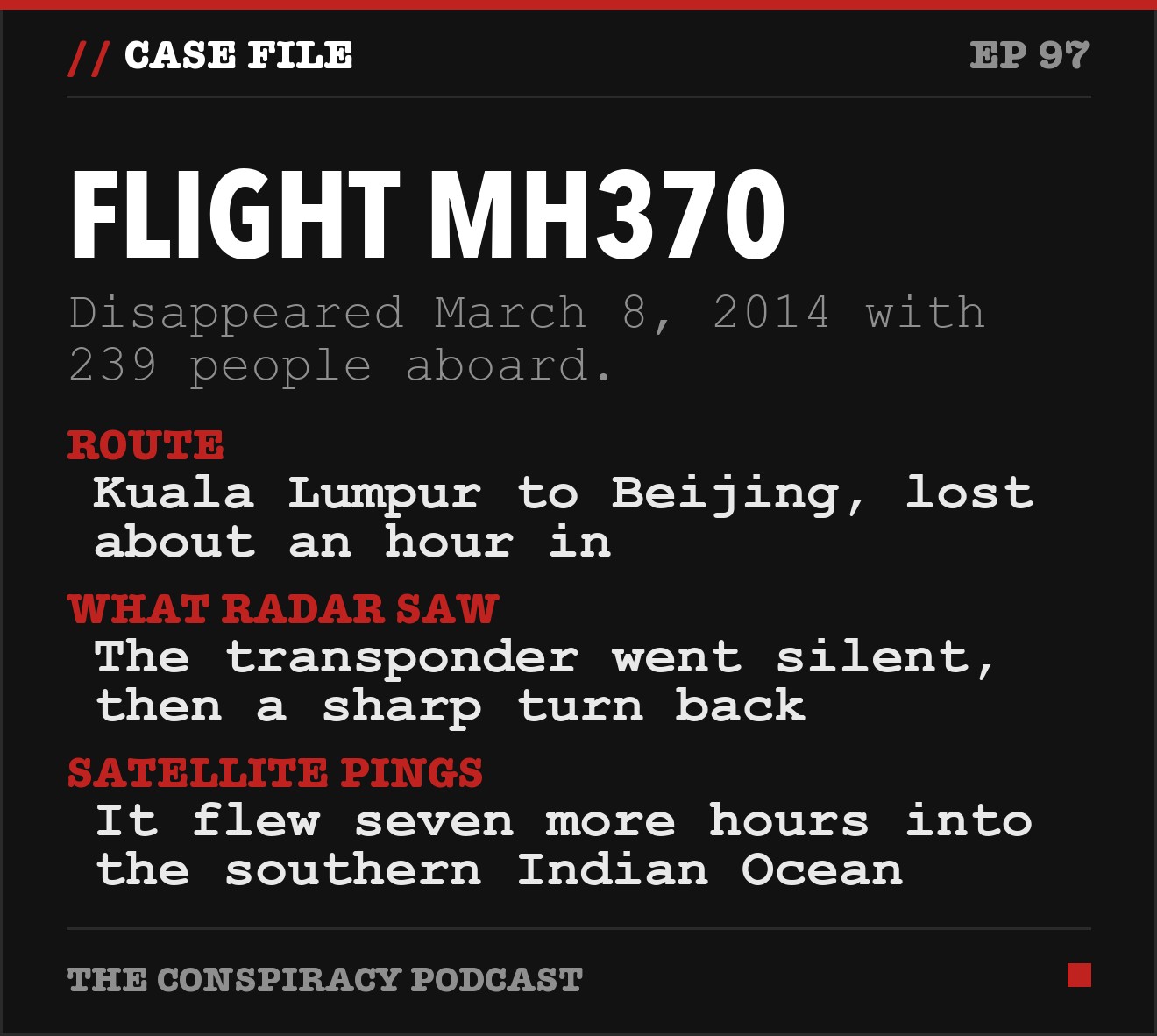
Malaysia Airlines Flight 370 disappeared on March 8, 2014, about an hour into a red eye from Kuala Lumpur to Beijing with 239 people aboard. Its transponder went silent, radar tracked a sharp turn back across Malaysia, and satellite pings show it flew for seven more hours into the remote southern Indian Ocean. The cause has never been confirmed.
By the Conspiracy Podcast team | Last updated: August 2026
More than a decade later, MH370 is still the least resolved disaster in modern aviation, and not knowing is hardest on the families who lost someone aboard. Searchers have covered an area larger than most countries without finding the plane. That gap is where every theory below lives.
What happened to Malaysia Airlines Flight 370?
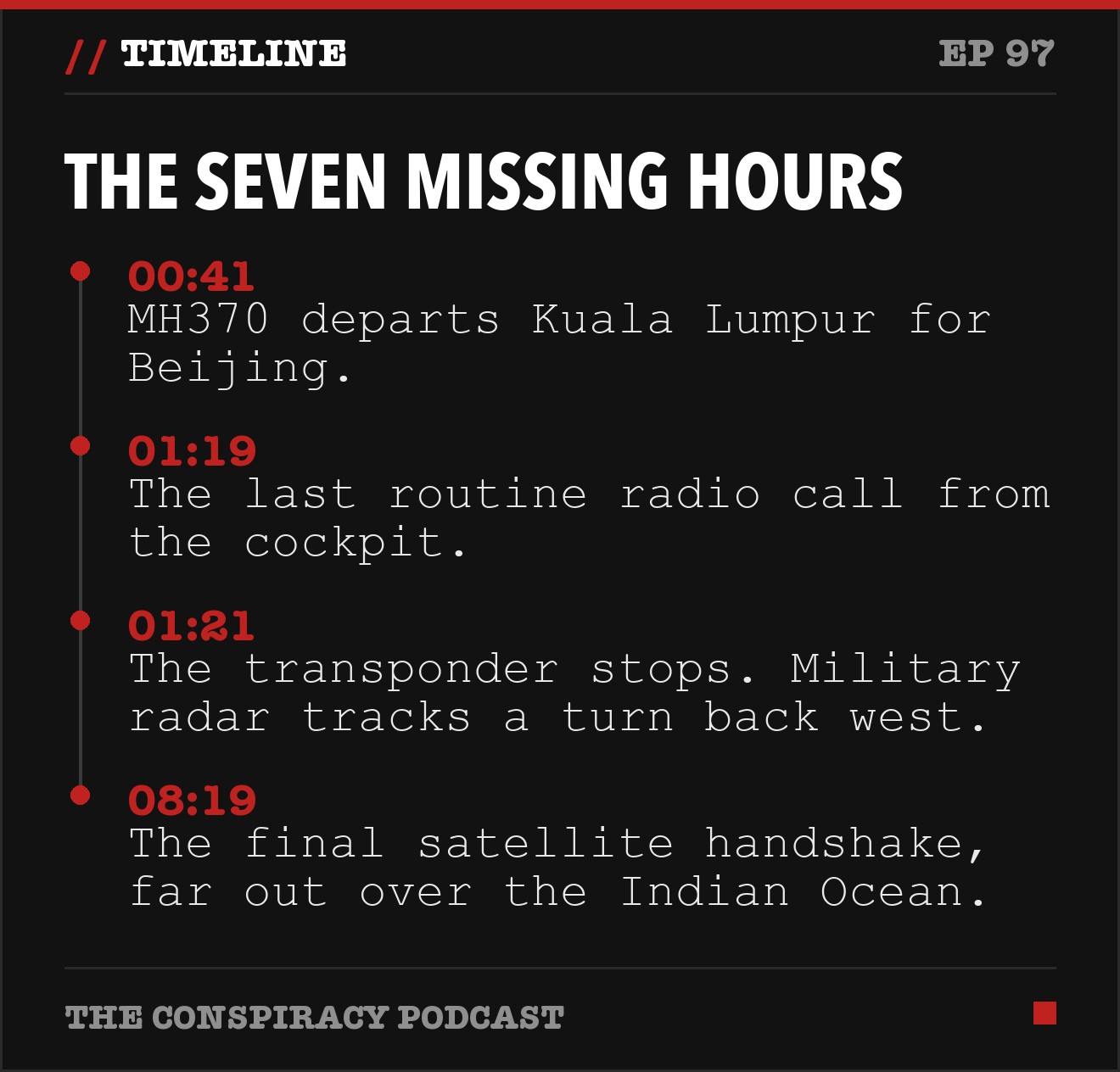
MH370 took off from Kuala Lumpur at 12:41 a.m. on March 8, 2014, on a scheduled overnight flight to Beijing. At 1:19 a.m., as it left Malaysian airspace, someone in the cockpit radioed “all right, good night.” Two minutes later the transponder stopped transmitting, and the plane vanished from civilian radar without ever reaching Vietnamese airspace.
Thai and Malaysian military radar picked up an unidentified aircraft turning back across the Malaysian Peninsula within minutes of the transponder going dark, tracking it toward the Strait of Malacca before contact was lost around 2:15 a.m. Malaysia Airlines did not confirm the plane was missing until 2:40 a.m., and did not announce it publicly until 7:24 a.m., on Facebook. Switching off a transponder sets off no alarm, so nobody was watching MH370 during the exact window it changed course.
The story would have ended there if not for Inmarsat, a British satellite company whose equipment automatically pings aircraft once an hour to confirm the link is live. MH370 kept answering for seven more hours after radar lost it, meaning it flew on until it ran out of fuel over the remote southern Indian Ocean. The guys walk that timeline minute by minute in part one of their MH370 breakdown. No wreckage from that final leg, and neither black box, has ever been recovered.
Has any wreckage from MH370 ever been found?
Yes. More than 30 pieces of debris, confirmed or considered highly likely to be from MH370, have washed up across the western Indian Ocean since 2015, most notably a wing flaperon on Reunion Island. The main wreckage, the fuselage, and both flight recorders have never been located.
The first confirmed piece was the flaperon, a wing control surface, found on the beach at Reunion Island in July 2015, more than a year after the crash and thousands of miles from where the plane is believed to have gone down. Investigators matched it to MH370 by serial number, and its condition matched more than a year adrift at sea. It is the clearest physical evidence that the plane went down in the southern Indian Ocean, which is why searchers have concentrated there ever since.
More pieces followed: wing components on the coast of South Africa, an engine cowling stamped with a Rolls-Royce logo, a stabilizer fragment, and cabin interior pieces, including a floor panel and a seatback fragment, in Madagascar. Some were confirmed by serial number, others are considered highly likely matches. Analysts read the scattered, fragmented debris as a sign the plane hit the water with extreme force, consistent with why the fuselage and both flight recorders have never surfaced.
Why did MH370 turn around?
Radar shows MH370 made a sharp turn back across the Malaysian Peninsula within minutes of its transponder going dark, right as it left Malaysian airspace for Vietnamese airspace. Malaysia’s official investigation concluded the turn was likely flown manually, but never determined who made that input, or why.
A sharp, deliberate turn is hard to explain as equipment malfunctioning on its own. A genuine mechanical fault, like a fire or system failure, would not easily explain why the plane then flew on a controlled path for roughly seven more hours rather than losing altitude quickly or attempting an emergency landing at a nearby airport. That combination, a precise turn plus hours of continued flight, is the main reason the leading theories center on someone at the controls making a deliberate choice.
One alternative avoids assigning intent to anyone. In 2005, Helios Airways Flight 522 lost cabin pressure, the crew and passengers passed out from hypoxia, and the plane flew on under autopilot until it ran out of fuel and crashed. The guys raise it as a real precedent, but it does not fit perfectly: Helios held a straight line to its destination, while MH370 turned first and held a long, deliberate looking path west and south, hard to reconcile with a crew already unconscious. That gap is exactly why the turn itself remains the central clue in this case.
Is anyone still searching for MH370?
Yes. Ocean Infinity, a marine robotics company, is searching a new zone of the southern Indian Ocean under a no find, no fee contract with Malaysia’s government, paid up to 70 million dollars only if it locates the wreckage. Its most recent search phase ended in January 2026 without a find, and the contract now runs through June 2027.
The hunt has stopped and restarted more than once. The original underwater search, led by Australian authorities, covered a huge stretch of seabed and closed in January 2017 without finding the plane. Ocean Infinity ran its own privately funded search in 2018, covering about 112,000 square kilometers with underwater drones, and also came up empty. The trail then went quiet for years. In December 2024, Malaysia’s government agreed in principle to bring Ocean Infinity back, and by March 2025 the cabinet signed off on the current arrangement, targeting a new 15,000 square kilometer site based on updated drift analysis.
No vessel is searching right now. Malaysia’s Cabinet extended the contract through June 2027 to cover the roughly 7,400 square kilometers still left in the zone, with vessels expected back once the weather window reopens, typically November to April. This search has changed status more than once since 2014, from a multinational effort, to a private no find no fee search, to years of silence, to this renewed push, so treat any single update as a snapshot, not a final word. For more cases where the paper trail runs out this fast, see our roundup of famous conspiracy theories.
What is the pilot suicide theory?
The pilot suicide theory holds that Captain Zaharie Ahmad Shah deliberately diverted MH370 and flew it until it ran out of fuel. Some investigators and analysts favor it because of circumstantial details from his home flight simulator. It was never established. Malaysia’s official 2018 report did not conclude he was responsible, and his family publicly rejects the theory.
The theory rests on circumstantial details, not direct evidence. Malaysian police recovered data from Captain Zaharie’s home flight simulator showing practice routes into the southern Indian Ocean, and a captain can lock the cockpit door against the first officer. The transponder also went dark right as the plane crossed into new airspace, a moment a diversion would be easy to disguise as routine. None of that proves intent. Malaysia’s 2018 Safety Investigation Report, led by chief investigator Kok Soo Chon, found no red flags in either pilot’s mental health or finances, and stated plainly the team could not determine why the aircraft deviated.
Captain Zaharie’s sister, Sakinab Shah, has spoken publicly and repeatedly against the theory, saying the family saw no signs of trouble or crisis before the flight, and that her brother has been treated as guilty without proof. The guys land on pilot involvement as the explanation they find most plausible in part two of the series, while stressing they remain far from certain. That tension, a theory some find persuasive against a family that firmly rejects it and a report that never closed the case, is the honest state of this question. Nobody has ever been charged, and nothing has ever been officially confirmed.
| Theory | What the record shows |
|---|---|
| Mechanical failure or fire. A malfunction forces an emergency diversion. | The plane flew on for seven more hours after the turn, with no distress call or landing attempt, arguing against a fast-moving emergency. |
| Cabin depressurization. A hypoxia event like 2005’s Helios Flight 522 knocks out the crew, and the plane flies on until fuel runs out. | Helios flew straight to its destination. MH370 turned first, hard to square with a crew already unconscious. |
| Pilot murder-suicide. Captain Zaharie deliberately diverted the plane, pointing to his home simulator and the locked cockpit door. | Malaysia’s 2018 report found no red flags and did not conclude he was responsible. Never established. His family rejects it. |
| Remote cyber hijacking. Hijackers seize the systems electronically, no one physically aboard. | No group ever claimed it. Key systems sit on isolated hardware, separate from any network a remote hijacker could reach. |
| Accidental military shootdown. A nation’s military mistakes MH370 for a threat, often pointing to Ukraine. | No military aircraft was ever confirmed near the plane, and engagement rules require a confirmed threat first. Treated as unlikely. |
| Kazakhstan hijack and MH17 swap. Writer Jeff Wise argues the plane flew to Kazakhstan, satellite data faked, later swapped in for MH17. | Unsupported. No physical evidence backs it, and independent review of the Inmarsat data has held up. |
Yeah, so it’s like looking in your backyard when you’re trying to search the whole state.
the guys, on the record