How Did Michael Jackson Die?
How Did Michael Jackson Die?
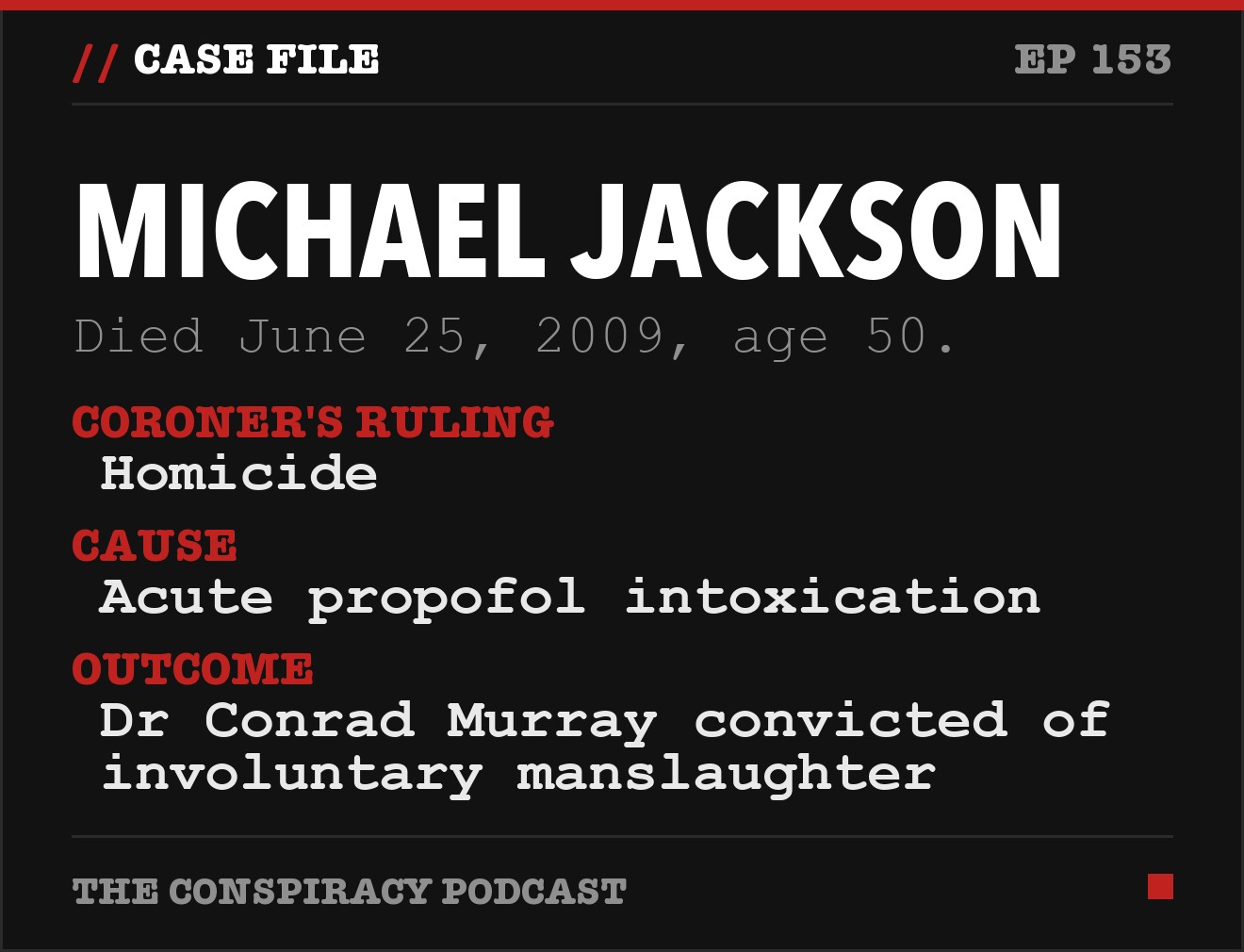
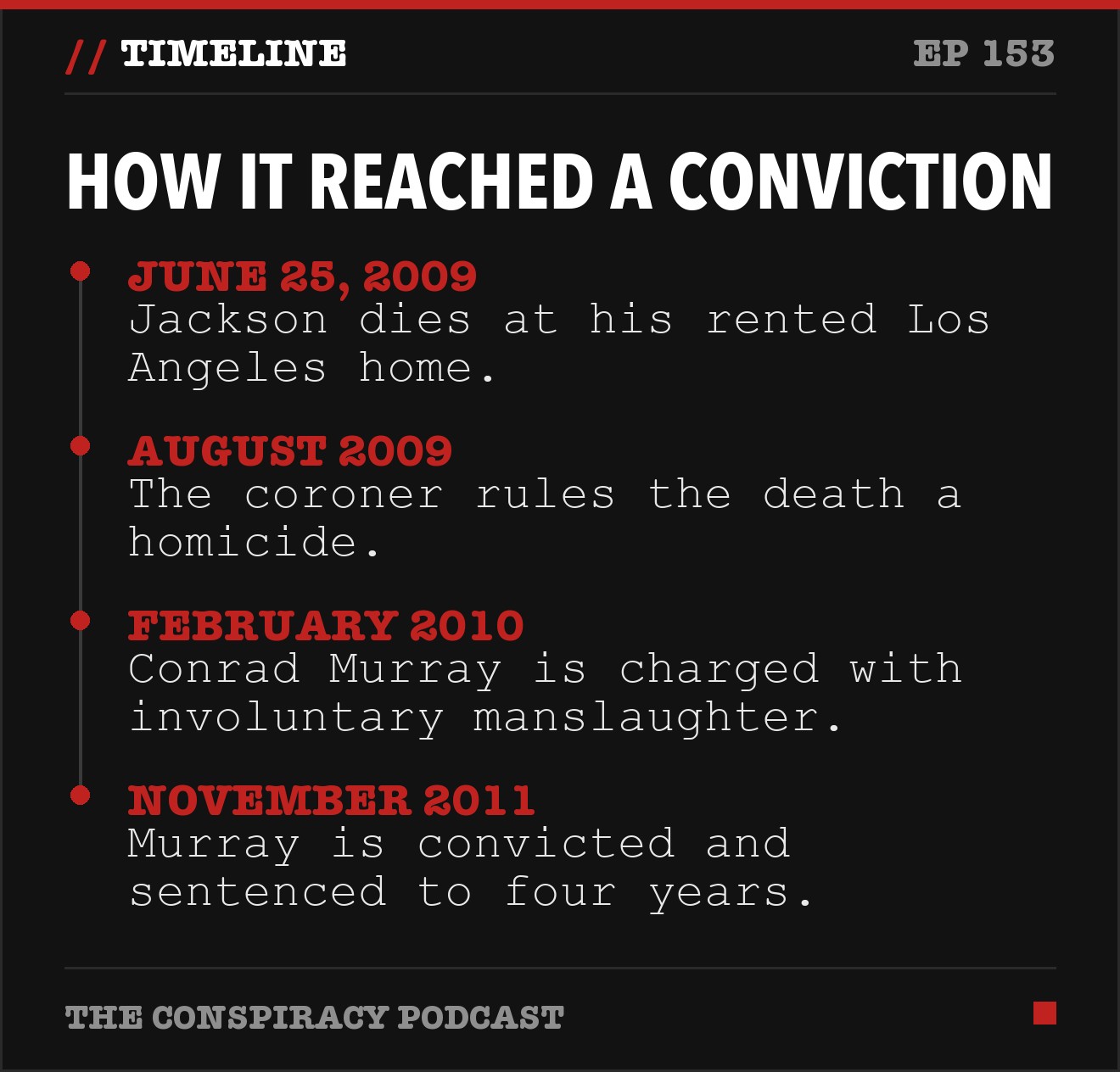
Michael Jackson died on June 25, 2009, at age 50. The coroner ruled the cause of death acute propofol intoxication, a homicide tied to the anesthetic his physician, Conrad Murray, had been giving him as a sleep aid. Murray was convicted of involuntary manslaughter in 2011.
By the Conspiracy Podcast team | Last updated: August 2026
A jury already answered the biggest legal question. Conrad Murray was convicted, and the cause of death is not seriously disputed. What still gets argued is everything around it. Here are the questions people actually search, answered.
What did Michael Jackson die from?
Michael Jackson died from acute propofol intoxication, according to the coroner’s official ruling. Propofol is a surgical anesthetic, and his physician, Conrad Murray, had been using it as a sleep aid for roughly a decade. The coroner classified the death as homicide, and Murray was convicted of involuntary manslaughter in 2011.
Propofol is not a sleep aid in any ordinary sense. Hospitals use it to put patients under for surgery. It is milky white in color, which is reportedly why Jackson called it his milk. It is meant to be given only by trained anesthesiologists watching monitoring equipment the whole time, because the gap between a sedating dose and a fatal one is thin. On the morning he died, Murray administered propofol through an IV drip diluted with lidocaine, after other sedatives had already failed. No monitoring equipment was in the room, and no second medical professional was present to help.
Murray was not treating a life-threatening illness. He was treating insomnia, using an operating room anesthetic that was never approved for that purpose. Jackson had reportedly used propofol as a sleep aid for about a decade, and by Murray’s own account, he asked for it by name that morning after three other sedatives failed. The ruling did not turn on whether Jackson wanted the drug. It turned on how it was given: outside a hospital, without monitoring, and unwatched once the injection took effect. The hosts walk through that entire morning in the full episode on Michael Jackson’s last night.
What did MJ do when he died?
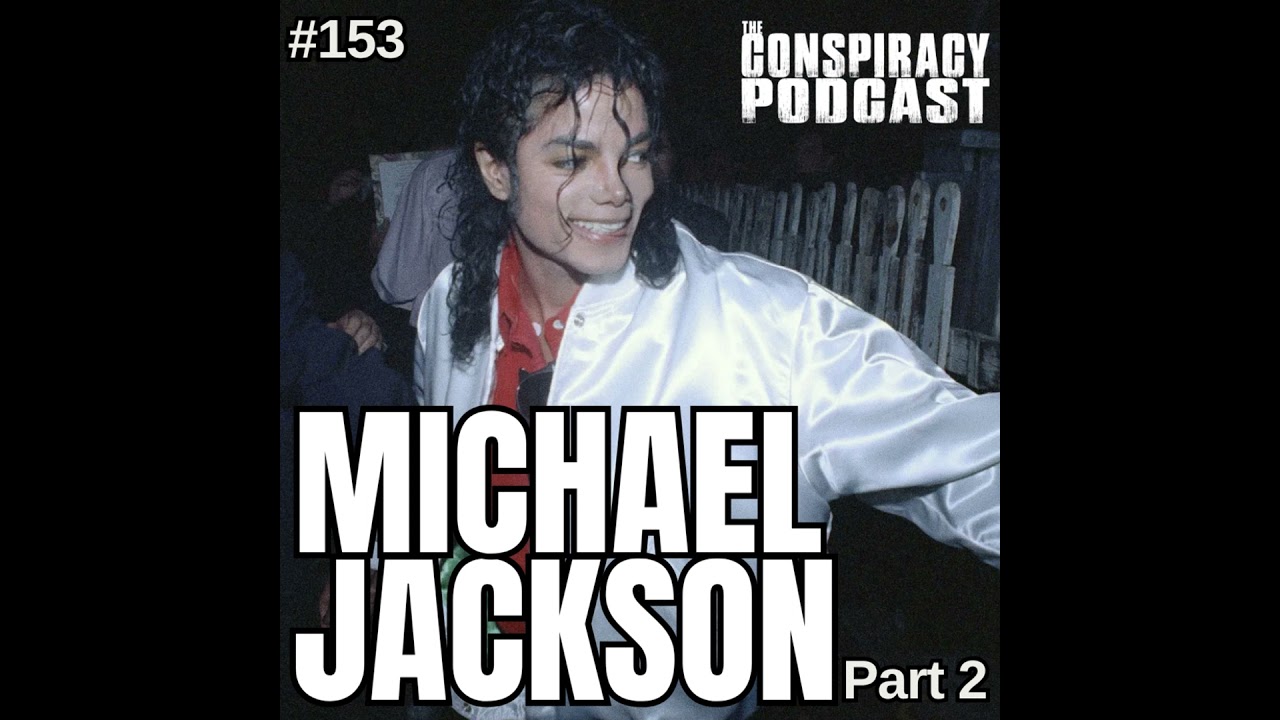
In his final hours, Jackson had just returned from a late night rehearsal for his comeback shows, This Is It, and was struggling with severe insomnia. His physician gave him a sequence of sedatives that failed, then the anesthetic propofol. Jackson went to sleep and stopped breathing.
Jackson spent the evening of June 24, 2009 rehearsing at the Staples Center for This Is It, the residency planned as his comeback. He came home in the early hours and could not sleep. Conrad Murray worked through a series of sedatives: diazepam, then lorazepam, then midazolam, roughly thirty minutes apart. None worked. Jackson had reportedly used propofol as a sleep aid for years, and by Murray’s account he asked for it by name that morning. Around 10 a.m., Murray injected propofol diluted with the anesthetic lidocaine through an IV drip. This time it worked, and Jackson finally went under.
Once Jackson was sedated, Murray left the bedside and spent time on the phone, calling his office and making personal calls, according to phone records later presented at trial. When he checked on Jackson again, he was not breathing. Murray said he attempted CPR on the bed rather than moving Jackson to the floor, using only one hand, and had a bodyguard collect medication vials from the room before paramedics arrived. Paramedics were not called until 12:21 p.m. They found Jackson in cardiac arrest, and he was pronounced dead that afternoon at Ronald Reagan UCLA Medical Center, at age 50.
Where did Michael Jackson pass away?
Michael Jackson collapsed at a rented mansion on Carolwood Drive in the Holmby Hills area of Los Angeles, where his physician had been treating his insomnia. He was rushed to Ronald Reagan UCLA Medical Center, where he was pronounced dead that afternoon, June 25, 2009, at age 50.
There are two locations tied to Michael Jackson’s death, and the difference matters. He stopped breathing inside the rented mansion where he was living at the time, on Carolwood Drive in the Holmby Hills section of Los Angeles. That is where his physician, Conrad Murray, had spent the morning giving him a series of sedatives followed by propofol, and where he was later found not breathing. It is the address most often attached to coverage of his death, since it is where the fatal dose was administered, where Murray attempted CPR, and where paramedics were ultimately called to the scene.
Paramedics took Jackson to Ronald Reagan UCLA Medical Center, the hospital nearest the house on Carolwood Drive, where doctors continued attempting to revive him after he arrived. He was pronounced dead there at 2:26 p.m. on June 25, 2009, at age 50. The 911 call from the house had gone out at 12:21 p.m., so roughly two hours passed between that call and the formal pronouncement, time spent on resuscitation efforts rather than any confusion about where he had collapsed. Strictly speaking, Jackson legally passed away inside a hospital, even though the event that killed him happened back at the house.
How long did Michael Jackson go without sleep?
Jackson had not gotten real restorative sleep for roughly 60 days by the time he died, per a Harvard sleep expert who testified in a 2013 civil trial. Conrad Murray had been giving him nightly propofol infusions, and propofol does not produce REM sleep, the stage the body needs most.
Jackson’s insomnia during This Is It rehearsals was severe enough that ordinary sedatives stopped working, which is part of why Murray turned to propofol. Propofol can make a patient look unconscious, but it does not produce REM sleep, the stage where the brain repairs itself most. Murray told investigators he had given Jackson propofol on 60 separate nights before his death, then tried weaning him off it on June 22, 2009, three days before he died. Because none of those nights included real REM sleep, Dr. Charles Czeisler, a Harvard sleep expert, later testified the effect was roughly two months of total sleep deprivation.
That scale of sleep deprivation is part of why this case was never treated as a simple prescribing error. Real sleep is not optional, and going without it for weeks does measurable damage to coordination, memory and mood, the kind of toll that made an anesthetic look like the only option left to a man who still had to rehearse daily. None of that changed the legal outcome, though. Whatever drove Jackson’s sleeplessness, the way the drug was ultimately administered, with no monitoring and no one watching once he was under, is what the coroner and the criminal court held Murray responsible for.
What happened to Conrad Murray?
Conrad Murray, Jackson’s personal physician, was convicted of involuntary manslaughter in 2011 for administering the propofol that killed Jackson. He was sentenced to four years, served two, and was released in 2013. He later relocated to Trinidad and Tobago, where he has continued to practice medicine.
Murray stood trial for involuntary manslaughter, not murder: prosecutors argued he was reckless and negligent rather than intentional. They pointed to an anesthetic never approved for home use, given without monitoring, then a doctor who left the room. His own phone records became central evidence. In the window after the injection, and before Jackson was found not breathing, he called his office, left a voicemail for a patient, and made a personal call. Paramedics also testified that when they arrived, Murray never mentioned giving Jackson propofol. The jury convicted him on the single count in 2011, and the judge sentenced him to four years.
That conviction is the closest thing to a final legal answer this case has. The coroner ruled the death a homicide, and a jury agreed a doctor’s actions, not a tragic accident, caused it. What still gets argued is everything upstream of that verdict: how a superstar came to depend on an anesthetic just to fall asleep, and whether anyone besides the doctor holding the syringe should have stepped in. For the fuller arc of who he was before that final morning, from Gary, Indiana to Neverland Ranch, the series starts with the first episode on Michael Jackson’s rise to fame.
Here is how the main explanations compare:
| Theory | What the record shows |
|---|---|
| Homicide by acute propofol intoxication. The coroner’s official ruling. | Murray was tried and convicted of involuntary manslaughter in 2011 and served two years. |
| An accidental death, not a crime. A fatal reaction while under a doctor’s care. | Rejected. Propofol was given with no monitoring, and Murray left Jackson unattended, so it was charged as a crime. |
| The tour promoter was responsible. A lawsuit claimed AEG negligently hired Murray and pushed an exhausted Jackson into the tour. | A jury ruled for AEG in October 2013. |
This is far from the only case where the official finding and the popular theory pull apart. Our roundup of famous conspiracy theories covers more of them.
Whatever, if you take an oath as a doctor, you violated an oath. Not to mention you gave him four other drugs already.
the guys, on the record