
What Happened at Dyatlov Pass?
What Happened at Dyatlov Pass?
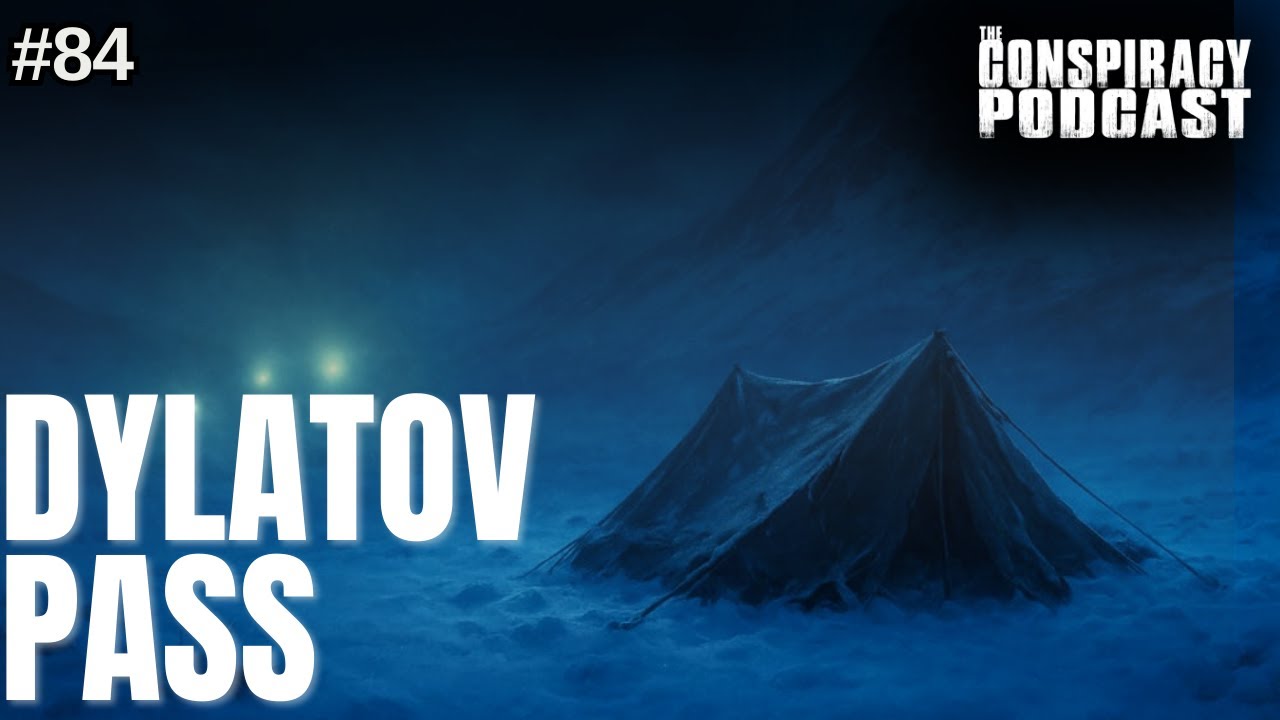
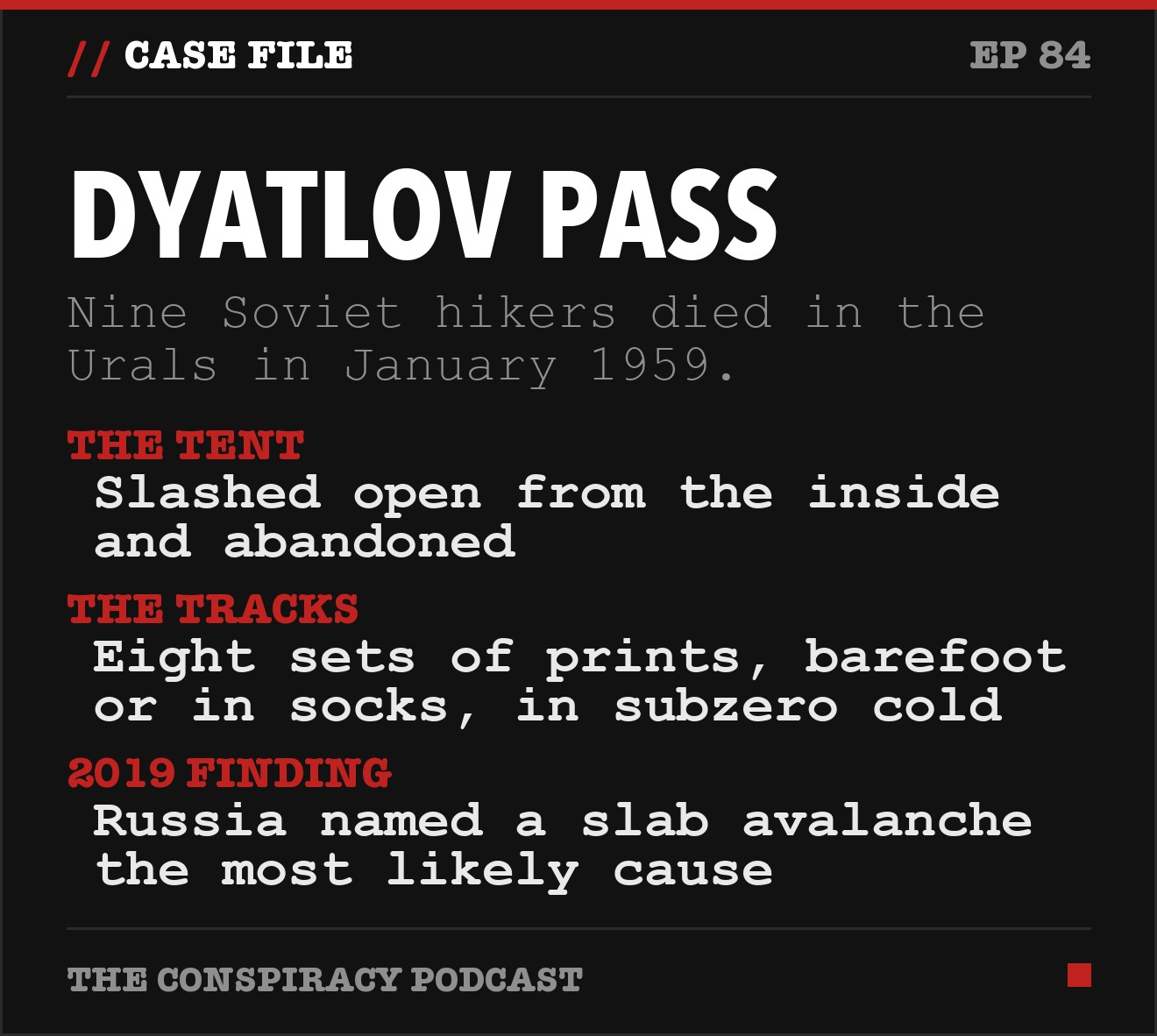
On January 23, 1959, nine experienced Soviet hikers led by Igor Dyatlov vanished into the Ural Mountains. Weeks later, searchers found their tent slashed open from inside and abandoned, with eight sets of barefoot or sock-footed prints leading away into subzero cold. All nine died. Investigators still debate the cause: Russia’s 2019 re-investigation named a slab avalanche most likely.
By the Conspiracy Podcast team | Last updated: August 2026
Nine trained hikers do not typically die on a routine ski trip, especially when the last four bodies recovered had fractured skulls, two missing eyes, and one, Lyudmila Dubinina, a missing tongue, alongside radiation later found on two bodies. Soviet investigators closed their file in 1959 blaming an unnamed force of nature, then sealed it for decades. That gap, real trauma next to an official shrug, is why the case still gets argued more than 60 years later.
Has the Dyatlov mystery been solved?
Not to universal agreement. Russian prosecutors reopened the case in 2019 and concluded a slab avalanche most likely forced the group from their tent. That finding does not fully explain the injuries on the four hikers recovered later, or the radiation found on two bodies, so researchers still push back on it.
The original 1959 investigation closed without identifying a crime, blamed an unspecified force of nature, and was sealed. The public did not see the investigators’ own photographs, journals, and reports until decades later, well after the Soviet Union had collapsed. In that gap, every theory from military testing to Yeti sightings found room to grow. The Dyatlov Pass episode walks through that case file, including the recovered cameras and journal entries showing the group in good spirits just days before they died.
Russia’s Prosecutor General’s office reopened the case in 2019, sixty years after it first closed, and settled on a slab avalanche, a small, delayed snow release rather than a dramatic large-scale slide, as the most probable trigger. That fits part of the physical record: a damaged tent and a rushed exit into the cold. It does not obviously explain why four hikers had severe blunt trauma with no matching signs of snow impact, why two were missing their eyes, or why radiation turned up on two bodies. A separate 2021 modeling study dug deeper into the mechanics, and even its own authors say it does not resolve every injury. The file is closed on paper. It is not closed in practice.
Who is the only survivor of the Dyatlov Pass incident?
Yuri Yudin is the answer. He was the tenth member of the original expedition and turned back just a few days in, after a sciatica flare-up made it impossible to keep skiing. The other nine hikers, seven men and two women, continued without him into the Urals and all died there weeks later.
Sciatica is nerve pain that radiates from the lower back down the leg, exactly the kind of injury that can turn a multi-day ski expedition into a liability. Yudin had been dealing with it before the trip, and it worsened once the group was moving, so within the first few days he made the call to stop rather than push through on a route with no easy way to get help. It was a practical call, not a dramatic one, and it happened to be the decision that separated him from the other nine.
His survival reads less like a twist than a coincidence that landed before the tragedy started. The expedition set out as a group of ten, eight men and two women, and if Yudin’s back had held up, he would almost certainly have been in that tent with the rest of them that night. Instead he is the only member of the original party who lived to see the investigation, the decades of Soviet silence, and the theories that followed.
What caused the radiation at the Dyatlov Pass?
It has never been fully explained. Investigators recorded high radiation readings on the clothing of two of the nine hikers, a detail the original Soviet file never resolved. Proposed explanations range from prior work exposure to Cold War weapons testing, but none is confirmed, keeping radiation one of the case’s most cited anomalies.
The detail is stranger than it sounds, because radiation contamination is rarely selective. If the source were environmental, something in the ground, the air, or fallout drifting through, it would likely have touched more than two of the nine. Instead only two showed elevated readings, which points away from a shared environmental cause and toward something specific to those two people, whether that was a radioactive workplace or something that happened to them in their final hours. Neither explanation has been confirmed.
One theory tied to this detail is that the hikers were caught up in secretive Soviet military testing, possibly involving explosive devices, since the Ural region did host weapons and defense programs at the time. That theory is still only a theory. No concrete evidence of military involvement has surfaced, and declassified records and witness testimony have not tied any test or unit to the case. It stays a serious explanation precisely because it cannot be ruled out, not because anyone has proven it.
What is the new evidence about the Dyatlov Pass incident?
The most significant new evidence is Russia’s 2019 re-investigation, pointing to a slab avalanche using modern forensic review. A separate 2021 study, published in Communications Earth and Environment by researchers Johan Gaume and Alexander Puzrin, used engineering models to show how a small, delayed snow slab could plausibly cause the blunt injuries found on four hikers.
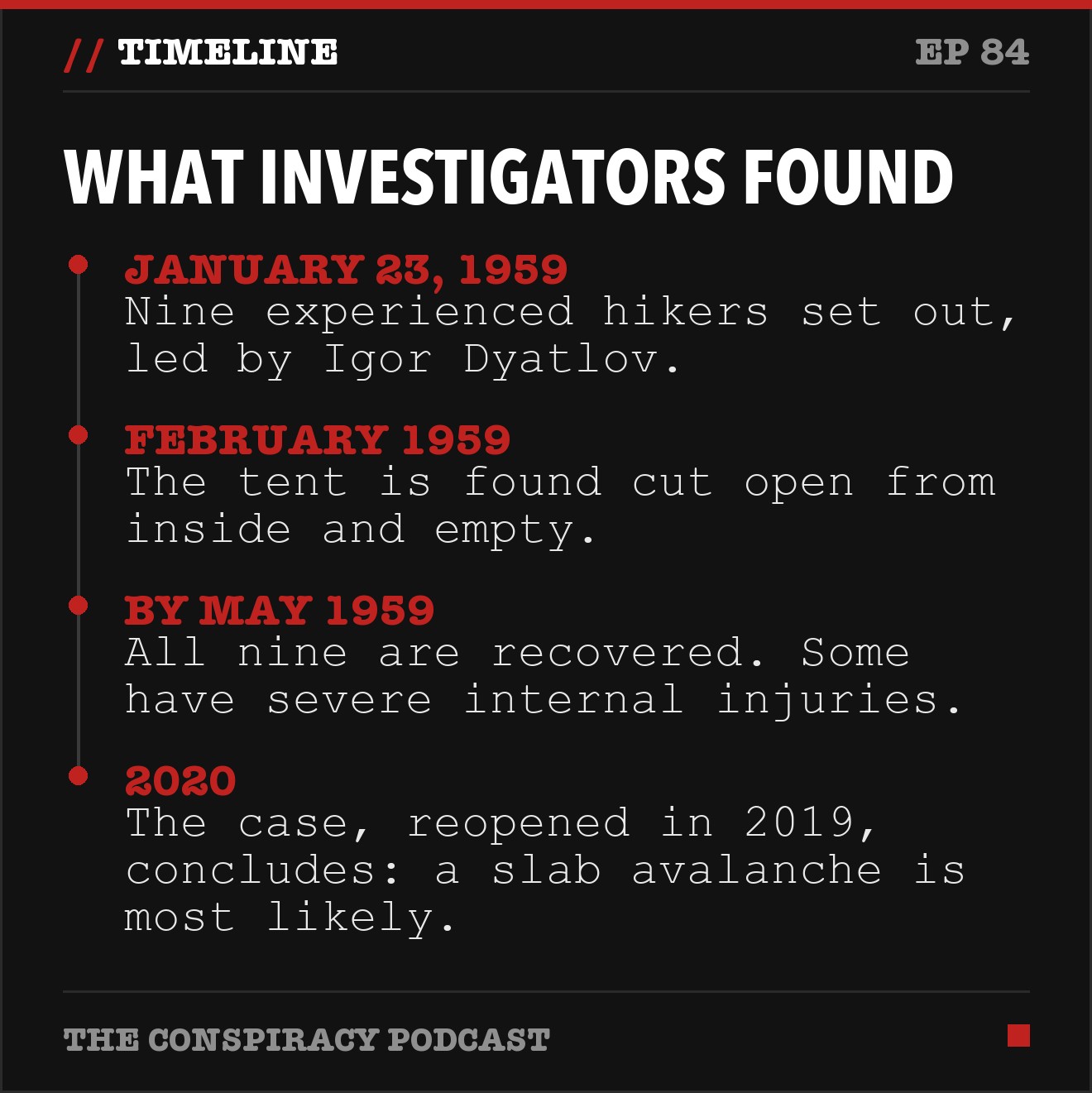
In 2019, Russian prosecutors reopened the file, sixty years after it first closed. Reviewing the physical evidence with modern methods, they concluded a slab avalanche, not a headline-scale event but a smaller, dense block of wind-packed snow, was the likely cause of the group’s rushed exit. That lines up with the tent damage and the barefoot footprints, and gave the case its first official update in six decades. It still left the harder questions, the missing eyes, the missing tongue, and the radiation, without an answer.
The 2021 paper went further on the mechanics. Gaume and Puzrin modeled the slope where the tent stood, roughly 22 degrees, and argued that cutting into the snow to pitch the tent, combined with wind-drifted snow building overnight, could trigger a delayed slab release hours after the hikers had gone to sleep. Borrowing injury thresholds from vehicle crash testing, they showed a compact slab could fracture ribs and skulls without breaking skin, matching what investigators found on four bodies. By the authors’ own account, the model addresses blunt trauma only, not the missing eyes or tongue, so even the most rigorous new study leaves part of the case where it was.
Why did the hikers cut their way out of the tent?
Because the tent was sealed against the cold, and cutting through the fabric was faster than fighting to the entrance in the dark. Investigators found the tent slashed open from inside, with shoes and warm clothing left behind, and eight sets of footprints, some bare, some in socks, leading away from it into temperatures around negative 10.
Nine people were in the tent, but only eight sets of footprints led away from it, suggesting one hiker may already have been hurt and was carried rather than walking out. None of the group’s boots went with them. The leading theory is a partial snow-slab collapse that crushed or pinned part of the tent, and with the exit blocked or at risk of collapsing further, slicing the canvas open was faster than digging out the door. Competing theories point to violent winds or a disorienting, panic-inducing sound instead of snow, but each shares the same shape: staying inside felt more dangerous than running into the cold half dressed.
| Theory | What the record shows |
|---|---|
| Slab avalanche. A delayed block of wind-packed snow crushed or partly collapsed the tent. | Backed by the 2019 Russian re-investigation and a 2021 study. Explains the blunt injuries, not the eyes or tongue. |
| Katabatic winds. Sudden downslope winds said to have driven the group out in a panic. | Fits the terrain, but nothing confirms it happened that night, and it does not explain the injuries. |
| Infrasound-induced panic. Low frequency wind sound theorized to cause disorientation and irrational fear. | A real phenomenon in general, but no data from the campsite confirms it happened here. |
| Military testing. The region hosted Soviet defense activity, linked by some to the injuries and the radiation. | No concrete evidence has surfaced. Declassified records and testimony show no confirmed link. |
| Yeti or UFO involvement. Based on a blurry recovered photo and local reports of lights in the sky. | The figure appears to be in ordinary winter clothing. No physical evidence supports either theory. |
None of the alternatives has physical evidence behind it the way the avalanche theory does, which is why the case still gets argued online and on shows like this one. Our full breakdown of the Dyatlov Pass incident goes through every theory in the order the hosts reasoned through it. For more cases built the same way, the site’s roundup of famous conspiracy theories is a good next stop.
I firmly believe there’s some sort of avalanche.
the guys, on the record