
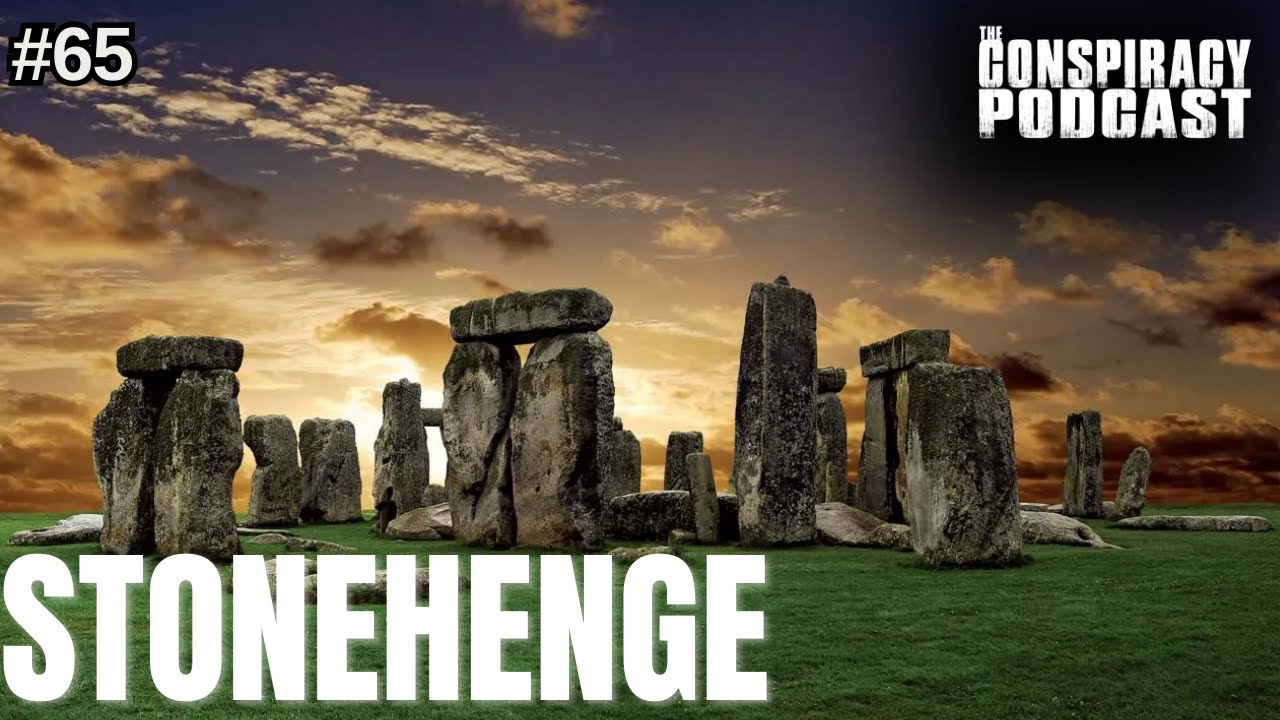
Stonehenge: Ancient Technology or Ancient Visitors – Episode #65


Stonehenge: Ancient Technology or Ancient Visitors?
On Salisbury Plain in Wiltshire sits a ring of 13-foot sarsen stones weighing 25 tons each, topped with lintels and surrounded by smaller bluestones hauled roughly 150 miles from the Preseli Hills in Wales. Built in phases from around 3100 BC to 1600 BC, it lines up with the sunrise on the summer solstice and the sunset on the winter solstice, and it doubled as one of Britain’s earliest cremation cemeteries.
The crew runs through the theories: druid temple, healing site, astronomical observatory, peace-and-unity meeting ground, and even a 3,000-year team-building exercise. Jorge starts the episode team-aliens and actually flips to team-human by the end, conceding that with enough logs, ropes, horses, and generations, ingenuity gets it done. The real conspiracy, they decide, is that the purpose got lost in time.
- The 25-ton sarsen stones and the mystery of how anyone lifted a 25-ton lintel onto two upright pillars of the exact same height
- The two-ton bluestones quarried in the Preseli Hills in Wales and dragged roughly 150 miles, plus the debunked theory that a glacier carried them
- Stonehenge built in phases from about 3100 BC to 1600 BC, raising the idea of a project no builder would live to see finished
- The cremation burials: thousands of bone fragments from dozens of people, making it one of Britain’s earliest cremation cemeteries
- Geoffrey of Monmouth’s tale that the wizard Merlin and thousands of men hauled the healing stones over from Ireland
Read the full transcript
So today we have Stonehenge. I’ve been waiting for this for so long. I’ve seen it from afar, because you actually you’ve been there, right? Well, you can’t actually go. This is a funny story. You can’t actually go to Stonehenge, you can’t go and touch the rocks. No way, really? No, you can’t. So it’s protected, and we’ll get into this. It’s actually a protected area for the English government, it’s a historical thing, and they don’t want people, you know, because you let any Tom, Dick or Harry go touch it, they’re going to etch their names like “Tim loves Tanisha.”
So we, when we went, pretty much our driver was like, “So yeah, we’re going to have to wait like an hour in line, and then you’re going to be able to take some pictures from afar.” I’m like, we can’t go touch it. He’s like, no. I’m like, well, let’s just take some long distance pics, and then we’re going to be good. 100x zoom it. Thankfully you got that Samsung 100x zoom. Does tourism bug you? It kind of upsets me. I really want to go to Machu Picchu, my uncle went, it’s in Peru, and I’ve heard it’s just so bombarded with tourism that it kind of ruins the experience.
No, but tourism equals income. They’re fine with it, because especially with a country that has low GDP, you need the money. It’s not like Peru is shitting gold bricks out, they need the cash. But it’s like one of those things. You got to hike up there for I don’t even know how long, you got to take one of those super suspect buses, it’s like super tiny, and the guy’s like, “Don’t worry,” and his tires are off the cliff. It’s one of those videos that’s like Instagram versus reality. Literally, that’s exactly what’s happening.
So first things first, and just as an aside, this episode, a lot of it is more or less a history lesson. We’re not going to bear with me. So what is Stonehenge? Obviously most people know, 99.9% of humans know, but as we do on the Conspiracy Podcast, we’re going to give you the list, we’re going to dive in. So Stonehenge is a prehistoric megalithic structure. A megalithic structure is a large stone that has been used to construct a prehistoric structure or monument, either alone or together with other stones. That’s what megalithic means.
Megalithic structure like the pyramids? Yeah, that qualifies. But if I went out and got a box of rocks and placed it in a circle, in 2,000 years that would be a megalithic structure? I guess we got to use the word mega, it’s got to be mega. No, it has to be a large stone, something that’s not like a pebble. So this is on Salisbury Plain in Wiltshire, England, which is two miles west of Amesbury. That’s where it’s located. So it consists of an outer ring of vertical sarsen. Sarsen is a type of sandstone block that’s found around Southern England.
And there’s sarsen standing stones, each of them are around 13 feet high, 7 feet wide, and weighing around 25 tons each. So they’re also topped with connecting horizontal lintel stones, and a lintel stone is like a beam that spans an opening, like a door. So for example, a window has a lintel, and the bottom is called a sill, so that’s what a lintel and a sill are. Learn some new shit here. Welcome to Conspiracy Podcast. So inside is a ring of smaller blue stones. Inside these are freestanding trilithons.
So a trilithon is, tri, which is three, so imagine if you’ve seen pictures of Stonehenge, it’s like two pillars and then a thing on the top. So that’s what’s called a trilithon. When you say inside, you’re talking about inside the circle? Inside the circle, yeah. So there’s freestanding trilithons, and they’re made up of two bulkier vertical sarsen stones, which we just talked about, and joined by a lintel. So it’s just three. They’re huge. So the whole monument, how many tons was it? Around 25 tons each. It’s big.
So the whole monument is aligned towards the sunrise on the summer solstice and then the sunset on the winter solstice. So it’s actually aligned towards astrological type shit. How is it aligned? So during the summer solstice, the way it’s, and we have pictures, so it’s actually, there’s an opening, so it’s almost like that’s the entrance or the exit, the sun will be placed. During the summer solstice the sunrise will come up through that area, and then during the winter solstice the sunset will set through that area.
So obviously aliens. No, the seasons. No, astrology, like celestial bodies. I feel like everyone was kind of in tune to that back in the day, like everyone was like, this means something, we don’t know what it is, but it’s the sun. And correct me if I’m wrong, but I think summer is around June, summer solstice. The winter is definitely December, that makes sense. So the stones are set within works in the middle of the densest complex of Neolithic, which means it’s between 4500 and 2500 BC, and Bronze Age, which is 2500 to 800 BC monuments in England.
So these also include several hundred tumuli. A tumuli is a mound of earth and stones raised over a grave or graves, it’s also known as a burial mound. So this area includes several hundred of these burial mounds. So the first known excavation of Stonehenge was undertaken in the 1620s by the Duke of Buckingham. Goddamn, 1620, that’s 400 years ago. America was like, the Indians were like, we run this shit, goddamn buffalo. So this was prompted by a visit by King James.
So the king commissioned this architect named Inigo Jones to conduct a survey and study the monument, and they were like, “Hey, check this shit out,” and he argued that Stonehenge was built by the Romans. So then later in time there was an antiquary named John Aubrey, and an antiquary is a person who collects, deals in, or studies antiques, ancient works of art, or ancient times. It’s a thing in Egypt, it’s a post in the government, they’re actually a government entity. We don’t really have that in the US, because there’s nothing that old.
So this guy John Aubrey surveyed Stonehenge in the late 17th century, and he was the first to record the ring of pits that were later named after him, called Aubrey holes. So his study of the stone circles in other parts of Britain led him to conclude that they were built by the native inhabitants rather than the Romans or the Danes, the people who took over that area later in time. The Druids were the only prehistoric British priests mentioned in classical text, so he was like, Stonehenge was made by the Druids, as opposed to the Romans or the Danish people.
So it’s been excavated numerous times since then, but those are the two main excavations. So closer to present day there’s a guy named Mike Parker Pearson, he was the leader of what’s called the Stonehenge Riverside Project that was based around Durrington Walls. So he noted that Stonehenge appeared to be associated with burial from its earliest parts of existence. So this is a quote from him: Stonehenge was a place of burial from its beginning to its zenith in the mid-third millennium BC, and it was still very much a domain of the dead.
So then in 2013, a team of archaeologists led by Mike Parker Pearson excavated more than 50,000 cremated bone fragments from 63 individuals buried at Stonehenge. How the fuck they know it was from 63 people? There’s not many people, trust me. Eric is on the case, Eric is far smarter than I give him credit for. I excavate bodies all the time, CSI is calling. So these remains were originally buried individually in the Aubrey holes, named after John Aubrey, and they were exhumed during a previous excavation conducted by a guy named William Hawley in 1920.
But at the time he was like, “Yeah, they’re not important,” so they just dumped it all in like one hole. They literally picked up these remains and were like, “Nah, fuck it,” so they dumped it all in one of the holes. They didn’t give a shit. So then physical and chemical analysis of the remains showed that the cremated were almost equally men and women, and they included some children. This is out of 63 people, equally men and women, and some were children.
And then there was evidence underlying, there’s chalk beneath these graves, being crushed by the weight of stone, 25 tons. They concluded that the first blue stones were brought from Wales and were probably used as gravestones, like grave markers. So then radiocarbon dating of the remains put the date of the site 500 years earlier than they previously thought, to around 3000 BC. So that’s over 5,000 years ago, long as shit. So then a 2018 study of the strontium content of the bones found that many of the individuals buried there around the time of construction had probably come from near the source of where the blue stones were in Wales.
So there’s a quarry in Wales where they were getting these blue stones from. So they figured out the makeup of the stone and matched it to where it came from, and they’re saying that most of these people probably came from around that area and not actually around Stonehenge. How far away is that area? We’re going to get into that. I’m pretty sure there’s a couple quarries where these sarsen stones and these blue stones came from. I believe the one in Wales is like 16 miles. But carrying a 25 ton stone 16 miles on hilly England, pretty far.
So one of the most famous landmarks in England is Stonehenge. So Stonehenge is regarded as a British cultural icon. Isn’t it considered a wonder of the world almost? Not quite like one of them, but it’s a thing. So, aliens come down, hear me out. The emissary alien comes, like from Dune, and he comes to Jorge and he says, “Jorge, what are the things that humans have done?” Put rocks together. So what do you tell that alien? Today comes? Tell me really quickly the history of humans, the great achievements.
You would say the pyramids? No, because it wasn’t humans. Now we’re talking skyscrapers, the Dubai tower, Chick-fil-A. You would say the pyramids, you would say the Eiffel Tower, the transatlantic railroads. Would you throw in Stonehenge? I would not, because it’s just a wonder of the world, it’s a bunch of rocks. I wouldn’t be telling aliens, “Check it out, some rocks.” They’d be like, “Cool, we’re dipping now.” I’m saying it is amazing from my point of view, but what, I tell an alien, look at what we did, cuz he’d go over there and be sweet, you guys made Legos.
What’s your list? I’d say the pyramids in Mexico, I’d say Machu Picchu, New York City, Hong Kong, basically every pyramid, the Egyptian pyramids. He’s like, “Have you seen a Bugatti, my man?” I would show him the entire American Navy, that’s kind of a feat. They literally traveled here from a different planet and you’re like, “Look at this ship that floats on water.” Our ancestors did the Great Wall of China, Stonehenge, pyramids, they’d be like, “All right, peace out.” They should just kill Eric, you never met us. Anyways, I digress.
So Stonehenge has been legally protected as what they call a scheduled monument. So the site and its surroundings were added to UNESCO’s list of World Heritage Sites in 1986. World Heritage, not a wonder of the world. So Stonehenge is wholly owned by the Crown and managed by English Heritage, and the surrounding land is owned by the National Trust. This is my problem, you can’t go fucking touch it. They have the audacity to say they own Stonehenge. It just drives me crazy, it’s like, we own the land.
If you’ve watched episode two of Shogun, it was like the Spanish king and the English king, and he’s like, “What the fuck did you say?” He’s super pissed. Even America, the concept of eminent domain, where it’s like, well technically we have the rights because we own it, because we said so, and you want this highway, don’t you? You know what I’d like to do is a couple episodes where there is a thing that when people say the word conspiracy, they kind of tie it to, it’s got to be weird shit and murder, but actually it’s more two or more people conspiring to commit an illegal act or crime.
So I want to do some episodes where it’s out of the norm of conspiracy where we’re able to talk about just people doing fucked up shit. Flint Michigan, the water supply with the fracking, and they were making so much money, didn’t give a shit, and we can light our water on fire because natural gas is in the water. Or how America basically made Chinese slave labor to build the railroads across the United States. The Chinese people were paid. Eric’s whole theory is that employees built the pyramids, paid. It’s a similar scenario, you built a railway across 3,000 miles in a straight line.
So we’re going to get into the creation of Stonehenge. So archaeologists believe that Stonehenge was constructed in several phases. It wasn’t just like a one time whammy, it wasn’t like the pyramids one time deal. So it was from around 3100 BC to around 1600 BC, with the circle of large sarsen stones placed between 2600 BC and 2400 BC. The large sarsen stone thing that we see today was over a 200-year period. Can you imagine trying to build something that you know will not be finished by the time you die? By the time your kids die.
So say you have this idea. I don’t think they knew, I don’t think they were like, “Oh, this is going to take us 200 years.” Their estimation of timeline effort was wrong. So say you’re the mastermind behind this, you don’t finish, you’re 80 years old, I’m your son and we’re on your deathbed, and you say, “Finish it.” You 100% think your son’s going to finish? The thing is, if you look at average lifespan back in the day, they probably live till like 30. They were like, “He’s balding, this motherfucker can’t hunt, just kill him.”
So the surrounding circular earth bank and ditch, here, you can see this is a computer rendering, you can see the actual ditch that they made. And if you guys aren’t seeing this, it’ll be on Patreon. It does look like the Starship Enterprise, it weirdly does. So that surrounding earth bank and ditch constitutes the earliest phase of the monument, that’s dated around 3100 BC. And so radiocarbon dating suggests that the blue stones were given their current positions between 2400 and 2200 BC, although they may have been there as early as 3000 BC.
So those holes, some of those are the Aubrey holes, and then other holes were actually used, they speculate, for wooden poles. So phase one, the first monument consisted of a circular bank and ditch, and that was made of late Cretaceous sea chalk, Cretaceous being a period of time. So it measures about 360 feet in diameter, across, with a large entrance to the northeast, and then a smaller one to the south. So it stood in an open grassland on a slightly sloping spot. This is phase one, the origination, before there’s any stones, they make the big ditch and then there’s openings.
So then the builders placed the bones of deer and oxen in the bottom of the ditch, as well as worked flint tools that they found there too. So this is so confusing already. Like what the fuck they were doing, someone gave them plans, they’re like just build this random ass shit. The first 10 minutes in, I was like, I got it, it makes sense, and now all of this I’m like, I don’t understand. What the fuck were they doing with the animal remains? I don’t know. The 63 people died? I don’t know.
So the ditch was continuous, it had been dug in sections, and this was like ditches of earlier causewayed enclosures of the era. So maybe they took pisses in it, or runoff water, it’s England so it’s raining all the time, so maybe it’s so they’re not sleeping in pools of water. So the chalk that was dug up from this they used to form a bank, so it didn’t pool. So they really thought this out for hundreds of years. So the first stage, 3100 BC, when they built this, just the outer ring. So they began with this, they were like, first things first, let’s make it so we don’t fucking drown.
So maybe my great grandpa Jorge Rodriguez built the original, it’d be like great great great great great. And then later on, oh, I got to follow in Jorge’s footsteps, and I built this 100 years later. It’s so fucking hard to pass a story on. How the hell do they pass on this concept and the blueprint for hundreds of years? Maybe it wasn’t supposed to be like that. Maybe it started as something else, and then a couple hundred years later the great great great grandchildren were like, oh, I got a better idea.
But have you been to Chicago? So if you walk downtown, you can see buildings that are built in the 20s and then buildings that were built last year. That’s 100 years. Look at the technology, what are you talking about, it’s 100 years. I live in a house that’s almost 100 years old, it’s in the 50s. Seventy years, bro. Point made, okay. So on the outer edge, you’ll see these little white dots on this thing, the outer edge is enclosed of a circle of 56 pits, each about three and a half feet in diameter, and these are the Aubrey holes, where they put the cremated remains.
So these pits and the bank and the ditch together are known as the Palisade or the gate ditch. So this is an ode to something higher than you. It’s a graveyard, or a sacrifice or offering. So these pits may have contained timbers creating a timber circle, although there’s no excavated evidence of that, because wood is biodegradable. So maybe they had big wood pillars, maybe they make like a tent, they’re like tailgating but for a long time. Maybe this is like the original Coliseum, battle to the death, they do two parties a year, summer solstice, winter, and it’s the biggest rager, take acid and shrooms.
It’s like Burning Man, but they’re all fucked up like, “We need rocks, we need huge rocks, massive rocks.” I feel like we fully solved this. Burning Man 3000 BC, old school Woodstock. So there is a recent excavation that suggested that these Aubrey holes may have been originally used to erect the bluestone circle, which comes underneath. So maybe like the wood beams that they had in there, they use some sort of pulley system. How do they get these 25 tons there? We’ll get into that. We’re not even talking about getting them 16 miles away, we’re talking about how do you lift them.
According to you, that pulley system is what it was used for, for the pyramids. Eric believes we use water to raise a five ton brick all the way to the top. They took a bunch of sandwich baggies filled with air and they’re like, “It’ll float.” Water’s just one of the biggest forces on Earth. You realize rocks aren’t buoyant. So phase two of construction occurred approximately 2900 to 2600 BC, and the number of postholes suggests that some form of timber structure was built within the enclosure during this period.
So further, the standing timbers were placed at the northeast entrance, and a parallel line of posts ran inwards from the southern entrance. So the postholes are smaller than the Aubrey holes, being only around 16 inches in diameter, and much less regularly spaced. So then at least 25 of the Aubrey holes are known to have contained later intrusive cremation burials dating to the two centuries after the monument’s inception. So literally, I think after the fact, that’s when they started putting bodies in. They originally were used for actual posts, and then after the fact 2,000 years later they’re like, “Burn the bodies.”
So it seems that whatever the hole’s initial function, it changed to become more of a funerary purpose. So then 30 further cremations were placed in the enclosure ditch and at other points within the monument, mostly in the eastern half. Because of this, Stonehenge is interpreted as functioning as an enclosed cremation cemetery, and it’s the earliest known cremation cemetery of the British Isles. And maybe they had funeral pyres in the middle and they would light shit up, because there’s a lot of fragments of unburnt bone found in these ditch fills.
So then we get into phase three. Based on archaeological excavation, around 2600 BC, the builders abandoned the timber in favor of stone, and they dug two concentric arrays of holes which they call the Q and R holes in the center of the site. And these holes held up to 80 standing stones. So I have a different picture here, this is technically colored. You printed in black and white trying to save some money. Bro, do you know how expensive colored ink is? It’s insanity.
So it’s generally accepted that the blue stones were transported by the builders from the Preseli Hills, which is 150 miles away, in modern day Pembrokeshire in Wales. I said 16, I was wrong, 150 miles. So how many stones, the big ones? We’re talking about 80 standing stones, they’re 25 tons each, 150 miles. So those big ones standing up are also 25 tons. In the range 15 to 25, they’re massive. The little guys are probably 15. So how the fuck do you transport that? There’s got to be a river nearby, is there? I don’t know, I didn’t go that far.
So another theory is that they were brought much nearer to the site as glacial stones by the Irish Sea Glacier, although there’s no evidence of glacier deposits within southern central England. That’s a theory, that maybe a giant glacier was there and after it melted the stones were just there. I don’t buy that. So a 2019 publication announced that evidence of a megalithic quarrying had been found at quarries in Wales identified as a source of Stonehenge’s blue stones, indicating that the bluestone was quarried by human agency and not transported by glacier. A quarry is like a mine for stone.
So the long distance human transport theory was bolstered in 2011 by the discovery of a megalithic bluestone quarry at Craig Rhos-y-felin, which is the most likely place where some of the stones were obtained. So the stones, which weighed about two tons, these are smaller stones, it’s like a truck. So some of the stones could have been moved by lifting and carrying them on rows of poles and rectangular frameworks of poles, as recorded in China, Japan, and India previously. I’m so glad we’re doing this episode, because it’s a transition into the pyramids, because it’s a smaller feat of humanity.
We’re talking about 80 stones, maybe 150 stones, there’s 2 million stones on the Great Pyramid. And they built it in 20 years. This shit was built over 3,000 years. It took them three fucking thousand years to build this shit. So it is not known whether the stones were taken directly from the quarries to Salisbury Plain, or were the result of removal of a venerated stone circle in Preseli. Maybe they stole the stones from a different place and merged the two into one. One of the theories is maybe they did that in terms of trying to unite two politically separate regions, like, “We’ll take some of your stones, add them with our stones, we’re all the same stone.”
So there was evidence of a 110-meter stone circle at Waun Mawn near Preseli, which could have contained some of the stones from Stonehenge, but they don’t really know. So during phase three, 30 enormous sarsen stones were brought to the site. These are the stones that we know of now. They came from a quarry that was 16 miles north of Stonehenge. I swear to God, I was like, I swear to God 16 miles. The two ton ones were from 150. So the stones were dressed and fashioned with mortise and tenon joints.
A mortise and tenon joint connects two pieces of wood or other material. Here’s the tongue and groove and the mortise and tenon joints. How they built this in rock is beyond me. It’s advanced stone masonry. So they were fashioned with these joints before the 30 sarsen stones were erected as a 108-foot diameter circle of standing stones, with a ring of 30 lintel stones resting on top. So the lintels were fitted to one another using tongue and groove joints, another woodworking method. And then each standing stone was around 13 feet high and just under 7 feet wide, each weighing around 25 tons.
So these are big boys. I don’t know how they move these, because that’s 30 stones at 25 tons. That’s almost 700 tons of rock that a bunch of bros with ropes are moving. So kind of ending remarks on construction. Stonehenge was produced by a culture that had no written records. It’s not like they had books and were like, “Hey, here’s how we did it, boys, here’s why we did it, here’s where the stones came from.” There were no records at all. So many aspects of Stonehenge, such as how it was built, why it was built, no one knows. And this is the whole purpose of what the fuck, why is this here.
So there are a number of myths. The site specifically, the trilithons, the encompassing horseshoe arrangement of the five central trilithons, the heel stone, the embanked avenue, the alignment to the sunset of the winter solstice, the opposing sunrise of the summer solstice. This is where the speculation comes into play. So there’s no direct evidence revealing the techniques they used to construct it. There’ve been various authors who’ve suggested either supernatural or anachronistic methods. Anachronistic means methods used by previous periods of time, in essence lost technology, asserting that the stones would be impossible to move otherwise.
How do you get the 25 ton on top? That’s crazy. I can get behind standing them up, but how do you get the 25 ton guy on top of the other 25 ton guys, and how are the two 25 ton guys the same height? I think we don’t realize how much lost technology they had. We’re not talking about aliens, just the ability to do something, whether or not they came from aliens, who knows, but the technology just seems to be gone. There is technology in terms of moving them, which I can get behind, but setting them up like this I have a really hard time believing.
The most common theory is prehistoric people moved them using log tracks, the large stones were rolled along, and there’s another theory of a ramp. There’s another theory that there was a sleigh that was running on a track that was greased with animal fat. Not buying it. But there was an experiment where a sleigh carrying a 40 ton slab of stone was successfully conducted near Stonehenge in 1995. It took a team of more than 100 workers and they managed to push and pull a slab along the 18-mile journey from Marlborough Downs.
So there’s other things, I categorize this as potential functions as well as potential theories. So proposed functions of the site include astronomical observatory, sure, maybe it’s like you got a good view, go look at the stars, make out point. Other things, potential religious site, some sort of religious following. That kind of makes sense when you think about how it’s aligned to the solstice. There’s a homie named Gerald Hawkins, in the 1960s he described in detail how the site was apparently set to observe the sun and the moon over a recurring 56-year cycle.
So maybe it’s a long game they’re playing. A 56-year cycle, so one person will never see the cycle, it’s always another person. More recently there’s two major new theories. There’s a guy named Geoffrey Wainwright, he was the president of the Society of Antiquaries of London, and a guy named Timothy Darvill of Bournemouth University. They suggested that Stonehenge was a place of healing. So they argue that this would account for the high number of burials, people brought there from different regions to be healed and subsequently die. And there was evidence of trauma and deformity in some of the graves.
So the reason they’re saying this, it’s either that or some sort of worship center, because they did isotope analysis on the buried remains and they were shown to be from other regions over different periods of time. There was a teenage boy from approximately 1550 BC that they determined was raised near the Mediterranean Sea, there was a metal worker from 2300 BC. All things point to it’s a worship spot or a healing thing. Why would you bring shit from all over the place? This guy was from the Alpine foothills near Germany, another one was from Wales or Brittany or France.
So aren’t there, in a lot of religions, you make a pilgrimage? So what if for thousands of years this is one of those spots you go to. For once, Eric makes a good point. On the other hand, Mike Parker Pearson suggested that Stonehenge was part of a ritual landscape, whether that be where you bury your dead, and it’s actually the journey to Stonehenge that’s a rite of ritual passage from life to death, to celebrate past ancestors and the recently deceased. So you make a pilgrimage there and this is where you bring your dead homies.
Your grandma passes and you bring her along, pour a little liquor out, that’s my dead homie, little one on the stones. They also theorize it could have been built as a symbol of peace and unity, conflicting tribes and conflicting peoples, like, “We can all get along here, we can drink the ayahuasca tea and look to the stars and be chilling.” Have you talked to anybody who’s been there? I’ve been talking to him for the last hour. But like, walked up to it? I don’t think anyone’s walked up to it recently. What I’m wondering is if it’s awe-inspiring.
You know what was more incredible to me, honestly, it’s the Giant’s Causeway in Ireland, it looks fake. How are these stones real, and they’re all in hexagon shapes, I’m like how is this possible. The Giant’s Causeway is in Northern Ireland, it’s beautiful, amazing. There are these stones, but they’re a part of the earth, they look like they’ve been shaved and sanded down to be perfect stones, and they’re all in the weird hexagon shape. And if the weather’s right you can see Scotland. And they call it the Giant’s Causeway because they said giants were throwing rocks.
Definitely not natural. But it is natural, it’s a weird part of mother nature. That looks natural to you? I was there, I’ve touched those stones with my hands. It’s mind-blowing. That’s why I say, to me that was more awe-inspiring. When I went to Giant’s Causeway I was just like, holy shit mother nature, we walked miles. That’s not erosion, perfect perfect perfect erosion. No, that’s 100% literally what it is, water erosion. Anyways, we’ll do an episode on that.
So tying in with the healing concept. In Stonehenge there’s the blue stones and the large sarsen stones. The blue stones appear to have originated from the Preseli Hills, which is 140 to 160 miles away. They analyzed these stones, and these blue stones possess unusual acoustic properties, so when you strike them they have a loud clanging noise. These rocks with acoustic properties come from this area, and they’re called ringing stones, they call them Welsh ringing stones, and they actually would use some of these stones as bells.
These acoustic properties could explain why they were used, and in certain ancient cultures they would believe that such stones would have mystic or healing powers because they made sounds. So that’s what I hypothesize, maybe they actually believed that, because these stones made sounds, maybe they had some sort of healing or spiritual effect to them. So then my personal favorite. In the 12th century, the Historia Regum Britanniae, which is the History of the Kings of Britain by a guy named Geoffrey of Monmouth, includes a fanciful tale of how Stonehenge was brought from Ireland with the help of the wizard Merlin.
So according to the tale, the stones of Stonehenge were healing stones which giants had brought from Africa to Ireland. They had been raised on Mount Killaraus to form a stone circle known as the Giants’ Ring or the Giants’ Round. So the fifth century King Aurelius Ambrosius wished to build a great memorial to the British Celtic nobles slain by the Saxons at Salisbury, so Merlin advised him to use the Giants’ Ring. So the king sent Merlin and Uther Pendragon, who is King Arthur’s father, with 15,000 men to bring it from Ireland.
They defeated an Irish army led by Gillomanius, but they were unable to move the huge stones. With Merlin’s help they transported the stones to Britain and re-erected them as they had stood. Although the tale is fiction, archaeologist Mike Parker Pearson, who’s everywhere, suggests it may hold a grain of truth, as evidence suggests that Stonehenge’s blue stones were brought from Waun Mawn stone circle on the Irish Sea coast of Wales. So I do like the Merlin scenario. Although we don’t even know if Merlin existed, so that itself is a problem.
I have a picture, this is the oldest known depiction of Stonehenge, from the second quarter of the 14th century. So it’s a giant helping Merlin build Stonehenge. I’m assuming this guy’s Merlin because of the beard, and this guy looks like his servant. He’s like, “Put this little stone on top there, brother.” I don’t know why the stone on top’s like twice the size of the ones on the bottom. People think aliens helped with Stonehenge, I just think it’s a terrible use of alien time. Let’s make trilithons.
And then there’s another interesting one. Besides Merlin, there’s one that it was a concert hall, I guess it has great acoustics, so people thought maybe they built it as a little concert, kind of like the Coliseum. There’s a spot in Tampa, there’s a park, and it has a miniature scale of the Coliseum. It’s the same layout, and if you stand in a certain spot the people at the back can hear you. You’re supposed to talk normally, like, “Hey Jorge, how are you,” and then the person at the 40th seat can hear you. That’s cool, and it’s in Tampa.
And the best, and probably my pick for actual thing, was that it was a team building exercise. I saw that, I was like, for 3,000 years? Build teams for generations, keep them busy, busy work. So crazy. So couple things. Something that blew my mind when I was looking into this, the pyramids were built around the same time. Wow. So the pyramids were built in 2800 BC, and this was built in 3100 to 1500. So it’s around the same time. But all they could do was build a couple little stone TPs, and the Egyptians built a fucking pyramid.
Let me bring you back to early Earth, and realize that means there’s a possibility that there were dudes building this structure at the same time as in Egypt they were building this similar mind-blowing structure. How long did those pyramids take? Twenty to 50 years, not 300 to 500. This is a different example, because it seems like the outer ring was built first, the ditch, then there was an outer ring of smaller stones, then another inner ring, and then the very most inner ring is what exists today. And so each one was built at different time periods with different people.
So maybe your ancestors came here to party every summer solstice, and then you’re like, “Well, we should build something, get the sticks, put the sticks in the hole,” and then it just kept going. I probably think it’s like a giant orgy tent, they built a big orgy and the stone slabs were like, “I got the top bunk, let it rip.” All right, so that is Stonehenge. It’s more of a history lesson honestly. I think the conspiracy really behind it is what’s its purpose, and maybe the true purpose was probably lost in time.
I think someone probably had an idea, like, we’re going to do this as some sort of religious, astrological thing, we don’t like using the word occultist but it would factor. Obviously there was a design here, they built it in a certain way on purpose, it wasn’t on accident that they had this facing a certain direction. I don’t feel like it would be out of this world type shit like the pyramids. The pyramids, 100% aliens. This is not aliens. You know what, before we started this I thought aliens on Stonehenge, but it changed my mind.
I hate to admit that, for Eric, and the reason I hate to admit it is because I feel it’s a stepping stone to the pyramid episode. Eric has spent years, like erosion, eroding at Jorge and Sean’s principles. I feel that this was 100% all man-made human. And how did they get a 25 ton stone up there? Doesn’t make sense. But the pyramids, they got 25 ton stones 100 feet in the air. But if you can figure out how to get it up 10 feet, you can figure out exponentially. It’s exponentially different.
I don’t know how they built the skyscrapers in Dubai. It’s called technology. I can’t tell you exactly how. Oh Eric, then that means we know nothing. Eric, how do they make that glass bottle? No idea, we don’t know that. It’s a great thing, I don’t know how my fucking phone works. There’s chips in the cell phone, don’t know. I’m getting super behind this lost technology thing, because it’s so easy to believe. Imagine there was a giant solar event from the sun and we lost all technology for 100 years. We’d be back to the Stone Age.
Who’s going to build the computer? We’d be fucked, and it would be lost, and then we’d restart and we’d be like, “Let’s build rock to the sun.” Although I figured out how to build a wheel, I can lever something, I can pick up something way heavier than I can pick up. Imagine there was a cataclysmic event that wiped out not everybody but 90 to 95%. Restart, and then generations go by, and no one knows what happened. The great example is the phone. Let’s say all the, we survived, none of us know how to build the phone, not even a clue.
So then go five to six generations ahead of that, and we didn’t know, and so we lost it. I don’t even know how to make bread. The only thing I can make is a fire. Imagine we just lost the power, all of the United States, or even the whole world, electricity, no power, no internet, no phones, no computers, no refrigeration. After one generation you’ve lost 50% of the people who knew how to even make it happen in the first place, and it’s not like you can go online and Google how the fuck do I set up.
So we bring it back to this, and we don’t know how they transported this stuff, we don’t know what it was for. This is my theory on it: they lived and died by the seasons, they lived and died by farming, they lived and died by whether or not it was going to be a rough winter or a fruitful summer. So I would celebrate the summer solstice 100%. In the winter it’s going to suck, you’re like, fuck, wash away worries. Why not do that at home, why would you transport 25 tons? You got to be with your homies, you got to think it’s a celebratory thing.
Imagine it’s like this, we live where we live currently, you know it would take me a six-hour horse ride to get to your house, I’m not going to be going over the chill. So summer solstice is coming, plan the party, meet me at the rocks. And every twice a year we gallop on up and we let it loose for a week. Why wouldn’t they just build a barn, why does it have to be 25 tons? That’s a good point. Let’s say us three celebrated at the rocks for 20 years, 20 years I die, bury his ass there, burn his corpse and bury his ass at the rocks.
And then it became a memorial, a spiritual spot. Maybe homie was right with this. No, because they started the barrows before the stones were even there. So maybe it lends credence to the peace and unity thing, like you got homies from different tribes, and they’re like, “You know what, this is neutral ground, can’t be killing shit on this ground, you have the talking stick now, pass it on, just all drink mead.” So I think it was a celebratory spot, and not a ritual, because I don’t like the connotation with ritual.
I mean like a tradition. Nowadays we have traditions, like in America you have a barbecue on the Fourth of July, or your birthday, that’s a tradition. But this just happened to be a rad spot that we would travel for, the winter solstice and the summer solstice, two parties a year, two things that at that time were important to everyone. And then eventually it turned into a burial site, and then eventually it got a little weird. But that doesn’t make sense, because the winter and summer solstice you can’t see until the big stones were there.
No, the way it was originally formed, it was formed in this way to face, from the beginning it was all about the winter and summer solstice. The entrances and the ditches face that, this main entrance. So they knew that from the start. You see that arrow that faces out, that main entrance, that is it. So maybe they did plan it from the jump street, like they had an idea, maybe they thought it was going to take a hundred years but ended up being like 1,500. Maybe it’s a Stargate.
But we were talking about it off air, that people in different generations build upon the previous generations and it has nothing to do with what they did, they just go in a different direction. So it seems like there are different levels of this. It started off as a farm crop circle, then it turned into a winter solstice party circle. What do you think the purpose was? I actually still don’t fucking know. If I had to guess, I would go with the whole winter solstice, astronomy, tied to the gods type of thing.
And how did they get it there? Again, I hate to admit it, but ingenuity, like logs and the river, they just figured it out, they just made it happen. You could do a lot with some rolling logs and a thousand people, and some horses and donkeys, in 1,500 years. I could probably move a big rock from here to Miami in 150 years. So where are you at? I think it started off as being more of a religious type feel, and I think it metamorphosed over the years to be more of getting the various clients together for a big bash.
And we have evidence that shows that people were buried, so at some generation they were like, this is a cemetery, and then they’re just like, “Fuck it, put the bodies there.” All I’m saying is, say he visited there for 20 years twice a year, and then he passed, and we were like, “Hey, this is where he would want to be.” Imagine if we actually put his name there, etched in stainless steel, “Here lies Jorge the president Rodriguez,” and in 4,000 years they’re like, “Stonehenge was a Mexican refuge, the president was buried there.”
The Aztecs owned England before. How they took over England, the Aztecs owned England. That’d be hilarious. So that’s Stonehenge. It was more of a history lesson than anything, but trying to make it fun for you. Let’s put up a poll and see if you guys think it’s aliens, do you think it’s burial, do you think it’s religious, or do you think it’s a party, do you think it’s Burning Man. We’re going to put this up on Spotify, go check that out.